Archive for the ‘Doctrine’ Category

African Fought the Allegorists

Friday, August 15th, 2008

South African Village
African Hut

COGwriter

When Origen and some of the other late 2nd/early third century Greco-Roman allegorists started to do away with a literal millennium, there were protests by people who preferred to believe the Bible. One was an African bishop/pastor named Nepos.

Here is what The Catholic Encyclopedia reported:

An Egyptian bishop, Nepos, taught the Chiliastic error that there would be a reign of Christ upon earth for a thousand years, a period of corporal delights; he founded this doctrine upon the Apocalypse in a book entitled “Refutation of the Allegorizers” (Chapman, John. “Dionysius of Alexandria.” The Catholic Encyclopedia. Vol. 5. New York: Robert Appleton Company, 1909. 14 Aug. 2008 <http://www.newadvent.org/cathen/05011a.htm>.).

Note: Chialism is the Greek equivalent of the Latin term millennium.

A nineteenth century anti-millennial scholar named Giovanni Battista Pagani went as far as to write the following about Nepos and those who supported the millennium:

…all those who teach a millennium framed according to Jewish ideas, saying that during the millennium, Mosaic law will be restored…These are called Judaical Millenarians, not as being Jews, but as having invented and upheld a millennium according to Jewish taste. The principal authors of this error were Nepos, an African Bishop, against whom St. Dionysius wrote his two books on Promises; and Apollinaris, whom St. Epiphanius confound in his work against heresies (Pagani, Giovanni Battista. Published by Charles Dolman, 1855. Original from Oxford University. Digitized Aug 15, 2006, pp. 252-253).

It should be of interest to note that neither Nepos nor Apollinaris were Jews, but were condemned for having a religion that had “Jewish” beliefs. And since Apollinaris is a Catholic saint (see chapter ), it should be clear that the respected and non-Jewish Christian leaders in the early third century clearly did hold to ideas that were condemned by the allegorists.

The following from Dionysius clearly shows that Nepos was still respected after he died (Nepos died prior to Dionysius’ mid-third century writing of the following) and really did not refute him from a biblical perspective:

But as they produce a certain composition by Nepos, on which they insist very strongly, as if it demonstrated incontestably that there will be a (temporal) reign of Christ upon the earth, I have to say, that in many other respects I accept the opinion of Nepos, and love him at once for his faith, and his laboriousness, and his patient study in the Scriptures, as also for his great efforts in psalmody, by which even now many of the brethren are delighted. I hold the man, too, in deep respect still more, inasmuch as he has gone to his rest before us. Nevertheless the truth is to be prized and reverenced above all things else. And while it is indeed proper to praise and approve ungrudgingly anything that is said aright, it is no less proper to examine and correct anything which may appear to have been written unsoundly. If he had been present then himself, and had been stating his opinions orally, it would have been sufficient to discuss the question together without the use of writing, and to endeavour to convince the opponents, and carry them along by interrogation and reply. But the work is published, and is, as it seems to some, of a very persuasive character; and there are unquestionably some teachers, who hold that the law and the prophets are of no importance, and who decline to follow the Gospels, and who depreciate the epistles of the apostles, and who have also made large promises regarding the doctrine of this composition, as though it were some great and hidden mystery, and who, at the same time, do not allow that our simpler brethren have any sublime and elevated conceptions either of our Lord’s appearing in His glory and His true divinity, or of our own resurrection from the dead, and of our being gathered together to Him, and assimilated to Him, but, on the contrary, endeavour to lead them to hope for things which are trivial and corruptible, and only such as what we find at present in the kingdom of God. And since this is the case, it becomes necessary for us to discuss this subject with our brother Nepos just as if he were present (Dionysius of Alexandria. From the Two Books on the Promises. Copyright © 2008 by Kevin Knight. Viewed 8/14/08).

In other words, Nepos knew his Bible, but did not hold to the same position that allegorists like Dionysius of Alexandria held. But those who held to Judaeo-Christian beliefs, while slightly chastised, simply were almost never condemned by the early allegorists.

Why?

Because many of the allegorist writers basically knew that the original apostles and followers they appointed did retain various “Jewish” practices and they could not yet get away with condemning to harshly.

And while that really changed after Constantine who wrote:

Let us then have nothing in common with the detestable Jewish crowd (Eusebius’ Life of Constantine, Book III chapter 18.)

The fact is that the original church always had some practices that would be considered to be “Jewish”. Yet, there were African and other leaders who fought the rising Greco-Roman confederation of allegorists.

Several articles of possibly related interest may include:

Africa: Its Biblical Past and Prophesied Future. What does the Bible teach about Africa, its history, and its future? Will God call all who are from Africa?
What is the Appropriate Form of Biblical Interpretation? Should the Bible be literally understood? What do the writings of the Bible, Origen, Herbert W. Armstrong, and Augustine show?
The History of Early Christianity Are you aware that what most people believe is not what truly happened to the true Christian church? Do you know where the early church was based? Do you know what were the doctrines of the early church? Is your faith really based upon the truth or compromise?
Did The Early Church Teach Millenarianism? Was the millennium (sometimes called chiliasm) taught by early Christians? Who condemned it. Will Jesus literally reign for 1000 years on the earth? Is this time near?

Pope Prohibits Yahweh

Thursday, August 14th, 2008

Pope Benedict XVI Sitting & Wearing White

Pope Benedictus XVI

COGwriter

The following unusual item was in the news yesterday:

No ‘Yahweh’ in songs, prayers at Catholic Masses, Vatican rules

Catholic News Service - Aug 12, 2008

WASHINGTON (CNS) — In the not-too-distant future, songs such as “You Are Near,” “I Will Bless Yahweh” and “Rise, O Yahweh” will no longer be part of the Catholic worship experience in the United States.

At the very least, the songs will be edited to remove the word “Yahweh” — a name of God that the Vatican has ruled must not “be used or pronounced” in songs and prayers during Catholic Masses.

Bishop Arthur J. Serratelli of Paterson, N.J., chairman of the U.S. bishops’ Committee on Divine Worship, announced the new Vatican “directives on the use of ‘the name of God’ in the sacred liturgy” in an Aug. 8 letter to his fellow bishops…

“By directive of the Holy Father, in accord with the Congregation for the Doctrine of the Faith, this congregation … deems it convenient to communicate to the bishops’ conferences … as regards the translation and the pronunciation, in a liturgical setting, of the divine name signified in the sacred Tetragrammaton,” said the letter signed by Cardinal Francis Arinze and Archbishop Malcolm Ranjith, congregation prefect and secretary, respectively.

The Tetragrammaton is YHWH, the four consonants of the ancient Hebrew name for God.

“As an expression of the infinite greatness and majesty of God, it was held to be unpronounceable and hence was replaced during the reading of sacred Scripture by means of the use of an alternate name: ‘Adonai,’ which means ‘Lord,’” the Vatican letter said. Similarly, Greek translations of the Bible used the word “Kyrios” and Latin scholars translated it to “Dominus”; both also mean Lord. http://www.catholicnews.com/data/stories/cns/0804119.htm

Now this who subject is a touchy one as there are many who falsely believe that the entire New Testament was originally written in Hebrew (it was basically written in koine Greek) and that not using the name Yahweh or Yahveh (or something similar) is a violation of the second commandment.

Of course, the New Testament was not originally written in Latin (Jerome translated into Latin and his translation has been the standard for the Catholics of Rome) either.

The Jehovah’s Witnesses believe that the Tetragrammaton should be pronounced “Jehovah”.

In most Protestant translations of the Bible, the Tetragrammaton is not translated but instead the term LORD (all caps) is used.

Many of us in the COGs instead of worrying about precisely pronouncing a word whose pronunciation is not known for certainty, often translate the Tetragrammaton when reading scripture out loud as “Eternal”, “the I Am”, or “Self-Existing One” which is what the Tetragrammaton is defined to mean (cf. Exodus 3:14).

Several articles of possibly related interest may include:

Why the Names Jesus and Christ in English? Was the New Testament Written in Hebrew or Greek? Various groups believe that the name Jesus should not be used, but instead other pronunciations and spellings. This is an article, which appeared in the The Living Church News by the late evangelist John Ogwyn, addresses this, as well as if the New Testament was written in Hebrew or Greek.
God’s Names and the Jewish Reading Tradition This article which appeared in the The Living Church News by John Wheeler, addresses this, as well as a few other Hebrew and Greek points.
Which Is Faithful: The Roman Catholic Church or the Living Church of God? Do you know that both groups shared a lot of the earliest teachings? Do you know which church changed? Do you know which group is most faithful to the teachings of the apostolic church? Which group best represents true Christianity? This documented article answers those questions.
Similarities and Differences Between the Jehovah’s Witnesses and the Living Church of God Both groups claim to represent the original Christian faith. Do you know much about them? Both groups have some interesting similarities, but many major differences. Would you like information on how to deal with Jehovah’s Witnesses?
There are Many COGs: Why Support the Living Church of God? This is an article for those who wish to more easily sort out the different COGs. It really should be a MUST READ for current and former WCG members or any interested in supporting the faithful church. It also explains a lot of what the COGs are all about.

CGI: Is Christ the End of the Law?

Monday, August 11th, 2008

Ten Commandments in Holy Land, Arkansas
Large Display of the Ten Commandments in Arkansas, 1998

The summer 2008 edition of CGI’s International News has the following in an article from its Mike Nolen titled Was Christ the “End” of the Law?:

Most suppose our Savior came to put an end to the law, and the passage typically quoted in support of this belief is Romans 10:4, which reads: “For Christ is the end of the Law for righteousness to every one that believeth.” Am I to understand that the One who said, “Think not that I am come to destroy the law” is taught by the Apostle Paul as the One whose coming abrogated the law as a way of righteousness, and therefore Christians are released from any obedience to the law? If the reader is not predisposed to entertain contradictions in the Word of God, then, let us endeavor to understand what Paul is actually saying. The controversy involves not the verse, but one word within the verse—“end.” The English word “end” typically invokes thoughts of cessation, or the point at which something is terminated. The word “end” in this passage translates from the Greek word telos, which has a variety of meanings. Not only can telos refer to the point at which a thing ceases, but it can also connote aim, outcome, purpose, and goal…

Before we address Paul’s objective, take notice of the following additional words by Paul regarding the law to the Roman church which, in context, contradict not Romans 10:4, but rather the antinomian termination view:

• “…For not the hearers of the law are just before God, but the doers of the law shall be justified…” (Romans 2:13).
• “…Do we then make void the law through faith? God forbid:yea, we establish the law” (Romans 3:31).
• “…Wherefore the law is holy, and the commandment holy, and just,and good” (Romans 7:12).

When we honestly study Paul’s analysis of the law, we find not abrogation of the law, but a clarification of the true intent of the law. In an effort to understand what Paul is saying in Romans 10:4, one must consider the broad context of Romans chapters 9–11, which primarily involves the rejection of Christ and a misunderstanding of the true purpose of the law by God’s people Israel. Instead of attaining righteousness by faith, Israel sought its own righteousness relying on obedience to law rather than recognizing God’s intention on their behalf through Jesus Christ (Romans 9:31–10:3)…

Paul presents Christ as the goal of the law Who offers righteousness to all believers and elaborates in verse 5 by quoting Leviticus 18:5, “whoever follows the way of righteousness taught by the Law shall live by it.” Paraphrasing Deuteronomy 30:12–14 in verses 6–8, Paul shows that achieving the righteousness required by the law in order to live (Leviticus 18:5) is not insurmountable, does not require extraordinary effort, like climbing to heaven to bring Christ down or descending into the abyss to raise Him up. This was Paul’s way of pointing out the Pharisees’ misinterpretation of the law, which created an impossible situation the Jews pursued via their own efforts. Question: Would God establish a law designed to be a yoke and bondage upon the people? The Apostle Peter did not believe so (Acts 15:10).

Jesus said, “… I have kept my Fathers commandments …” (John 15:10). He was the only human who was completely obedient to the law’s requirements (Philippians 2:8; Romans 10:5). During the Sermon on the Mount, He made the following enlightening statement, which has become a stumbling stone to many a prospective antinomian: “Think not that I am come to destroy the law, or the prophets: I am not come to destroy, but to fulfill” (Matthew 5:17). The law of God has reached its fulfillment in Him. Jesus is the embodiment, the purpose, and the goal, of God’s holy righteous law. He was the object of all the promises, types, and sacrificial ceremonies (Hebrews 10:1–8). Paul understood this—thus his statement in Romans 10:4. Jesus and Paul were not incongruous. The righteousness required by the law is fulfilled through the Word, which is in the heart and in the mouth, in essence, by believing and confessing that Jesus is the Christ (Romans 10:8–10). Christ is not the end, but the goal of the law in the sense that without His presence in our lives, we are unable to live by the just requirements of the law.

Not only did Paul and Christ not do away with the ten commandments, perhaps Protestants (many of whom mistakenly believe that they are done away) should also consider what their leader, Martin Luther wrote on the subject of the ten commandments:

God threatens to punish all who break these commandments…Therefore, we should also love and trust in Him and gladly do what He commands” (Luther’s Small Catechism with Explanation. Concordia Publishing House, St. Louis, 1986, p.12).

The fruits of this sin are afterwards the evil deeds which are forbidden in the Ten Commandments…we hold that the Law was given by God, first, to restrain sin by threats and the dread of punishment, and by the promise and offer of grace and benefit (Luther Martin. The Smallclad Papers. 1537. Translated by F. Bente and W. H. T. Dau Published in: _Triglot Concordia: The Symbolical Books of the Ev. Lutheran Church_. (St. Louis: Concordia Publishing House, 1921), pp. 453-529).

…teach them first of all these articles, namely the ten commandments…But as for those that will not learn, let them be told that they deny Christ and are no Christians…(Luther M. The Short Catechism, 1529. Cited in Bettenson H, ed., Documents of the Christian Church. London: Oxford University Press, 1943, p. 225).

So Martin Luther taught that those that will not learn, and apparently not try to keep, the ten commandments are not Christians–on that point he was correct.

However, whether they know them or not, most people throughout the world seem to live as if the Ten Commandments do not exist.

Several articles on the Ten Commandments include:

Were the Ten Commandments in Effect Before Mount Sinai? Some have said not. This article provides biblical quotes to answer this important question.
Job and the Ten Commandments Was Job written prior to Mount Sinai? Did Job know about the ten commandments? This article provides biblical answers to those questions.
What Did Jesus Teach About the Ten Commandments? This article quotes what Jesus actually said about them (His words are in red).
Were the Ten Commandments Nailed to the Cross? Some have said so. This article provides some biblical quotes to answer this important question.
What Did Paul Actually Teach About the Ten Commandments? Many say Paul taught against the ten commandments. Is this true? This article quotes Paul with his words in green.
Are the Ten Commandment Still in Effect? This article quotes the ten commandments and combines some of the previous articles into one article about the ten commandments. The commandments are shown at Mount Sinai, before Mount Sinai, in the teachings of Jesus, after the crucifixion, and in the teachings of Paul. It addresses the most common “traditions of men” regarding them as well.
Were the Pharisees Condemned for Keeping the Law or Reasoning Around it? Many believe that the Pharisees were condemned for keeping the law, but what does your Bible say? If they were not condemned for that, what were they condemned for?
The Ten Commandments Reflect Love, Breaking them is Evil Some feel that the ten commandments are a burden. Is that what Jesus, Paul, Peter, James, and John taught?
Was the Commandment to Love the Only Command? Some have stated that John’s writings teach this, but is that what the Bible really says?
The Ten Commandments and the Early Church Did Jesus and the Early Church keep the ten commandments? What order were they in? Here are quotes from the Bible and early writings.

The Dead Will Rise

Thursday, August 7th, 2008

The Dead Will Rise in the Resurrection
This Will Happen to Those in the First Resurrection

COGwriter

Did the early church understand about the resurrection of the dead?

Polycarp of Smyrna was a disciple of the Apostle John, the last of the original apostles to die.

Here is some of what Polycarp wrote:

But He who raised Him up from the dead will raise up us also, if we do His will, and walk in His commandments, and love what He loved, keeping ourselves from all unrighteousness, covetousness, love of money, evil speaking, falsewitness; “not rendering evil for evil, or railing for railing,” or blow for blow, or cursing for cursing (Polycarp. Letter to the Philippians, Chapter II. From Ante-Nicene Fathers, Volume 1as edited by Alexander Roberts & James Donaldson. American Edition, 1885).

Polycarp taught that the body and soul were to be resurrected, hence he taught against the immortality of the soul doctrine:

I bless you for because you have considered me worthy of this day and hour, that I might receive a place among the number of martyrs in the cup of your Christ, to the resurrection to eternal life, both of soul and of body, in the incorruptibility of the Holy Spirit (The Martyrdom of Polycarp, 14:2. In Holmes M.W. The Apostolic Fathers, Greek Texts and English Translations. Baker Books, Grand Rapids (MI), 2004, p.239).

Theophilus of Antioch in the mid-late second century wrote:

But you do not believe that the dead are raised. When the resurrection shall take place, then you will believe, whether you will or no; and your faith shall be reckoned for unbelief, unless you believe now…Moreover, you believe that the images made by men are gods, and do great things; and can you not believe that the God who made you is able also to make you afterwards? (Theophilus of Antioch. To Autolycus, Book 1, Chapter VII. Translated by Marcus Dods, A.M. Excerpted from Ante-Nicene Fathers, Volume 2. Edited by Alexander Roberts & James Donaldson. American Edition, 1885. Online Edition Copyright © 2004 by K. Knight).

But the moon wanes monthly, and in a manner dies, being a type of man; then it is born again, and is crescent, for a pattern of the future resurrection (Theophilus of Antioch. To Autolycus, Book II, Chapter XV. Translated by Marcus Dods, A.M. Excerpted from Ante-Nicene Fathers, Volume 2. Edited by Alexander Roberts & James Donaldson. American Edition, 1885. Online Edition Copyright © 2004 by K. Knight).

Notice that Theophilus is teaching that there will be those born again at the resurrection. And that he taught that unbelievers would be raised whether they believed him or not–which is a different resurrection.

Polycrates of Ephesus in the late second century wrote and told the Roman Bishop Victor:

For in Asia also great lights have fallen asleep, which shall rise again on the last day, at the coming of the Lord, when he shall come with glory from heaven and shall seek out all the saints. Among these are Philip, one of the twelve apostles, who sleeps in Hierapolis, and his two aged virgin daughters, and another daughter who lived in the Holy Spirit and now rests at Ephesus; and moreover John, who was both a witness and a teacher, who reclined upon the bosom of the Lord, and being a priest wore the sacerdotal plate. He also sleeps at Ephesus (Eusebius. Church History, Book III, Chapter 31. Translated by Arthur Cushman McGiffert. Excerpted from Nicene and Post-Nicene Fathers, Series Two, Volume 1. Edited by Philip Schaff and Henry Wace. American Edition, 1890. Online Edition Copyright © 2004 by K. Knight).

Why need I mention the bishop and martyr Sagaris who fell asleep in Laodicea, or the blessed Papirius, or Melito, the Eunuch who lived altogether in the Holy Spirit, and who lies in Sardis, awaiting the episcopate from heaven, when he shall rise from the dead? (Eusebius. Church History, Book V, Chapter 24).

Hence, second century Christian writers understood that death is like sleep and that there would be actual resurrections.

Do Modern Scholars Know This?

Notice that even in the 21st century, non-COG scholars acknowlege that the early church taught the resurrection and that the Bible supports the idea that death is like sleep:

Malcolm Jeeves, an honorary professor of psychology at the University of St. Andrews, is one of many believing scientists…Jeeves says. “Furthermore, the original Christian view was not the immortality of the soul but the resurrection of the body.” (Tolson J. Is There Room for the Soul? New challenges to our most cherished beliefs about self and the human spirit. US NEWS AND WORLD REPORT, October 23, 2006).

The following is from an interview with N.T. Wright, a high-ranking bishop in the Church of England:

Wright: …St. Paul is very clear that Jesus Christ has been raised from the dead already, but that nobody else has yet. Secondly, our physical state. The New Testament says that when Christ does return, the dead will experience a whole new life: not just our soul, but our bodies. And finally, the location. At no point do the resurrection narratives in the four Gospels say, “Jesus has been raised, therefore we are all going to heaven.” It says that Christ is coming here, to join together the heavens and the Earth in an act of new creation.

TIME: Is there anything more in the Bible about the period between death and the resurrection of the dead?

Wright: … Paul writes that …it will be like being asleep. The Wisdom of Solomon, a Jewish text from about the same time as Jesus, says “the souls of the righteous are in the hand of God,” and that seems like a poetic way to put the Christian understanding, as well (Van Biema D. Christians Wrong About Heaven, Says Bishop (N.T. Wright). Time, February 7, 2008. http://www.time.com/time/world/article/0,8599,1710844,00.html viewed 02/08/08).

It is nice when prominent theologians sometimes come and speak out in favor of biblical, Living Church of God, doctrines.

But early Christians taught more than that, they taught three resurrections according to other scholars.

The above and more is in the article What Did Early Christians Understand About the Resurrection?

Cardinal Admits Lack of Early Primacy

Sunday, August 3rd, 2008

Cardinal Walter Kasper
Vatican-Based Cardinal Walter Kasper

COGwriter

In a speech to the Anglicans in Canterbury England, Vatican-based Cardinal Walter Kasper reiterated his earlier position admitting that there was NOT a single bishop who ruled all of Christendom from the beginning.

Notice what Zenit.org, a pro-Vatican news source reported:

In brief, I argued that unity, unanimity and koinonia (communion) are fundamental concepts in the New Testament and in the early Church. I argued: “From the beginning the episcopal office was “koinonially” or collegially embedded in the communion of all bishops; it was never perceived as an office to be understood or practised individually.” Then I turned to the theology of the episcopal office of a Church Father of great importance for Anglicans and Catholics alike, the martyr bishop Cyprian of Carthage of the third century.

His sentence “episcopatus unus et indivisus” is well known. This sentence stands in the context of an urgent admonition by Cyprian to his fellow bishops: “Quam unitatem tenere firmiter et vindicare debemus maxime episcopi, qui in ecclesia praesidimus, ut episcopatum quoque ipsum unum atque indivisum probemus.” [“And this unity we ought firmly to hold and assert, especially those of us that are bishops who preside in the church, that we may also prove the episcopate one and undivided.”] This urgent exhortation is followed by a precise interpretation of the statement “episcopatus unus et indivisus”. “Episcopatus unus est cuius a singulis in solidum pars tenetur” [“The episcopate is one, each part of which is held by each one for the whole.”] (De ecclesiae catholicae unitate I, 5).

But Cyprian goes even one step further: he not only emphasises the unity of the people of God with its own individual bishop, but also adds that no one should imagine that he can be in communion with just a few, for “the Catholic Church is not split or divided” but “united and held together by the glue of the mutual cohesion of the bishops” (Ep. 66,8)…(Kasper, Cardinal Walter. Cardinal Kasper to Anglican Communion “The Aim of Our Dialogue Has Receded Further”. CANTERBURY, England, JULY 31, 2008 (Zenit.org)).

Cardinal Kasper is not the only Roman Catholic scholar to admit this. The truth is that informed Catholic scholars know that what most people think happened (Peter was bishop of Rome and anointed Linus to take the “cathedra” to rule over all of Christendom who then passed it on to a line of bishops simply is not the case.

Notice what a Catholic priest and professor of theology published:

ALTHOUGH CATHOLIC TRADITION, BEGINNING IN the late second and early third centuries, regards St. Peter as the first bishop of Rome and, therefore, as the first pope, there is no evidence that Peter was involved in the initial establishment of the Christian community in Rome (indeed, what evidence there is would seem to point in the opposite direction) or that he served as Rome’s first bishop. Not until the pontificate of St. Pius I in the middle of the second century (ca. 142-ca. 155) did the Roman Church have a monoepiscopal structure of government (one bishop as pastoral leader of a diocese). Those who Catholic tradition lists as Peter’s immediate successors (Linus, Anacletus, Clement, et al.) did not function as the one bishop of Rome (McBrien, Richard P. Lives of the Popes: The Pontiffs from St. Peter to Benedict XVI. Harper, San Francisco, 2005 updated ed., p.25).

The truth is that the Roman Catholics (and Eastern Orthodox for that matter) simply do not have the type of apostolic succession that their members have been normally led to believe that they have.

The only universally accepted apostle to “bishop” transfer of leadership for the 1st and 2nd centuries that continued until at least the end of the 2nd century was through Polycarp of Smyrna. And while the Catholics and Orthodox claim Polycarp to be one of their saints, the truth is that only the Church of God has the same teachings and practices of that original church (such as Passover and the Millennium–teachings that were later condemned by the Greco-Roman leaders).

All this and more is documented in the following articles:

Apostolic Succession What really happened? Did structure and beliefs change? Are many of the widely-held current understandings of this even possible? Did you know that Catholic scholars really do not believe that several of the claimed “apostolic sees” of the Orthodox have apostolic succession–despite the fact that the current pontiff himself seems to wish to ignore this view? Is there actually a true church that has ties to any of the apostles that is not part of the Catholic or Orthodox churches? Read this article if you truly are interested in the truth on this matter!
What Do Roman Catholic Scholars Actually Teach About Early Church History? Although most believe that the Roman Catholic Church history teaches an unbroken line of succession of bishops beginning with Peter, with stories about most of them, Roman Catholic scholars know the truth of this matter. This eye-opening article is a must-read for any who really wants to know what Roman Catholic history actually admits about the early church.
Location of the Early Church: Another Look at Ephesus, Smyrna, and Rome What actually happened to the primitive Church? And did the Bible tell about this in advance?
Polycarp of Smyrna: The Heretic Fighter Polycarp was the successor of the Apostle John and a major leader in Asia Minor. Do you know much about what he taught?
Melito of Sardis Who was this 2nd Century Church Leader? What Old Testament did he list? What did he teach that most who call themselves Christian later change?
Thraseas Thraseas died circa 160 in Smyrna, but oversaw the churches from Eumenia.
Sagaris Sagaris died circa 166-167 and oversaw a church in Laodicea of Asia Minor.
Papirius He died circa 170 and oversaw churches from Smyrna.
Polycrates of Ephesus He was an early church leader that claimed to continue the practices of the Gospel, John, Philip, Melito, and Polycarp, while refusing to accept traditions that came from Rome.
Passover and the Early Church Did the early Christians observe Passover? What did Jesus and Paul teach? Why did Jesus die for our sins?
Did The Early Church Teach Millenarianism? Was the millennium (sometimes called chiliasm) taught by early Christians? Who condemned it. Will Jesus literally reign for 1000 years on the earth? Is this time near?
Hope of Salvation: How the Living Church of God differ from most Protestants How the Living Church of God differs from mainstream/traditional Protestants, is perhaps the question I am asked most by those without a Church of God background.
Which Is Faithful: The Roman Catholic Church or the Living Church of God? Do you know that both groups shared a lot of the earliest teachings? Do you know which church changed? Do you know which group is most faithful to the teachings of the apostolic church? Which group best represents true Christianity? This documented article answers those questions.
Some Similarities and Differences Between the Orthodox Church and the Living Church of God Both groups claim to be the original church, but both groups have differing ways to claim it. Both groups have some amazing similarities and some major differences. Do you know what they are?
There are Many COGs: Why Support the Living Church of God? This is an article for those who wish to more easily sort out the different COGs. It really should be a MUST READ for current and former WCG members or any interested in supporting the faithful church. It also explains a lot of what the COGs are all about.

Pope and Patriarch Denied Divinity of the Holy Spirit

Tuesday, July 29th, 2008

Pope Liberius, Bishop of Rome
Liberius, Bishop of Rome from 352-366 A.D.

COGwriter

While the Catholics, Orthodox, and Protestants like to act like every “Christian” long believed in the trinity, (even though that doctrine was not finalized for them until a council in 381 A.D.), the truth is that even the primary leaders of the Romans and Greeks denied the divinity of the Holy Spirit as late as the mid-4th century.

The Cathecism of the Catholic Church admits the doctrine was not finalized until 381:

245 The apostolic faith concerning the Spirit was announced by the second ecumenical council at Constantinople (381) (Catechism of the Catholic Church. Imprimatur Potest +Joseph Cardinal Ratzinger. Doubleday, NY 1995, p. 72).

At least one Protestant trinitarian scholar has admitted some facts about the Holy Spirit as well as the 381 date:

The language of the New Testament permits the Holy Spirit to be understood as an impersonal force or influence more readily than it does the Son…The attempt to develop an understanding of the Holy Spirit consistent with the trinitarian passages…came to fruition at Constantinople in 381. (Brown HOJ. Heresies: Heresy and Orthodoxy in the History of the Church. Hendrickson Publishers, Peabody (MA), 1988, p. 140).

And an Orthodox scholar teaches that its church from 381 onwards accepted the personhood/divinity of the Holy Spirit:

Since the Council of Constantinople (381), which condemned the Pneumatomachians (”fighters against the Spirit”), no one in the Orthodox East has ever denied that the Spirit is not only a “gift” but also the giver–i.e., that he is the third Person of the holy Trinity” (Serbian Orthodox Diocese of Raska and Prizren. Basic Doctrines: Holy Spirit. http://www.kosovo.com/doctrine1.html#Holy%20Spirit 8/20/05).

But what is also interesting is that many, if not most, in the mid-4th century (including the Patriarch of the Orthodox and the “Pope” of the Roman Catholics”) considered denying the divinity of the Holy Spirit to be sound doctrinally!

Did you know that?

Notice what The Catholic Encyclopedia states,

Semiarians and Semiarianism
A name frequently given to the conservative majority in the East in the fourth century…showing that the very name of father implies a son of like substance…rejected the Divinity of the Holy Ghost (Chapman J. Transcribed by Douglas J. Potter. Semiarians and Semiarianism. The Catholic Encyclopedia, Volume XIII. Published 1912. New York: Robert Appleton Company. Nihil Obstat, February 1, 1912. Remy Lafort, D.D., Censor. Imprimatur. +John Cardinal Farley, Archbishop of New York).

Towards the middle of the fourth century, Macedonius, Bishop of Constantinople, and, after him a number of Semi-Arians, while apparently admitting the Divinity of the Word, denied that of the Holy Ghost (Forget J. Transcribed by W.S. French, Jr. Holy Ghost. The Catholic Encyclopedia, Volume VII. Copyright © 1910 by Robert Appleton Company. Online Edition Copyright © 2003 by K. Knight. Nihil Obstat, June 1, 1910. Remy Lafort, S.T.D., Censor. Imprimatur. +John Cardinal Farley, Archbishop of New York).

The expression “the East” refers to the area also known as Asia Minor. It was always at least as important as Rome among those that professed Christ for the previous centuries (as well as for many later centuries)–and notice that MOST of those living there WERE Semi-Arian–including Macedonius, who is in the list of successors of the Ecumenical Patriarchate of Constantinople (the primary “see”, if you will, within the Eastern Orthodox faith). But the Orthodox (who like to claim that theirs is the original church and that it did not change) do not seem to realize that their leaders and members WERE NOT trinitarian until the late 4th century.

Although later Roman Catholic writers have had many definitions of those that they called Pneumatomachi or “Semi-Arians” (most of which disagree with the Church of God position), one that somewhat defines the view held in the early church would possibly be this one written by Epiphanius in the mid-4th Century,

Semi-Arians…hold the truly orthodox view of the Son, that he was forever with the Father…but has been begotten without beginning and not in time…But all of these blaspheme the Holy Spirit, and do not count him in the Godhead with the Father and the Son (Epiphanius. The Panarion of Epiphanius of Salamis, Books II and III (Sects 47-80), De Fide). Section VI, Verses 1,1 and 1,3. Translated by Frank Williams. EJ Brill, New York, 1994, pp.471-472).

According to The Catholic Encylopedia, at least one 4th century Pope acknowledged soundness of the faith of the Pneumatomachi:

Pneumatomachi…The majority of this sect were clearly orthodox on the Consubstantiality of the Son; they had sent a deputation from the Semi-Arian council of Lampsacus (364 A.D.) to Pope Liberius, who after some hesitation acknowledged the soundness of their faith; but with regard to the Third Person, both pope and bishops were satisfied with the phrase: “We believe in the Holy Ghost” (Arendzen, John. “Pneumatomachi.” The Catholic Encyclopedia. Vol. 12. New York: Robert Appleton Company, 1911. 11 Jul. 2008 <http://www.newadvent.org/cathen/12174a.htm>)

So, it should be abundantly clear that until the latter part of the 4th century, many (if not most) who professed Christ in Asia Minor and even Rome held to some type of a binitarian view and at least one Pope (Liberius) and one Patriarch (Macedonius) accepted that as sound. Have you been taught this before?

Here is more on “Pope” Liberius (the bishops of Rome did not actually take the title “Pope” until about 30 years after Liberius). It is also recorded:

Liberius (352-366)…the signing of a document that contained a formulation very close to the Arian thesis…he was criticized by many (Athanasius, Hilary of Poiters, Jerome) who saw this submission as a weakness due to fear of death (Lopes A. Translation by Charles Nopar. The Popes. Pontifical Administration, Rome, 1997, p. 12).

The Catholic Saint Jerome, while discussing Arian and anti-Arian writings wrote:

Fortunatianus, an African by birth, bishop of Aquilia during the reign of Constantius, composed brief Commentaries on the gospels arranged by chapters, written in a rustic style, and is held in detestation because, when Liberius bishop of Rome was driven into exile for the faith, he was induced by the urgency of Fortunatianus to subscribe to heresy. (Jerome. De Viris Illustribus (On Illustrious Men), Chapter 97).

So, it seems that while later Catholics believe that Liberius was pressured to appear to be Semi-Arian from imperial forces, that perhaps he was simply persuaded (or perhaps even was always Semi-Arian).  Would a true “apostolic successor” hold a position that is now condemned by his own church as heresy?

If not, then Liberius (as only one such example) disproves the notion of an unbroken succession of bishops from Peter–hence Liberius is one more example of why the Catholics truly do not have apostolic succession (Macedonius, Bishop of Constantinople, also is another that disproves the Orthodox claim to succession).

But the fact is that at least one bishop of Rome (Liberius), one bishop of Constantinople (Macedonius), and many other 4th century Greco-Roman bishops were still, at least partially, Semi-Arian–that is, they denied that the Holy Spirit was the third divine person in a trinity.

While we in the Living Church of God do believe in the Father, Son, and the Holy Spirit (Matthew 28:19), we do not believe that the Holy Spirit is the third divine person in a trinity as a council in 381 declared.

Even trinitarian scholars understand that the Holy Spirit is not biblically shown to be clearly a person. Notice the following written by a modern Orthodox scholar:

Roman Catholic and Orthodox theologians agree in recognizing a certain anonymity characterizes the Third Person of the Holy Trinity. While the names Father and Son denote very clear personal distinctions, are in no sense interchangeable, and cannot in any case refer to the common nature of the two hypostases, the name Holy Spirit does not have that advantage. Indeed, we say that God is Spirit, meaning by that the common nature as much as any one of the persons. We say that he is holy…Taken in itself, the term Holy Spirit thus might be applied, not to a personal distinction…In that sense, Thomas Aquinas was right in saying that…the name Holy Spirit has been given to him…we find an image of the economy of the Third Person rather than an image of his hypostatic character: we find the procession of a divine force or spirit which accomplishes sanctification. We reach a paradoxical conclusions: all that we know about the Holy Spirit refers to his economy; all that we do not know makes us venerate him as a person (Clendenin D.B. ed. Eastern Orthodox Theology, 2nd ed. Baker Academic, 2003, pp. 165-166).

The above is quite an astounding admission! The main trinitarian groups admit that the Holy Spirit is simply a procession of a divine force and that it is venerated as a person based upon what scripture does not say.

Did you know all of this? If not, perhaps you had better look into this further.

Articles of related interest may include:

Did Early Christians Think the Holy Spirit Was A Separate Person in a Trinity? Or did they have a different view?
Binitarian View: One God, Two Beings Before the Beginning Is binitarianism the correct position? What about unitarianism or trinitarianism?
Is The Father God? What is the view of the Bible? What was the view of the early church?
Jesus is God, But Was Made Man Was Jesus fully human and fully God or what?
Virgin Birth: Does the Bible Teach It? What does the Bible teach? What is claimed in The Da Vinci Code?
Did the True Church Ever Teach a Trinity? Most act like this is so, but is it?
Was Unitarianism the Teaching of the Bible or Early Church? Many, including Jehovah’s Witnesses, claim it was, but was it?
Binitarianism: One God, Two Beings Before the Beginning This is a shorter article than the Binitarian View article, but has a little more information on binitarianism.
Which Is Faithful: The Roman Catholic Church or the Living Church of God? Do you know that both groups shared a lot of the earliest teachings? Do you know which church changed? Do you know which group is most faithful to the teachings of the apostolic church? Which group best represents true Christianity? This documented article answers those questions.
Some Similarities and Differences Between the Orthodox Church and the Living Church of God Both groups claim to be the original church, but both groups have differing ways to claim it. Both groups have some amazing similarities and some major differences. Do you know what they are?

More on God’s Exciting Plan

Sunday, July 20th, 2008

Straight Path in Tobago
A slightly difficult uphill and narrow way in Tobago

COGwriter

Do You Know that God Has a Loving and Exciting Plan?

Since God has a plan for the forgiveness of sins (Acts 13:38) and is a God of love (1 John 4:8,16; John 3:16), the Bible shows He will intervene for the elect’s sake (Matthew 24:22) and that He has a loving and exciting plan (Revelation 21:1-8).

Since God is love (1 John 4:16), we in the Living Church of God believe that He has a plan that takes into account how human beings would have rebelled against Him (cf. 1 Peter 1:20-21). We also believe that God is smart enough to have developed a plan that does not result in the vast majority of humanity having to suffer end-less torment. Thus we believe it is logical that His plan will result in nearly everyone who ever lived, no matter what their religion or background was, to be saved. And that there are hundreds of verses in the Bible that show this—and this is God’s will (2 Peter 3:9; John 3:16-17). This plan is also consistent with writings about Christianity throughout history—though most in modern times seem to wish to overlook that fact.

We in the Living Church of God specifically believe that the Bible teaches that God made everything and it was “very good” (Genesis 1:1-31). And that God made humans upright (Ecclesiastes 7:29), but that humans felt that they could decide to disobey God’s commands (Genesis 3:6). Because of that disobedience, God stopped humans from having immediate access to the tree of life on their own (Genesis 3:22; John 6:44)–even though He had a plan of redemption from before “the foundation of the world” involving Jesus (Revelation 13:8).

We in the Living Church of God believe that God gave humans 6,000 years to live their own way (please see chapter 60). We believe that humans will mess things up so bad, “unless those days were shortened, no flesh would be saved” (Matthew 24:22).

Notice that the Bible teaches that some are elect now, and others blinded now:

What then? Israel has not obtained what it seeks; but the elect have obtained it, and the rest were blinded (Romans 11:6-7).

And since those blinded do not have that held against them (John 9:41), scripture shows:

…all flesh shall see the salvation of God (Luke 3:6).

Thus, salvation will be offered to all—either now or later.

Predestined to Be Called, to Serve, and to Have Others Join Us

But the Bible also shows that some are predestined to be called and converted in this age.

Notice what the Apostle Paul wrote about predestination:

28 And we know that all things work together for good to those who love God, to those who are the called according to His purpose. 29 For whom He foreknew, He also predestined to be conformed to the image of His Son, that He might be the firstborn among many brethren. 30 Moreover whom He predestined, these He also called; whom He called, these He also justified; and whom He justified, these He also glorified (Romans 8:28-30).

11 In Him also we have obtained an inheritance, being predestined according to the purpose of Him who works all things according to the counsel of His will, 12 that we who first trusted in Christ should be to the praise of His glory (Ephesians 1:11-13).

Paul is teaching that there is a work for those who are predestined to be called in this age. Notice also that Paul specifically refers to those who FIRST trusted in Christ. The implication is that there will be others who were not predestined in to be called in this age to be called later. And that is basically what predestination is all about—some few people were predestined to be called in this life in order to show others (both now and in the future) that it is possible to live God’s way of life and so that they can be called later.

People can only be called now if the Father draws them to be called:

No one can come to Me unless the Father who sent Me draws him; and I will raise him up at the last day (John 6:44).

It is on that last day that those predestined in this age will be the praise to Christ’s glory to those on the earth in a way that has not happened before.

Jesus was clear that only a few will find this way in this age:

23 Then one said to Him, “Lord, are there few who are saved?” And He said to them, 24 Strive to enter through the narrow gate, for many, I say to you, will seek to enter and will not be able (Luke 13:23-24).

14 Because narrow is the gate and difficult is the way which leads to life, and there are few who find it (Matthew 7:14).

So only some few will be called in this age. And there is an “age to come” (Matthew 12:32) where even infamous sinners will have an opportunity (cf. Matthew 10:15;11:22).

Jesus to establish a millennial kingdom on earth (Revelation 11:15; 20:4). During this 1,000 year reign the world will become beautiful again (Isaiah 35:1-10). Those predestined now will help rule in His kingdom (Revelation 20:4-5) to teach and assist those who will not always know how they should live (Isaiah 30:20-21).

So while some are predestined to be called in this age and to rule in the millennium, all others will be called later. After this thousand year reign, all who ever lived will be resurrected for judgment (Revelation 20:5).

One thing that many do not realize about that time of judgment is that God will not only judge, He will plead His case:

The LORD stands up to plead, And stands to judge the people (Isaiah 3:13).

A noise will come to the ends of the earth–For the LORD has a controversy with the nations; He will plead His case with all flesh (Jeremiah 25:31).

And those not called in this age, those who never really had an opportunity for salvation, will be called then.

Before explaining what God might plead, notice what Ezekiel was inspired to write happens when this noise occurs:

7 So I prophesied as I was commanded; and as I prophesied, there was a noise, and suddenly a rattling; and the bones came together, bone to bone. 8 Indeed, as I looked, the sinews and the flesh came upon them, and the skin covered them over; but there was no breath in them. 9 Then He said to me, “Prophesy to the breath, prophesy, son of man, and say to the breath, ‘Thus says the Lord GOD: “Come from the four winds, O breath, and breathe on these slain, that they may live.” ‘ ” 10 So I prophesied as He commanded me, and breath came into them, and they lived, and stood upon their feet, an exceedingly great army.

11 Then He said to me, “Son of man, these bones are the whole house of Israel. They indeed say, ‘Our bones are dry, our hope is lost, and we ourselves are cut off!’ 12 “Therefore prophesy and say to them, ‘Thus says the Lord GOD: “Behold, O My people, I will open your graves and cause you to come up from your graves, and bring you into the land of Israel. 13 Then you shall know that I am the LORD, when I have opened your graves, O My people, and brought you up from your graves. 14 I will put My Spirit in you, and you shall live, and I will place you in your own land. Then you shall know that I, the LORD, have spoken it and performed it,” says the LORD.’ ” (Ezekiel 37:7-14).

So, after a noise there will be a resurrection and those that thought that they had no hope will be raised. It is important to understand that this time of judgment and resurrection is after the Day of the Lord and after the millennium (Revelation 20:4-13). But it is after this noise that God will judge and He will plead His case with all flesh (Jeremiah 25:31).

Why then?

This is because God will be able to point out how the human race came to the point of utter extinction, but that God prevented that for the sake of the elect. Notice:

And unless those days were shortened, no flesh would be saved; but for the elect’s sake those days will be shortened (Matthew 24:22).

God will be able to contrast His ways with the ways of humankind. When those resurrected see how humans started out with a very good and beautiful earth and messed up and nearly completely destroyed it (Revelation 11:18) in their 6,000 years, they will realize that it was not wise for humankind that distanced itself from the true God.

God might point out that He had to intervene to stop this destruction and that he implemented His kingdom for 1,000 years (Revelation 20:4-5), God may also point out how well humans did during the millennium (Isaiah 35:1-10).

Most resurrected humans will realize that it is God’s way of life that worked best and they will accept His generous offer of salvation.

Those who are called now in this age were predestined to serve. We in the Living Church of God believe that the way of God is the way of give, while the way of the world is the way of get. And because of Satanic deception (Revelation 12:9), human society cut off from God (1 John 2:15-17; 2 Peter 1:4), and personal selfishness (James 1:14-15), all sin (Romans 3:23)—this is why Jesus taught that few are chosen in this age (Matthew 20:16).

This differs greatly from much of what passes for mainstream Christianity as the Catholics and Protestants normally teach that most who ever lived are such horrible people that God will torture them for all eternity.

The Holy Days Reveal This Plan

We in the Living Church of God believe that the biblical Holy Days (Leviticus 23) reveal God’s loving plan of salvation.

The following is from the Official Statement of Fundamental Beliefs of the Living Church of God:

ANNUAL FESTIVALS PICTURE GOD’S MASTER PLAN OF SALVATION

God’s annual Festivals are listed in Leviticus 23 and in Deuteronomy 16. These God-given holy days were commanded to be observed “forever” (Leviticus 23:14, 21, 31, 41). The Apostolic Church observed the annual Sabbaths (Acts 2; 12:3-4; 18:21; 20:6, 16; 27:9; 1 Corinthians 16:8). These Sabbaths will continue to be observed during Christ’s millennial rule (Zechariah 14:1, 9, 16-19).

God’s annual Festivals picture the seven vital steps in His plan of salvation:

1. The Passover pictures the sacrifice of Jesus Christ, the “Lamb of God” (John 1:29, 36; Revelation 5:6) sacrificed for us, (1 Corinthians 5:7). Jesus established the New Testament Passover with the symbols of bread and wine (1 Corinthians 11:23-26).

2. The Seven Days of Unleavened Bread typify purging the leaven of malice and wickedness out of the believer’s life, and partaking of God’s nature, the “unleavened bread of sincerity and truth” (1 Corinthians 5:6-13; Luke 12:1).

3. The Feast of Firstfruits (Pentecost) pictures the small harvest of “begotten” followers of Christ who will be harvested at the “first resurrection” (Revelation 20:4-5), as “a kind of firstfruits” (James 1:18).

4. The Feast of Trumpets points prophetically to the second coming of Jesus Christ (Matthew 24:31; 1 Corinthians 15:52; 1 Thessalonians 4:13-17; Revelation 11:15-18; 19:15; Zechariah 14:9).

5. The Day of Atonement pictures the banishment of Satan, and man’s becoming “at one” with God (Leviticus 16:8, 10, 15-27; Revelation 20:1-3).

6. The Feast of Tabernacles pictures the soon-coming wonderful world under the government of Jesus Christ and His saints (Zechariah 14; Matthew 9:37-38; 13:1-30; Luke 12:32; John 7:6-14; Acts 17:31; Revelation 12:9; 20:4-6).

7. The Last Great Day features the great judgment that will occur at the end of the millennial reign of Jesus Christ on earth (John 7:37; Leviticus 23:36, 39, 33-34; Revelation 20:11-12).

RC Meredith of LCG also added:

Notice Revelation 20:11-12: Then I saw a great white throne and Him who sat on it, from whose face the earth and the heaven fled away. And there was found no place for them. And I saw the dead, small and great, standing before God, and books were opened. And another book was opened, which is the Book of Life. And the dead were judged according to their works, by the things which were written in the books…

Revelation 20 then describes the opening of another book—the Book of Life. What is this books purpose? Paul explains that the saints names are written in the Book of Life (Philippians 4:3). Revelation 21:27 describes the New Jerusalem as inhabited by only those who are written in the Lambs Book of Life.
The opportunity for eternal life is at last presented to these multitudes of people small and great. They are resurrected back to physical life for perhaps a period of 100 years—long enough for a thorough opportunity for them to learn, grow and be tried and tested as to their willingness to live eternal life Gods way (Isaiah 65:20). They will be called and have the opportunity to study and to understand the Bible. Then—and only then—God says that these resurrected people will be judged according to their works, by the things which were written in the books (Revelation 20:12). Finally, after being given a genuine opportunity to know and to act upon the Truth, these people are judged by how they respond to and obey the teachings of the books of the Bible.

God truly does have an exciting plan. All who ever lived will be offered an opportunity for salvation.

Several articles of related interest may include:

Universal Offer of Salvation: There Are Hundreds of Verses in the Bible Supporting the Doctrine of True Apocatastasis Do you believe what the Bible actually teaches on this? Will all good things be restored? Does God’s plan of salvation take rebellion and spiritual blindness into account?
Hope of Salvation: How the Living Church of God differ from most Protestants How the Living Church of God differs from mainstream/traditional Protestants, is perhaps the question I am asked most by those without a Church of God background.
The Gospel of the Kingdom of God was the Emphasis of Jesus and the Early Church Did you know that? Do you even know what the gospel of the kingdom is all about? True religion should be based upon the true gospel.
Is God Unreasonable? Some have suggested that if God requires Sabbath-keeping He is unreasonable. Is that true?
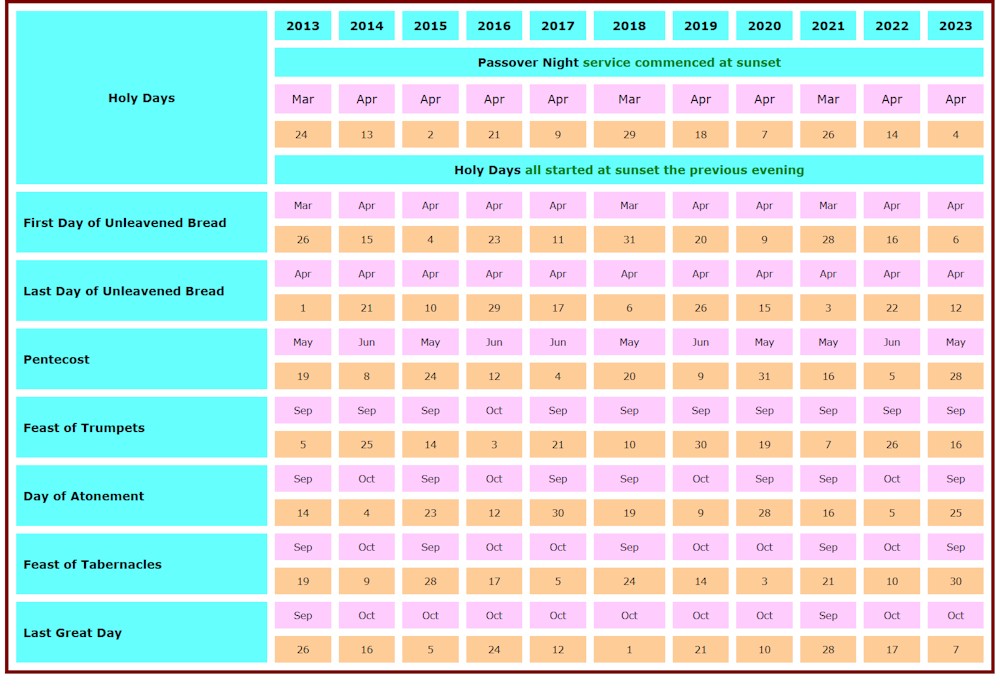
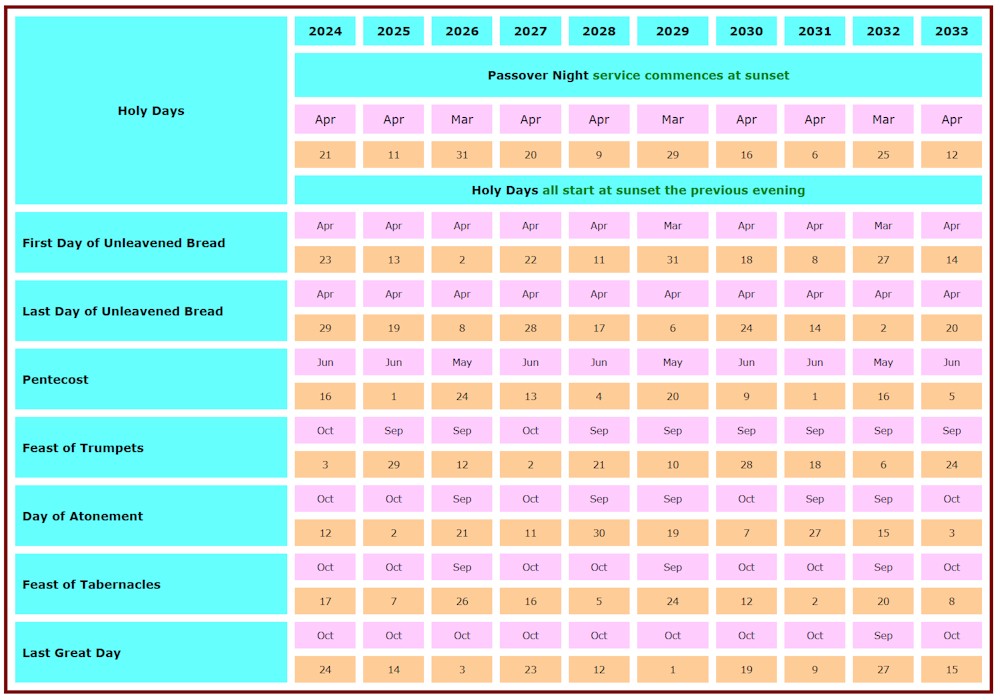
Is There “An Annual Worship Calendar” In the Bible? This paper provides a biblical and historical critique of several articles, including one by WCG which states that this should be a local decision. What do the Holy Days mean? Also you can click here for the calendar of Holy Days.
Passover and the Early Church Did the early Christians observe Passover? What did Jesus and Paul teach? Why did Jesus die for our sins?
Melito’s Homily on the Passover This is one of the earliest Christian writings about the Passover. This also includes what Apollinaris wrote on the Passover as well.
Should Christians Keep the Days of Unleavened Bread? Do they have any use or meaning now? What is leaven? This article supplies some biblical answers.
Pentecost: Is it more than Acts 2? Many “Christians” somewhat observe Pentecost. Do they know what it means? It is also called the Feast of Harvest, the Feast of Weeks, and the day of firstfruits.
Did Early Christians Observe the Fall Holy Days? Did they? Did Jesus? Should you?
The Book of Life and the Feast of Trumpets? Are they related? Is so how? If not, where not?
The Day of Atonement–Its Christian Significance The Jews call it Yom Kippur, Christians “The Day of Atonement”. Does it have any relevance for Christians today?
The Feast of Tabernacles: A Time for Christians? Is this pilgrimage holy day still valid? Does it teach anything relevant for today’s Christians?

RC Meredith: The Truth Almost No One Knows

Sunday, July 20th, 2008

Straight Path in Tobago
A slightly difficult uphill and narrow way in Tobago

COGwriter

Jesus taught,

…narrow is the gate and difficult is the way which leads to life, and there are few who find it (Matt 7:14).

And while that is true in this age, many do not understand that God of love we in the Living Church of God serve does have a plan that will result in the vast majority of those that ever lived to be saved.

In the current issue of LCG’s Tomorrow’s World magazine has the following by evangelist Roderick C. Meredith:

What God Is Accomplishing NOW

The Apostle Peter was inspired to tell us: But, beloved, do not forget this one thing, that with the Lord one day is as a thousand years, and a thousand years as one day. The Lord is not slack concerning His promise, as some count slackness, but is longsuffering toward us, not willing that any should perish but that all should come to repentance (2 Peter 3:89).
Do you see?
In working out His supreme purpose, God is in no hurry! In His time—not our time—God wants all to come to repentance. He indicates that His plan will be accomplished over thousands of years! Again, remember that God is not trying to save the whole world now. Yet He is not condemning those who have been deceived by Satan, the god of this age whom the Creator God has allowed to influence and rule this world during this present time.
Remember how God condemned the wicked cities of Sodom and Gomorrah, turning them into ashes and making them an example to those who afterward would live ungodly (2 Peter 2:6). Yet, when you understand, you quickly realize that those perverted people were blinded to the Truth and did not know the true God. So how will God eventually deal with those blinded human beings who never had a genuine opportunity for salvation?
In Matthew 11, Jesus describes how the cities of His day refused to hear the Truth: Woe to you, Chorazin! Woe to you, Bethsaida! For if the mighty works which were done in you had been done in Tyre and Sidon, they would have repented long ago in sackcloth and ashes. But I say to you, it will be more tolerable for Tyre and Sidon in the day of judgment than for you (vv. 2122). Then Jesus made a remarkable statement: But I say to you that it shall be more tolerable for the land of Sodom in the day of judgment than for you (v. 24). So there is a day of judgment coming in which it will be more tolerable for Sodom and Gomorrah than for the cities of Jesus time. Jesus here clearly recognizes that those ancient cities were never presented with the Truth. They had no opportunity at all!
God inspired the Apostle Paul to state the following about the Gentiles in Ephesus: Therefore remember that you, once Gentiles in the flesh—who are called Uncircumcision by what is called the Circumcision made in the flesh by hands—that at that time you were without Christ, being aliens from the commonwealth of Israel and strangers from the covenants of promise, having no hope and without God in the world (Ephesians 2:1112). The absolute truth is that God has allowed most people to go their own way for the last 6,000 years under Satans influence. The Almighty God has not even tried to save them. Otherwise, they would be saved! But He has planned a day of judgment—not a day of condemnation—so that those billions of human beings may have a genuine opportunity for salvation and then be judged according to what they do at that time when their eyes are really opened to the Truth!
How will they be saved? The Bible is very clear in stating that the only way to eternal life is through Jesus Christ! Jesus Himself stated: Most assuredly, I say to you, he who does not enter the sheepfold by the door, but climbs up some other way, the same is a thief and a robber. Then Jesus said to them again, Most assuredly, I say to you, I am the door of the sheep. All who ever came before Me are thieves and robbers, but the sheep did not hear them (John 10:1, 78). Here Jesus clearly condemns any other way to eternal life! For God alone can give us everlasting life. He sets the conditions—not misguided human beings who may have sentimental thoughts about false Christianity, Hinduism, Buddhism, Islam, New Age theories or any other ideas or theories of men!
The Apostle Peter was inspired to state emphatically: Let it be known to you all, and to all the people of Israel, that by the name of Jesus Christ of Nazareth, whom you crucified, whom God raised from the dead, by Him this man stands here before you whole. This [Christ] is the stone which was rejected by you builders, which has become the chief cornerstone. Nor is there salvation in any other, for there is no other name under heaven given among men by which we must be saved (Acts 4:10-12).

The White Throne Judgment

We read earlier that in the prophesied day of judgment it will be more tolerable for the Sodomites than for the men of Jesus day who rejected Him in person. The inspired gospel of Luke adds details to Matthews account. In Luke 10:1314, Jesus Christ said: Woe to you, Chorazin! Woe to you, Bethsaida! For if the mighty works which were done in you had been done in Tyre and Sidon, they would have repented long ago, sitting in sackcloth and ashes. But it will be more tolerable for Tyre and Sidon at the judgment than for you.
The plain indication is that since ancient Tyre, Sidon and Sodom were not given a genuine opportunity to learn the Truth, they will not be held responsible for being blinded. In fact, Jesus stated that He knew they would have repented (v. 13) if they had seen Jesus mighty works.
Since God is no respecter of persons, you may wonder: when and how will the people of these ancient Gentile cities, and the other billions of similarly blinded human beings, be given a genuine opportunity to understand Gods purpose in life, and to attain salvation? Does the Bible ever speak of such a time?
Yes, it does! The book of Revelation gives the time sequence of prophetic events more clearly than any other book in the Bible. Revelation 19:1121 describes Christs return in full glory as King of kings (vv. 1416). Then, after crushing the armies of the coming European dictator called the Beast, Christ casts him and the coming false religious leader into the Lake of Fire (v. 20).
Then God describes a mighty angel coming down to the earth: He laid hold of the dragon, that serpent of old, who is the Devil and Satan, and bound him for a thousand years; and he cast him into the bottomless pit, and shut him up, and set a seal on him, so that he should deceive the nations no more till the thousand years were finished. But after these things he must be released for a little while (Revelation 20:23). Note that these verses also tell us that Satan has been deceiving the nations of this earth!
After Satan is bound, the glorious millennial rule of Christ on the earth begins. Speaking of that time, Revelation 20 shows that the true saints lived and reigned with Christ for a thousand years (v. 4). Then we are told: Blessed and holy is he who has part in the first resurrection. Over such the second death has no power, but they shall be priests of God and of Christ, and shall reign with Him a thousand years (v. 6).
True Christians who have been genuinely called by God understand His purpose. They know that they are now in training to become kings and priests in the coming reign of Christ on Earth—that they will rule even over angels (1 Corinthians 6:13)! The coming millennial rule of Christ and the saints (Daniel 7:2627) will be a magnificent opportunity to help, to encourage and to teach the confused multitudes about Gods true ways.
But what happens to the untold billions of blinded people who die before the Millennium—who have never known the true God and His Plan? And realize that this includes many millions of professing Christians now living who have never been genuinely converted! It includes millions of young people who never lived long enough to understand, truly repent and grow in grace and in knowledge of Gods Truth. It includes millions of well-meaning but weak people, with all their problems, who may have called themselves Christians but who never truly understood and surrendered to God.
After describing a relatively brief time when Satan is loosed from his prison and, once again, quickly deceives a multitude of people (Revelation 20:710), Gods word begins to tell us about the Great White Throne Judgment period. But look back for a moment at verse 5. Here, inserted as a parenthetical comment after describing the thousand-year rule of the saints, Gods word says: But the rest of the dead did not live again until the thousand years were finished.
The rest of the dead? Yes! Those billions of people from ages past who were never called to salvation and, therefore, obviously had no opportunity to be in the first resurrection.
Notice Revelation 20:11-12: Then I saw a great white throne and Him who sat on it, from whose face the earth and the heaven fled away. And there was found no place for them. And I saw the dead, small and great, standing before God, and books were opened. And another book was opened, which is the Book of Life. And the dead were judged according to their works, by the things which were written in the books.

A Time of Genuine UNDERSTANDING

Here we find described perhaps the most awesome event in human history, a time when all people—the unknown, the famous and the infamous—will truly come to understand why they were born! These formerly dead people are seen standing before God—obviously in a resurrection. Then the books are opened. The term books here is translated from the Greek word biblion, which is the same word translated Bible—meaning the books of the Bible!

Revelation 20 then describes the opening of another book—the Book of Life. What is this books purpose? Paul explains that the saints names are written in the Book of Life (Philippians 4:3). Revelation 21:27 describes the New Jerusalem as inhabited by only those who are written in the Lambs Book of Life.
The opportunity for eternal life is at last presented to these multitudes of people small and great. They are resurrected back to physical life for perhaps a period of 100 years—long enough for a thorough opportunity for them to learn, grow and be tried and tested as to their willingness to live eternal life Gods way (Isaiah 65:20). They will be called and have the opportunity to study and to understand the Bible. Then—and only then—God says that these resurrected people will be judged according to their works, by the things which were written in the books (Revelation 20:12). Finally, after being given a genuine opportunity to know and to act upon the Truth, these people are judged by how they respond to and obey the teachings of the books of the Bible. As James was inspired to tell us, faith without works is dead (James 2:20).

Make no mistake; if these untold billions of formerly blinded individuals are merely judged by the works they did in their former lifetime—smany of them as thieves, prostitutes, sexual deviants, dictators and false prophets—then they will all surely perish in the Lake of Fire! For in their past lives they did not accept the only name given under heaven by which we must be saved. They did not truly repent (Acts 2:38) of their wrong ways and surrender their lives to Christ and allow Him—through the Holy Spirit—to fashion and mold them and help them to grow in the grace and knowledge of our Lord and Savior Jesus Christ (2 Peter 3:18).

God does not have a double standard! These countless billions of individuals deserve to have a real opportunity—and to be judged on what they do after they have known the Truth of God! Yet countless theologians and ministers—who themselves are deceived—try to imagine that God will somehow save many of our unrepentant friends and relatives, and multitudes from ages past, even though they never came to real repentance and true surrender to the living Christ. These theologians could not be more wrong!

(You can click the following link for the full article: The Truth Almost No One Knows.)

The fact is that the idea that God will in the future offer salvation to all who really did not have a chance in this age is a biblical doctrine. Did you know that There Are Hundreds of Verses in the Bible Supporting the Doctrine of True Apocatastasis?

Several articles of related interest may include:

Universal Offer of Salvation: There Are Hundreds of Verses in the Bible Supporting the Doctrine of True Apocatastasis Do you believe what the Bible actually teaches on this? Will all good things be restored? Does God’s plan of salvation take rebellion and spiritual blindness into account?
Hope of Salvation: How the Living Church of God differ from most Protestants How the Living Church of God differs from mainstream/traditional Protestants, is perhaps the question I am asked most by those without a Church of God background.
The Gospel of the Kingdom of God was the Emphasis of Jesus and the Early Church Did you know that? Do you even know what the gospel of the kingdom is all about? True religion should be based upon the true gospel.

Work the Wait

Tuesday, July 15th, 2008

Joyce on Aeropagus Rock

My Wife Has Co-Hosted Our Videogroup for Over 12 Years

COGwriter

The July-August 2008 edition of Today’s Christian Woman (a Protestant publication) had the following article by Stephanie Voiland:

Work the Wait

How I make the most of God’s delays

When will I get my turn to hang a white dress in my closet?” I mumbled as I hung up my fourth bridesmaid dress last summer. A single 29-year-old, I’d watched friend after friend join the ranks of “Mrs.”; I couldn’t help but wonder, How much longer, God?

As I contemplated my life’s many delays, I realized I don’t like waiting—and I’m not very good at it. But I wanted to grow during my waiting seasons rather than become bitter or lose faith. So I asked God to show me how he’s working through these divine delays.

Reminders of Redemption

Sometimes, a wait seems to have no apparent reason. The delay is simply the product of a sin-ravaged world…

The Timing of Trust

Strangely, it’s in the bleakest waiting moments that God’s intervention manifests itself most clearly. Sometimes, those miracles are glamorous. We receive the perfect job, the physical healing, the necessary funds—and the wait is over.

But other times, God does the miracle in us…

A Compassionate Presence

Often a wait seems long when life doesn’t unfold according to our agendas. But sometimes God has amazing reasons for a delay.

I mainly posted the above article because of the title. Jesus told us to wait and to do the work until He returns.

That is what I strive to do, that is what the Living Church of God strives to do, and that is what I pray that readers of this page will do.

Several articles of possibly related interest may include:

Women and the New Testament Church Were women important in the New Testament Church? Which women and how were they involved?
Priscilla and Aquila An early Christian married couple from Rome who moved to Asia Minor.
The Gospel of the Kingdom of God was the Emphasis of Jesus and the Early Church Did you know that? Do you even know what the gospel of the kingdom is all about? True religion should be based upon the true gospel.
Are You Saved? Do You Love Jesus? What is a True Christian? What is the Gospel? Evangelist Richard Ames answers those important questions.
Getting the Gospel Out is More than a Local Job Discusses Biblical rationale for doing an international, and not just a local, work.
How Much Did You Cost? Some have complained that the total costs spent to proclaim the gospel as a witness is too high since it does not (in their opinion) result in enough conversions. Is that how God sees it?
The Temple and the Work This article discusses the two temples of the Old Testament and gives insight as to their possible relevance to the situation which has impacted the Church during this past decade or so. It also answers the question, does a physical temple need to be built in Jerusalem before Christ returns?
Parable of the Mustard Seed Jesus told many parables. Why? What might this one mean?
Should the Church Still Try to Place its Top Priority on Proclaiming the Gospel or Did Herbert W. Armstrong Change that Priority for the Work? Some say the Church should mainly feed the flock now as that is what Herbert W. Armstrong reportedly said. Is that what he said? Is that what the Bible says? What did Paul and Herbert W. Armstrong expect from evangelists?

Superbugs in Pork?

Monday, July 14th, 2008

COGwriter

The following web-news item was of interest:

Are There Deadly Superbugs in Your Pork?

Scientists have detected antibiotic-resistant bacteria in pork, pigs and some veterinarians. It is possible that these so-called superbugs could infect farmworkers or even people who eat pork.

Antibiotic-resistant bugs were found in more than 7 percent of over 100 swine veterinarians tested. The same bacterial strains were found in nearly 50 percent of 300 tested pigs.

Perhaps of greatest concern, the bacteria were also found in 10 percent of more than 200 samples of ground pork and pork chops collected from four Canadian provinces.

An estimated 18,650 deaths a year in the U.S. are estimated to be caused by antibiotic-resistant bacteria. http://articles.mercola.com/sites/articles/archive/2008/07/12/are-there-deadly-superbugs-in-your-pork.aspx?source=nl

The site also had the following from Dr. Mercola:

Scientific Backing for the Avoidance of Pork

Bacon, perhaps one of America’s favorite breakfast staples, is in fact one of the worst type of processed meats you could eat for your health. According to a 2006 study, published in the American Journal of Clinical Nutrition, eating bacon five or more times a week was linked to increasing your risk of bladder cancer by 59 percent. Aside from the processing of the meat, another likely cause for bacon’s negative influence on your health is the heterocyclic amines that form when meat is cooked at high temperatures.

If you cook meat that is loaded with pesticides and hormones at high temperatures, you’re simply asking for trouble. That’s why I limit my meat choices as much as possible to grass-fed and organic meats.

You also need to beware of eating undercooked pork, as it can cause trichinosis. Fortunately, trichinosis affects only 11 people per year in the U.S. and less than 2 percent of those infected actually die from the disease, which means there is one death every five years in the U.S. from this.

As far as MRSA is concerned, the Centers for Disease Control and Prevention (CDC) have previously warned consumers about the risks inherent in the ever-popular holiday ham in their Morbidity and Mortality Weekly Report. Turns out the high salt and sugar content of pre-cooked canned hams provides an ideal growth medium for the Staphylococcus aureus bacteria.

Additionally, if you’re a diabetic or if you have a weakened immune system, you may also do well to steer clear of chitterlings, a dish consisting of boiled pig intestines that are served up as traditional holiday fare in the Southern U.S.

It’s possible for people with poorly controlled diabetes to become seriously ill with enteritis necroticans, a potentially life-threatening intestinal infection. The rare disease causes severe stomach pain, vomiting of blood and low blood pressure. The culprit is the chitterlings-contaminating bacterium known as Clostridium perfringens type C, which produces a toxin that is lethal to tissue in your digestive tract. Even cooking the chitterlings might not rid them of the bacteria.

But wait, there’s more!

The Unsavory Side of Pork

The pork and swine industry has been continually plagued, and continues to be so to this day, by a wide variety of hazardous and deadly infections and diseases, including:

PRRS — A horrendous disease, which I first reported on in 2001, but which had been a nightmare for many nations since the mid-1980s, is still alive and kicking today.

At one point referred to as “swine mystery disease,” “blue abortion,” and “swine infertility,” the disease was finally named “Porcine Reproductive and Respiratory Syndrome” (PRRS), and may afflict about 75 percent of American pig herds.

The PRRS virus primarily attacks the pig’s immune system, leaving its body open to a host of infections, particularly in the lungs. Initial research revealed that the virus was transmitted via semen, saliva and blood, leaving pigs herded closely together and transported in close quarters by trucks more susceptible to infection.

However, according to new research presented at the 2007 International PRRS Symposium shows that the disease is now airborne, making eradication efforts very difficult. According to the PRRS Coordinated Agricultural Project (CAP) and the National Pork Board, it is still the most economically significant disease of swine in the U.S.

The Nipah VirusDiscovered in 1999, the Nipah virus has caused disease in both animals and humans, through contact with infected animals. In humans, the virus can lead to deadly encephalitis (an acute inflammation of your brain). I originally reported on this virus in 2000, but according to CDC data, the Nipah virus reemerged again in 2004.

Hepatitis E (HEV) – According to the Mayo Clinic and an article in the Journal of Clinical Biology, pork may be the reservoir responsible for sporadic, locally acquired cases of acute hepatitis reported in regions with relatively mild climates as HEV has been found to transmit between swine and humans.

Porcine Endogenous Retrovirus (PERV) – According to a study in the journal Lancet, this virus can spread to people receiving pig organ transplants, and according to test tube studies, PERV strains does have the ability to infect human cells. PERV genes are scattered throughout pigs’ genetic material, and researchers have found that pig heart, spleen and kidney cells release various strains of the virus. 

Menangle Virus – In 1998, the journal Emerging Infectious Diseases reported that a new virus infecting pigs was able to jump to humans. The menangle virus was discovered in August 1997 when sows at an Australian piggery began giving birth to deformed and mummified piglets.

What About Pasture-Raised Pork?

In a slightly ironic twist, I can’t even safely recommend consuming pasture-raised pork, because while researching this article I stumbled across a study in the current issue of Emerging Infectious Diseases citing concerns about pastured pigs being vulnerable to Trichinella spiralis infection, due to their exposure to wild hosts that carry the disease.

Pasture-raised pig farming has expanded with increased demand from health conscious consumers, and currently there are 28 U.S. farms located within 50 kilometers of a previously infected site.

Of course, since we in the Living Church of God do not eat pork, we are less likely than pork eaters to be affected by diseases in it.  However, once people get infections, they can often pass them on to others.

An article of related biblical interest would be:

The New Testament Church and Unclean Meats Are foods considered to have been unclean in the Old Testament considered to be food in the New Testament? This article discusses this from the perspective of the New Testament. It also has a list of clean and unclean animals.