Secularists often ignore evidence that the Exodus did occur
Thursday, April 11th, 2024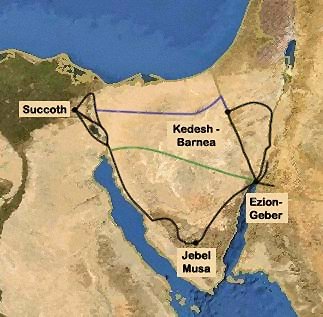
Some Proposed Routes of the Exodus
There is a lot of confusion and wrong information in the mainstream about when the Exodus was, particularly since many now consider it to be a myth.
From time to time, there are various reports from some archaeologists and Egyptologists who deny the account of the Exodus in the Bible.
Wikipedia, which claims to be factual without a point of view, calls it a myth:
The Exodus is the founding myth of the Israelites. … The traditions behind the Exodus story can be traced in the writings of the 8th-century BCE prophets, beyond which their history is obscured by centuries of transmission. No historical basis for the biblical Exodus story exists … There is no indication that the Israelites ever lived in Ancient Egypt, and the Sinai Peninsula shows almost no sign of any occupation for the entire 2nd millennium BCE … (The Exodus, Wikipedia, accessed 10/28/18)
Nearly all the above statements are false.
Part of the reason for the denial by Wikipedia and other secular sources is that they often hold to the wrong century for the time of the Exodus, hence many refuse to consider actual historical evidence.
This denial is not new, but has been long running.
Notice the following from several decades ago:
“There is no record of any Exodus in the Egyptian records.” So thousands of students are assured by college professors. And few stop to question this blanket statement from such erudite scholars. …
The following statement by an eminent historian summarizes the views of many:
The present century has brought extensive archaeological investigations in Egypt, the Holy Land, and adjacent countries which indicate that the Biblical account of the enslavement of the Children of Israel in Egypt and their exodus to the promised land of Canaan is traditional and legendary and without support of documentary archaeological evidence… no Egyptian records have been found relating to this early period of Hebrew history (Homer Hockett, The Critical Method in Historical Research and Writing, p. 52).
(Grabbe L. The Exodus. Tomorrow’s World, April 1971, pp. 28-29).
One of the reasons for this is that many scholars have assumed, for various reasons, that it supposedly should have occurred around 1250 B.C. Based upon that time period, there is no evidence that they see in Egypt or in the Palestinian region that supports the view that great numbers of Israelites left Egypt and settled in the area that ancient Israel came to dominate.
Part of the problem is the assumption that Ramesses II was supposedly the Pharaoh that Moses dealt with. This misconception was carried forward in the popular movie starring Charlton Heston as Moses and Yul Brynner as Pharaoh Ramses/Ramesses. Ramesses II was pharaoh from about 1279 to 1213 B.C.
But is that the right period of time to be looking at?
Well, there is a clear numeric reference to the year of the Exodus in the Bible. Notice:
1 And it came to pass in the four hundred and eightieth year after the children of Israel had come out of the land of Egypt, in the fourth year of Solomon’s reign over Israel, in the month of Ziv, which is the second month, that he began to build the house of the Lord. (1 Kings 6:1)
So, 1 Kings 6:1 shows 480 years from the exodus from Egypt to the fourth year of Solomon’s reign. That fourth year of Solomon’s reign would have been about 966 B.C. (see When was the Exodus?), hence a c. 1446 B.C. exodus is a more scriptural time period.
There is also an interesting piece of evidence that blasts a hole in the theory that the Exodus was in the 13th century. This has to do with a find called the Soleb Temple Inscription that has been dated to c. 1385 B.C. (the fourteenth century B.C.), which also shows that the children of Israel were where the Bible indicates they were. Here is the hieroglyphic inscription:


Here is information about it:
The … hieroglyphic rendering corresponds very precisely to the Hebrew tetragrammaton YHWH, or Yahweh, and antedates the hitherto oldest occurrence of that divine name – on the Moabite Stone – by over five hundred years. (Astour, Michael C. (1979). “Yahweh in Egyptian Topographic Lists.” In Festschrift Elmar Edel, eds. M. Gorg & E. Pusch, Bamberg, as cited by Wikipedia)
Of particular interest is the Shasu name that has attached to it the element,
which reads yhw3. Because this linguistically corresponds to the Hebrew YHWH, it was quickly associated with the personal name of the God of Israel. … The initial response to the occurance of the topomyn “Shasu land of Yahwa” led many scholars to conclude that this name points to a geographical territory where a cult of Yahwa existed in the fourteenth century B.C. This interpretation is strengthened by the proximty of Seir in the same list. Thus it has been thought that the “Shasu land of Yahwa” was in the same region as the Shasu in the land of Seir … Thus this Egyptian evidence seems to support the theory that Israel spent time in the very region the Bible suggests. (Hoffmeier JK. Ancient Israel in Sinai: The Evidence for the Authenticity of the Wilderness Tradition. Oxford University Press, USA, 2005, p. 242)
The … Soleb Temple Inscription, which is an Egyptian hieroglyphic inscription that dates to ca. 1385 BC. This inscription, which comes from the reign of Pharaoh Amenhotep III, is found in an Egyptian temple at Soleb in which is today northern Sudan.
The Soleb Inscription, which is on a stone column base and which is written on the body of a bound enemy soldier, refers to a people called the “Shasu of Yahweh.” Shasu is a term used in ancient Egypt for semi-nomadic–generally Semitic–peoples with herd animals, who lived almost exclusively to the east and west of the Jordan River. All Shasu tribes were seen as the mortal enemies by the Egyptians.
The entire Soleb Inscription reads “the land of the Shasu of Yahweh.” It is highly probable that the Shasu mentioned in the Soleb Inscription were the Israelites who had just invaded into Canaan under Joshua. Incidentally, there is no archaeological evidence that the ancient Egyptians ever exercised any administrate authority in the Shasu lands east of the Jordan River.
The name Yahweh in the Soleb Inscription is recognized by nearly alll ancient historians and archeologists today as the very name for God–Jehovah in some English translations–that is found in the Hebrew Old Testament. Exodus 3:13-15 indicates that Yahweh was a new name for God that was first revealed to Moses at the Burning Bush just prior to the Exodus of the Israelites from Egypt.
After being commissioned by Yahweh as his representative, Moses and his brother Aaron went to the Pharaoh of Egypt. Exodus 5:1-2 records that discourse between Moses and Pharaoh during their first meeting, and this meeting is highly relevant to this discussion on the date of the Exodus. It reads:
Afterwards Moses and Aaron went to Pharaoh and said, “Thus says Yahweh, the God [Elohim] of Israel, ‘let my people go that they may hold a feast to me wilderness.’” But Pharaoh said, “Who is Yahweh that I should obey his voice and let Israel go. I do not know Yahweh, and I will not let Israel go.”
It is clear from this passage of Scripture that the Pharaoh of the Exodus had never heard of a God named Yahweh. However, Pharaoh Amenhotep III (ruled ca. 1391-1354 BC) clearly had heard of Yahweh since he mentions him by name in the Soleb Inscription.
Since Pharaoh Amenhotep III knew of Yahweh in ca. 1385 BC and since the name Yahweh is not used until the life of Moses, then the Exodus of the Israelites from Egypt must have happened before ca. 1385 BC. Tis makes the Late Date of the Exodus in ca. 1265 BC under Pharaoh Ramses II (ruled ca. 1279-1212 BC) untenable for Bible believers! Billington C. The New Crossway Archaeology Study Bible Reviewed. Artifax, Summer 2018, pp. 21-22)
Thus, the Soleb Temple Inscription supports a fifteenth century B.C. exodus of the children of Israel from Egypt like many of us have pointed to for years.
Notice also some scriptures:
17 “But when the time of the promise drew near which God had sworn to Abraham, the people grew and multiplied in Egypt 18 till another king arose who did not know Joseph. 19 This man dealt treacherously with our people, and oppressed our forefathers, making them expose their babies, so that they might not live. 20 At this time Moses was born, and was well pleasing to God; and he was brought up in his father’s house for three months. 21 But when he was set out, Pharaoh’s daughter took him away and brought him up as her own son. 22 And Moses was learned in all the wisdom of the Egyptians, and was mighty in words and deeds.
23 “Now when he was forty years old, it came into his heart to visit his brethren, the children of Israel. 24 And seeing one of them suffer wrong, he defended and avenged him who was oppressed, and struck down the Egyptian. 25 For he supposed that his brethren would have understood that God would deliver them by his hand, but they did not understand. 26 And the next day he appeared to two of them as they were fighting, and tried to reconcile them, saying, ‘Men, you are brethren; why do you wrong one another?’ 27 But he who did his neighbor wrong pushed him away, saying, ‘Who made you a ruler and a judge over us? 28 Do you want to kill me as you did the Egyptian yesterday?’ 29 Then, at this saying, Moses fled and became a dweller in the land of Midian, where he had two sons. (Acts 7:17-29)
7 And Moses was eighty years old and Aaron eighty-three years old when they spoke to Pharaoh. (Exodus 7:7)
Looking at these passages, we can see that Moses was in Midian for 40 years.
Rameses I and II become impossible.
Why?
Rameses I and and his son Rameses II are believed to have reigned for 2 and 66 years (consecutively) respectively. The Bible shows that Moses was born (Exodus 2:1-8) after the city of Rameses was built (Exodus 1:7). The Bible also shows that Moses was eighty when he went to Pharaoh to ask for the departure of the children of Israel (Exodus 7:7). Thus, adding the reigns of the two Pharaoh Rameses together makes it impossible that either was the Pharaoh of the Exodus.
Thus, simply because the Israelites earlier left a region called Rameses does not mean that it had been named after a pharaoh of the 19th dynasty–it certainly does not align with the Bible or secular history.
Now, I would add that according to certain readings of an inscription on the “Merneptah Stele,” the ancient Israelites already occupied the land of Canaan during the 1213-1203 B.C. reign of Merneptah (Jürgen von Beckerath, Chronologie des Pharaonischen Ägypten, Mainz, (1997), pp.190). The “Merneptah Stele” tells of a battle, shows people dressed like Canaanites, and tells of Egypt’s destroying seed of Israel. This seed would likely be grain as Egypt did not destroy all of Israel then. (A stele/stela is an upright stone slab or column typically bearing a commemorative inscription or relief design.)
Anyway, the “Merneptah Stele” is not only historically supportive of the Exodus, it basically proves that the idea that the Exodus happened during the time of Ramses II is impossible.
Why?
Ramesses II allegedly reigned until 1213 B.C. and the Bible shows that the children of Israel wandered for forty years in the wilderness (Numbers 14:34-35; 32:13) before settling in the land of Canaan. It would make no sense that a defeated Ramses II could have reigned for at least 30 years (40 years, less the ten of Merneptah) after experiencing the plagues and loss of armies as described in the account in the Book of Exodus.
The term Rameses is mentioned in the Bible several times. Three are in connection with the children of Israel leaving that area (Exodus 12:37; Numbers 33:3,5). But notice the first reference:
5 Then Pharaoh spoke to Joseph, saying, “Your father and your brothers have come to you. 6 The land of Egypt is before you. Have your father and brothers dwell in the best of the land; let them dwell in the land of Goshen. …
11 And Joseph situated his father and his brothers, and gave them a possession in the land of Egypt, in the best of the land, in the land of Rameses, as Pharaoh had commanded. (Genesis 47:5-6, 11)
From the above account it looks as if it is possible that Rameses was the name of an area centuries before the Exodus.
The name Ramesses means “Ra [is] the one who gave birth [to] him”. (Rameses, Wikipedia, viewed 03/08/15).
Since Ra was an important god to the Egyptians, perhaps because of its location of where the sun rise was perceived elsewhere in Egypt, the area could have been considered a ‘child’ of Ra. Ra was a god of the Egyptians for many centuries:
Ra /rɑː/[1] or Re /reɪ/ … is the ancient Egyptian solar deity. By the Fifth Dynasty (2494 to 2345 BCE) he had become a major god in ancient Egyptian religion, identified primarily with the midday sun. (Ra. Wikipedia, accessed 03/14/15).
The Bible teaches:
40 Now the sojourn of the children of Israel who lived in Egypt was four hundred and thirty years. 41 And it came to pass at the end of the four hundred and thirty years — on that very same day — it came to pass that all the armies of the Lord went out from the land of Egypt. (Exodus 12:40-41)
Thus, the biblical chronology indicates that the children of Israel entered Egypt around 1876 B.C. (1446 B.C. plus 430 years). Ra was already a major god to the Egyptians for centuries before the children of Israel went to the area of Rameses.
In the 19th dynasty, its first leader took the name Ramesses for himself:
Originally called Pa-ra-mes-su, Ramesses I was of non-royal birth, being born into a noble military family from the Nile delta region. (Rameses I. Wikipedia, viewed 03/08/15).
Since Rameses I was not of royal birth and was starting his own dynasty (considered to be Egypt’s 19th), he decided to take the name, which he would have heard of, to himself. He probably felt that name gave him the type of authority he wanted to project.
Thus because of the length of time the Egyptians worshiped Ra, simply because the Israelites earlier left a region called Rameses does not mean that it had been named after a pharaoh of the 19th dynasty. The Pulpit Commentary on Genesis 47:11 indicates that the area of Rameses could have existed in the time of Joseph, but was later fortified by the Israelites while they were slaves in Egypt–and that probably was the case. If may have also been because of its fortification that Pa-ra-mes-su decided to take the name Ramesses for himself.
Then, if Ramesses II was not the Pharaoh of the Exodus, who could be?
Amenhotep II.
Notice more information about Amenhotep II:
Chaeremon, an Egyptian who lived in the first half of the first century … as a priest and pedagogue in Alexandria and after 49 in Rome as the tutor of Nero, gives yet another version of the story. The goddess Isis appeared to King Amenophis in a dream and reproached him because of the destruction of her temple in times of war. The priest and scribe Phritibantes (“the chief of the temple”) advised him to propitiate the goddess by “purging” Egypt of the lepers. The King gathered 250,000 lepers and expelled them from Egypt. Their leaders were Moses and Joseph, whose Egyptian names were Tisithen and Peteseph. (Assmann J. Moses the Egyptian: The Memory of Egypt in Western Monotheism. Harvard University Press, 2009, p. 35)
The Abandonment of Avaris During the Reign of Amenhotep II
Archaeologist, Douglas Petrovich at the University of Toronto has written a fascinating article (Douglas Petrovich, ‘Toward Pinpointing the Timing of the Abandonment of Avaris During the Middle of the 18th Dynasty,’ in Journal of Ancient Egyptian Interconnections, Vol. 5:2, 2013, 9-28) which explores the precise timing of the abandonment of the ancient Egyptian city of Avaris during the Egyptian 18th Dynasty. In the article, Petrovich explores the various theories about the exact timing of the abandonment of the city of Avaris which seems to coincide with Amenhotep II. The significance of this and its possible relevance to the exodus, is that it is indirect evidence of a major crisis event which happened in the 9th year of Amenhotep’s rule. That event could very well be the Israelite exodus. This is not exactly what Petrovich is stating in the article, but it could be what he is implying. The timing is exactly in line with the “Early-Date Exodus/Conquest” model.
At the end of the article Petrovich makes some starling observations in his conclusions:
More inscriptional evidence may attest directly to the Year-9 crisis is Amenhotep II’s commissioning of a decree for his couriers to destroy all the images of the gods, singling out Amun-Re in particular. Given that Thutmose III and Amenhotep II expressly ascribed praise to Amun-Re for military victories on their Asiatic campaigns, and that Amenhotep II originated and/or perpetuated the desecration of Hatshepsut’s images throughout Egypt, there is plenty of reason to hypothesize that the religious crisis—and subsequent decree to destroy all the “bodies” of Egyptian deities throughout the land—may be intricately bound to the military and political turmoil of his Year-9. Moreover, a potential interruption in the high priesthood of Amun during this time may also attest to this “perfect storm” of events. Therefore, a religious crisis focused on Amun-Re at this time may have been initiated by Amenhotep II as a result of a devastating loss in battle which coincided with the abandonment of their principle naval base from which military operations into Asia were launched, and led to an unavoidable shift in foreign policy. (Ibid., 22)
Why would Amenhotep II order the destruction of the images of Egyptian gods? Why was there major turmoil & upheaval in Egypt’s religious practices? Why was there a complete change of foreign policy with regard Egypt’s nearest neighbors in Asia [in the Levant] in the later part of Amenhotep II’s reign? This evidence alone does not prove the exodus, but it is certainly consistent with the behavior of an autocratic & military ruler such as Amenhotep II, if such an event such as the biblical exodus took place. The exodus was an event in which Egypt’s gods were rendered impotent and pharaoh’s military forces were drastically reduced. I submit that the exodus, as it is exactly described in the Bible, is the most reasonable explanation for this turn of event’s Amenhotep II’s rule. (Wright T. Was There an Exodus & Conquest? July 20, 2013. http://crossexamined.org/was-there-an-exodus-conquest/#_ftn11 viewed 03/01/15)
Was Amenhotep II possibly Pharaoh at the right time? Notice:
Egyptian Chronology: Dating the Pharaonic Reigns
Before determining whether Amenhotep II is a viable candidate for the exodus-pharaoh, one must synchronize the date of the exodus with Egyptian history. Though inspirati on does not extend to extra-biblical literature or ancient inscriptions, some extant writings are trustworthy. Several factors are relevant.
First, the Ebers Papyrus, an ancient Egyptian manuscript that dates the heliacal rising of Sothis in Year 9, Month 3, Season 3, Day 9 ( ca . 15 May) of Amenhotep I’s reign, records this astronomical even that assigns its composition to an identifiable time in the Eighteenth Dynasty. [26 The Eighteenth Dynasty of Egypt (ca. 1560-1307 B.C)…]
Since astronomers can pinpoint this event by charting the positions of stars in antiquity, the papyrus can be dated to ca . 1541 B.C., making the initial regnal year ca. 1550 B.C.. This widely accepted dating is based on the ancient capital of Memphis as the point of observation, despite the Theban provenance of the papyrus. A Theban point of observation, which is accepted by other Egyptologists, dates the papyrus to c a. 1523 B.C. [27 William A. Ward, “ The Present Status of Egyptian Chronology,” BASOR 288 (Nov 1992):58-5 …] Though the Egyptians never stated where they observed the Sothic rising, Olympiodorus noted in A.D. 6 that it was celebrated at Alexandria, after being observed at Memphis. [28 Ibid., 59.]
Therefore, Memphis is the probable correct point of observation for the rising. Second, even without astronomical dating, the chronology of Egypt in the mid- 1400s B.C. remains sure. Ward notes that “New Kingdom chronology can be fairly well established on the basis of the monuments and synchronisms, without recourse to the astronomical materia l.” [29 Ibid., 56. Egypt’s New Kingdom (ca. 1560-1069 B .C.) consists of Dynasties 18-20.] As for the Eighteenth Dynasty, he adds that the 25-year gap separating current theories on its starting date narrows to a scant three or four years by the middle of the dynasty, meaning that most mainstream Egyptologists consider the dating of Egypt’s exodus-er a history to be fixed and reliable. [30 Ibid.]
Last, regnal dates of Eighteenth-Dynasty pharaohs from the Ebers Papyrus to the exodus are fixed with relative certainty. With firm regnal dates for Amenhotep I, the reigns of the subsequent Eighteenth-Dynasty pharaohs down to Amenhotep II are as follows: Thutmose I (ca. 1529 -1516 B.C.), Thutmose II ( ca . 1516-1506 B.C.), Queen Hatshepsut (ca. 1504 -1484 B .C.), Thutmose III (ca . 1506-1452 B.C.), and Amenhotep II (ca. 1455-1418 B.C.). [31 Egyptologists disagree over the year of Thutmose III’s accession, with three views predominant: ca. 1504 B.C., ca .1490 B.C., and ca. 1479 B.C. (Redford, Egypt, Canaan, and Israel 104). The year 1504 is prefer red because of its exclusive agreement with the Ebers Papyrus when assuming a Memphite point of observation for the rising of Sothis. Shea agrees (William Shea, “Amenhotep II as Phar aoh,” Bible and Spade 16/2 [200 3]:43 ).] With these reigns chronologically ordered, a positive evaluation of Amenhotep II’s candidacy for the exodus-pharaoh is possible. [Petrovich D. AMENHOTEP II AN D THE HISTORICITY OF THE EXODUS- PHARAOH. The Master’s Seminary Journal. TMSJ 17/1 (Spring 2006) 81-110. http://www.tms.edu/m/17f.pdf viewed 03/07/15]
Is there any other evidence?
Yes, there is an ancient Egyptian document called the Ipuwer papyrus, of which a 13th century B.C. copy was found. It includes information that sounds like the plagues of Egypt that the Book of Exodus tells of. It is believed to date prior to the 13th century, hence it too tends to point more towards a 15th century B.C. date for the Exodus (though some claim it was older). It basically provides historical evidence of the plagues that afflicted the Egyptians prior to the time they let the children of Israel go (see also Reasons, Proofs, and Ramifications of the Ten Plagues of Exodus).
As far as travel related to the Exodus, notice:
If the dating of archaeological sites should be based on pottery and other historical considerations (such as the chronology of Egypt’s pharaohs), then all of the evidence from Tell Jericho argues for its destruction and burning around 1401-1406 B.C. All of the evidence from Jericho at this time (ca. 1401-6 B.C.) fits the biblical record in an amazing way, from the details about the city being burned along with everything in it [offered to God as a burnt offering] (see Joshua 6), to the walls having dwelling places [houses] where Rahab helped the Jewish spies enter the city to spy its defenses (Joshua 2).
Continuing research at Jericho and now new research at Tel-el Maqatir (biblical Ai?) is yielding results that confirm the biblical record of Joshua’s conquest in amazing ways. Most critical scholars place Ai at et-Tell but there is no archaeological evidence of a destruction there which fits the biblical description. However, just one kilometer west is another site (Tel el-Maqatir) which very well could be the biblical site of Ai. This conclusion is based, once again, not on opinion but on hard evidence. (see, Bryant Wood’s, ‘The Search for Joshua’s Ai,’ in Richard S. Hess, Gerald A. Klingbeil and Paul K. Ray Jr., Editors, Critical Issues in Early Israelite History (Winona Lake, Indiana: Eisenbrauns, 2008), 205-40.) (Wright T. Was There an Exodus & Conquest? July 20, 2013. http://crossexamined.org/was-there-an-exodus-conquest/#_ftn11 viewed 03/01/15)
I would add if the Exodus did take place in 1446 B.C., forty years of wilderness wandering would bring us to 1406 B.C. as a likely time for the destruction of Jericho.
As for others who do not believe it occurred because of looking at dates about two centuries later, understand that the Bible teaches:
4… Indeed, let God be true but every man a liar. (Romans 3:4)
20… Guard what was committed to your trust, avoiding the profane and idle babblings and contradictions of what is falsely called knowledge — 21 by professing it some have strayed concerning the faith. (1 Timothy 6:20-21)
The Bible also tells of people who are “always learning and never able to come to the knowledge of the truth” (2 Timothy 3:7).
So, when you hear the opinion of ‘scholars’ when they blatantly contradict the Bible, realize that the Bible is still true.
Just because there were pharaohs of the 19th dynasty named Ramesses, does not mean that the Exodus occurred during that dynasty. The Bible tells of the existence of a region called Rameses centuries before the Exodus. ‘Ra’ worship was around for many centuries before the children of Israel entered Egypt.
Events related to Amenhotep II and Jericho are consistent with the biblical account.
The late Dr. Herman Hoeh was with the Radio Church of God and then the Worldwide Church of God. He did a lot of historical research throughout his lifetime.
In December 1983, Dr. Herman Hoeh wrote:
Exodus date 1443 occurred at end of ninth year, beginning of tenth year of Amenhotep II who reigned jointly two and a half years with Thutmose III. Thutmose III reigned 54 years 1504-1450 B.C. Amenhotep II began to reign in 1453 B.C. Daughter of Thutmose I (a pharaoh) was Hatshepsut, who adopted Moses. She ruled jointly with her nephew Thutmose from 1504 to 1483 B.C. In the year 1483 Moses’ stepmother and protector died. This agrees with Moses’ flight 40 years before Exodus. (Hoeh H. Notes on the Reign of Kings. December 1983)
Notice that the belief was that it was Amenhotep II, not Ramses II, that was the pharaoh that Moses dealt with.
Although in 1983 he was leaning towards a date of the exodus in 1443 B.C., in a conversation on December 3, 1997, he changed that date to 1446 B.C. according to the following:
There are notes from a phone conversation with Dr. Hoeh from December 3, 1997 that speak of a kings chronology beginning in 930 B.C.
CHRONOLOGY UPDATE FROM A PHONE CONVERSATION (Dec 1997)
Dr. Hoeh: he is in a position to support a “change of my perspective” of Israel
— can prove date “about” 930 B.C. is a correct date
— Edwin Thiele — first year of Rehoboam was 930 B.C.
– spring to spring not autumn to autumn
– cannot move this date up or down
– Jews recognized autumn to autumnHarvard Sem. Monograph #48
“Studies in the Chronology of the Divided Monarchy of Israel”
by William Hamilton Barnes
Scholars Press 1991 Harvard Univ.– Kings of Tyre are linked with building of temple — Solomon 1561 (?)
— 1446 date of Exodus
— 1406 Jordan crossing
— 3983 Creation
— 2328 Flood * 2327 end of Flood
— 1975 Abraham’s birth
— 1800 Abraham’s death
— 6 1/2 years after crossing of Jordan land was divided after 400 yearsA correction is in order
— beginning of Jeroboam’s/Rehoboam’s reign(s) = 930 B.C.
— 3983 B.C. = Creation
— 2328-2327 B.C. = Flood
— End of 6,000 = 2018 A.D.
— Edwin Thiele:
Thiele has correct date at the beginning of Jeroboam’s/Rehoboam’s reigns.
Spring to Spring “STUDIES ON THE CHRONOLOGY OF THE DIVIDED MONARCHY OF ISRAEL” by Edwin Thiele
— 1446 = Exodus
— 1406 = Entry into Promised Land— Jehu = “Yahu” (Assyrian records)
— Spring of 930 B.C. = Beginning of Jeroboam’s reign
— Velikovsky & Amalekites:
So, Herman Hoeh came to a 1446 B.C. date for the exodus. Although I did not see the above account from Dr. Hoeh until March 2015, back in 2009, I published a book where I quoted 1 Kings 6:1 and the 966 B.C. date of Solomon’s reign, hence also coming to the 1446 B.C. date.
Notice also the following:
Biblical Chronology: Dating the Exodus
The central text for establishing the exact date of the exodus, 1 Kgs 6:1, connects it to later Israelite history by noting that Solomon began constructing the Temple in the 480th year after the exodus, signifying an elapsed time of 479 years. 12 All but the minimalists agree that the 479 years begin with May of 967 or 966 B .C., depending on whether one accepts Young’s or Thiele’s version of Solomon’s regnal dates. 13 Thus the 479 years began in either 1446 or 1445 B .C., either of which can be substantiated by the biblical text and agree with the conclusions of this article. [Petrovich D. AMENHOTEP II AN D THE HISTORICITY OF THE EXODUS- PHARAOH. The Master’s Seminary Journal. TMSJ 17/1 (Spring 2006) 81-110. http://www.tms.edu/m/17f.pdf viewed 03/07/15]
1446 is possible.
Now, if Ramesses II was not the Pharaoh of the Exodus, who could be?
Dr. Hoeh mentioned Amenhotep II.
The Exodus happened and it happened over 3400 years ago.
Despite the evidence that the Exodus occurred when and as the Bible tells of it, many do not wish to believe it.
Some items of related interest may include the following:
When was the Exodus? Did it Happen? Some deny the biblical account of the Exodus. Was Ramses II the pharaoh then? When did the Exodus occur? Is there proof outside of the Bible that there was an Exodus? Here is a related article in the Spanish language: ¿Cuándo fue el Éxodo? ¿Ocurrió realmente?
Reasons, Proofs, and Ramifications of the Ten Plagues of Exodus What do you know about these plagues? Is there any confirmation outside the Bible? Might something worse be coming? A related two-part sermon is available: Egypt and the Plagues (Part 1) and Exodus Plagues and Prophecy (Part 2).
Exodus and the Days of Unleavened Bread This article discusses parts of the Book of Exodus with some connections to the Days of Unleavened Bread. A related sermon is available and is titled: Unleavened Bread: Lessons in Exodus. Another sermon is Exodus, Judgments, and Jesus.
EXODUS Exodus sermons, which it total cover each and every verse of that book, include Exodus 1-4: Jewish Myths or Lessons for Christians Today?, Exodus 5-7: Serpents, Blood, and Revelation, Exodus 8-9: Plagues and Prophecy, Exodus 10-12: The Last Plagues & 21st Century Prophecies, and Exodus 13-15: Passover Protection and Armageddon. Another article is Exodus 16-19 which covers all of those verses–here is a link to a related sermon: Exodus 16-19: Manna, Governance, and End Time Protection. Another article is Exodus 20 which covers all of the verses in that chapter–here is a link to a related sermon: Exodus 20: The Ten Commandments. Another article covers the verses in those chapters Exodus 21-24: These are the Judgments–here is a link to a related sermon: Exodus 21-24: Judgments. Here is a link to the article Exodus 25: Ark of the Covenant and Mercy Seat–here is a link to a related sermon: Exodus 25: Ark of the Covenant and the Mercy Seat. Here is a link to the article Exodus 26-32 Tabernacle, Sacrifices, & the Book of Life–here is a link to a related sermon:Exodus 26-32: Tabernacle, Golden Calf, and Book of Life. A final article is: Exodus 33-40, The Final Chapters.Here are links to two related video sermons: Exodus 33-36: Moses Shown and You Should Too and Exodus 37-40: Finishing the Work.There is also more, such as the article: When was the Exodus? Did it Happen? Some deny the biblical account of the Exodus. Was Ramses II the pharaoh then? When did the Exodus occur? Is there proof outside of the Bible that there was an Exodus? Here is a related article in the Spanish language: ¿Cuándo fue el Éxodo? ¿Ocurrió realmente? Also: Reasons, Proofs, and Ramifications of the Ten Plagues of Exodus What do you know about these plagues? What happened to the ‘gods of Egypt’? Is there any confirmation outside the Bible? Might something worse be coming? A related two-part sermon is available: Egypt and the Plagues (Part 1) and Exodus Plagues and Prophecy (Part 2). Also: Exodus and the Days of Unleavened Bread. This article discusses parts of the Book of Exodus with some connections to the Days of Unleavened Bread. Also Exodus 4:24, Why would God have sought to kill Moses? What did Moses do wrong? Do you have a similar problem?
Holy Day Calendar This is a listing of the biblical holy days through 2033, with their Roman calendar dates. They are really hard to observe if you do not know when they occur 🙂 In the Spanish/Español/Castellano language: Calendario de los Días Santos. In Mandarin Chinese: 何日是神的圣日? 这里是一份神的圣日日历从2013年至2024年。.
Should You Keep God’s Holy Days or Demonic Holidays? This is a free pdf booklet explaining what the Bible and history shows about God’s Holy Days and popular holidays. Two related sermons would be Which Spring Days should Christians observe? and Fall Holy Days for Christians.
Timelines and Early Church History This has dates and some timelines when biblical and non-biblical events took place.