By COGwriter
(An earlier version of this article was published in the October 31, 2001 issue of The Journal: News of the Churches of God.)
We all know that God allowed ancient Israel to participate in warfare. But should Christians participate in military service? What about being fans of violent sports?
What does the Bible teach? (A related sermon would be: Christians, Violence, and Military Service.)
What did the early church understand from the teachings of the Bible and from the apostles? Have some strayed from the historical position? What is the proper Christian perspective on this subject?
Were Christians supposed to be the persecutors or the persecuted? What have religious leaders like popes and Martin Luther done?
This article will look to the Bible and historians to answer those questions. It will also discuss some disturbing statements made by those who claim to be in the COG as well as some who do not make that claim.
In addition, it will show how and when various ones who professed Christ changed from being a part of a pacifist religion to a warring religion. A change that the true Church of God never would accept.
The Church of God Position
Wars come from covetousness (James 4:1-2). The historically proper Church of God (COG) position is that true Christians refrain from military service whenever possible, and never engage in carnal warfare in this age (John 18:36).
The September 30, 2001, October 31, 2001, and November 30, 2001 issues of The Journal: News of the Churches of God included comments from some in the Churches of God (COGs) involving a problem that I thought was resolved long ago. And this was one of the differences between the COGs and the Seventh-day Adventists. It is now clear that, sadly, some who claim to be in the COG are now teaching that military service is acceptable for Christians.
However, most in the COGs correctly still do not teach that.
That view is also consistent with what G.G. Rupport, once affiliated with part of the Church of God (Seventh-Day), taught in 1917:
I prefer to lose my life than 'killing someone' under a fit of enthusiasm or imaginary loyalty. (Rupport G.G. Remnant of Israel, May 1917. As quoted in The Remnant of Israel. Richard Nickels' Reprint 1993).
Notice what the late Herbert W. Armstrong taught:
We believe that Christian disciples of Christ are forbidden by Him and the commandments of God to kill, or in any manner directly or indirectly to take human life; by whatsoever means; we believe that bearing arms is directly contrary to this fundamental doctrine of our belief; we therefore conscientiously refuse to bear arms or to come under the military authority." (Armstrong, Herbert W. Fundamental Beliefs of the Radio Church of God. As quoted in Early Writings of Herbert W. Armstrong, Public domain articles written from 1928-1953.)
Jesus had some comments that should be mentioned here:
21"You have heard that it was said to the ancients, 'Thou shalt not commit murder', and whoever commits murder will be answerable to the magistrate. 22But I say to you that every one who becomes angry with his brother shall be answerable to the magistrate; that whoever says to his brother 'Raca,' shall be answerable to the Sanhedrin; and that whoever says, 'You fool!' shall be liable to the Gehenna of Fire. (Matthew 5:21-22, Weymouth New Testament)
18 ... Jesus said, "'You shall not murder..." (Matthew 19:18, NKJV)
As Jesus’ comments in Matthew 5:21-22 demonstrate, He expanded the restrictions against murder. Those expansions generally do not condone carnal warfare nor encourage violence in sports. Many fans of violent sports get inappropriately angry.
I have been asked about where to draw the line about sports' violence, or how can one determine if a sport is appropriate?
The short answer is that Christians should consider that if the INTENT of the sport, if played according to the rules, is to inflict violent physical contact that can reasonably be expected to cause bodily harm, then the sport is evil. It is Satanic to encourage such behavior.
Notice what the Apostle Paul wrote:
12... they all may be condemned who did not believe the truth but had pleasure in unrighteousness.(2 Thessalonians 2:12)
28 And even as they did not like to retain God in their knowledge, God gave them over to a debased mind, to do those things which are not fitting; 29 being filled with all unrighteousness, sexual immorality, wickedness, covetousness, maliciousness; full of envy, murder, strife, deceit, evil-mindedness; they are whisperers, 30 backbiters, haters of God, violent, proud, boasters, inventors of evil things, disobedient to parents, 31 undiscerning, untrustworthy, unloving, unforgiving, unmerciful; 32 who, knowing the righteous judgment of God, that those who practice such things are deserving of death, not only do the same but also approve of those who practice them. (Romans 1:28-32, NKJV)
Christians are not supposed to be entertained by violence, participate in violence, nor approve violence.
Jesus Was Non-Violent
Jesus taught:
7 Blessed are the merciful, For they shall obtain mercy. 8 Blessed are the pure in heart, For they shall see God. 9 Blessed are the peacemakers, For they shall be called sons of God. (Matthew 5:7-9)
Notice the following about Jesus:
18 "Behold! My Servant whom I have chosen,
My Beloved in whom My soul is well pleased!
I will put My Spirit upon Him,
And He will declare justice to the Gentiles.
19 He will not quarrel nor cry out,
Nor will anyone hear His voice in the streets.
20 A bruised reed He will not break,
And smoking flax He will not quench,
Till He sends forth justice to victory;
21 And in His name Gentiles will trust. (Matthew 12:18-21)
Jesus was not violent.
The Apostle Paul wrote:
1 Imitate me, just as I also imitate Christ. (1 Corinthians 11:1)
The Apostle Paul was non-violent. The Apostle Paul was not militaristic.
Neither was Jesus.
Neither, should be, His true followers.
The Apostle Paul wrote:
11 Finally, brethren, farewell. Become complete. Be of good comfort, be of one mind, live in peace; and the God of love and peace will be with you. (2 Corinthians 13:11)
Christians are to live in peace!
The Apostle Paul also wrote:
16 Now may the Lord of peace Himself give you peace always in every way. The Lord be with you all. (2 Thessalonians 3:16)
Christians cannot have peace in every way if they are in the military or engaging in violent sports.
The Early Church
The Apostle John was the last of Christ's original apostles to die. And he died near the end of the first century. After his death, how did those in the second and third centuries view military service?
Well those who at least professed Christ basically would participate in it (though there have always been exceptions).
Although he held some heretical doctrines, even Justin (Martyr) taught around 150 A.D.:
For from Jerusalem there went out into the world, men, twelve in number, and these illiterate, of no ability in speaking: but by the power of God they proclaimed to every race of men that they were sent by Christ to teach to all the word of God; and we who formerly used to murder one another do not only now refrain from making war upon our enemies, but also, that we may not lie nor deceive our examiners, willingly die confessing Christ (Justin. First Apology, Chapter 39).
O unreasoning men! understanding not what has been proved by all these passages, that two advents of Christ have been announced: the one, in which He is set forth as suffering, inglorious, dishonoured, and crucified; but the other, in which He shall come from heaven with glory, when the man of apostasy, who speaks strange things against the Most High, shall venture to do unlawful deeds on the earth against us the Christians, who, having learned the true worship of God from the law, and the word which went forth from Jerusalem by means of the apostles of Jesus, have fled for safety to the God of Jacob and God of Israel; and we who were filled with war, and mutual slaughter, and every wickedness, have each through the whole earth changed our warlike weapons,--our swords into ploughshares, and our spears into implements of tillage,--and we cultivate piety, righteousness, philanthropy, faith, and hope, which we have from the Father Himself through Him who was crucified; and sitting each under his vine (Dialogue, Chapter 110).
Melito, a leading Church of God Christian leader wrote around 170 A.D., that if a leader is just, then God provides peace:
My opinion is this: that in `this' way a kingdom may be governed in peace-when the sovereign is acquainted with the God of truth, and is withheld by fear of Him from doing wrong to those who are his subjects, and judges everything with equity, as one who knows that he himself also will be judged before God; while, at the same time, those who are under his rule are withheld by the fear of God from doing wrong to their sovereign, and are restrained by the same fear from doing wrong to one another. By this knowledge of God and fear of Him all evil may be removed from the realm. For, if the sovereign abstain from doing wrong to those who are under his rule, and they abstain from doing wrong to him and to each other, it is evident that the whole country will dwell in peace. Many blessings, too, will be enjoyed there, because amongst them all the name of God will be glorified. For what blessing is greater than this, that a sovereign should deliver the people that are under his rule from error, and by this good deed render himself pleasing to God? For from error arise all those evils from which kingdoms suffer; but the greatest of all errors is this: when a man is ignorant of God, and in God's stead worships that which is not God. (Melito. Translation by Roberts and Donaldson. A DISCOURSE WHICH WAS IN THE PRESENCE OF ANTONINUS CAESAR, AND HE EXHORTED THE SAID CAESAR TO ACQUAINT HIMSELF WITH GOD, AND SHOWED TO HIM THE WAY OF TRUTH. Online version copyright © 2001 Peter Kirby. http://www.earlychristianwritings.com/text/melito.html 11/18/06).
Tatian, a professing Christian apologist, wrote around 170 A.D.:
And for these the witnesses take their seats, and the boxers meet in single combat, for no reason whatever, nor does any one come down into the arena to succour. Do such exhibitions as these redound to your credit? He who is chief among you collects a legion of blood-stained murderers, engaging to maintain them; and these ruffians are sent forth by him, and you assemble at the spectacle to be judges, partly of the wickedness of the adjudicator, and partly of that of the men who engage in the combat. And he who misses the murderous exhibition is grieved, because he was not doomed to be a spectator of wicked and impious and abominable deeds (Tatian. Translated by J.E. Ryland. Tatian's Address to the Greeks, Chapter XXIII . Excerpted from Ante-Nicene Fathers, Volume 2. Edited by Alexander Roberts & James Donaldson. American Edition, 1885. Online Edition Copyright © 2004 by K. Knight).
Athenagoras, a professing Christian apologist, wrote around 170 A.D.:
What man of sound mind, therefore, will affirm, while such is our character, that we are murderers?...
Who does not reckon among the things of greatest interest the contests of gladiators and wild beasts, especially those which are given by you? But we, deeming that to see a man put to death is much the same as killing him, have abjured such spectacles (Athenagoras. A Plea for the Christians, Chapter XXXV. Translated by B.P. Pratten. Excerpted from Ante-Nicene Fathers, Volume 2. Edited by Alexander Roberts & James Donaldson. American Edition, 1885. Online Edition Copyright © 2004 by K. Knight).
Even today, many Christians realize that watching brutal events intent on causing physical harm, such as real boxing and American football, is inappropriate.
Now, here is something from Theophilus of Antioch (who is considered a saint by the Greco-Roman Catholics and those of us in the Continuing Church of God) wrote about 180 A.D.:
Consider, therefore, whether those who teach such things can possibly live indifferently, and be commingled in unlawful intercourse, or, most impious of all, eat human flesh, especially when we are forbidden so much as to witness shows of gladiators, lest we become partakers and abettors of murders. But neither may we see the other spectacles, lest our eyes and ears be defiled, participating in the utterances there sung. Theophilus of Antioch. To Autolycus, Book III, Chapter XV. Translated by Marcus Dods, A.M. Excerpted from Ante-Nicene Fathers, Volume 2. Edited by Alexander Roberts & James Donaldson. American Edition, 1885. Online Edition)
So, true Christians did not believe that they were to fight nor even watch the violent sports that were popular in the second century.
Also in the second century, Greco-Roman Catholic saint Irenaeus wrote:
... from the Lord's advent, the new covenant which brings back peace, and the law which gives life, has gone forth over the whole earth, as the prophets said: For out of Zion shall go forth the law, and the word of the Lord from Jerusalem; and He shall rebuke many people; and they shall break down their swords into ploughshares, and their spears into pruning-hooks, and they shall no longer learn to fight. ... But if the law of liberty, that is, the word of God, preached by the apostles (who went forth from Jerusalem) throughout all the earth, caused such a change in the state of things, that these [nations] did form the swords and war-lances into ploughshares, and changed them into pruning-hooks for reaping the grain, [that is], into instruments used for peaceful purposes, and that they are now unaccustomed to fighting, but when smitten, offer also the other cheek, then the prophets have not spoken these things of any other person, but of Him who effected them. (Irenaeus Against Heresies, Book IV, Chapter XXXIV, section 4)
Notice that not watching violent sports or being in the military was also the position of the third century Roman Catholic theologian and bishop Hippolytus, who also adds various occupations to those that reject one from being a follower of Christ:
16:6 A charioteer, likewise, or one who takes part in the games, or one who goes to the games, he shall cease or he shall be rejected. 7 If someone is a gladiator, or one who teaches those among the gladiators how to fight, or a hunter who is in the wild beast shows in the arena, or a public official who is concerned with gladiator shows, either he shall cease, or he shall be rejected. 8 If someone is a priest of idols, or an attendant of idols, he shall cease or he shall be rejected. 9 A military man in authority must not execute men. If he is ordered, he must not carry it out. Nor must he take military oath. If he refuses, he shall be rejected. 10 If someone is a military governor, or the ruler of a city who wears the purple, he shall cease or he shall be rejected. 11 The catechumen or faithful who wants to become a soldier is to be rejected, for he has despised God. (Hippolytus. The Apostolic Tradition of Hippolytus of Rome. From the work of Bernard Botte (La Tradition Apostolique. Sources Chretiennes, 11 bis. Paris, Editions du Cerf, 1984) and of Gregory Dix (The Treatise on the Apostolic Tradition of St. Hippolytus of Rome, Bishop and Martyr. London: Alban Press, 1992) as translated by Kevin P. Edgecomb http://www.bombaxo.com/hippolytus.html viewed 08/06/09)
Around 250 A.D., COG elder/presbyter Pionius of Smyrna asked:
To whom have we done wrong? Have we perchance murdered someone? Or, do we persecute anyone? Or have we obliged anyone to venerate idols? (Martyrdom of Pionius as translated in Monroy, Mauricio Saavedra. The Church of Smyrna: History and Theology of a Primitive Christian Community. Peter Lang edition, 2015, p. 155)
He asked those questions knowing full well that real Christians had not done any of those things.
As late as the beginning of the fourth century, the Greco-Roman Catholic apologist Lactanus/Lactanius wrote:
For when God forbids us to kill, He not only prohibits us from open violence, which is not even allowed by the public laws, but He warns us against the commission of those things which are esteemed lawful among men. Thus it will be neither lawful for a just man to engage in warfare (Lactanus. Divine Institutes, Book VI (Of True Wisdom and Religion), Chapter 20).
Or why should he carry on war, and mix himself with the passions of others, when his mind is engaged in perpetual peace with men? {The Christian} considers it unlawful not only himself to commit slaughter, but to be present with those who do it, and to behold it (Lactanus. Divine Institutes, Book V (Of True Wisdom and Religion), Chapter 18).
Christianity Today has recognized that early Christians were against military service:
The ancient church understood that war has been around as long as human beings and sin have coexisted. It is a consistent tenet throughout the Christian tradition that war is the result of sin. The responses to war, however, have followed two basic trains of thought: pacifism, and the idea that certain wars can be just.
Pacifism is characteristic of the early centuries of Christianity in someone like the North African apologist Tertullian (160-220 A.D.), who regularly warned Christians to distance themselves from pagan culture. He wrote:
"How will he serve in the army even during peacetime without the sword that Jesus Christ has taken away? Even if soldiers came to John and got advice on how they ought to act, even if the centurion became a believer, the Lord by taking away Peter's sword, disarmed every soldier thereafter. We are not allowed to wear any uniform that symbolizes a sinful act" (On Idolatry 19.3).
The third-century Roman Presbyter Hippolytus wrote The Apostolic Tradition, Canon 16, (ca. 215 A.D.) which opposed serving in the military as a matter of church discipline:
"A soldier in the lower ranks shall kill no one. If ordered to do so, he shall not obey, and he shall not take an oath. If he does not want to comply with this directive, let him be dismissed [from the church]."
(Elowsky, Joel. Ancient Christian Commentary on Current Events: What Is War Good For? Christianity Today, posted October 28, 2003).
Now, I should add that is doubtful that most of those quoted in the article were true Christians themselves. Yet, it is clear that they understood that John the Baptist and the Apostles were against war.
Here are more from Tertullian's writings:
But now inquiry is made about this point, whether a believer may turn himself unto military service, and whether the military may be admitted unto the faith, even the rank and file, or each inferior grade, to whom there is no necessity for taking part in sacrifices or capital punishments. There is no agreement between the divine and the human sacrament, the standard of Christ and the standard of the devil, the camp of light and the camp of darkness. One soul cannot be due to two masters--God and Caesar. And yet Moses carried a rod, and Aaron wore a buckle, and John (Baptist) is girt with leather and Joshua the son of Nun leads a line of march; and the People warred: if it pleases you to sport with the subject. But how will a Christian man war, nay, how will he serve even in peace, without a sword, which the Lord has taken away? (Tertullian. On Idolatry, Chapter 19. Translated by S. Thelwall. Excerpted from Ante-Nicene Fathers, Volume 3. Edited by Alexander Roberts and James Donaldson. American Edition, 1885. Online Edition Copyright © 2004 by K. Knight).
To begin with the real ground of the military crown, I think we must first inquire whether warfare is proper at all for Christians. What sense is there in discussing the merely accidental, when that on which it rests is to be condemned? Do we believe it lawful for a human oath to be superadded to one divine, for a man to come under promise to another master after Christ, and to abjure father, mother, and all nearest kinsfolk, whom even the law has commanded us to honour and love next to God Himself, to whom the gospel, too, holding them only of less account than Christ, has in like manner rendered honour? Shall it be held lawful to make an occupation of the sword, when the Lord proclaims that he who uses the sword shall perish by the sword? And shall the son of peace take part in the battle when it does not become him even to sue at law? And shall he apply the chain, and the prison, and the torture, and the punishment, who is not the avenger even of his own wrongs? Shall he, forsooth, either keep watch-service for others more than for Christ, or shall he do it on the Lord's day, when he does not even do it for Christ Himself? (Tertullian. The Chaplet, Chapter 11. Translated by S. Thelwall. From Ante-Nicene Fathers, Vol. 3. Edited by Alexander Roberts, James Donaldson, and A. Cleveland Coxe. (Buffalo, NY: Christian Literature Publishing Co., 1885)
Tertullian wrote in Latin: De Corona 11.4-5: "aut omnibus modis cauillandum, ne quid aduersus Deum committatur quae nec extra militiam permittuntur, aut nouissime perpetiendum pro Deo, quod aeque fides pagana condixit. nec enim delictorum impunitatem aut mar-tyriorum immunitatem militia promittit. Nusquam christianus aliud est"
The Roman Catholic theologian Hippolytus, early third century, noted this:
That it is not meet for Christians to bear arms (Hippolytus. Heads of the Canons of Abulides or Hippolytus, Which Are Used by the Ethiopian Christians. Excerpted from Ante-Nicene Fathers, Volume 5. Edited by Alexander Roberts & James Donaldson. American Edition, 1886. Online Edition Copyright © 2005 by K. Knight).
Theological historian Bart Ehrman noted this as a difference between the Jews and the early Christians:
Further indications of a separation of Christians from Jews came soon thereafter in the Jewish uprising against the Romans in Palestine, leading to a three-year war and the ultimate destruction of Jerusalem and the Temple in the year 70 C.E. Old traditions indicate that the Christian Jews refused to participate in the struggle (Ehrman B. From Jesus to Constantine: A History of Early Christianity. The Teaching Company, Chantilly (VA), 2004, p. 33).
Furthermore, the historian Kenneth Scott Latourette noted that even late into the third century:
...perhaps most of the early Christians had conscientious scruples against military service (Latourette K.S. A History of Christianity, Volume 1, Beginnings to 1500. Harper, San Francisco, 1975, p. 89).
And while after some time, much of the empire soldiers professed Christ, this empire-wide acceptance of Christianity occurred with a "compromise with the world...a serious peril to the Gospel" (ibid, p.108).
The Greco-Roman Churches Changed: Were Christians Supposed to Become the Persecutors or the Persecuted?
Consider the following from a source that does not believe early Christians were pacifist:
From the conversion of Cornelius at about AD 39 to AD 173, we have absolutely no sources referencing Christian participation in the army. None. (Jones C. Christians in the Roman Army: Countering the Pacifist Narrative. April 20, 2012. https://gatesofnineveh.wordpress.com/2012/04/20/christians-in-the-roman-army-countering-the-pacifist-narrative/)
Now, the above article then cites the later apostates Tertullian and Origen for proof about Christians in the military, but the reality is that any who would have joined voluntarily to kill were not really Christian.
Tertullian claimed that around the years 172-176 'Christian soldiers' prayed for rain associated with the Marcomannic Wars:
So far from that, we, on the contrary, bring before you one who was their protector, as you will see by examining the letters of Marcus Aurelius, that most grave of emperors, in which he bears his testimony that that Germanic drought was removed by the rains obtained through the prayers of the Christians who chanced to be fighting under him. And as he did not by public law remove from Christians their legal disabilities, yet in another way he put them openly aside, even adding a sentence of condemnation, and that of greater severity, against their accusers. (Tertullian. Apology chapter 5, verse 6)
Now consider something that the University of Saskatchewan reported:
For the Christian apologist Tertullian the miracle was a response of his god to prayers of Christian soldiers who happened to be fighting in the Roman army (Apologeticus 5.6). Tertullian cited as his source a letter of Marcus Aurelius; this can hardly have been a genuine letter. (https://www.usask.ca/antiquities/our-collection-/roman/sculpture/rain-miracle-scene-from-the-column-of-marcus-aurelius/index.php accessed 06/20/17)
So, the earliest claimed 'Christian' involvement in the military is apparently based on a document that is not believed to have been genuine. But even if it were, these were not faithful Christians who voluntarily joined the military.
The following account is cited by some as proof Christians were militaristic:
In the year 313 Saint Constantine the Great issued an edict granting Christians religious freedom, and officially recognizing Christianity as equal with paganism under the law. But his co-ruler Licinius was a pagan, and he decided to stamp out Christianity in his part of the Empire. As Licinius prepared his army to fight Constantine, he decided to remove Christians from his army, fearing mutiny.
One of the military commanders of that time in the Armenian city of Sebaste was Agricola, a zealous champion of idolatry. Under his command was a company of forty Cappadocians, brave soldiers who had distinguished themselves in many battles. When these Christian soldiers refused to offer sacrifice to the pagan gods, Agricola locked them up in prison. The soldiers occupied themselves with prayer and psalmody, and during the night they heard a voice saying, "Persevere until the end, then you shall be saved."
... Licius then ordered his servants to stone the holy martyrs. But the stones missed the saints and returned to strike those who had thrown them. One stone thrown by Licius hit Agricola in the face, smashing his teeth. The torturers realized that the saints were guarded by some invisible power. In prison, the soldiers spent the night in prayer and again they heard the voice of the Lord comforting them: "He who believes in me, though he die, yet shall he live (John 11:25). Be brave and fear not, for you shall obtain imperishable crowns." ...
In the morning, the torturers saw with surprise that the martyrs were still alive, and their guard Aggias was glorifying Christ together with them. They led the soldiers out of the water and broke their legs. During this horrible execution the mother of the youngest of the soldiers, Meliton, pleaded with her son to persevere until death.
They put the bodies of the martyrs on a cart and committed them to fire. (40 Holy Martyrs of Sebaste. Orthodox Church in America. https://oca.org/saints/lives/2015/03/09/100706-40-holy-martyrs-of-sebaste accessed 06/21/17)
Again, this is not something close to the early time of church. Some credit what they believe was "God's intervention" as proof that Christians were to be militaristic, but the truth is that early Christians were not militaristic.
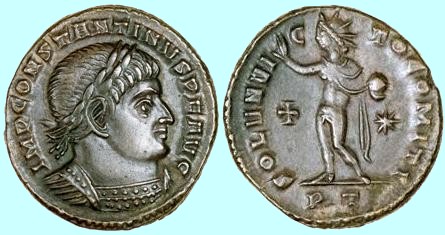
It was mainly because of influence of the militaristic sun-god worshiping Emperor Constantine, who was a member of the Mithra religion (which was a military cult, see Do You Practice Mithraism?), that most of those who claimed Christ who affiliated with him became accepting of military service.
A former Roman Catholic priest reported:
Whereas up to the year 175 there was not a single Christian soldier, in 416, by an edict of Theodosius, only Christians were allowed to enlist (De Rosa, Peter. Vicars of Christ. Poolberg Press, Dublin, 2000, p. 156).
Yet, this military service is not an area that true Christians compromised on. The only ones who enlisted were those that ended up accepting the type of "Christianity" that nearly all the Greco-Roman Emperors from Constantine onwards endorsed.
In the later centuries, this violent trend worsened.
Notice that hate and violence against others who differed doctrinally was promoted by the Greco-Roman bishop and saint Gregory of Nyssa in the fourth century:
I affirm, then, that it is a lawful thing to hate God's enemies, and that this kind of hatred is pleasing to our Lord: and by God's enemies I mean those who deny the glory of our Lord, be they Jews, or downright idolaters, or those who through Arius' teaching idolize the creature, and so adopt the error of the Jews. Now when the Father, the Son, and the Holy Ghost, are with orthodox devotion being glorified and adored by those who believe that in a distinct and unconfused Trinity there is One Substance, Glory, Kingship, Power, and Universal Rule, in such a case as this what good excuse for fighting can there be? (Gregory of Nyssa. Letter 17 to Eustathia, Ambrosia, and Basilissa. Translated by William Moore. From Nicene and Post-Nicene Fathers, Second Series, Vol. 5. Edited by Philip Schaff and Henry Wace. (Buffalo, NY: Christian Literature Publishing Co., 1893)
So, before the end of the 4th century there were people teaching that hatred and fighting against those who did not accept a doctrine that was not formally adopted by the Greco-Romans until 381 A.D. was good (more on the trinity can be found in the article Did the True Church Ever Teach a Trinity?).
Notice also what The Catholic Encyclopedia teaches about a later time:
Leo V, though an Iconoclast, tried to refute the accusation that he was a Paulician by persecuting them furiously. A great number of them at this time rebelled and fled to the Saracens. Sergius was killed in 835. Theodora, regent for her son Michael III, continued the persecution...We hear continually of wars against the Saracens, Armenians, and Paulicians...This eliminated the sect as a military power. Meanwhile other Paulicians, heretics but not rebels, lived in groups throughout the empire (Fortesque A. Transcribed by Richard L. George. Paulicians. The Catholic Encyclopedia, Volume XI. Copyright © 1911 by Robert Appleton Company. Online Edition Copyright © 2003 by K. Knight. Nihil Obstat, February 1, 1911. Remy Lafort, S.T.D., Censor. Imprimatur. +John Cardinal Farley, Archbishop of New York).
It should be noted that the reason that some of the Paulicians did not fight back was because some of them were in the true Church of God (please see the article The Churches of Revelation 2 & 3).
The Paulicians were followed by the Bogomils, Cathars, and Albigenses.
Harvard scholar H. Brown wrote:
...in Slavoni, the name "Bogomil" means "beloved of God"...The specific predecessors of the Bogomils are the Paulicians...Many Bogomils, and especially their leaders, exhibited a zeal and a purity of life that contrasted with the indifference and frivolity of all too many orthodox ecclestiastics in both East and West (Brown HOJ. Heresies: Heresy and Orthodoxy in the History of the Church. Hendrickson Publishers, Peabody (MA), 1988, pp. 247,252).
Dr. Brown also noted that the Bogomils were pacifists (Ibid p.260). So have other scholars:
Bogomils and Cathars were communities of non-violence (Vassilev, Georgi. DUALISTIC IDEAS IN THE WORKS OF WILLIAM TYNDALE. ACADEMIE BULGARE DES SCIENCES. INSTITUT D'ETUDES BALKANIQUES. ETUDES BALKANIQUES, n° 1, 2003: 124-142).
The pacifist Bogomils were condemned by the Greco-Roman Catholics as heretics. Notice this from The Catholic Encyclopedia:
The heresy of the Bogomili was started in the tenth century... followers called themselves Christians and considered their faith the only true one. In Bosnia they were named Paterines. The Paterines, or Bogomili ... forbade intercourse with those of other faiths, disbelieved in war (Klaar K. Transcribed by Joseph E. O'Connor. Bosnia and Herzegovina. The Catholic Encyclopedia, Volume II. Published 1907. New York: Robert Appleton Company. Nihil Obstat, 1907. Remy Lafort, S.T.D., Censor. Imprimatur. +John M. Farley, Archbishop of New York).
The Cathari condemned the Greco-Romans because they supported and encouraged warfare:
The Cathari ... One of the charges made against the established Church was that it countenanced war and marshalled armies. (History of the Christian Church By Philip Schaff, David Schley Schaff Published by C. Scribner's sons, 1907 Item notes: v.5:pt.1 Original from Harvard University Digitized Feb 5, 2008, pp. 474-490).
The Albigenses were pacifists, but they and those who sometimes failed to not turn them in to Greco-Roman Catholic authorities were often killed. Notice what a former Roman Catholic priest reported:
It has been reckoned that in the last and most savage persecution under Emperor Diocletian about two thousand Christians perished, worldwide. In the first incident of Pope Innocent's Crusade ten times that number of people were slaughtered. Not all were Albigensians. It comes as a shock to discover that, at a stroke, a pope killed far more Christians than Diocletian (De Rosa, Peter. Vicars of Christ. Poolberg Press, Dublin, 2000, pp. 160-161).
(The entire persecution that Roman Emperor Diocletian unleashed lasted from 303-313 A.D; the inquisition-persecution that Innocent III unleashed lasted hundreds of years.)
The Greco-Roman Catholics also called for the crusades which killed Muslims and eventually others:
Urban's main achievement was convoking the Council of Clermont, November 1095, which called the First Crusade. The Byzantine Emperor, Alexius Commenus, had sent a desperate appeal to Urban for armed knights to defend Christianity against the Moslem enemy. When the Pope laid the Emperor's pleas before the knights in Clermont, the main concern of the noblemen there was not so much the defense of Byzantium as the rescue of the Holy land from Moslem domination. Palestine had been under Moslem control since the days of the Caliph Omar, but at least the Arab Moslems had allowed Christian pilgrims to visit the places made sacred by the life of Christ. The SeIjuk Turks, now the dominant Moslem power, had, on the other hand, closed off the Holy Land.
Thus the Pope concluded his speech to the council with these words: “Men of God, men chosen and blessed among all, combine your forces! Take the road to the Holy Sepulcher assured of the imperishable glory that awaits you in God's kingdom. Let each one deny himself and take the Cross!” With a shout God wills it" -- the Assembly rose. They adopted a red cross as their emblem, and within a few hours no more red material remained in the town because the knights had cut it all up into crosses to be sewn on their sleeves. Because of their emblem (crux is the Latin word for cross) they were given the name Crusaders. (Carrol A. The Crusades. Catholic Education Resource Center. http://catholiceducation.org/articles/history/world/wh0010.html viewed 07/27/14)
Decrees of Pope Urban II at the Council of Clermont, 1095... He established and decreed that knights and footmen, that is whoever were able to go to deliver Jerusalem and the other churches of Asia from the power of the pagans, for the love of God and to obtain remission of all their sins, should set forth with one soul, bearing arms, and he decreed that in their property until their return unbroken peace and security should be observed. At the same time he provided that all who went there should bear the sign of the cross marked on the garments on their shoulders or on their forehead, whereby they would show the piety and pilgrimage of so great a journey and be impeded by no one. All those who were present, hearing such a good and desirable edict, lifted their voices to the heaven in ovation, shouting altogether again and again : God wills it, God wills it, God wills it. (Decrees of Pope Urban II at the Council of Clermont, 1095. In a Historia peregrinorum at Monte Cassino is contained an amplified version of the Cencius-Baluze text (p. 124n.) Translated from Robert Somerville, The Councils of Urban II. vol 1, DECRETA CLAROMONTENSIA, Amsterdam 1972. http://falcon.arts.cornell.edu/prh3/259/texts/clermont.html viewed 07/27/14)
The Crusades were expeditions undertaken, in fulfilment of a solemn vow, to deliver the Holy Places from Mohammedan tyranny. The origin of the word may be traced to the cross made of cloth and worn as a badge on the outer garment of those who took part in these enterprises. Medieval writers use the terms crux (pro cruce transmarina, Charter of 1284, cited by Du Cange s.v. crux), croisement (Joinville), croiserie (Monstrelet), etc. Since the Middle Ages the meaning of the word crusade has been extended to include all wars undertaken in pursuance of a vow, and directed against infidels, i.e. against Mohammedans, pagans, heretics, or those under the ban of excommunication... the extermination of the Albigensian heresy was due to a crusade ( "Crusades." The Catholic Encyclopedia. Vol. 4. New York: Robert Appleton Company, 1908. 27 Jul. 2014 <http://www.newadvent.org/cathen/04543c.htm>)
The positions of the Church of God and Church of Rome were not the same. Neither on violence, nor the cross (see also What is the Origin of the Cross as a 'Christian' Symbol?).
Into the early middle ages, some in the true Church of God were called Waldenses (though most called that name were not in the Church of God) were pacifists. Notice this description of them :
Their opposition to bearing arms, and to war in all its operations, was unanimous and unequivocal. Whoever commanded them to the field they refused to obey, alleging that they could not conscientiously comply (Quoted from Davis, Tamar. A General History of the Sabbatarian Churches. 1851; Reprinted 1995 by Commonwealth Publishing, Salt Lake City, p. 78).
Notice this account in the thirteenth century:
After this, the Crusaders moved to Lavaur...Afterwards, 400 perfecti were led out of town and burned in a vast funeral pyre. Vaux de Cernay put on record for the pope's benefit: 'Cum ingenti gaudio combusserunt', 'They set them alight with immense joy'. They were relaxed knowing they had his Holiness's blessing.
Only one of the perfecti renounced his faith. They were pacifists. They died with dignity (De Rosa, Peter. Vicars of Christ. Poolberg Press, Dublin, 2000, p. 161).
It is sad that those killing pacifists believed that the pope's approval meant that persecution and murder was appropriate. Nowhere in my Bible do I see any verse suggesting that real Christians were ever to become murderous persecutors. Actually, the 30 times in the New Testament the NKJV translators used the terms persecute, persecuted, persecution, those terms refer to something happening to Christians--not the other way around (have they not read "Blessed are you when they revile and persecute you", in Matthew 5:11?).
Of course, the true Christians (and some who were not Christian) did not accept papal views on violence--they remembered what the Bible taught. And the position of the true Church of God has not changed throughout the centuries.
To understand the difference between the truly faithful and the others, notice what Jesus taught:
2 ... yes, the time is coming that whoever kills you will think that he offers God service. 3 And these things they will do to you because they have not known the Father nor Me. 4 But these things I have told you, that when the time comes, you may remember that I told you of them. And these things I did not say to you at the beginning, because I was with you (John 16:2-4).
Notice what the Apostle Paul wrote:
12 Yes, and all who desire to live godly in Christ Jesus will suffer persecution. 13 But evil men and impostors will grow worse and worse, deceiving and being deceived. 14 But you must continue in the things which you have learned and been assured of (2 Timothy 3:12-14).
10 Love does no harm to a neighbor (Romans 13:10a)
Of course, violence does harm to neighbors.
Jesus taught love:
27 "But I say to you who hear: Love your enemies, do good to those who hate you, 28 bless those who curse you, and pray for those who spitefully use you. 29 To him who strikes you on the one cheek, offer the other also. And from him who takes away your cloak, do not withhold your tunic either. 30 Give to everyone who asks of you. And from him who takes away your goods do not ask them back. 31 And just as you want men to do to you, you also do to them likewise.
32 "But if you love those who love you, what credit is that to you? For even sinners love those who love them. 33 And if you do good to those who do good to you, what credit is that to you? For even sinners do the same. 34 And if you lend to those from whom you hope to receive back, what credit is that to you? For even sinners lend to sinners to receive as much back. 35 But love your enemies, do good, and lend, hoping for nothing in return; and your reward will be great, and you will be sons of the Most High. For He is kind to the unthankful and evil. 36 Therefore be merciful, just as your Father also is merciful. (Luke 6:27-36)
Compare Paul's writings and Jesus' statements to the following:
Some statements from Martin Luther's position on killing are shown later in this paper.In 1520, Leo X condemned Martin Luther for daring to say that burning heretics is against the will of God (De Rosa, Peter. Vicars of Christ. Poolberg Press, Dublin, 2000, p. 145).
COG Position in the 1800s
In the 1800s, there was a lot of controversy among those who claimed to be in the Church of God, and military service was one of the many controversies.
I should probably mention that the position of the U.S. government used to essentially be that conscientious objectors could pay a fine in lieu of military service and that that is what Church of God members, Quakers, and members of other pacifist religions did until about the end of the Civil War.
One publication, called the Hope of Israel, which began publishing in 1863, was put out by Sabbath-keeping group (they were among those that refused to affiliate with the Seventh-day Adventists).
Here are two reports from Richard Nickels on the history of the Church of God that suggest those associated with the Hope of Israel tended to be strong conscientious objectors, while the Seventh Day Adventists had less objections (as they seemed to feel being drafted made military participation possibly acceptable):
One clear indication of the beliefs of the Hope of Israel supporters generally was their conscientious objection to participation in the Civil War.
It appears that some Advent groups attempted to buy exemption from the draft for their male members. Eli Wilsey of the Hartford "Church of Christ" spent at least four months in prison "for refusing to fight with carnal weapons."
Frequent news articles on the progress, and staggering costs, of the war were published, with the exhortation to the brethren to have nothing to do with the "war, revenge and murder."
One news report was that brother William Cronk of Casco was drafted, passed examination, "But was declared exempt from field service on account of his religious principles. He is in the government service in the hospital."
N. Wallen and R.C. Horton reported in a letter dated January 16, 1865 from South Haven, Michigan that the brethren of Hartford and Casco were going to try and raise $300.00 to clear all the brethren who may be drafted.
The April 23, 1865 issue contained a quote from the Harbinger expressing sorrow at the death of President Lincoln, thanking God that Lincoln made laws to deliver Christians from participating in war.
John L. Staunton, a one-time president of the Michigan Conference, enlisted in the Union army, and the Waverly church disfellowshipped him, maintaining that only non-resisters could be in their church." (Nickels RC. Conscientious Objectors During the Civil War. In History of the Seventh Day Church of God. 1988: 31-32).
H.E. Carver was conscientiously opposed to Christians fighting with carnal weapons, that is, in warfare. He believed that the church should adopt the same position and urged that the question be discussed in the columns of the Advent Review. This occurred at the outbreak of the Civil War, shortly before the foundation of the Seventh Day Adventist denomination.
The Whites stated at a council in Lisbon, Iowa that the subject should not be discussed because of the danger of being destroyed by the war elements in the country for seeming to be unpatriotic. James White wrote in the Review that to engage in war would be a violation of two of God's commandments, but in case of being drafted, the government would be responsible for an individual's violation of God's commandments. In effect, he said that it was all right to break God's law! This error was so obvious that Ellen G. White had to apologize in the Review for her husband, but maintained that something had to be said on this delicate subject.
Conscientious objection was too controversial for Mrs. White to pronounce a vision concerning it. Yet she did publish a vision purporting to foretell the outcome of the Battle of Bull Run, after it had been fought and the result was known.
The Iowa Church of God brethren were firmly convinced that it was wrong for Christians to engage in warfare. During the initial phase of the Civil War, Elders B.F. Snook and J.H. Waggoner prepared a petition to the Iowa state government, asking their church be exempted as non-combatants. The petition was circulated among the brethren for signatures, and sent to the state capital. Battle Creek did not sanction this effort, terming it "fanaticism". Due to the Church of God petition, a law was enacted exempting non-combatants from bearing arms. Carver termed the non-action of the Battle Creek Seventh Day Adventists as "cowardly".
However, Uriah Smith reported that the Seventh Day Adventist General Conference did indirectly exempt Seventh Day Adventists by petitioning the government to exempt them through an already existing law (Nickels RC. James White Counsels Breaking God's Law in the Civil War. In History of the Seventh Day Church of God. 1988: 47-48).
When the United States entered the war in 1917, {A.N.} Dugger {Church of God, Adventist}, with a Missouri congressman, had a personal interview with President Woodrow Wilson, obtaining Church of God exemption. (Nickels RC. History of the Seventh Day Church of God, p. 92)
Historically the Church of God has been against military service for its members. And while many associated with the Hope of Israel were not truly COG, some were and likely were partially attracted by its strong stance against military participation.
The Seventh Day Adventists
While some feel otherwise, the Seventh Day Adventists have made so many exceptions in modern times such that it would be difficult to state that it is truly against military service for its members.
Actually, a recent article shows that they now allow their members to be military combatants and that their pastors do endorse killing in the military by their members. Notice this from Adventist News Network (official news agency of the Seventh-day Adventist Church) - Sept 22, 2006:
Is the Adventist Stance on Noncombatancy Shifting?
Where have all the Desmond Dosses gone? Epitomizing the traditional position advocated by Seventh-day Adventists during wartime, Doss was a World War II United States Army medic who refused to carry a weapon, yet earned the Congressional Medal of Honor for single-handedly rescuing 75 wounded soldiers amid a blitz of enemy bullets on the island of Okinawa, Japan.
Ever since the Adventist church's beginnings, its official statements and members' behavior have generally reflected an equal commitment to nonviolence.
But today, an estimated 7,500 Adventists serve in the United States military.
And virtually all of them are enlisted as combatants...
But, he points out, "Prior to the 1970s, the thought of a practicing church member volunteering for a combat role in the military would have been inconceivable to the vast majority of Adventists." Not so anymore...
Above all, Councell says, it is unfair to single out the issue of noncombatancy. He views slackening attitudes toward active combat as a symptom of a larger issue: a general shift in the values climate of Adventism, reflecting current socio-cultural trends...
At a recent press conference in Cameroon, Pastor Jan Paulsen, president of the Adventist world church, remarked that "using weapons is an inhumane solution to situations that can be solved. There is a better way to live together and that is to co-exist rather than war."
"We must prayerfully and principally seek moral and spiritual counsel regarding this issue," advises Councell. "There is room for differences of opinion and viewpoint. We are all finite individuals and situations are often imposed upon us." But that doesn't change our core commitment to the well-being of humanity, he adds.
And he believes that commitment sometimes demands action. "We have a moral obligation to defend the innocent and helpless, and if you neglect that I think you have shirked your Christian duty. However, [chaplains] are not advocating killing or the use of weapons and force. Killing during wartime may be necessary in some instances, but that doesn't mean it doesn't leave scars. It does." source: http://news.adventist.org/data/2006/08/1158929606/index.html.en
The Seventh Day Adventists (SDAs) are becoming more and more Protestant--the COGs are NOT Protestant.
But I should state here that many SDAs still remain opposed to military service, though this opposition is definitely diminishing. (An article of possible interest might be SDA/COG Differences: Two Horned Beast of Revelation and 666.)
21st Century Departures from the Faith
We appear to be living in what the Bible calls the "latter times." Note what is prophesied to occur then:
1 Now the Spirit expressly says that in latter times some will depart from the faith (I Timothy 4:1).
Sadly, military service is another area where several claiming to be in the Church of God have departed from the faith.
Several years ago, the changed and Protestant Worldwide Church of God (which since renamed itself Grace Communion International) changed its position against military service. It now endorses it. Years ago, it even ordained an active military officer to be a minister in charge of several congregations in Hawaii.
The Journal: News of the Churches of God had some articles in the past by some who seem to support Christian participation in war. The headline of an article on this subject back in 2007 was:
Are there CO hawks in the Churches of God?
By Wes White
Wes White was named as the president of the Ronald L Dart Evangelistic Association in August 2017 (see ‘Ronald L Dart Evangelistic Association’ announcement).
Anyway, his satirical article basically hints that many in the COGs advocate military intervention, but we hold to a pacifist position because we are afraid that we or our children may be hurt in war. The term “hypocrite” seems to be used to describe those that Wes White felt are “chicken hawks” (those who favor military intervention, but are afraid to participate in the military).
While there are hypocrites pretty much everywhere, those of us who hold to actual Christian teachings know full well that we hold to them because we believe that the Bible teaches them. The fact that many in the COGs understand why governments will intervene militarily neither makes us “hawks” (war-mongers) nor “chickens” (pacifists due to cowardice).
Actually, while those unrepentant sinners who break the commandment against killing will not be in the Kingdom of God (Revelation 22:15), neither will the “cowardly” (Revelation 21:8).
It is not cowardice to stand up for true Christian teachings–even if people call us names that imply real Christians are cowards.
On the other hand Whaid Rose, then president of the Church of God, Seventh Day-Denver (CG7) correctly wrote:
Christians should renounce such carnality and the weapons of human strife, and should not participate in military combat through the armed forces (Rose, Whaid. E-Vision, October 1, 2001)
Yet, Whaid Rose admitted he was considering changing his view as he concluded with:
You should know that over the years I have defended the church's pacifist stance, but that the events of September 11th has me thinking much about this. Would you say that this "different kind of war against America" calls for an exception to the rule? (ibid)
No, I would not say that circumstances should change doctrine. Jesus taught (Revelation 3:11) that the Philadelphian Christians should ‘hold fast’ (it should be added that I am not implying that CG7 is part of that era, as we in the COGs have tended to view CG7 as part of the Sardis-era remnant).
A non-Philadelphia COG group that did not hold fast, CGOM, was discussed as follows:
THE JOURNAL asked what is the CGOM’s view on the appropriateness of members serving in the military. A couple of the men in the meeting said whether to serve or not is a personal decision for any member of a CGOM-affiliated church. The CGOM has no official doctrine on it. Military service is not mentioned in the CGOM’s statements of belief. But Mr. Gregory’s personal view “is that we need to stress that God’s Kingdom is not of this world, and we’re called to be separate from this world and trust in faith for protection. I believe personally it is better not to come under the military because of personal sovereignty one must necessarily lose by being in the military. “But I don’t condemn anyone who makes a different decision, as long as they allow me that courtesy” (Cartwright, Dixon. CGOM happy with response to USA Today ad. The Journal. November 30, 2001: 15).
CGOM came out of CGI, and here is some information from CGI,
Bronson James of the Church of God International, Tyler, Texas … The CGI differs … in the matter of military service and war. Mr. James told The Journal that the CGI “has no policy” against members serving in the military (Overton, Mac. COG leaders react to terrorist attacks. The Journal. September 30, 2001: 1,14).
The late Ron Dart, who was once part of CGI, and headed up the non-Philadelphian Christian Education Ministries, wrote:
Paul was surely a citizen of God’s Kingdom, but he did not hesitate to demand his rights as a Roman citizen. We don’t hesitate to demand our rights as American citizens, but how can we exercise our rights while we avoid our responsibilities? Our country is a government of the people, by the people and for the people. We have, just as God said, judges and officers in all our gates. Why should we, as saints, decline to serve as judges and officers? Who is better able to sit on a jury and judge God’s people?..I am persuaded that it is not only permissible for a Christian to serve on a jury if called; it is an obligation. I think God will hold us accountable for responsible government in our communities at least to the extent of doing what we can…We should clean out that rat’s nest called the Taliban and avenge the murder of our citizens. For us as individuals to turn the other cheek, we need a government that will take up our cause and defend us. This is not vengeance taken with a spiteful heart. It is justice, and it is right. We should have done it a long time ago (Dart, Ron. Take a new, hard look at vengeance. The Journal. 10/31/01).
When later specifically asked about this subject, Ron Dart responded:
A Christian could serve in the military (email from Ron Dart to TW 6/7/02).
Ron Dart later posted:
I saw some satellite images, shot at night over the Korean peninsula, which made me think long and hard about it. What the dictator of North Korea has accomplished since the war could just as easily have been the picture of South Korea. We can talk endlessly about the evils of war, but one does have to look at results when all is said and done. The images below are night time satellite views of the Korean peninsula. Do you see any difference at all between north and south? I am anti-war, too, but I believe there is a time to fight…On this day of Thanksgiving, I am thankful for what it means to be free. (Dart, Ronald L. Anti-War. http://www.rondart.com/. November 23, 2006).
CCG of Texas, another non-Philadelphian group, was covered in The Journal:
Jeff Booth believes the Churches of God have gotten it all wrong. Mr. Booth, founder of the Christian Church of God and pastor of the CCG congregation in Amarillo, Texas, says young Church of God men should feel free to join up to help fight America’s war on terrorism, and in fact they should feel an obligation to do so. Mr. Booth, 53, made his remarks on Oct. 2, the first day of the Feast of Tabernacles, at the CCG’s Feast site near St. Petersburg, Fla…He quoted from Luke 3:13. The writer of the third Gospel reports that some soldiers asked John the Baptist what they should do to please God. “Do not intimidate anyone or accuse falsely, and be content with your wages,” the baptist advised the military men. John did not say “You’ve got to go AWOL or resign,” said Mr. Booth. He did not say “You’ve got to put down your weapons” (Cartwright, Dixon. Pastor says COG member should support war on terrorism, including militarily. The Journal. 10/31/01).
Down deep, Mr. Booth always had a problem with the old WCG’s view that Christians should never fight. “Somewhere in the back of my mind I always believed good should fight against evil. I kind of felt like we were copping out and letting somebody else fight our battles for us. That always bothered me.” However, he was officially a conscientious objector as a young man during the Vietnam War, which was raging at the time of his graduation from AC. Theology status “Like I say, I did embrace it, but I did so reluctantly. I had some internal conflicts. Once I resolved those conflicts, I came to the conclusion that there was absolutely nothing wrong with serving in the military and defending your country…”My point was not that I was saying that people should serve in the military,” said Mr. Booth. “I’m just saying that there is no prohibition for a Christian to serve in the military…”All I’m saying is that we cannot tell our young people that they cannot join the military. I can’t support it in Scripture to deny them military service if they feel moved to serve” (Cartwright, Dixon. Pastor explains his stance on military and war. The Journal. 10/31/01).
So here is a pastor of a group who clearly favors military involvement.
Shameful.
If these leaders think they are in the true Church of God, do they not understand the New Testament and the historical teachings of the Church of God?
UCG-Related Comments
Perhaps the most disturbing was this report of a Journal interview with, Ellis Stewart, then an elder in UCG,aIA. Though this is not UCG's official position, it is similar to how I have seen UCG handle certain other doctrinal matters in writing.
He also, unlike the old Radio/Worldwide Church of God, does not advocate enforcing a pacifist belief on other Church of God members. "I firmly believe this is a personal choice, a very personal choice," he said. THE JOURNAL asked Mr. Stewart why he believes it is wrong for a Church of God member to serve in the military. "That's a pointed question," he said...The question is should a COG member join one of these killing organizations? Should he submit to the draft in times of military conscription? "I can't speak for anyone else but myself," said Mr. Stewart. "For me the answer to that question is no."...What about Luke 3:14, where John the Baptist advises the soldier who is seeking to obey God to "be content with [his] wages"? "I think that advice shows that the soldier was already in the position of no longer being his own boss. Not only was he not his own boss, he was a military organization's slave. John's advice was simply an acknowledgment of that reality; there was nothing the soldier could do to get out of his predicament. I don't think this is a definitive statement on whether it is appropriate to serve in the military."...Mr. Stewart wanted to say again that he does not condemn anyone for defending himself and his country. "I'm not even saying that a Church of God kid should not join the military. That is purely a personal choice. They're doing what they think is right, and I'm doing what I think is right. I'm basing my decisions on what I feel Christ taught, and I'm sure they may be doing the same thing" (Cartwright Dixon. Longtime elder concerned about COG hawks. The Journal. 10/31/01).
It was disturbing that a UCG elder will not take a strong stand on a fundamental belief of UCG. It is disturbing that he teaches against the military for himself, but not younger COG members.
The following quote concerning a former UCG member is also of concern (he does not hold any leadership position in UCG that I am aware of and his positions are not the same as UCG's),
Prophecy scholar and UCG member Steven Collins of Sioux Falls, S.D., who wrote The Lost Ten Tribes of Israel . . . Found!, a book about the prophetic identity of the biblical Israel, thinks the attacks validate his prophetic scenario, which is contrary to the traditional WCG view mentioned earlier. Mr. Collins believes the United States and European nations will remain allies and that the threat against both will come from nations of the East. "Those were not Germans or Europeans at the controls of those suicide aircraft," Mr. Collins told The Journal. "Our enemies have come from within the alliance of nations recorded in Ezekiel 38 as the latter-day enemies of the 10 tribes of Israel. Ezekiel 38 identifies Persia and Kush as enemies of Israel." Mr. Collins thinks the Persia of the Bible is modern Iran, and Kush is Afghanistan, Pakistan and perhaps other nations, including the Sudan. "We're told in the New Testament to pray for the king and governors that 'he bears not the sword in vain'" (Romans 13:4), said Mr. Collins. "The president has scriptural authority to use military force against our enemies." Mr. Collins also cited Ecclesiastes 3:8, which speaks of a time for peace and a time for war. Mr. Collins said he is no longer a "conscientious objector." Mr. Collins has written a long booklet, which he plans to turn into a book, on his view of prophecy" (Overton, Mac. COG leaders react to terrorist attacks. The Journal. September 30, 2001: 1,14).
In a recent issue of THE JOURNAL, Pastor Jeff Booth of Amarillo, Texas, called upon Christians to support the president in our nation's war on terrorism (see the Oct. 31 issue). I agree with Mr. Booth and see no reason his call should cause any controversy...We read that those who do not provide for their own are worse than an infidel (1 Timothy 5:8). If someone is worse than an infidel for not feeding, sheltering and clothing one's family, how can he be any less an infidel if he refuses to fight in his family's defense?...There would be no disobedience to God in fighting and killing on the Sabbath to defend yourself and your nation...That principle is the ox-in-the-ditch exemption to which Jesus referred in Luke 14:5. Can there possibly be a greater ox in the ditch than warfare" (Collins Steve. Soldiers can be good Christians The Journal: 6).
In my opinion, Collins' views are dangerous for the COGs in general and (if he is still associated with them) UCG in particular.
To make matters worse, if that was possible, Collins' concluded with:
Since there is no current military draft in our nation, the issue of military service is rather moot. Those who choose to be conscientious objectors can simply refrain from joining the military. Those who wish to pursue military service may do so. The key issue is that brethren with either view should maintain unity in their churches and fellowships and not judge each other over the decisions made by others. This is a subject in which each person must be guided by his faith and understanding of the Scriptures. Just as the early New Testament church was big enough to include brethren with differing doctrinal views on matters such as circumcision, eating meat sacrificed to idols and vegetarianism, our modern churches should be able to handle some doctrinal differences as well" (p.6).
This is astounding all the more since he (as quoted previously) indicated that a Christian that does not fight is "worse than an infidel."
The following was written by Edwin Barnett who was in GCG (maybe even as an employee), then CGCF, and then UCG:
The traditional WCG doctrine against voting and to some extent for not serving in the military is wrong. It was speciously based upon the 20th-century interpretation of a word selected in 1611 by the King James translators who were translating a word that Paul penned in the first century in Greek. That word is presbeuo and is found in 2 Corinthians 5:20: ". . . We are ambassadors for Christ." The word ambassador today has a substantially different meaning from when Paul wrote 2 Corinthians. When a person insists on applying the 21st-century Western meaning to this first-century Greek word, he does so in order to take the listener to the crux restriction: An ambassador cannot entangle himself in the affairs of the country he was sent to. The problem with this crux, although well intentioned, is that it is arbitrarily selective. If this person were really an ambassador, then he must have fulfilled all the other requirements as well. One of those requirements is that the host country officially must accept his credentials. How many of us have been officially accepted by our governments? Not a one. Further, an ambassador cannot hold citizenship in the host country. How many of us have given up our national citizenship so we could move into the office of ambassador? Not a one" (Barnett, Edwin. Voting, military arguments not the same. The Journal. September 30, 2001:3,13).
Later though, Barnett seemed to support the position against military service.
Typical of those who have fallen away, that writer seeks to justify his departure through inaccurate reasoning. He neglects that Peter wrote that:
9 But you are a chosen generation, a royal priesthood, a holy nation, His own special people, that you may proclaim the praises of Him who called you out of darkness into His marvelous light; 10 who once were not a people but are now the people of God, who had not obtained mercy but now have obtained mercy (1 Peter 2:9-10).
There is no scripture that suggests that Peter nor God expects us to have our ambassadorship accepted by Gentiles, but Barnett suggests that this is required. And he suggests that one cannot do that yet retain his citizenship; perhaps he should recall that Paul still retained his Roman citizenship yet was one of God's people, yet wrote "For our citizenship is in heaven" (Philippians 3:20). Jesus Himself dealt with it this way,
35 Pilate answered, "Am I a Jew? Your own nation and the chief priests have delivered You to me. What have You done?"
36 Jesus answered, "My kingdom is not of this world. If My kingdom were of this world, My servants would fight, so that I should not be delivered to the Jews; but now My kingdom is not from here" (John 18:35-36).
Now Jesus was a Jewish citizen, but His kingdom, His true citizenship, were not of this world--the same reasoning applies to His servants, true Christians, which is why we do not fight.
Thus the so-called problems to be against voting and military involvement are certainly not biblically defendable. This happens to those who depart and no longer 'contend earnestly for the faith that was once for all delivered to the saints' (Jude 3). It should be noted that UCG itself hasn't officially fallen away this far on these subjects (UCG is officially against military service for its members and, though it teaches that elders should vote within UCG, it teaches against voting in national elections--its position on local elections is less clear).
It is just that those who reject the restored truth on governance end up with arguments which do weaken their ability to argue against military service.What Should Be Done?
Since the terrorist attacks are not a reason for an exception to the Church's historical position against military involvement, what should be done?That is easy. The nation should repent. God promises to protect the nation if we obey Him and to allow curses if we do not!
God protects those who obey Him,
1. Now it shall come to pass, if you diligently obey the voice of the LORD your God, to observe carefully all His commandments which I command you today, that the LORD your God will set you high above all nations of the earth. 2 And all these blessings shall come upon you and overtake you, because you obey the voice of the LORD your God: 3 Blessed shall you be in the city, and blessed shall you be in the country. 4 Blessed shall be the fruit of your body, the produce of your ground and the increase of your herds, the increase of your cattle and the offspring of your flocks. 5 Blessed shall be your basket and your kneading bowl. 6 Blessed shall you be when you come in, and blessed shall you be when you go out. 7 The LORD will cause your enemies who rise against you to be defeated before your face; they shall come out against you one way and flee before you seven ways (Deuteronomy 28:1-7).
But look what happens to those who disobey,
15 But it shall come to pass, if you do not obey the voice of the LORD your God, to observe carefully all His commandments and His statutes which I command you today, that all these curses will come upon you and overtake you: 16 Cursed shall you be in the city, and cursed shall you be in the country ... 22 The LORD will strike you with consumption, with fever, with inflammation, with severe burning fever, with the sword, with scorching, and with mildew; they shall pursue you until you perish. 23 And your heavens which are over your head shall be bronze, and the earth which is under you shall be iron. 24 The LORD will change the rain of your land to powder and dust; from the heaven it shall come down on you until you are destroyed. 25 The LORD will cause you to be defeated before your enemies; you shall go out one way against them and flee seven ways before them; and you shall become troublesome to all the kingdoms of the earth (Deuteronomy 28:15-16,22-25).
The Church of God message against military service is not popular among most who profess Christianity. It may be that one of the differences between those who go to a place of safety and some of whom do not (CGI teaches against the place of safety doctrine), is that those who do not, do not hold fast to the Church's position against military involvement. A pacifist stance is not popular with any government of man, and may be a reason that certain governments will be happy to see us leave. Paul taught:
19 Beloved, do not avenge yourselves, but rather give place to wrath; for it is written, "Vengeance is Mine, I will repay," says the Lord. 20 Therefore "If your enemy is hungry, feed him; If he is thirsty, give him a drink; For in so doing you will heap coals of fire on his head." 21 Do not be overcome by evil, but overcome evil with good (Romans 12:19-21).
From the New Testament
The Old Testament teaches:
1 To everything there is a season,
A time for every purpose under heaven:2 A time to be born,
And a time to die;
A time to plant,
And a time to pluck what is planted;
3 A time to kill,
And a time to heal;
A time to break down,
And a time to build up; (Ecclesiastes 3:1-3)
Well, the "time to kill" was something that God had the carnal nation of Israel do.
But that is not for this time in the church age.
In this season, we are to do good:
9 And let us not grow weary while doing good, for in due season we shall reap if we do not lose heart. (Galatians 6:9)
The New Testament, itself, makes it clear that Christians are not to participate in carnal warfare.
In addition to Jesus's comments that since His kingdom was not of this world, let's look at what else He said:
43 "You have heard that it was said, 'You shall love your neighbor and hate your enemy.' 44 But I say to you, love your enemies, bless those who curse you, do good to those who hate you, and pray for those who spitefully use you and persecute you, 45 that you may be sons of your Father in heaven; for He makes His sun rise on the evil and on the good, and sends rain on the just and on the unjust. 46 For if you love those who love you, what reward have you? Do not even the tax collectors do the same? 47 And if you greet your brethren only, what do you do more than others? Do not even the tax collectors do so? 48 Therefore you shall be perfect, just as your Father in heaven is perfect. (Matthew 5:43-48).
Jesus is teaching us not to respond as the world responds! You do not show love for your enemy by engaging in war to try to kill him/her--nor encouraging violence in sports. Furthermore:
51 "And suddenly, one of those who were with Jesus stretched out his hand and drew his sword, struck the servant of the high priest, and cut off his ear. 52 But Jesus said to him, "Put your sword in its place, for all who take the sword will perish by the sword. 53 Or do you think that I cannot now pray to My Father, and He will provide Me with more than twelve legions of angels?" (Matthew 26:51-53).
Jesus clearly was telling His followers to NOT take up arms--even to defend Him. Sadly, many who claim to be His followers o not agree with Him about that.
Notice also what the Apostle John wrote:
10 He who loves his brother abides in the light, and there is no cause for stumbling in him. 11 But he who hates his brother is in darkness and walks in darkness, and does not know where he is going, because the darkness has blinded his eyes (1 John 2:10-11)
14 He who does not love his brother abides in death. 15 Whoever hates his brother is a murderer, and you know that no murderer has eternal life abiding in him" (1 John 3:14-15).
Those that hate do not abide in the light nor have eternal life!
Some have asked what members of the Church are supposed to do if they are subject to attack. Jesus made that clear,
23 When they persecute you in this city, flee to another. For assuredly, I say to you, you will not have gone through the cities of Israel before the Son of Man comes (Matthew 10:23).
Jesus did not advise becoming part of the military.
Paul wrote:
1 Therefore I exhort first of all that supplications, prayers, intercessions, and giving of thanks be made for all men, 2 for kings and all who are in authority, that we may lead a quiet and peaceable life in all godliness and reverence. 3 For this is good and acceptable in the sight of God our Savior, (1 Timothy 2:1-3).
We are to pray for our governmental leaders so we can lead a quiet and peaceable life, we cannot possibly lead a peaceable life if we are engaged in military warfare. Paul also wrote:
3 For though we walk in the flesh, we do not war according to the flesh. 4 For the weapons of our warfare are not carnal ... (2 Corinthians 10:3-4)
Christians ARE NOT TP BE PART OF MILITARY FLESHLY WARS!
Notice the type of weapons and armour Christians are supposed to have--and that they are all for "spiritual" not carnal warfare:
11 Put on the whole armor of God, that you may be able to stand against the wiles of the devil. 12 For we do not wrestle against flesh and blood, but against principalities, against powers, against the rulers of the darkness of this age, against spiritual hosts of wickedness in the heavenly places. 13 Therefore take up the whole armor of God, that you may be able to withstand in the evil day, and having done all, to stand. 14 Stand therefore, having girded your waist with truth, having put on the breastplate of righteousness, 15 and having shod your feet with the preparation of the gospel of peace; 16 above all, taking the shield of faith with which you will be able to quench all the fiery darts of the wicked one. 17 And take the helmet of salvation, and the sword of the Spirit, which is the word of God; (Ephesians 6:11-17).
15 How beautiful are the feet of those who preach the gospel of peace, Who bring glad tidings of good things! (Romans 10:15)
8 But let us who are of the day be sober, putting on the breastplate of faith and love, and as a helmet the hope of salvation. 9 For God did not appoint us to wrath, but to obtain salvation through our Lord Jesus Christ (1 Thessalonians 5:8-9).
Those who advocate carnal warfare or violent sports for Christians do not understand the GOSPEL OF PEACE!
Most violent sports advocates do not seem to realize that they are being influenced by the devil who is the prince of the power of the air:
1 And you He made alive, who were dead in trespasses and sins, 2 in which you once walked according to the course of this world, according to the prince of the power of the air, the spirit who now works in the sons of disobedience, 3 among whom also we all once conducted ourselves in the lusts of our flesh, fulfilling the desires of the flesh and of the mind, and were by nature children of wrath, just as the others.
4 But God, who is rich in mercy, because of His great love with which He loved us, 5 even when we were dead in trespasses, made us alive together with Christ (by grace you have been saved), 6 and raised us up together, and made us sit together in the heavenly places in Christ Jesus, 7 that in the ages to come He might show the exceeding riches of His grace in His kindness toward us in Christ Jesus. 8 For by grace you have been saved through faith, and that not of yourselves; it is the gift of God, 9 not of works, lest anyone should boast. 10 For we are His workmanship, created in Christ Jesus for good works, which God prepared beforehand that we should walk in them. (Ephesians 2:1-10)
Does anyone feel that God Himself would condone encouraging violent sports as the type of 'good works' Christians should be involved in?
Furthermore, Paul wrote:
19 Now the works of the flesh are evident, which are: adultery, fornication, uncleanness, lewdness, 20 idolatry, sorcery, hatred, contentions, jealousies, outbursts of wrath, selfish ambitions, dissensions, heresies, 21 envy, murders, drunkenness, revelries, and the like; of which I tell you beforehand, just as I also told you in time past, that those who practice such things will not inherit the kingdom of God (Galatians 5:19-21).
Those who practice military behaviors in this life WILL NOT BE IN THE KINGDOM OF GOD!
Notice that what the New Testament admonishes Christians:
14 Pursue peace with all people, and holiness, without which no one will see the Lord (Hebrews 12:14).
You cannot observe the above if you are engaged in carnal warfare. Early Christians understood that and faithful Christians still do today.
Paul also wrote:
15 ... God has called us to peace. (1 Corinthians 7:15)
11 Finally, brethren, farewell. Become complete. Be of good comfort, be of one mind, live in peace; and the God of love and peace will be with you. (2 Corinthians 13:11)
18 If it is possible, as much as depends on you, live peaceably with all men. 19 Beloved, do not avenge yourselves, but rather give place to wrath; for it is written, "Vengeance is Mine, I will repay," says the Lord. 20 Therefore "If your enemy is hungry, feed him; If he is thirsty, give him a drink; For in so doing you will heap coals of fire on his head." 21 Do not be overcome by evil, but overcome evil with good. (Romans 12:18-21)
Vengeance is God's. Christians are to live peaceably.
While it is true that the resurrected saints will help Christ crush His enemies (Jude 14-15), the saints are changed and not physical humans at that time (cf. 1 Corinthians 15:51-52; 1 Thessalonians 4:16-17).
Peter wrote about Christian behavior in this life:
10 For "He who would love life And see good days, Let him refrain his tongue from evil, And his lips from speaking deceit. 11 Let him turn away from evil and do good; Let him seek peace and pursue it..." (1 Peter 3:10-11)
Notice something John the Baptist was prophesied to do:
79 To give light to those who sit in darkness and the shadow of death, To guide our feet into the way of peace. (Luke 1:79)
So, John the Baptist was expected to guide God's followers into the way of peace. So, notice that he addressed the military this way:
14 Likewise the soldiers asked him, saying, "And what shall we do?" So he said to them, "Do not intimidate anyone or accuse falsely, and be content with your wages" (Luke 3:14).
The word translated as 'intimidate' is the Greek word diaseio which the KJV translates as violence. Strong's translates it to shake thoroughly, to intimidate, to do violence to. It comes from two Greek words 'diagnosis' and 'seio'; diagnosis is translated as examination and seio as to rock, agitate, to throw in a tremor. There is no way a soldier can not 'agitate/intimidate' if they are trying to kill someone.
Thus, John the Baptist's statement here shows that military violence was not for the followers of God. Sadly, most groups who claim Christianity have not understood that.
The Apostle John was inspired to record:
9 If anyone has an ear, let him hear. 10 He who leads into captivity shall go into captivity; he who kills with the sword must be killed with the sword. Here is the patience and the faith of the saints (Revelation 13:9-10).
Notice that even until the end, saints are to be patient and NOT be among those that kill with the sword. No wonder that the Roman Church and Martin Luther have discounted the literal understanding of the Book of Revelation--otherwise they would have to change their positions on warfare (more on Martin Luther and Revelation can be found in the article Sola Scriptura or Prima Luther? What Did Martin Luther Really Believe About the Bible?).
Contrasting the Recommendations regarding 9/11/01
Brian Knowles was once the managing editor of the Plain Truth, in the old Worldwide Church of God. He considers himself an 'independent' these days. He has written:
First, we should ask that God grant us as a people the will and resolve to fight our enemy. We can legitimately ask for a complete victory over international terrorism. God supports those who actively fight evil in the world. Second, we could ask God to reward the terrorists in kind for what they have done to innocent people. Third, we can pray that God grant as many of them as possible the gift of genuine repentance for the evil they have unleashed upon the world...No matter the odds, no matter the tactics, this is an evil that can be defeated. To achieve victory the people of God need to be fully committed to the battle. We must vigorously oppose evil at all levels: physically, emotionally, psychologically and spiritually." (Knowles, Brian. Here are seven ways to deal with evil. The Journal. 10/31/01).
While Brian Knowles is correct with his third prayer point, the first point is similar to what pagan societies have long taught their peoples.
In contrast, look at what Rod Reynolds wrote:
All human beings are our 'brothers' in the sense that we all share a common origin and a common God-given destiny. Most who engage in terrorism and murder have excuses and reasons for their hatred. But for a Christian there is no excuse or justification for hatred directed at other human beings. "Whoever hates his brother is a murderer, and you know that no murderer has eternal life abiding in him" (I John 3:15)...Without hate, terrorism and similar evils would be impossible. "If someone says, "I love God," and hates his brother, he is a liar; for he who does not love his brother whom he has seen, how can he love God whom he has not seen? And this commandment we have from Him: that he who loves God must love his brother also" (I John 4:20-21). A true Christian has no option except to love his brother, which includes every human being...Scripture exhorts us to "love your enemies, do good, and lend, hoping for nothing in return; and your reward will be great, and you will be sons of the Most High. For He is kind to the unthankful and evil. Therefore be merciful, just as your Father also is merciful" (Luke 6:35-36)...
That means, for those of us in the United States, and others who may be affected by similar outrages, that we must love even those who perpetuate crimes like the recent terrorist attacks. That does not mean measures should not be taken to keep them from committing similar crimes in the future. Executing justice and maintaining order and public safety is a legitimate function of civil government (Romans13:3-4). But for us to cry out for vengeance in a spirit of hate is simply wrong. We must abhor their actions, but must also pray that they will ultimately repent, and will no longer perpetrate evil (Luke 6:27-28; Psalm 94). God desires salvation for all men, and we should pray and act accordingly (1 Timothy 2:1-7)." (Reynolds, Rod. Lessons from September 11, 2001. LCN. Nov-Dec 2001; pp.10-11).
The Bible, in Galations 2:20, states:
20 I have been crucified with Christ; it is no longer I who live, but Christ lives in me; and the life which I now live in the flesh I live by faith in the Son of God, who loved me and gave Himself for me.
Jesus Christ cannot live in you if you are going to kill, hate, or participate in human warfare.
In the 21st century, the Continuing Church of God has taken the following position in its Statement of Beliefs:
NOT OF THIS WORLD
Jesus taught, “My kingdom is not of this world” (John 18:36). John the Baptist taught, “Do violence to no man” (Luke 3:14, KJV). Historically, those of the Church of God have considered military service as wrong for its members. From Revolutionary War times to the Civil War and to present, countries like the United States have tended to have had provisions to exempt Church of God members and congregants from military participation because of conscientious objections. Early Christians did not participate in military warfare nor watch violent sports.
The Apostle Paul taught “we are ambassadors for Christ” (2 Corinthians 5:20; Ephesians 6:20). The Apostle Peter taught that God’s people were “a holy nation, His own special people, that you may proclaim the praises of Him who called you out” (1 Peter 2:9). The Bible also teaches that this world has been deceived by Satan the devil (Revelation 12:9) and that God’s people need to be separate from the world (John 15:19; 2 Corinthians 6:14-17; Revelation 18:4). Thus, historically, the Church of God has taught that its members not participate in secular juries and secular politics. However, Christians are expected to listen to (and pray for, 1 Timothy 2:1-3) governmental authorities (1 Peter 2:13-17) and pay their taxes (Matthew 22:17-21), yet if there is a conflict between the laws of men and the laws of God, “We must obey God rather than any human authority” (Acts 5:29, NLT). (Statement of Beliefs of the Continuing Church of God)
This is historically consistent with the COG throughout history as well as the New Testament.
What About the Old Testament, the Hebrew Scriptures, the Torah?
Of course, God did allow (and encourage) the physical descendants of Jacob to partipate in carnal warfare. And even though David was a man after God's own heart, he was not allowed to build the Temple because he shed so much blood.
Before getting to the following information as to why God allowed the nation of Israel to be involved in war, it needs to be understood that love is God's plan and how He has Christians with His spirit show that is different than what He allowed those of ancient Israel to do (the same thing is true basically with divorce, cf. Mark 10:2-9).
Here is an explanation from Dexter B. Wakefield:
If War Is So Bad, Why Did God Command Israel To Fight?
Ancient Israel was a physical nation, given physical promises—and they always had a lot of physical problems in addition to their spiritual ones! Again and again, they rejected the spiritual solutions and insisted on the physical ones, so God gave them the physical solutions they sought.
Consider that when Israel and Judah went into physical slavery, it was because of their spiritual captivity to sin, which preceded the physical captivity. Their spiritual condition of rebellion came first—then came war and capture. Even so, God promised that He would free them when they repented and turned to Him with all their hearts.
When God took Israel out of Egypt, He did it with a mighty hand to show His power over mankind—a power He asserted repeatedly, otherwise the Israelites would not have believed Him. “For ask now concerning the days that are past, which were before you, since the day that God created man on the earth, and ask from one end of heaven to the other, whether any great thing like this has happened, or anything like it has been heard. Did any people ever hear the voice of God speaking out of the midst of the fire, as you have heard, and live? Or did God ever try to go and take for Himself a nation from the midst of another nation, by trials, by signs, by wonders, by war, by a mighty hand and an outstretched arm, and by great terrors, according to all that the Lord your God did for you in Egypt before your eyes?” (Deuteronomy 4:32–34).
Israel saw and believed for a time, but not for long.
But why would a God of love tell Israel to war against its enemies? Some people accuse the God of the Bible of being inconsistent for teaching love while promoting war. What people forget is that, originally, Israel did not need to fight. God promised that He would fight for them! But that benefit was conditional; all they had to do was to trust God and obey Him.
Remember, God fought the Egyptians on Israel’s behalf. “And when Pharaoh drew near, the children of Israel lifted their eyes, and behold, the Egyptians marched after them. So they were very afraid, and the children of Israel cried out to the Lord.... The Lord will fight for you, and you shall hold your peace” (Exodus 14:10, 14).
Later, however, when the Israelites lost faith, they had to fight against Amalek. “They tempted the Lord, saying, ‘Is the Lord among us or not?’ Now Amalek came and fought with Israel in Rephidim. And Moses said to Joshua, ‘Choose us some men and go out, fight with Amalek. Tomorrow I will stand on the top of the hill with the rod of God in my hand’” (Exodus 17:7–9).
Notice that God made an important conditional (“If… then…”) promise: “Behold, I send an Angel before you to keep you in the way and to bring you into the place which I have prepared.… But if you indeed obey His voice and do all that I speak, then I will be an enemy to your enemies and an adversary to your adversaries. For My Angel will go before you and bring you in to the Amorites and the Hittites and the Perizzites and the Canaanites and the Hivites and the Jebusites; and I will cut them off… I will send My fear before you, I will cause confusion among all the people to whom you come, and will make all your enemies turn their backs to you. And I will send hornets before you, which shall drive out the Hivite, the Canaanite, and the Hittite from before you. I will not drive them out from before you in one year, lest the land become desolate and the beasts of the field become too numerous for you. Little by little I will drive them out from before you, until you have increased, and you inherit the land” (Exodus 23:20–23, 27–30).
There are other examples of God fighting on behalf of the Israelites. “Nevertheless you would not go up, but rebelled against the command of the Lord your God; and you complained in your tents, and said, ‘Because the Lord hates us, He has brought us out of the land of Egypt to deliver us into the hand of the Amorites, to destroy us….’ Then I said to you, ‘Do not be terrified, or afraid of them. The Lord your God, who goes before you, He will fight for you, according to all He did for you in Egypt before your eyes, and in the wilderness where you saw how the Lord your God carried you, as a man carries his son, in all the way that you went until you came to this place.’ Yet, for all that, you did not believe the Lord your God” (Deuteronomy 1:26–32).
Also: “Now the Lord spoke to Moses in the plains of Moab by the Jordan, across from Jericho, saying, ‘Speak to the children of Israel, and say to them: “When you have crossed the Jordan into the land of Canaan, then you shall drive out [not kill] all the inhabitants of the land from before you, destroy all their engraved stones, destroy all their molded images, and demolish all their high places; you shall dispossess the inhabitants of the land and dwell in it, for I have given you the land to possess”’” (Numbers 33:50–53).
By the time Israel had arrived at the Jordan River to cross over, God was requiring them to take up arms. But we should notice that they did not start out in the wilderness that way. They only took up arms after much rebellion and distrust against God.
So, why did God on occasion order the Israelites to fight against certain peoples? There were reasons such as ending the horrors of pagan child sacrifice, but ultimately it was His purpose to remove those peoples from the land so He could accomplish His purpose for Israel. The first century Church understood that Israel had received “the land possessed by the Gentiles, whom God drove out before the face of our fathers until the days of David” (Acts 7:45). The Israelites could have trusted in God and avoided physical combat, but they rejected His protection. Instead, God had to use human means to accomplish His purpose, but ultimately it was still God who put the pagan peoples out.
War is not the only area in which God made conditional promises to Israel. He also said He would heal their diseases, and that He would bless their crops, their cattle, their weather, their childbearing and many other aspects of their lives—if they would only obey. But again and again they did not obey, and the result of their sin was continuing violence.
Even so, God kept faithful to His promise when Israel believed and trusted Him. For instance, God defeated the Ethiopians for King Asa (2 Chronicles 14), and He defeated Sennacherib for King Hezekiah (2 Chronicles 32). (Wakefield D. Why War? LCN, September-October 2011, pp. 16-17)
Furthermore, remember that all who professed Christ until the late 3rd and early 4th century did not believe that Christians were to participate in military warfare. Hence, they understood the New Testament teachings that since Christians were a peculiar people (1 Peter 2:9, KJV) and not now fight (John 18:36), that this was a way that they were to be separate from the warring Babylonian world (Revelation 18:4).
Mithras was the god of war, and it was only after compromising with Mithraism and later the Mithra-follower Constantine that the bulk of those that professed Christ would be involved in carnal warfare (though the truly faithful never made that type of compromise with Mithraism; see also Do You Practice Mithraism?).
While some with more "modern" interpretations of the applicability of the Torah have sometimes came to a different understanding to allow Christians to war, that view on the applicability of the Torah for Christians here is absolutely contrary to those held by the faithful, and even most of the less faithful, professors of Christ for at least 2 centuries after Jesus was resurrected.
Consider also that God made it clear that His people were to trust Him and not in the military:
15 For thus says the Lord God, the Holy One of Israel:
"In returning and rest you shall be saved;
In quietness and confidence shall be your strength."
But you would not,
16 And you said, "No, for we will flee on horses" —
Therefore you shall flee!
And, "We will ride on swift horses" —
Therefore those who pursue you shall be swift!17 One thousand shall flee at the threat of one,
At the threat of five you shall flee,
Till you are left as a pole on top of a mountain
And as a banner on a hill. (Isaiah 30:15-17)
Trust in God, not in military capabilities.
The Roman Catholic Church
As suggested earlier, the Roman Catholic Church no longer has a position consistent with the early Church or the New Testament. And essentially, this seemed to have began no later than the fourth century.
The Church of Rome really adopted the acceptance of military service once it had a benefactor known as Emperor Constantine, who was a follower of the sun-god Mithras. Notice the accounts from two historians:
The Battle of the Milvian Bridge (312 A.d.)...Constantine...the... cross. He had been led to adopt this emblem through the appearance, as once he prayed to the sun-god, of a cross over the setting sun, with the inscriptson upon it, In this sign conquer. Obedient unto the celestial vision, Constantine had at once made the cross his banner,a and it was beneath this new emblem that his soldiers marched to victory at the battle of the Milvian Bridge.
Whatever may have been the circumstances or the motives which led Constantine to make the cross his standard, this act of his constitutes a turning point in the history of the Christian Church. Christianity had come into the world as a religion of peace and good will. The Master had commanded his disciples to put up the sword. For two centuries and more, obedience to this command by a large body of his followers had been so implicit that a Quaker, nonmilitary spirit had throughout this period characterized the new sect . Some of the early Church Fathers taught that the profession of arms was incompatible with a true Christian life. But after the victory for the Cross at the Milvian Bridge a change passed over the Church. It leaned more and more upon earthly power, and became militant. This infusion into the Church of the military spirit of Rome was one of the most important consequences of the story of the miraculous cross in the sky, and of the espousal of the Christian cause by the emperor Constantine. (Van Ness Myers, Philip. Ancient History. Published by Ginn and company, 1916 Original from the New York Public Library Digitized Sep 26, 2007, pp. 480-481).
{Constantine} described to them the figure of the sign he had seen, bidding them represent it in gold and precious stones...Now it was made in the following manner. A long spear, overlaid with gold, formed the figure of the cross by means of a transverse bar laid over it. On the top of the whole was fixed a wreath of gold and precious stones; and within this, the symbol of the Saviour's name, two letters indicating the name of Christ by means of its initial characters, the letter P being intersected by X in its centre...
The emperor constantly made use of this sign of salvation as a safeguard against every adverse and hostile power, and commanded that others similar to it should be carried at the head of all his armies (Eusebius. The Life of Constantine, Book 1, Chapter 31).
So, in other words, like the Quakers and the faithful of the Church of God, those who considered themselves Christians were opposed to military participation until a sun-worshipping emperor claimed to see a spear in the sky with a cross bar. Then he and his immediately "Christian" soldiers used this as their emblem when they went out and killed. So, this is how participation in carnal military warfare became "acceptable." Do Protestants, Roman Catholics, and Orthodox realize that this is the real reason that "Christians" decided that they could bear arms for carnal governments?
Many claim that Emperor Constantine was, or became, a Christian no later than in 312 A.D. when he supposedly had a vision that contained a cross.
Yet, this is not quite so. It is not that he did not claim to have a militaristic vision then (see also What is the Origin of the Cross as a 'Christian' Symbol?), but he had not renounced his connections to the sun god.
Constantine personally claimed to see an apparition of the sun god Sol in a grove of Apollo in Gaul in 310 (discussed in Rodgers, Barbara S. “Constantine’s Pagan Vision, ”Byzantion, vol. 50, 1980, pp. 259–78).
Even after his alleged conversion to his claimed version of the Christian faith in 312 (if he was ever baptized, it was supposedly on his death bed in 337 A.D., despite him declaring himself a lay “Christian” bishop by 325), Emperor Constantine still put the sun god Sol on his coins.
Below is a coin from 317 A.D. which shows his likeness on one side and the sun-god on the other side:
The expression SOLI INVI-C-TO COMITI in English means “In honor of the unconquered Sun (god)”. Hence it is clear that in 317 Constantine was still honoring the sun-god.
Before going further, a bishop-approved Roman Catholic source suggests that the symbol originally adopted by Emperor Constantine (the Chi-Rho, also known as Labarum cross) is going to be the symbol of the beast powers of Revelation 13:
Priest P. Huchedé (19th century): What this sign shall be time alone will reveal. Yet there are some {Roman Catholic} commentators of the Holt Writ, who, according to a special revelation pretend to say that it shall be formed out of the Greek letters X and P, interlaced...which resembles the number of Christ. (Cornelius a Lapide in Epis. 2 to Thes.). No one can either buy or sell without that…(Huchedé, P. Translated by JBD. History of Antichrist. Imprimatur: Edward Charles Fabre, Bishop of Montreal. English edition 1884, Reprint 1976. TAN Books, Rockford (IL), p. 24).
In the above book, Priest Huchedé actually shows the Labarum cross symbol in a manner indicating that he feels that it will be the symbol of Antichrist. Since the ten-horned beast of Revelation 13 is a military leader (13:4) and the Bible warns he will make all have a particular mark/image in order to buy or sell (13:16-17), it seems that even Greco-Roman Catholic prophetic writers are warning against following the warring cross symbol that Constantine first imposed on his troops in 312 A.D.
It should be emphasized that Emperor Constantine was clearly a follower of Mithraism prior to his acceptance of some form of "Christianity" as even The Catholic Encyclopedia tends to admit:
…it was especially in the western part of the empire that the veneration of Mithras predominated. Would it not be possible to gather all the different nationalities around his altars? Could not Sol Deus Invictus, to whom even Constantine dedicated his coins for a long time, or Sol Mithras Deus Invictus, venerated by Diocletian and Galerius, become the supreme god of the empire? Constantine may have pondered over this. Nor had he absolutely rejected the thought even after a miraculous event had strongly influenced him in favour of the God of the Christians…As pontifex maximus he watched over the heathen worship and protected its rights…It is true that the believers in Mithras also observed Sunday as well as Christmas. Consequently Constantine speaks not of the day of the Lord, but of the everlasting day of the sun (Herbermann, Charles, and Georg Grupp. "Constantine the Great." The Catholic Encyclopedia. Vol. 4. New York: Robert Appleton Company, 1908. 1 Sept. 2008 <http://www.newadvent.org/cathen/04295c.htm>).
And why is that important? Because Mithraism was first and foremost a military cult according to Roman Catholic scholars:
Mithraism was first and foremost a military cult, brought to these regions by foreign Mithra-worshippers, who along with other orientals were enlisted in the Roman army and stationed in the numerous camps that dotted the extensive frontier on the North. Some of the Roman soldiers, even centurions and higher officers, became initiated in the mysteries of the victorious light-god, and when afterwards they were sent to different parts of the empire (Aiken C.F., Mithraism, The Catholic University bulletin, Volume 19, 1913. Original from the University of Michigan, Digitized Dec 19, 2008, p. 255).
Hence, it should be no surprise that an Emperor who embraced a form of Mithraism would expect military participation for people who held religious beliefs that were similar to his. Are you aware that this is the most likely reason WHY people who claim Christ actually changed their views to support military participation? They were influenced by a Roman Emperor who had deep roots within Mithraism (for more on Mithraism, please see the article Do You Practice Mithraism?).
Constantine had an interfaith agenda and ending up combining Mithraism with a profession of Christianity (see also Do You Practice Mithraism?)--he used a council to get some of that accomplished and state pressure for other aspects of his interfaith/political unity project. He started off by encouraging soldiers to put crosses (see also What is the Origin of the Cross as a 'Christian' Symbol?) on their shields and fight--these soldiers were NOT Christian (see also Military Service and the Churches of God: Do Real Christians Participate in Carnal Warfare or Encourage Violence?). After winning the battle of Milvian Bridge and improperly claiming he saw Jesus, he then (combined with political and economic pressure) was able to get the Greco-Roman faiths to accept his views of participation in carnal warfare.
Of course, not everyone agreed with the militaristic emperor.
To deal with that, around 332, Constantine issued what is known as the Edict Against the Heretics,
Victor Constantinus, Maximus Augustus, to the heretics. “Understand now, by this present statute, ye Novatians, Valentinians, Marcionites, Paulians, ye who are called Cataphrygians,3304 and all ye who devise and support heresies by means of your private assemblies, with what a tissue of falsehood and vanity, with what destructive and venomous errors, your doctrines are inseparably interwoven; so that through you the healthy soul is stricken with disease, and the living becomes the prey of everlasting death. Ye haters and enemies of truth and life, in league with destruction! All your counsels are opposed to the truth, but familiar with deeds of baseness; full of absurdities and fictions: and by these ye frame falsehoods, oppress the innocent, and withhold the light from them that believe. Ever trespassing under the mask of godliness, ye fill all things with defilement: ye pierce the pure and guileless conscience with deadly wounds, while ye withdraw, one may almost say, the very light of day from the eyes of men. But why should I particularize, when to speak of your criminality as it deserves demands more time and leisure than I can give? For so long and unmeasured is the catalogue of your offenses, so hateful and altogether atrocious are they, that a single day would not suffice to recount them all. And, indeed, it is well to turn one’s ears and eyes from such a subject, lest by a description of each particular evil, the pure sincerity and freshness of one’s own faith be impaired. Why then do I still bear with such abounding evil; especially since this protracted clemency is the cause that some who were sound are become tainted with this pestilent disease? Why not at once strike, as it were, at the root of so great a mischief by a public manifestation of displeasure? (Chapter LXIV.—Constantine’s Edict against the Heretics. This document is from the Christian Classics Ethereal Library at Calvin College).
Some of those referred to as Paulians (Paulicians) and Cataphrygians were part of the true Church of God (please see the article The Churches of Revelation 2 & 3). Note that they are condemned for private assemblies and being haters of truth. Apparently Constantine felt that supporting the biblical sabbath, the biblical Passover, and other biblical doctrines were against his non-Christian version of the truth.
It is astounding to note it has been reported that:
More Christians were killed (by other Christians!) in the first century after the Council of Nicea than had been killed by pagans in the century before Nicea. Constantine, only one year after convening the Council of Nicea, had his own son (Crispus) put to death. Later he suffocated Fausta (his wife) in an overheated bath. Then he had his sister's son flogged to death and her husband strangled. (1) It was also during the reign of Constantine that the cross became a sacred symbol in Christianity, just as it had been in pagan religions.(2) Throughout his reign, Constantine treated the bishops as political aides. He agreed to enforce whatever opinion the majority of the bishops formulated (Chaimberlin RA. Anti-Judiasm and the Council of Nicea. From Petah Tikvah Magazine Vol. 14, No. 3, http://www.yashanet.com/library/antisem.htm 4/28/04).
Of course, we in the Continuing Church of God do not believe that true Christians were involved in intentionally killing Christians as true Christians are opposed to fighting in the military.
The Greco-Romans changed their views on carnal warfare after the influence of Emperor Constantine and other non-Christians, not the Bible. “According to the view of many historians, the Constantinian shift turned Christianity from a persecuted into a persecuting religion” (History of Christian thought on persecution and tolerance. World Heritage Encyclopedia. Copyright © 2021, World Library Foundation). Of course, original catholic Christians were never the persecutors, only the persecuted—and this was never to change in this age.
“As early as the fifth century, St. Augustine of Hippo was considering the moral consequences of war. He was one of the first people to articulate a philosophical statement on war and justice, known as the Just War doctrine” (Just War Doctrine. Catholic League for Religious and Civil Rights, October 21st, 2014). The concept of "just war," whereby limited uses of war were considered acceptable originated with earlier non-Christian Roman and Greek thinkers such as Cicero and Plato (Syse H. "The Platonic roots of just war doctrine: a reading of Plato's Republic". Diametros, 2010, 23: 104–123). Augustine (and others) borrowed much of the justification for warfare from pagan writers and Roman Law (Wells D, ed. An Encyclopedia of War and Ethics. Greenwood Press, 1996, pp. 30–31.).
Leading Roman Catholic theologians tried to justify war in the fifth (Augustine) and thirteenth centuries (Aquinas). Thomas Aquinas actually listed some of the objections that real Christians should have to war:
Objection 1. It would seem that it is always sinful to wage war. Because punishment is not inflicted except for sin. Now those who wage war are threatened by Our Lord with punishment, according to Mt. 26:52: "All that take the sword shall perish with the sword." Therefore all wars are unlawful.
Objection 2. Further, whatever is contrary to a Divine precept is a sin. But war is contrary to a Divine precept, for it is written (Matthew 5:39): "But I say to you not to resist evil"; and (Romans 12:19): "Not revenging yourselves, my dearly beloved, but give place unto wrath." Therefore war is always sinful.
Objection 3. Further, nothing, except sin, is contrary to an act of virtue.
But war is contrary to peace. Therefore war is always a sin.
Objection 4. Further, the exercise of a lawful thing is itself lawful, as is evident in scientific exercises. But warlike exercises which take place in tournaments are forbidden by the Church, since those who are slain in these trials are deprived of ecclesiastical burial. Therefore it seems that war is a sin in itself.
On the contrary, Augustine says in a sermon on the son of the centurion [Ep. ad Marcel. cxxxviii]: "If the Christian Religion forbade war altogether, those who sought salutary advice in the Gospel would rather have been counselled to cast aside their arms, and to give up soldiering altogether. On the contrary, they were told: 'Do violence to no man . . . and be content with your pay' [Luke 3:14. If he commanded them to be content with their pay, he did not forbid soldiering." (Aquinas Thomas. The Summa Theologica of St. Thomas Aquinas. Second and Revised Edition, 1920. Literally translated by Fathers of the English Dominican Province. Online Edition Copyright © 2006 by Kevin Knight. Nihil Obstat. F. Innocentius Apap, O.P., S.T.M., Censor. Theol. Imprimatur. Edus. Canonicus Surmont, Vicarius Generalis. Westmonasterii. APPROBATIO ORDINIS. Nihil Obstat. F. Raphael Moss, O.P., S.T.L. and F. Leo Moore, O.P., S.T.L. Imprimatur. F. Beda Jarrett, O.P., S.T.L., A.M., Prior Provincialis Angliæ).
After listing 4 valid objections, Aquinas attempts to justify war over those objections. I would simply comment here that it is impossible to Do violence to no man if you are killing or trying to kill others--thus for Aquinas to use Augustine's argument here simply does not prove his point. The main point of Luke 3:14 is that John the Baptist taught that newly repentant people who happened to have been in the military (and who probably were not allowed to quit) should do NO VIOLENCE. Presumably, like the Apostle Paul taught about slaves (1 Corinthians 7:21), soldiers were being told that they should accept their burden until they could be free of it--and perhaps because of them doing no violence, it may be that they might be allowed out of their military obligation early (military commanders generally do not want soldiers who will not fight).
Anyway, to further justify war, Thomas Aquinas continued with:
Those who wage war justly aim at peace, and so they are not opposed to peace, except to the evil peace, which Our Lord "came not to send upon earth" (Matthew 10:34). Hence Augustine says (Ep. ad Bonif. clxxxix): "We do not seek peace in order to be at war, but we go to war that we may have peace. Be peaceful, therefore, in warring, so that you may vanquish those whom you war against, and bring them to the prosperity of peace" (Ibid).
Perhaps I should add here that the term "evil peace" is in no version of the Bible that I have ever seen, hence does not appear to be a valid reason for justifying Christian participation in warfare.
It should be noted that although the early Church was against military service, in the fourteenth century the Roman Church later decreed:
Both, therefore, are in the power of the Church, that is to say, the spiritual and the material sword, but the former is to be administered for the Church but the latter by the Church; the former in the hands of the priest; the latter by the hands of kings and soldiers, but at the will and sufferance of the priest. However, one sword ought to be subordinated to the other and temporal authority, subjected to spiritual power...Furthermore, we declare, we proclaim, we define that it is absolutely necessary for salvation that every human creature be subject to the Roman Pontiff (THE BULL UNAM SANCTAM , 1302. English translation taken from a doctoral dissertation written in the Dept. of Philosophy at the Catholic University of America, and published by CUA Press in 1927. In Medieval Sourcebook, http://www.fordham.edu/halsall/source/b8-unam.html 01/16/06).
Thus, Roman leaders endorsed killing and the use of the military under the authority of church leadership.
The Crusades were one of the most famous use of the military by those associated with the Roman Catholic (as well as Eastern Orthodox) Church.
As well as the famous inquisition:
The next major step in the establishment of the Inquisition was taken by Innocent III...In the West, the same pope launched a "Crusade" against the Cathars, or Albigenses, of Southern France in 1208...In the second century of the Christian Era, most Christians refused to take up arms at all.. One millennium later, Christians were not only fighting for the church against "infidels" who had conquered ancient biblical lands, but against other Christians, heretical ones, who only asked to be able to live in peace on their ancestral soil...Perhaps for medieval popes the crucial factor that caused them to condemn dissidents was really the dissidents' rejection of papal authority (Brown HOJ. Heresies: Heresy and Orthodoxy in the History of the Church. Hendrickson Publishers, Peabody (MA), 1988, p. 260-261).
But using military force was not just Rome's position in the Middle Ages.
Notice the following curious statements from the its former pontiff, Benedict XVI, who to a large degree is supporting his predecessor, as well as the position of Aquinas:
In this regard, the Introduction of "Spirituali Militum Curae" expressly cites "Gaudium et Spes," recalling that those doing military service must be considered as "ministers of the security and freedom of peoples", because, "if they carry out their duties properly, they also truly contribute to stabilizing peace" (cf. "Gaudium et Spes," n. 79).
If, therefore, the Council calls members of the armed forces "custodians of security", how much more so would be the Pastors to whom they are entrusted!
I therefore urge you all to ensure that military Chaplains are authentic experts and teachers of what the Church teaches and practices, with a view to building peace in the world.
Pope John Paul II's Apostolic Constitution is an important milestone in this teaching and its contribution in this context can be summed up in the words you have rightly chosen as the theme of this Congress: "'Ministerium pacis inter arma' -- Soldiers at the service of peace".
My Predecessor considered this "ministerium pacis inter arma" "a new proclamation of the Gospel in the military world, of which the Christian soldiers and their communities cannot fail to be the first heralds" (Address, Third International Congress of Military Ordinariates, 11 March 1994; ORE, 23 March, n. 5, p. 6).
The Church is missionary by nature and her principal task is evangelization, which aims to proclaim and to witness to Christ and to promote his Gospel of peace and love in every environment and culture.
The Church is also called in the military world to be "salt", "light" and "leaven", to use the images to which Jesus himself refers, so that mindsets and structures may be ever more fully oriented to building peace, in other words, to that "order planned and willed by the love of God" (Message for World Day of Peace, 1 January 2006, n. 3; ORE, 21 December 2005, p. 6), in which people and peoples can develop to the full and see their own fundamental rights recognized (cf. ibid., n. 4).
The Church's teaching on the subject of peace is an essential aspect of her social doctrine. Grafted onto very ancient roots, it continued to develop in the past century in a sort of "crescendo" which culminated in the Pastoral Constitution "Gaudium et Spes," in the Encyclicals of Bl. John XXIII and of the Servants of God Paul VI and John Paul II, as well as in their Addresses to the United Nations Organization and their Messages for each World Day of Peace.
This insistent appeal for peace has influenced Western culture, fostering the ideal that the Armed Forces are "an exclusive service for the security and freedom of peoples" (John Paul II, Address, Third International Convention of Military Ordinariates; ORE, 23 March 1994, n. 5, p. 6). (Benedict XVI. Giving Priority to the Soldier's Christian Formation. Vatican translation of the address Benedict XVI delivered in the Vatican on Oct. 26 to the participants in the 5th International Congress of Military Ordinariates. From http://www.zenit.org/english/ 11/13/06 ).
So even though mentioning the "Gospel of peace," Benedict XVI seemed to clearly be teaching that participants in the military are essential to the Roman Catholic's teaching on peace. We in the Continuing Church of God take a different view.
Consider as Christians we are to promote the "gospel of peace" (Ephesians 6:15).
Consider that:
165 Great peace have those who love Your law, (Psalms 119:165)
Notice that the Bible prophecies about Jesus:
3 He shall judge between many peoples, And rebuke strong nations afar off; They shall beat their swords into plowshares, And their spears into pruning hooks; Nation shall not lift up sword against nation, Neither shall they learn war any more. 4 But everyone shall sit under his vine and under his fig tree, And no one shall make them afraid; For the mouth of the LORD of hosts has spoken (Micah 4:3-4).
4 He shall judge between the nations, And rebuke many people; They shall beat their swords into plowshares, And their spears into pruning hooks; Nation shall not lift up sword against nation, Neither shall they learn war anymore. (Isaiah 2:4)
6 For unto us a Child is born, Unto us a Son is given; And the government will be upon His shoulder. And His name will be called Wonderful, Counselor, Mighty God, Everlasting Father, Prince of Peace. 7 Of the increase of His government and peace There will be no end, Upon the throne of David and over His kingdom, To order it and establish it with judgment and justice From that time forward, even forever. The zeal of the Lord of hosts will perform this. (Isaiah 9:6-7)
Thus, we in the Continuing Church of God see no reason to encourage behaviour that Christ will eliminate--Jesus is the Prince of Peace! And that is part of why we teach against Christians participating in carnal warfare.
The Apostle Paul warned:
7 For the mystery of lawlessness is already at work; only He who now restrains will do so until He is taken out of the way. 8 And then the lawless one will be revealed, whom the Lord will consume with the breath of His mouth and destroy with the brightness of His coming. 9 The coming of the lawless one is according to the working of Satan, with all power, signs, and lying wonders, 10 and with all unrighteous deception among those who perish, because they did not receive the love of the truth, that they might be saved. 11 And for this reason God will send them strong delusion, that they should believe the lie, 12 that they all may be condemned who did not believe the truth but had pleasure in unrighteousness. (2 Thessalonians 2:7-12)
The above prophecy shows that the mystery of lawlessness was present in the Apostle Paul’s day, but that even worse lawlessness would arise later.
Yet the mystery of lawless (referred to as the "mystery of iniquity" in KJV) has persuaded people that this is God’s world and that military service is appropriate for Christians
The Lutherans and Similar Protestants
A Baptist minister wrote the following about the 15th century:
The emperor entered Bohemia with a large force, while the Protestants to defend their rights, took up arms, and choose Ziska as their general.... the Vaudois, Waldenses, or Picards did not enter Ziska's army during the war. We know their principles were opposed to war, and they do not seem to have borne arms at any time. During such commotions, it is said of them, that "they were always going and coming, retiring from the cities while others were coming to reside." When they were persecuted in one city, they fled to another. (Orchard GH. A Concise History of Foreign Baptists. George Wightman Paternoster Row, London, 1838, p. 239
While people were not technically called Protestants then , some of those that refused to bear arms were COG.
16th century Protestant Reformer, Martin Luther himself was part of the Roman Catholic Church prior to his "reformation theology." And while he renounced certain aspects of Roman Catholicism, he and his followers endorsed military service and warfare, and then condemned the Anabaptists for not accepting their views of "civil" service.
Notice what the followers of Martin Luther declared in 1530:
Article XVI: Of Civil Affairs. Of Civil Affairs they teach that lawful civil ordinances are good works of God, and that it is right for Christians to bear civil office, to sit as judges, to judge matters by the Imperial and other existing laws, to award just punishments, to engage in just wars, to serve as soldiers....They condemn the Anabaptists who forbid these civil offices to Christians.
It should be noted that some of those called Anabaptists were in the Church of God (please see the article The Sardis Church Era). Martin Luther would have also condemned groups like the Continuing Church of God which hold to beliefs that he condemned on these matters.
That is one of the many ways which Protestanism boldly shows it is a daughter of the church of the mother of harlots in Revelation 17:5. The fact is that Protestantism did NOT protest non-biblical practices of the Church of Rome enough, nor did it really stand for sola Scriptura. We have a free ebook that also may be of assistance: Hope of Salvation: How the Continuing Church of God Differs from Protestantism.
Martin Luther apparently considered killing Jews and others as just. Notice what Martin Luther specifically advised his followers:
...to burn down Jewish schools and synagogues, and to throw pitch and sulphur into the flames; to destroy their homes; to confiscate their ready money in gold and silver; to take from them their sacred books, even the whole Bible; and if that did not help matters, to hunt them of the country like mad dogs" (Luther’s Works, vol. Xx, pp. 2230-2632 as quoted in Stoddard JL. Rebuilding a Lost Faith, 1922, p.99).
He also stated:
I, Martin Luther, slew all the peasants in the rebellion, for I said that they should be slain; all their blood is upon my head. But I cast it on the Lord God, who commanded me to speak this way (Werke, Erl. Edition, lix, p. 284 ‘Table Talk’ as quoted in Stoddard JL. Rebuilding a Lost Faith, 1922, p.96).
It is reported that 100,000 perished at that time.
Do Protestants realize that Martin Luther was a mass murderer?
Yet nearly all Protestant faiths have followed Martin Luther's lead, as sadly they, like the Romans, endorse carnal warfare.
Conclusion
Encouraging violence is evil--which is why being a fan of violent sports is wrong (see also
Is American Football Evil?). Christians who feel that since they do not participate in the military, but excuse themselves for being fans of violent sports are deceiving themselves.
Harming ones neighbor is wrong--it is not love.
Paul wrote:
9 ... if there is any other commandment, are all summed up in this saying, namely, "You shall love your neighbor as yourself." 10 Love does no harm to a neighbor; therefore love is the fulfillment of the law. (Romans 13:9-10).
Participating in military fighting harms one's neighbor. Encouraging violent sports harms one's neighbor--violent sports hurt people, this is a documented and proven facts. Many in the COGs seem to somewhat understand that military fighting does harm, but many have trouble understanding about violent sports. But Philadelphia Christians need to understand what love is all about and what the Bible really teaches. Remember that Philadelphia basically means to love the brethren--Philadelphia Christians truly do love their neighbor.
Jesus taught that even certain thoughts of anger were murder (Matthew 5:21-22).
Killing is evil. Vengeance is God's (Romans 12:19).
If Christians are not supposed to be soldiers, what should be done about peace?
Seek it and pray for it! Notice from the Psalms:
14 Depart from evil and do good; Seek peace and pursue it (Psalm 34:14).
6 Pray for the peace of Jerusalem (Psalm 122:6).
Notice what Paul wrote:
1 Therefore I exhort first of all that supplications, prayers, intercessions, and giving of thanks be made for all men, 2 for kings and all who are in authority, that we may lead a quiet and peaceable life in all godliness and reverence. 3 For this is good and acceptable in the sight of God our Savior (1 Timothy 2:1-3).
Notice that we are to pray for worldly leaders and those that have authority over us so that we may lead a quiet and peaceful life.
Paul also wrote:
23 You were bought at a price; do not become slaves of men (1 Corinthians 7:23).
Becoming part of the military makes one a 'slave of men,' and do so intentionally violates this admonition. Remember, in cases of conflict between Church and State, Peter taught:
29 We ought to obey God rather than men (Acts 5:29).
Military participation became part of mainstream "Christianity" after one who embraced the sun-god insisted that those who disagreed with him should be persecuted. Should Christians follow the Bible or non-biblical "traditions of men"?
Obviously, members of the real Church of God are to rely on God. That is what we in the Continuing Church of God teach.
We are to love our enemies, pray for them, and trust God. Christ's kingdom is not now of this world, thus we His servants do not fight. It is sad that not all who claim to be Christians still believe and teach this.
Do you have the patience and faith of the saints (Revelation 13:10)?
A related sermon would be: Christians, Violence, and Military Service.
Back to Early Christianity page
Thiel B. Ph.D. Military Service and the COGs. www.cogwriter.com (c) 2001/2002/2005/2006/2007/2008/2009/2011/2012/2013/2014/2015/2016/2017/2018/2019/2020 / 2021 / 2022 /2024 /2025 /2026 0426