Spiritual Samaritans: Old and New
By COGwriter
Samaritans are mentioned in the Old and New Testaments. While the world in general likes to focus on the parable concerning "the good Samaritan," it does not seem to wish to focus on what the Samaritans generally spiritually represented.
Are there ties between Samaria and the tribe of Joseph?
Do Samaritans represent true Christianity or something else? Is there a tie between Manasseh, Samaria, and the USA?
The Bible, which is the basis for doctrine (2 Timothy 3:16), gives us insights and the answers.
Here is a link to a related sermon: USA in Prophecy: Samaria.
Old Testament Samaritans
Samaria was an area north of Jerusalem. The Jewish Encyclopedia of 1906 states:
Samaria ... Omri selected it as the site of his residence; and it continued to be the capital of the kingdom of the Ten Tribes for a space of two centuries, till it was destroyed by the Assyrian king (I Kings xvi. 29 et passim; II Kings i. 3, iii. 1, et passim). Isaiah called Samaria "the head of Ephraim" (Isa. vii. 9), and Ezekiel speaks of "Samaria and her daughters" (Ezek. xvi. 53).
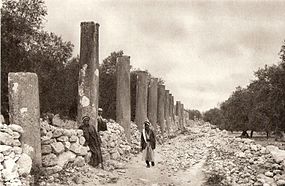
Ancient Samaria
Essentially, the Israelitish kingdom that ended up with Samaria as its capital formed after the death of Solomon, during the reign of his son Rehoboam:
16 Now when all Israel saw that the king did not listen to them, the people answered the king, saying:
"What share have we in David? We have no inheritance in the son of Jesse. To your tents, O Israel! Now, see to your own house, O David!"
So Israel departed to their tents. 17 But Rehoboam reigned over the children of Israel who dwelt in the cities of Judah.
18 Then King Rehoboam sent Adoram, who was in charge of the revenue; but all Israel stoned him with stones, and he died. Therefore King Rehoboam mounted his chariot in haste to flee to Jerusalem. 19 So Israel has been in rebellion against the house of David to this day.
20 Now it came to pass when all Israel heard that Jeroboam had come back, they sent for him and called him to the congregation, and made him king over all Israel. There was none who followed the house of David, but the tribe of Judah only.
21 And when Rehoboam came to Jerusalem, he assembled all the house of Judah with the tribe of Benjamin, one hundred and eighty thousand chosen men who were warriors, to fight against the house of Israel, that he might restore the kingdom to Rehoboam the son of Solomon. 22 But the word of God came to Shemaiah the man of God, saying,
23 "Speak to Rehoboam the son of Solomon, king of Judah, to all the house of Judah and Benjamin, and to the rest of the people, saying, 24 'Thus says the Lord: "You shall not go up nor fight against your brethren the children of Israel. Let every man return to his house, for this thing is from Me."'" (1 Kings 12:16-24, NKJV throughout unless otherwise noted)
So, we see that there was a separation between the tribe of Judah (which also had Benjamin with it--its first king, Saul, was a Benjaminite--1 Samuel 9:19-27). This is separation of Judah from what later were called the 'ten lost tribes' (see Anglo - America in Prophecy & the Lost Tribes of Israel and/or watch Where are the Ten Lost Tribes? Why does it matter?).
The first mention of the actual word Samaria in the Bible is 1 Kings 13:32, which discusses a pronouncement from "a man of God" (vs. 31), "For the saying which he cried out by the word of the LORD against the altar in Bethel, and against all the shrines on the high places which are in the cities of Samaria, will surely come to pass"; this was a complaint suggesting false worship.
After the nation of the ten tribes of Israel lost a major war, because of their sins God allowed the Israelites in Samaria to be deported:
5 Now the king of Assyria went throughout all the land, and went up to Samaria and besieged it for three years. 6 In the ninth year of Hoshea, the king of Assyria took Samaria and carried Israel away to Assyria, and placed them in Halah and by the Habor, the River of Gozan, and in the cities of the Medes.
7 For so it was that the children of Israel had sinned against the Lord their God, who had brought them up out of the land of Egypt, from under the hand of Pharaoh king of Egypt; and they had feared other gods, 8 and had walked in the statutes of the nations whom the Lord had cast out from before the children of Israel, and of the kings of Israel, which they had made. 9 Also the children of Israel secretly did against the Lord their God things that were not right, and they built for themselves high places in all their cities, from watchtower to fortified city. 10 They set up for themselves sacred pillars and wooden images on every high hill and under every green tree. 11 There they burned incense on all the high places, like the nations whom the Lord had carried away before them; and they did wicked things to provoke the Lord to anger, 12 for they served idols, of which the Lord had said to them, "You shall not do this thing."
13 Yet the Lord testified against Israel and against Judah, by all of His prophets, every seer, saying, "Turn from your evil ways, and keep My commandments and My statutes, according to all the law which I commanded your fathers, and which I sent to you by My servants the prophets." 14 Nevertheless they would not hear, but stiffened their necks, like the necks of their fathers, who did not believe in the Lord their God. 15 And they rejected His statutes and His covenant that He had made with their fathers, and His testimonies which He had testified against them; they followed idols, became idolaters, and went after the nations who were all around them, concerning whom the Lord had charged them that they should not do like them. 16 So they left all the commandments of the Lord their God, made for themselves a molded image and two calves, made a wooden image and worshiped all the host of heaven, and served Baal. 17 And they caused their sons and daughters to pass through the fire, practiced witchcraft and soothsaying, and sold themselves to do evil in the sight of the Lord, to provoke Him to anger. 18 Therefore the Lord was very angry with Israel, and removed them from His sight; there was none left but the tribe of Judah alone. (2 Kings 17:5-18)
Some of deportations are believed to have begun in 745 B.C.:
The progressive captivity of Israel began with King Tiglath Pileser III (an assumed name) of Assyria, who ruled from c 745–727 BC. ...
Josephus op. cit. 9:14:1 “Shalmaneser, king of Assyria besieged Samaria three years, quite demolished the government of the Israelites, and translated all the people into Media and Persia.” Shalmaneser V began the attack, but died toward the end of the siege. Most of the remaining tribes of Samaria were removed by Shalmaneser before he died. His successor Sargon completed this in 721 BC. (Israelite Deportations by Assyria. Bible Topic Exposition, December 20, 2015. https://bibletopicexpo.wordpress.com/2015/12/20/israelite-deportations-by-assyria/ accessed 08/01/17)
I would also add that 2520 years after the deportation of Samaritans began, the thirteen colonies declared their independence in 1776--more on 2520 years is also discussed in the article The Times of the Gentiles.
The fall of the capital Samaria was completed in c. 721 B.C. (Samaria. Jewish Encyclopedia of 1906)--though some sources point to 722 B.C. Samaria was taken over by the Assyrians and many became slaves--this will also happen to the end time Samaria--the USA (Isaiah 10:5-12; see also Will the Anglo-Saxon Nations be Divided and Have People Taken as Slaves?).
Later, Samaria became inhabited by primarily by non-Israelites:
"Then the king of Assyria brought people from Babylon, Cuthah, Ava, Hamath, and from Sepharvim, and placed them in the cities of Samaria instead of the children of Israel" (2 Kings 17:24).
These idolators were first called Samaritans in 2 Kings 17:29:
"However every nation continued to make gods of its own, and put them in the shrines on the high places which the Samaritans had made, every nation in the cities where they dwelt."
There was something unusual about this group of people,
"They feared the LORD, yet served their own gods--according to the rituals of the nations from among whom they were carried away. To this day they continue practicing the former rituals; they do not fear the LORD, nor do they follow their statutes or their ordinances, or the law and commandment which the LORD had commanded children of Jacob, whom He named Israel, with whom the LORD had made a covenant and charged them, saying, 'You shall not fear other gods, nor bow down to them; but the LORD, who brought you up from the land of Egypt with great power and an outstretched arm, Him you shall fear, Him you shall worship, and to Him you shall offer sacrifice. And the statutes, the ordinances, the law, and the commandment which He wrote for you, you shall be careful to observe forever; you shall not fear other gods. And the covenant that I have made with you, you shall not forget, nor shall you fear other gods. But the LORD your God you shall fear; and He will deliver you from the hand of all your enemies.' However they did not obey, but they followed their former rituals. So these nations feared the LORD, yet served their carved images; also their children and their children's children have continued doing as their fathers did, even to this day." (2 Kings 17:33-41).
Thus, the Samaritans in the Old Testament are clearly described as a group of people who did not truly worship the true God, who did not keep his commandments, and who included pagan rituals in their worship.
God was not pleased with the Samaritans. The prophet Hosea wrote:
Then the iniquity of Ephraim was uncovered, and the wickedness of Samaria. For they have committed fraud. (Hosea 7:1)
Your calf is rejected, O Samaria! My anger is aroused against them--How long until they attain to innocence? For from Israel is even this: A workman made it, and it is not God; But the calf of Samaria shall be broken to pieces. (Hosea 8:5-6)
Samaria is held guilty, for she has rebelled against her God. They shall fall by the sword, Their infants shall be dashed in pieces, and their women with child ripped open. (Hosea 13:16)
It should be noted that when the children of Israel worshiped the golden calf in Exodus, they claimed they were actually worshiping the true God (Exodus 32:8)--God was not pleased with that either (Exodus 32:9).
Various ones point to 2 Chronicles 34:9 as proof that there were descendants of Ephraim and Manasseh that remained in and/or returned to Samaria, and thus there could have been interbreeding of those from the Assyrians and the sons of Joseph:
9 they delivered the money that was brought into the house of God, which the Levites who kept the doors had gathered from the hand of Manasseh and Ephraim, from all the remnant of Israel, from all Judah and Benjamin, and which they had brought back to Jerusalem. (2 Chronicles 34:9)
Joseph's two sons were Ephraim and Manasseh.
Notice something from the Book of Genesis:
1
Now it came to pass after these things that Joseph was told, "Indeed your father is sick"; and he took with him his two sons, Manasseh and Ephraim. 2 And Jacob was told, "Look, your son Joseph is coming to you"; and Israel strengthened himself and sat up on the bed. 3 Then Jacob said to Joseph: "God Almighty appeared to me at Luz in the land of Canaan and blessed me, 4 and said to me, 'Behold, I will make you fruitful and multiply you, and I will make of you a multitude of people, and give this land to your descendants after you as an everlasting possession.' 5 And now your two sons, Ephraim and Manasseh, who were born to you in the land of Egypt before I came to you in Egypt, are mine; as Reuben and Simeon, they shall be mine. 6 Your offspring whom you beget after them shall be yours; they will be called by the name of their brothers in their inheritance. 7 But as for me, when I came from Padan, Rachel died beside me in the land of Canaan on the way, when there was but a little distance to go to Ephrath; and I buried her there on the way to Ephrath (that is, Bethlehem)."
8 Then Israel saw Joseph's sons, and said, "Who are these?"
9 Joseph said to his father, "They are my sons, whom God has given me in this place."
And he said, "Please bring them to me, and I will bless them." 10 Now the eyes of Israel were dim with age, so that he could not see. Then Joseph brought them near him, and he kissed them and embraced them. 11 And Israel said to Joseph, "I had not thought to see your face; but in fact, God has also shown me your offspring!"
12 So Joseph brought them from beside his knees, and he bowed down with his face to the earth. 13 And Joseph took them both, Ephraim with his right hand toward Israel's left hand, and Manasseh with his left hand toward Israel's right hand, and brought them near him. 14 Then Israel stretched out his right hand and laid it on Ephraim's head, who was the younger, and his left hand on Manasseh's head, guiding his hands knowingly, for Manasseh was the firstborn. 15 And he blessed Joseph, and said:
"God, before whom my fathers Abraham and Isaac walked,
The God who has fed me all my life long to this day,
16 The Angel who has redeemed me from all evil,
Bless the lads;
Let my name be named upon them,
And the name of my fathers Abraham and Isaac;
And let them grow into a multitude in the midst of the earth."
17 Now when Joseph saw that his father laid his right hand on the head of Ephraim, it displeased him; so he took hold of his father's hand to remove it from Ephraim's head to Manasseh's head. 18 And Joseph said to his father, "Not so, my father, for this one is the firstborn; put your right hand on his head."
19 But his father refused and said, "I know, my son, I know. He also shall become a people, and he also shall be great; but truly his younger brother shall be greater than he, and his descendants shall become a multitude of nations." (Genesis 48:1-19)
So, Joseph's sons were Ephraim and Manasseh and are told that they are also to take Jacob's name and be called Israel. And Manasseh was to become a great nation.
Some Church of God leaders have suggested that was Israel the only other name Manasseh seems to be referred to prophetically in the Bible.
But it that so?
No.
One other name is Joseph, and another is a reference to Jacob:
11 from the tribe of Joseph, that is, from the tribe of Manasseh, (Numbers 13:11)
7 Alas! For that day is great, So that none is like it; And it is the time of Jacob's trouble, But he shall be saved out of it. (Jeremiah 30:7)
The time of Jacob's trouble (Jeremiah 30:7), also known as the "great tribulation" (Matthew 24:21; see also When Will the Great Tribulation Begin?), will come and affect the descendants of Joseph--Ephraim and Manasseh--the British and USA peoples, respectively.
And while certain Church of God leaders also taught all of that, they tended to not make the direction connection of Manasseh to Samaria. Notice:
The terms "house of Israel" or "all Israel," when the meaning is national, or the terms "Jacob," or "Rachel," or "Ephraim," or "house of Joseph," or "Samaria," often used in the Bible in prophecy, RELATE TO THE TEN-TRIBED BIRTHRIGHT PEOPLE, NOT TO THE JEWS. This is a KEY, and a master key, to Bible understanding! (Armstrong HW. The United States And Britain In Prophecy, Chapter 6).
There could be implied a connection above, but it was not clear (I have not found a writing from Herbert Armstrong were he specifically states Manasseh is Samaria).
When a Samaritan woman encountered Jesus, she claimed that Jacob was the father of the Samaritans:
9 Then the woman of Samaria said to Him, "How is it that You, being a Jew, ask a drink from me, a Samaritan woman?" For Jews have no dealings with Samaritans.
10 Jesus answered and said to her, "If you knew the gift of God, and who it is who says to you, 'Give Me a drink,' you would have asked Him, and He would have given you living water."
11 The woman said to Him, "Sir, You have nothing to draw with, and the well is deep. Where then do You get that living water? 12 Are You greater than our father Jacob, who gave us the well, and drank from it himself, as well as his sons and his livestock?" (John 4:9-12)
So, we see that the Samaritans considered that they were of Jacob even in Jesus' time.
Manasseh is Prophetic Samaria
Various scriptures point to Manasseh also being referred to as Samaria.
Notice, for example, the following:
19 They shall possess the fields of Ephraim And the fields of Samaria. (Obadiah 19)
So, the contrast is between the son of Joseph called Ephraim, and the other Manasseh, yet referred to as Samaria.
The following from Jeremiah sends a similar message:
5 You shall yet plant vines on the mountains of Samaria; The planters shall plant and eat them as ordinary food. 6 For there shall be a day When the watchmen will cry on Mount Ephraim, (Jeremiah 31:5-6)
It is interesting to note that, while an ethnic mixture, the Samaritans themselves claimed, not only from Jacob as Jesus was told (John 4:9-12), but specifically from the tribe of Joseph.
A Midrash (midrash is the genre of rabbinic literature which contains early interpretations and commentaries on the Written Torah and Oral Torah, etc.) from A.D. 300-500 (Genesis Rabbah Sect. 94) relates about an encounter between a Jewish rabbi and a Samaritan. The story that developed includes the following dialogue:
R. Meir asks the Samaritan: What tribe are you from?
The Samaritan answers: From Joseph.
R. Meir : No!
(RABIN MISHNAH STUDY GROUP Mishnah study in the religious climate of Masorti (Conservative) Judaism by Rabbi Simchah Roth. BET MIDRASH VIRTUALI of the Rabbinical Assembly in Israel. February 27th 2003 / I Adar 25th 5763 [Sotah 083] http://www.bmv.org.il/shiurim/sotah/sot083.html accessed 01/20/17)
Rabbi Meir apparently considered the Samaritans to be Gentiles or a melting pot mixture.
Notice also the following from the Encyclopaedia Judaica:
Until the middle of the 20th century it was customary to believe that the Samaritans originated from a mixture of the people living in Samaria and other peoples at the time of the conquest of Samaria by Assyria (722–721 BCE). The Biblical account in II Kings 17 had long been the decisive source for the formulation of historical accounts of Samaritan origins. Reconsideration of this passage, however, has led to more attention being paid to the Chronicles of the Samaritans themselves. With the publication of Chronicle II (Sefer ha-Yamim), the fullest Samaritan version of their own history became available: the chronicles, and a variety of non-Samaritan materials. According to the former, the Samaritans are the direct descendants of the Joseph tribes, Ephraim and Manasseh, and until the 17th century CE they possessed a high priesthood descending directly from Aaron through Eleazar and Phinehas. They claim to have continuously occupied their ancient territory and to have been at peace with other Israelite tribes until the time when Eli disrupted the Northern cult by moving from Shechem to Shiloh and attracting some northern Israelites to his new followers there. For the Samaritans, this was the 'schism' par excellence.( "Samaritans" in Encyclopaedia Judaica, 1972, Volume 14, col. 727, as cited in Louvish M. Religious life and communities. Keter Books, 1974, p. 61).
Interestingly years ago (at least 5-6 years before I saw either of these above Jewish sources nor did I get this from any group's writings, but the Bible only), I had come up with the view that certain prophecies related to Samaria were, in fact, pointing to the USA (and so discussed this with the late LCG minister Gary Ehrman, when I was still with that group--he said I was right on this). The belief that Joseph, and specifically Manasseh were Samaritans, is consistent with my view.
And in late 2019, I saw the following from a Jewish source:
[Obadiah 1:19] AND THEY OF THE SOUTH SHALL POSSESS THE MOUNT OF ESAU; AND THEY OF THE PLAIN THE PHILISTINES: AND THEY SHALL POSSESS THE FIELDS OF EPHRAIM, AND THE FIELDS OF SAMARIA: AND BENJAMIN SHALL POSSESS GILEAD.
Samaria means Menasseh (says Daat Sofrim) who according to Rashi (Davidy Y. Commentary on the book of Obadiah. http://britam.org/obadiah.html accessed 11/05/19)
Though not quite directly stating that connection, the old Radio/Worldwide Church of God tied the fall of Samaria to the rise of the UK and USA:
Then seven times or 2520 prophetic days would equal 2520 literal years! This period of seven times or 2520 years punishment did come upon Israel because they went their own ways and would no: submit to the rule of God. Israel went into captivity about 721 B.C. and did not become a great people again until their times of punishment ceased about 1800 A.D. (Hoeh H. What are the Times of the Gentiles? Plain Truth, September 1955)
To reject God as Ruler was the greatest sin. Up until this time they had recognized Him—had looked to no other as King. This seems to have begun the years of complete sin, for which God punished them.
Nevertheless, under the “Old Covenant” of Mt. Sinai, they were still God’s nation. God still dealt with them. He did not “divorce” them until 721-718 B.C., as we shall see. ...
The Seven Prophetic Times
Now continue in Leviticus 26: “And if ye will not yet for all this hearken unto me, then I will punish you seven times more for your sins” (verse 18).
It is important to understand this!
This expression “seven times” is translated into the English from a Hebrew word which conveys a dual meaning. The original Hebrew word Moses wrote is shibah. It is defined as “seven times,” and also as “sevenfold.” The “seven times” implies duration or continuation of punishment. But the word also conveys the meaning of “sevenfold,” or seven times greater intensity of punishment—as a punishment that is sevenfold more intense. In this sense, the meaning would be the same as in Daniel 3:19, where King Nebuchadnezzar, in a rage, commanded that the furnace into which Daniel’s three friends were to be thrown should be made seven times hotter.
Now understand the “seven times”--or seven prophetic “times.” For this is a prophecy. In prophecy, a “time” is a prophetic 360-day year. And, during Israel’s punishment, each day represented a year being fulfilled. ...
But when that 2520-year withholding of the birthright had expired, God was faithful to His unconditional promise to Abraham! Not because of any British or American goodness, superiority, or worthiness, but because of God’s faithfulness to His promise, beginning in 1800 these two birthright peoples suddenly burst forth as the greatest world powers in all history! (Armstrong HW. The United States and Britain in Prophecy. WCG, 1980 edition)
721 B.C. is when the ten-tribed nation of Israel, sometimes referred to by the name of the tribe Ephraim (Ezekiel 37:16), was sieged by the ancient Assyrians.
It was essentially 2520 years later that the Anglo-American powers rose up. That particular 2520 year time of the Gentiles is over. The Anglo-American world order has essentially dominated much of the world since 1800. 2520 years after Samaria's capital was besieged by the Assyrians, the US Congress held its first session in Washington, D.C. on November 17, 1800 as its national capital.
So, the old Radio/Worldwide Church of God tied the 2520 years of the taking over of Samaria to the UK and the USA.
Now it has also been stated:
The result is that the true biblical date for the overthrow of Samaria is 718 B.C., and not 721 B.C. (Beecher WJ. The Date of the Downfall of Samaria. Journal of Biblical Literature Vol. 11, No. 2 (1892), pp. 211-213).
It has further been claimed that "West Manasseh got taken during the fall of Samaria in 718 B.C." (Salemi P. Manasseh is the United States of America. http://www.british-israel.ca/Manasseh.htm accessed 08/23/17), which would tend to point to 1803 for the USA. Or as another place worded it, "Samaria was conquered in 718 B.C. "Seven times" later Jefferson bought the "LOUISIANA PURCHASE" in 1803 A.D." (The United States and the British Empire FORETOLD in the Bible! HOIM, http://www.hope-of-israel.org/USforetold.html accessed 08/23/17).
More on 2520 years can be found in the article The Times of the Gentiles.
Furthermore, notice something that the old WCG also taught:
The peoples of the United States and Britain are actually descended from the tribes of Ephraim and Manasseh, which were part of the kingdom of Israel. The United States and Britain are often referred to in biblical prophecy as the "house of Israel," "all Israel," "Jacob," "Ephraim," "Samaria" and "Isaac."(Armstrong HW, editor in chief. THE MINOR PROPHETS SPEAK TO US! Youth Bible Lessons, Level 7, Lesson 9, 1986, p. 2)
Yes, prophetic Samaria is pointing to the USA.
If the following biblical prophecy has an end-time fulfillment, it seems to suggest that a male leader will be in charge when the U.S.A. falls as the U.S.A. is prophetic Samaria:
7 As for Samaria, her king is cut off Like a twig on the water. 8 Also the high places of Aven, the sin of Israel, Shall be destroyed. The thorn and thistle shall grow on their altars; They shall say to the mountains, “Cover us!” And to the hills, “Fall on us!” … 10 When it is My desire, I will chasten them. Peoples shall be gathered against them When I bind them for their two transgressions. (Hosea 10:7,8,10)
If Hosea 10:7-10 has end-time connotations (and part of it seems to, cf. Revelation 6:16), AND presuming that the Hebrew word translated as “king” literally means a male, then it suggests that a male would be the last President/leader of the United States.
New Testament Samaritans
Smith's Bible Dictionary says,
Certain other Jewish renegades had from time to time taken refuge with the Samaritans; hence by degrees the Samaritans claimed to partake of Jewish blood, especially if doing so was in their interest.
Not only did the Jews not consider Samaritans to be true Jews, the New Testament reports, "Jews have no dealings with Samaritans" (John 4:9). Notice that:
Jesus sent out and commanded them, saying: 'Do not go into the way of the Gentiles, and do not enter a city of the Samaritans. But go rather to the lost sheep of the house of Israel' (Matthew 10:5).
Thus, apparently Jesus considered the Samaritans to be like the Gentiles (after the resurrection Gentiles, as well some people living in Samaria, were called to be Christians, Acts 8:4-7; 9:31), though not exactly the same.
Jesus was quite clear of what He thought of the Samaritans and their false worship. While in Samaria (John 4:4-43), when speaking to one (John 4:7) who suggested that Samaritans knew about worship (vs. 20) , Jesus declared:
"You worship what you do not know; we know what we worship, for salvation is of the Jews. But the hour is coming, and now is, when the true worshipers will worship the Father in spirit and truth; for the Father is seeking such to worship Him. God is Spirit, and those who worship Him must worship in spirit and truth" (John 4:22-24).
The Samaritans were condemned for not knowing what they worship. True worship does not involve physical pagan rituals, but involves worshiping in truth! Jesus did not consider the Samaritans form of worship to be acceptable.
Jesus quoted from Isaiah to the Pharisees something that seems to fit what the Samaritans:
8 "These people draw near to Me with their mouth,
And honor Me with their lips,
But their heart is far from Me.
9 And in vain they worship Me,
Teaching as doctrines the commandments of men.'" (Matthew 15:8-9)
It is possible to be a Samaritan and do something good
29 But he, wanting to justify himself, said to Jesus, "And who is my neighbor?"
30 Then Jesus answered and said: "A certain man went down from Jerusalem to Jericho, and fell among thieves, who stripped him of his clothing, wounded him, and departed, leaving him half dead. 31 Now by chance a certain priest came down that road. And when he saw him, he passed by on the other side. 32 Likewise a Levite, when he arrived at the place, came and looked, and passed by on the other side. 33 But a certain Samaritan, as he journeyed, came where he was. And when he saw him, he had compassion. 34 So he went to him and bandaged his wounds, pouring on oil and wine; and he set him on his own animal, brought him to an inn, and took care of him. 35 On the next day, when he departed, he took out two denarii, gave them to the innkeeper, and said to him, 'Take care of him; and whatever more you spend, when I come again, I will repay you.' 36 So which of these three do you think was neighbor to him who fell among the thieves?"
37 And he said, "He who showed mercy on him."
Then Jesus said to him, "Go and do likewise." (Luke 10:29-37)
11 Now it happened as He went to Jerusalem that He passed through the midst of Samaria and Galilee. 12 Then as He entered a certain village, there met Him ten men who were lepers, who stood afar off. 13 And they lifted up their voices and said, "Jesus, Master, have mercy on us!"
14 So when He saw them, He said to them, "Go, show yourselves to the priests." And so it was that as they went, they were cleansed.
15 And one of them, when he saw that he was healed, returned, and with a loud voice glorified God, 16 and fell down on his face at His feet, giving Him thanks. And he was a Samaritan.
17 So Jesus answered and said, "Were there not ten cleansed? But where are the nine? 18 Were there not any found who returned to give glory to God except this foreigner?" 19 And He said to him, "Arise, go your way. Your faith has made you well." (Luke 17:11-19)
But that does not mean that the Samaritan religion is acceptable to God? As shown in all the other scriptures, the answer is clearly no!
The New Testament also shows that some Christians were scattered in Samaria and some became Christians there:
1 ... At that time a great persecution arose against the church which was at Jerusalem; and they were all scattered throughout the regions of Judea and Samaria, except the apostles. 2 And devout men carried Stephen to his burial, and made great lamentation over him.
3 As for Saul, he made havoc of the church, entering every house, and dragging off men and women, committing them to prison.
4 Therefore those who were scattered went everywhere preaching the word. 5 Then Philip went down to the city of Samaria and preached Christ to them. 6 And the multitudes with one accord heeded the things spoken by Philip, hearing and seeing the miracles which he did. 7 For unclean spirits, crying with a loud voice, came out of many who were possessed; and many who were paralyzed and lame were healed. 8 And there was great joy in that city.
9 But there was a certain man called Simon, who previously practiced sorcery in the city and astonished the people of Samaria, claiming that he was someone great, 10 to whom they all gave heed, from the least to the greatest, saying, "This man is the great power of God." 11 And they heeded him because he had astonished them with his sorceries for a long time. 12 But when they believed Philip as he preached the things concerning the kingdom of God and the name of Jesus Christ, both men and women were baptized. 13 Then Simon himself also believed; and when he was baptized he continued with Philip, and was amazed, seeing the miracles and signs which were done.
14 Now when the apostles who were at Jerusalem heard that Samaria had received the word of God, they sent Peter and John to them, 15 who, when they had come down, prayed for them that they might receive the Holy Spirit. 16 For as yet He had fallen upon none of them. They had only been baptized in the name of the Lord Jesus. 17 Then they laid hands on them, and they received the Holy Spirit.
18 And when Simon saw that through the laying on of the apostles' hands the Holy Spirit was given, he offered them money, 19 saying, "Give me this power also, that anyone on whom I lay hands may receive the Holy Spirit."
20 But Peter said to him, "Your money perish with you, because you thought that the gift of God could be purchased with money! 21 You have neither part nor portion in this matter, for your heart is not right in the sight of God. 22 Repent therefore of this your wickedness, and pray God if perhaps the thought of your heart may be forgiven you. 23 For I see that you are poisoned by bitterness and bound by iniquity."
24 Then Simon answered and said, "Pray to the Lord for me, that none of the things which you have spoken may come upon me."
25 So when they had testified and preached the word of the Lord, they returned to Jerusalem, preaching the gospel in many villages of the Samaritans. (Acts 8:1-25)
31 Then the churches throughout all Judea, Galilee, and Samaria had peace and were edified. And walking in the fear of the Lord and in the comfort of the Holy Spirit, they were multiplied. (Acts 9:31)
2 Therefore, when Paul and Barnabas had no small dissension and dispute with them, they determined that Paul and Barnabas and certain others of them should go up to Jerusalem, to the apostles and elders, about this question.
3 So, being sent on their way by the church, they passed through Phoenicia and Samaria, describing the conversion of the Gentiles; and they caused great joy to all the brethren. (Acts 15:2-4)
So, there were Christians in Samaria. But consider that Samaria was also the place that Simon Magus came from.
Various doctrines, that compromised professors of Christ, adopted, were introduced to them by Simon Magus and/or his supporters. Even those now considered to be early supporters of the Roman Catholic Church condemned Simon and his followers for doctrines such as statues, revering a woman, the doctrine of the immortal soul, incantations, mysteries, mystic priests, claiming divine titles for leaders, accepting money for religious favors, preferring allegory and tradition over many aspects of scripture, having a leader who wanted to be thought of as God/Christ on earth, and divorcing themselves from Christian biblical practices considered to be Jewish. And, even according to Roman Catholic recognized sources, Simon Magus directly influenced many in Rome (for details, see also Simon Magus, What Did He Teach?).
Modern Samaritans
Are there any religious people like the Samaritans today? Are there those who use non-biblical rituals and ceremonies as part of their worship? Did Jesus predict that there would be false Christians?
Jesus said,
21 "Not everyone who says to Me, 'Lord, Lord,' shall enter the kingdom of heaven, but he who does the will of My Father in heaven. 22 Many will say to Me in that day, 'Lord, Lord, have we not prophesied in Your name, cast out demons in Your name, and done many wonders in Your name?' 23 And then I will declare to them, 'I never knew you; depart from Me, you who practice lawlessness!' (Matthew 7:21-23)
Therefore, even if some have signs or apparently do good works, if they practice lawlessness Jesus says He never knew them. Jesus also said,
9 "Indeed I will make those of the synagogue of Satan, who say they are Jews and are not, but lie--indeed I will make them come and worship before your feet, and to know that I have loved you" (Revelation 3:9).
Thus the false Christians are essentially referred to as false Jews! This happens a lot in the USA, and we are seeing a tendency to see even more 'lawlessness.' Lawless is a mark of Antichrist.
There are many today who claim to worship Christ. They claim it is acceptable to God to use non-biblical practices to worship Him. They claim that any holidays they come up with are at least valid to God as God's Holy Days as listed in Leviticus 23 (for a related article, please read Is There an Annual Worship Calendar in the Bible?).
They claim they do not have to keep the commandments of God in order to be Christians (see also The Ten Commandments: The Decalogue, Christianity, and the Beast).
Apparently they have not understood Revelation 12:17, "And the dragon was enraged with the woman, and he went to make war with the rest of her offspring, who keep the commandments of God and have the testimony of Jesus Christ", which shows those that have the testimony of Jesus Christ keep the commandments of God. Like the Samaritans of old, they do not know what they worship. Sadly, they do not wish to worship God in truth. Thus, many who practice false Christianity seem to be modern Samaritans.
Many religious leaders teach lawlessness (see Hope of Salvation: How the Continuing Church of God Differs from Protestantism and The Mark of Antichrist).
Sometime back, the Chicagoland Church of God magazine Shepherd’s Voice had the following article by former GCG board member Norman Edwards:
For the mature Christian, the last words of Jesus Christ to His apostles are utterly vital. They certainly have application throughout the entire church age. They were not just for the first century.
Therefore, when they [the apostles] had come together, they asked Him, saying, “Lord, will You at this time restore the kingdom to Israel?” And He said to them, “It is not for you to know times or seasons which the Father has put in His own authority. But you shall receive power when the Holy Spirit has come upon you; and you shall be witnesses to Me in Jerusalem, and in all Judea and Samaria, and to the end of the earth.” Now when He had spoken these things, while they watched, He was taken up, and a cloud received Him out of their sight (Acts 1:6-9). …
Where to Witness
Once we recognize that the job of a believer is to be filled with the Holy Spirit and be a witness, we need to consider that last part of Christ’s statement which tells us where:
“…in Jerusalem, and in all Judea and Samaria, and to the end of the earth (Acts 1:8).
These areas were well known to the twelve apostles. They were in Jerusalem at the time (Acts 1:4); they had traveled through much of Judea during their ministry with Christ; they had traveled through Samaria, even though the Jews wanted little to do with the Samaritans (John 4:9); and to them, the “end of the earth” included the entire Roman Empire and whatever was beyond.
As we read the rest of the New Testament, we see that the Gospel went to all of those places. What do these four areas mean for believers today? Those in Jerusalem would be analogous to the believers in our congregation—those who are nearby us. Those in Judea would be those with similar beliefs to us, even though they are further way and lastly, the “end of the earth” is still everyone we know about—all seven billion of them—many with no knowledge of Christ or the Bible. But what about the Samaritans? Is Christ still telling us to evangelize the group of about a hundred people today who trace their lineage back to the original Samaritans and still practice that religion? Or is it something more important. The rest of this article will answer that question.
Who Are the Samaritans?
The Bible gives a lot of detail on who the Samaritans are and how their religion evolved. i t is all worth reading to help us understand our situation today. Notice in 2 Kings 17:23:
23 Until the LORD removed Israel out of His sight, as He had said by all His servants the prophets. So Israel was carried away from their own land to Assyria, as it is to this day.
24 Then the king of Assyria brought people from Babylon, Cuthah, Ava, Hamath, and from Sepharvaim, and placed them in the cities of Samaria instead of the children of Israel; and they took possession of Samaria and dwelt in its cities. 25 And it was so, at the beginning of their dwelling there, that they did not fear the LORD; therefore the LORD sent lions among them, which killed some of them. 26 So they spoke to the king of Assyria, saying, “The nations whom you have removed and placed in the cities of Samaria do not know the rituals of the God of the land; therefore He has sent lions among them, and indeed, they are killing them because they do not know the rituals of the God of the land.” 27 Then the king of Assyria commanded, saying, “Send there one of the priests whom you brought from there; let him go and dwell there, and let him teach them the rituals of the God of the land.” 28 Then one of the priests whom they had carried away from Samaria came and dwelt in Bethel, and taught them how they should fear the LORD.
29 However every nation continued to make gods of its own, and put them in the shrines on the high places which the Samaritans had made, every nation in the cities where they dwelt.
30 The men of Babylon made Succoth Benoth, the men of Cuth made Nergal, the men of Hamath made Ashima, 31 and the Avites made Nibhaz and Tartak; and the Sepharvites burned their children in fire to Adrammelech and Anammelech, the gods of Sepharvaim. 32 So they feared the LORD, and from every class they appointed for themselves priests of the high places, who sacrificed for them in the shrines of the high places. 33 They feared the LORD, yet served their own gods—according to the rituals of the nations from among whom they were carried away. 34 To this day they continue practicing the former rituals; they do not fear the LORD, nor do they follow their statutes or their ordinances, or the law and commandment which the LORD had commanded the children of Jacob, whom He named Israel, 35 with whom the LORD had made a covenant and charged them, saying: “You shall not fear other gods, nor bow down to them nor serve them nor sacrifice to them; 36 “but the LORD, who brought you up from the land of Egypt with great power and an outstretched arm, Him you shall fear, Him you shall worship, and to Him you shall offer sacrifice. 38 “And the statutes, the ordinances, the law, and the commandment which He wrote for you, you shall be careful to observe forever; you shall not fear other gods. 38 “And the covenant that I have made with you, you shall not forget, nor shall you fear other gods. 39 “But the LORD your God you shall fear; and He will deliver you from the hand of all your enemies.”
40 However they did not obey, but they followed their former rituals. 41 So these nations feared the LORD, yet served their carved images; also their children and their children’s children have continued doing as their fathers did, even to this day.
Notice that God himself sent lions among the Samaritans because they did not fear Him at all. When they began to fear the true God to some degree, the lions stopped. Yes, God himself had a hand in creating this half-way religion. He commanded them to fully obey Him, but let them remain under His limited protection even when they did not fully obey. Today, we know that the ancient Samaritans had their own version of the Old Testament, altered in places, but largely the same. But even with this knowledge of the truth, they continued their worship of many false gods, and did not obey the truth of the writings that they did have.
So is there a large group of people like this today, to whom we must be a witness? Yes! Mainstream evangelical Christianity! They use the Bible—with a few alterations and ignoring many parts to fit their doctrines. They also mix in the practices of other religions. Many celebrate holidays that contain Santa Claus, Yule logs, easter bunnies, Halloween evil spirits, the Roman Cupid, Leprechauns, etc. Their church building construction frequently makes use of steeples, gargoyles and the trappings of other religions.
They have doctrines that are partly true and partly erroneous. Most picture God as a “trinity”, a “three in one” concept found in Hinduism, even though the word “Trinity” is not found in the Bible and the New Testament constantly refers to two divine beings (Acts 7:55-56; Rom 1:7; 15:6; 1 Corinthians 1:3, 9; 8:6; 2 Corinthians 1:2-3; Galatians 1:1- 3; Ephesians 1:2-3, 17; 5:20; 6:23; Philippians 1:2; Colossians 1:2-3; 2:2; 1 Thessalonians 1:1-3; 3:11, 13; 2 Thessalonians 1:1-2; 2:16; 1 Timothy 1:2; 2 Timothy 1:2; Titus 1:4; Philemon 1:3; 1 Peter 1:2-3; 2 Peter 1:2; 1 John 1:3, 2:22; 2 John 1:3, 9; Jude 1:1; Revelation 11:15). Most mainstream Christians teach an immortal, conscious soul that either goes to heaven or hell at death— rather than the Biblical “dead know nothing” (Ecclesiastes 9:5) and are awaiting a resurrection (Daniel 12:1- 3; John 5:28-29; 1 Corinthians 15;51- 52; 1 Thessalonians 4:16; Hebrews 11:13, 39-40). Some Christians falsely teach that their human leaders sat in between the believers and Christ, and had authority over their salvation (2 Corinthians 1:24; 1 Peter 5:3).
It is not within the scope of this article—or even within the scope of the lifetime of this author—to cover all the arguments and resolve all doctrinal differences. He has written much on these doctrines and will probably write more. But it is on this author’s heart to help everyone see how Christ deals with “Samaritans” today, and how Bible-adhering Christians should deal with the mainstream evangelical Christians of today.
How Did Christ Deal with Samaritans?
Some believers might expect that Christ would have nothing to do with people who have a wrong concept of God or who hold false doctrines. As a matter of fact, that was the approach the early Apostles took to the Samaritans. They wanted to kill them for their persecution of the truth:
And as they went, they entered a village of the Samaritans, to prepare for Him. But they did not receive Him, because His face was set for the journey to Jerusalem. And when His disciples James and John saw this, they said, “Lord, do You want us to command fire to come down from heaven and consume them, just as Elijah did?” But He turned and rebuked them, and said, “You do not know what manner of spirit you are of. For the Son of Man did not come to destroy men’s lives but to save them.” And they went to another village (Luke 9:52-56).
But Jesus told them they were of the wrong spirit. And so today, when Christians have different beliefs, they often become upset with each other and sometimes want to destroy each other. Sure, it is easy to be angry at a group that wants to destroy you. But Christ said we are of a wrong spirit if we think like this. We can read and see how Christ dealt with Samaritans. He talked to them. He shared things with them He had not yet shared with His apostles. Jesus shocked His disciples and the Samaritans as well! Read the whole account beginning in John 4:4:
But He [Christ] needed to go through Samaria. 5 So He came to a city of Samaria which is called Sychar, near the plot of ground that Jacob gave to his son Joseph. 6 Now Jacob’s well was there. Jesus therefore, being wearied from His journey, sat thus by the well. It was about the sixth hour.
7 A woman of Samaria came to draw water. Jesus said to her, “Give Me a drink.” 8 For His disciples had gone away into the city to buy food. 9 Then the woman of Samaria said to Him, “How is it that You, being a Jew, ask a drink from me, a Samaritan woman?” For Jews have no dealings with Samaritans. 10 Jesus answered and said to her, “If you knew the gift of God, and who it is who says to you, ‘Give Me a drink,’ you would have asked Him, and He would have given you living water.” 11 The woman said to Him, “Sir, You have nothing to draw with, and the well is deep. Where then do You get that living water? 12 “Are You greater than our father Jacob, who gave us the well, and drank from it himself, as well as his sons and his livestock?” 13 Jesus answered and said to her, “Whoever drinks of this water will thirst again, 14 “but whoever drinks of the water that I shall give him will never thirst. But the water that I shall give him will become in him a fountain of water springing up into everlasting life.”
15 The woman said to Him, “Sir, give me this water, that I may not thirst, nor come here to draw.” 16 Jesus said to her, “Go, call your husband, and come here.” 17 The woman answered and said, “I have no husband.” Jesus said to her, “You have well said, ‘I have no husband,’ 18 “for you have had five husbands, and the one whom you now have is not your husband; in that you spoke truly.” 19 The woman said to Him, “Sir, I perceive that You are a prophet. 20 “Our fathers worshiped on this mountain, and you Jews say that in Jerusalem is the place where one ought to worship.” 21 Jesus said to her, “Woman, believe Me, the hour is coming when you will neither on this mountain, nor in Jerusalem, worship the Father. 22 “You worship what you do not know; we know what we worship, for salvation is of the Jews. 23 “But the hour is coming, and now is, when the true worshipers will worship the Father in spirit and truth; for the Father is seeking such to worship Him. 24 “God is Spirit, and those who worship Him must worship in spirit and truth.” 25 The woman said to Him, “I know that Messiah is coming” (who is called Christ). “When He comes, He will tell us all things.” 26 Jesus said to her, “I who speak to you am He.”
27 And at this point His disciples came, and they marveled that He talked with a woman; yet no one said, “What do You seek?” or, “Why are You talking with her? 28 The woman then left her waterpot, went her way into the city, and said to the men, 29 “Come, see a Man who told me all things that I ever did. Could this be the Christ?” 30 Then they went out of the city and came to Him. 31 In the meantime His disciples urged Him, saying, “Rabbi, eat.” 32 But He said to them, “I have food to eat of which you do not know.” 33 Therefore the disciples said to one another, “Has anyone brought Him anything to eat?” 34 Jesus said to them, “My food is to do the will of Him who sent Me, and to finish His work. 35 “Do you not say, ‘There are still four months and then comes the harvest’? Behold, I say to you, lift up your eyes and look at the fields, for they are already white for harvest! 36 “And he who reaps receives wages, and gathers fruit for eternal life, that both he who sows and he who reaps may rejoice together. 37 “For in this the saying is true: ‘One sows and another reaps.’ 38 “I sent you to reap that for which you have not labored; others have labored, and you have entered into their labors.”
39 And many of the Samaritans of that city believed in Him because of the word of the woman who testified, “He told me all that I ever did.” 40 So when the Samaritans had come to Him, they urged Him to stay with them; and He stayed there two days. 41 And many more believed because of His own word. 42 Then they said to the woman, “Now we believe, not because of what you said, for we ourselves have heard Him and we know that this is indeed the Christ, the Savior of the world .”
43 Now after the two days He departed from there and went to Galilee. 44 For Jesus Himself testified that a prophet has no honor in his own country.
There are many principles that both Christ’s apostles then and we believers today need to learn:
1. Christ talked to the Samaritans apart from the disciples, while they were obtaining food— symbolic of spiritual knowledge— elsewhere. Even though the disciples had learned from the real Hebrew Old Testament and had learned much directly from Christ, they were not yet ready to realize that Christ could also work with people who knew substantially less than they.
2. The Samaritan woman asserts a doctrinal error, that Mount Gerizim is the place of worship rather than Jerusalem. Christ explains to the woman that Samaritans have doctrinal errors—that they don’t know what they worship, but then goes on to explain a greater truth that even his disciples did not understand: God wants believers who will worship in spirit and in truth anywhere .
3. The woman is convicted by Christ’s divine ability to show her sin. She quickly goes evangelizing others and brings them to Christ. They recognize Him as the “Savior of the world” in a spiritual way. They do not ask about setting up any kind of physical kingdom or whether Jews, Samaritans or somebody else will be in charge.
4. The Samaritans knew the Old Testament prophecies of a Messiah to come, and they accepted Jesus as that Messiah. This passage occurs shortly after the turning of water to wine at Cana (John 2:1- 11)—Christ’s first miracle! Many Samaritans accepted Jesus as Messiah long before His apostles realized He was the Messiah. See for yourself:
When Jesus came into the region of Caesarea Philippi, He asked His disciples, saying, “Who do men say that I, the Son of Man, am?” So they said, “Some say John the Baptist, some Elijah, and others Jeremiah or one of the prophets.” He said to them, “But who do you say that I am?” Simon Peter answered and said, “You are the Christ, the Son of the living God” (Matthew 16:13-16).
5. The Samaritans whom Christ taught did not begin to meet with the Jewish believers. If they did, they would have known Jesus was the Messiah. Christ did teach them for two days. Does the “thousand years as one day” (2 Peter 3:8) principle apply here? Will there be spiritual Samaritans—people who accept Jesus but misunderstand some of the Bible for two-thousand years?
6. Christ told His disciples not to say that it is four months until the harvest, but to realize that the fields were now ready for harvest. What did He mean? i t was not too long since Jesus was at the Passover (John 2:23), which was in the first month of the year (Leviticus 23:5). Approximately 50 days later was the Feast of Weeks where all males were commanded to appear (Exodus 23:17; Leviticus 23:15- 16; Deuteronomy 16:16)—in the third month of the year. It would have been sensible that Jesus and His disciples left Jerusalem immediately after Pentecost, when it would have been four months to the great fall harvest, the Feast of Ingathering or the Feast of Tabernacles (Exodus 23:16; 34:22; Leviticus 23:34). Jesus’ disciples were continually looking to the Feast of Ingathering which pictures the return of Christ as King of the Nations. (Jude 1:14-15; Isaiah 9:6-7; Psalm 2:8-9; 149:5-9, etc.) Jesus was telling them to look at the spiritual Pentecost harvest four months earlier, with its two leavened loaves (Leviticus 23:17) perhaps representing a mixture of true and false doctrine. The Samaritans were ready then.
The parallels between the Samaritans and the modern day evangelical Christians are striking. Both understand that they are sinners in need of a Savior. They accept Jesus as that Messiah—more quickly than those with good knowledge of the Old Testament. They keep to themselves—do not mingle with the first century Jews or today’s Sabbatarian Christians. . .
This writer realizes that many Sabbatarian believers may be uncomfortable with this article. (Edwards N. Learning from the Samaritans. Shepherd's Voice, Summer, 2014. pp. 4-8, 10-11
(Norman Edwards granted me permission to post from that article as I normally do not post so much from sources where others may hold a copyright.)
There seem to be spiritual connections between Protestants and Samaritans, but also with Catholics as well.
More on Protestants can be found in the free online book: Hope of Salvation: How the Continuing Church of God Differs from Protestantism .
Samaria in Prophecy
The Encyclopædia Britannica has the following:
The United States is the world’s greatest economic power, measured in terms of gross domestic product (GDP). … The United States is relatively young by world standards, being less than 250 years old; it achieved its current size only in the mid-20th century. … Probably no other country has a wider range of racial, ethnic, and cultural types than does the United States. … Annually, the U.S. spends more on its military than the next seven highest-ranking countries in military spending combined. (Harris, JT, et al. United States. Encyclopædia Britannica. Last updated December 22, 2019)
Because its receipt of blessings and it being a 'melting pot' that included peoples from the area in the Bible known as Samaria, it appears that the United States of America may fulfill some of the biblical prophecies that mention Samaria (see Anglo - America in Prophecy & the Lost Tribes of Israel).
The late Herbert W. Armstrong proclaimed:
Again now, continuing what's going to happen to the United States. ... We are going the way of ancient Israel. We are living in paganized religion calling it Christianity, my friends, in more ways than one.
The ten tribes and their capital was not Jerusalem at all. Their capital was Samaria, way north of Jerusalem, up in the land of Palestine in the northern kingdom. We are their descendents ...
A Warning to our People
Listen and; "... I will build thee, and thou shalt be built, O virgin Israel [that's really America today, and the British people and the Jewish people too, it includes them, but it doesn't just mean them alone]:...Thou shalt...plant vine[yards] upon the mountains of Samaria..." (Jeremiah 31:4-5) That was the capital of Israel, not of the Jewish people. The Jewish people had their capital in Jerusalem, this is speaking of Samaria, the capital of Israel.
Now then, in verse seven, remember it said here; "...Sing with gladness for Jacob...shout among the chief of the nations [or, at the head of the nations, as the margin says, shout at the head of the nations]: publish ye, praise ye, and say, O [Eternal], save thy people, the remnant of Israel." (Jeremiah 31:7) The last generation. That's speaking of our people now. Our generation, the last generation in this age. Before the resurrection, before the second coming of Christ. "Behold, I will bring them from the north country... gather them from the coasts of the earth, with them the blind and the lame and the woman with child, her that travaileth with child together [and]: a great company shall return thither. They shall come with weeping, and with supplications...." (Jeremiah 31:8,9) My friends, if you survive the terrible times of famine, a national dust bowl that's going to fill the whole nation. (Armstrong HW. Outline of Prophecy 10 - Coming US Captivity - Why? World Tomorrow radio broadcast)
Israel occupied the territory north of Judea. Samaria became its capital city, and the House of Israel often is called "Samaria" in prophecy. This, too, is a vital "key" to understanding of prophecy. "Samaria" never refers to the Jews in prophecy (Armstrong HW. The United States and the British Commonwealth in Prophecy. RCG booklet, 1954, p. 8)
Notice the following:
Samaria was one of the capitals of Northern Israel and possibly its most important city. (Davidiy Y. The Tribes, 4th edition. Russell-David Publishers, 2011, p. 242)
From the West of England and from Wales, Scotland, and Ireland the United States of America received approximately 87% (sic. 87%) of its British immigrants in its formative period#. In other words, early American society was formed largely by groups from the Tribe of Manasseh. Even today, more than half the white population of the U.S.A. may trace its ancestry back to Britain and Ireland with the British side being slightly larger than that of Northern and Southern Ireland origin. (Davidiy, p. 426. #Kephart, apparently a reference to-- Calvin Kephart, "Races of Mankind, Their Origin and Migration," N.Y. 1960, pp.437-438).
While the USA was overwhelmingly made up of descendants of Manasseh centuries ago, because of immigration and other matters, it is more mixed. Perhaps not mixed quite like ancient Samaria, but enough so that references related to Samaria sometimes have applicability to it now.
Ancient Samaria was not predominantly Israelite after the Babylonians moved people there, nor is the USA predominantly Manassite in the 2020s.
Yair Davidiy reported that some believe that the term America (which most say comes from the explorer Amerigo Vespucce, actual derived from the term Machir, which itself was a derivative of Manasseh (Davidiy, pp. 400-401). While the Western Hemisphere is referred to as North, Central, and South America, when the term 'Americans' is used, this is normally universally to refer to those of the USA.
It should probably be mentioned that portions of Bible prophecy seem to tie the descendants of Manasseh as being prophetic Samaria. Notice, for example, the following:
8 The Lord sent a word against Jacob,
And it has fallen on Israel.
9 All the people will know —
Ephraim and the inhabitant of Samaria —
Who say in pride and arrogance of heart:
10 'The bricks have fallen down,
But we will rebuild with hewn stones;
The sycamores are cut down,
But we will replace them with cedars."
11 Therefore the Lord shall set up
The adversaries of Rezin against him,
And spur his enemies on,
12 The Syrians before and the Philistines behind;
And they shall devour Israel with an open mouth.
For all this His anger is not turned away,
But His hand is stretched out still...
21 Manasseh shall devour Ephraim, and Ephraim Manasseh;
Together they shall be against Judah.
For all this His anger is not turned away,
But His hand is stretched out still. (Isaiah 9:8-12,21)
1"When I would have healed Israel,
Then the iniquity of Ephraim was uncovered,
And the wickedness of Samaria.
For they have committed fraud;
A thief comes in;
A band of robbers takes spoil outside.
2 They do not consider in their hearts
That I remember all their wickedness;
Now their own deeds have surrounded them;
They are before My face.
3 They make a king glad with their wickedness,
And princes with their lies. (Hosea 7:1-3)
So, we see that Ephraim and Samaria are separate and at the end Ephraim and Manasseh (who was referred to as Samaria in two of the above passages) are separate. Hence, while Ephraim is not Samaria, sometimes it the Bible indicates that Manasseh is (cf. Hosea 7:1-7; Isaiah 10:9-21; Obadiah 18-19). Isaiah 9 seems to suggest that some of peoples who are alluded to in Psalm 83 (discussed later) will also harass Ephraim and Manasseh after they have suffered. Isaiah 9 ties the identity of Manasseh in with prophetic Samaria; Obadiah 18-19 seems to as well.
In addition to intermingling in that occurred in ancient Samaria, Samaria was part of the old territory of Manasseh:
The hill of Samaria was in the tribal territory of Manasseh, but apparently was not significantly inhabited until the time of King Omri (Ahab's father). For the next 160 years, the city was the capital of the northern kingdom, apparently reaching a size of 150 acres (as large as Jerusalem in Hezekiah's time). Samaria is well situated with steep slopes on all sides. (Samaria (Sebaste). http://www.bibleplaces.com/samaria.htm viewed 02/19/14)
23 Omri became king over Israel, and reigned twelve years. Six years he reigned in Tirzah. 24 And he bought the hill of Samaria from Shemer for two talents of silver; then he built on the hill, and called the name of the city which he built, Samaria, after the name of Shemer, owner of the hill. (1 Kings 16:23-24)
Northern Samaria is often referred to by its biblical tribal designation: Manasseh. (Killebrew Ann, Ph.D. Biblical peoples and ethnicity: an archaeological study of Egyptians, Canaanites, Philistines, and early Israel, 1300–1100 B.C.E. Society of Biblical Lit, 2005, p. 159)
Notice that Isaiah 9:9-10 ties the arrogant Samaritans in with making declarations to rebuild. After the attacks of 9/11/2001, various US politicians made statements consistent with the "we will rebuild" declaration. For example, notice the following quote that then Senator Tom Daschle made to Congress on 9/12/2001 related to the 9/11/2001 attack:
We will rebuild, we will recover.
Others have made similar statements. But notice that God calls those leaders arrogant. While the USA has rebuilt in the area known as 'ground zero,' the USA is not finished being subject to attacks and ultimately, despite having the strongest military, it will be taken over (cf. Daniel 11:3).
The following also seems to be directed against the USA:
9 'Assemble on the mountains of Samaria; See great tumults in her midst, And the oppressed within her. 10 For they do not know to do right, 'Says the Lord, 'Who store up violence and robbery in their palaces.'" 11 Therefore thus says the Lord God: "An adversary shall be all around the land; He shall sap your strength from you, And your palaces shall be plundered."
12 Thus says the Lord: "As a shepherd takes from the mouth of a lion Two legs or a piece of an ear, So shall the children of Israel be taken out Who dwell in Samaria — In the corner of a bed and on the edge of a couch! 13 Hear and testify against the house of Jacob,"Says the Lord God, the God of hosts, 14 'That in the day I punish Israel for their transgressions, I will also visit destruction on the altars of Bethel; And the horns of the altar shall be cut off And fall to the ground. (Amos 3:9-14)
19 They pursued us on the mountains And lay in wait for us in the wilderness (Lamentations 4:19).
The above indicates that some will be hiding in the mountains and other places in the USA while others are will be taken out of the USA. Most of the Anglos that are not killed will be made slaves. Hiding in the mountains may protect a few for a time, but it will be relatively few that survive that way for long.
They will be pursued.
But didn't Jesus teach to flee to the mountains?
Well, yes for the mountains of Judea:
15 "Therefore when you see the 'abomination of desolation,' spoken of by Daniel the prophet, standing in the holy place" (whoever reads, let him understand), 16 "then let those who are in Judea flee to the mountains. (Matthew 24:15-16)
But He also did not say one should plan to stay in them. Consider that Jesus then added:
17 Let him who is on the housetop not go down to take anything out of his house. 18 And let him who is in the field not go back to get his clothes. 19 But woe to those who are pregnant and to those who are nursing babies in those days! (Matthew 24:17-19)
Now this does not mean that Jesus expected one to go to a stocked bunker. Only that those in Judea who have not fled before they see the abomination will not have time to do anything then but flee. In time, any who are Philadelphian Christians will go elsewhere (see also There is a Place of Safety for the Philadelphians. Why it May Be Near Petra).
Mormons tend to believe that they need to have a year's supply of food on-hand, yet that will not be enough.
While most in the UK, Canada, Australia, and New Zealand believe that they will be protected by the USA, notice the following:
1 Hear this word, you cows of Bashan, who are on the mountain of Samaria, Who oppress the poor, Who crush the needy, Who say to your husbands, "Bring wine, let us drink!" ... 11 "I overthrew some of you, As God overthrew Sodom and Gomorrah, And you were like a firebrand plucked from the burning; Yet you have not returned to Me," Says the Lord. 12 "Therefore thus will I do to you, O Israel; Because I will do this to you, Prepare to meet your God, O Israel!" (Amos 4:1 11-12)
1 Woe to you who are at ease in Zion, And trust in Mount Samaria, Notable persons in the chief nation, To whom the house of Israel comes! 2 Go over to Calneh and see; And from there go to Hamath the great; Then go down to Gath of the Philistines. Are you better than these kingdoms? Or is their territory greater than your territory? 3 Woe to you who put far off the day of doom,Who cause the seat of violence to come near; 4 Who lie on beds of ivory, Stretch out on your couches, Eat lambs from the flock And calves from the midst of the stall; 5 Who sing idly to the sound of stringed instruments, And invent for yourselves musical instruments like David; 6 Who drink wine from bowls,And anoint yourselves with the best ointments, But are not grieved for the affliction of Joseph. 7 Therefore they shall now go captive as the first of the captives, And those who recline at banquets shall be removed. 8 The Lord God has sworn by Himself, The Lord God of hosts says: "I abhor the pride of Jacob, And hate his palaces; Therefore I will deliver up the city And all that is in it." (Amos 6:1-8)
Those who think that they will be able rely on the USA, possibly referred to as Mt. Samaria above, will be severely disappointed at a time in the future. And this includes those in the USA.
As many realize, in order to protect the rights of the citizens of the USA nation to practice their religion and to speak even against the government, the Bill of Rights came into effect as Constitutional Amendments on December 15, 1791. Here is the first amendment:
- First amendment — Congress shall make no law respecting an establishment of religion, or prohibiting the free exercise thereof; or abridging the freedom of speech, or of the press; or the right of the people peaceably to assemble, and to petition the Government for a redress of grievances.
But now we see laws that do respect secular religion as well as those against freedom of speech and even religious speech (e.g. watch: Biden-Harris & Hate Speech).
With court decisions and the proposed Equality Act, the situation of religious freedom in the USA will get worse.
Consider the following:
11 “Behold, the days are coming,” says the Lord God,
“That I will send a famine on the land,
Not a famine of bread,
Nor a thirst for water,
But of hearing the words of the Lord.
12 They shall wander from sea to sea,
And from north to east;
They shall run to and fro, seeking the word of the Lord,
But shall not find it.
13 “In that day the fair virgins
And strong young men
Shall faint from thirst.
14 Those who swear by the sin of Samaria,
Who say,
‘As your god lives, O Dan!’
And, ‘As the way of Beersheba lives!’
They shall fall and never rise again.” (Amos 8:11-14)
I believe that the government of the USA will be at least complicit with causing aspects of the truth of the Bible and its prophecies to be removed from at least parts of the internet.
While I often quote just the 11th and 12th verses of Amos 8, consider the two verses that follow.
Verse 14 mentions Samaria.
The reference to those who say the god of Dan lives is a reference to false religion (cf. Judges 18)–and the old WCG speculated that the idolatry of Dan was why it was NOT listed among the 144,000 in Revelation 7:4-8.
And yes, the USA as we know it will fall and never rise again.
But before its destruction, Philadelphian Christians who have gathered together (Zephaniah 2:1-3) will flee.
Perhaps it should be mentioned that the old Worldwide Church of God taught that God's warnings through Amos were pertinent now:
Amos described the national condition in chapter 6: "Woe to those who are at ease in Zion, and to those who feel secure on the mountain of Samaria, the notable men of the first of the nations, to whom the house of Israel come!" ... A Message for Today ... Today's religious ceremonies — often masquerading as "Christian" but unaccompanied by true righteousness and justice — are often every bit as hollow and meaningless as those of ancient Israel. ... The United States claims to be "One Nation Under God." Its coinage reads "In God We Trust." In spite of these noble and high-sounding words, how much of God do we see in Britain and the United States? ... If these frightening parallels between ancient Israel and our peoples today hold true, then it might be best to close this article with yet another message from Amos: "Prepare to meet your God, O Israel! (Knowles B. A Message From Amos. Good News, October 1975)
God seems to give a few reasons why those who are now the descendants (the Anglo-Saxons) of Israel will be punished:
6 Thus says the Lord: "For three transgressions of Israel, and for four, I will not turn away its punishment, Because they sell the righteous for silver, And the poor for a pair of sandals. 7 They pant after the dust of the earth which is on the head of the poor, And pervert the way of the humble. A man and his father go in to the same girl, To defile My holy name. 8 They lie down by every altar on clothes taken in pledge, And drink the wine of the condemned in the house of their god. (Amos 2:6-8)
27 As a cage is full of birds, So their houses are full of deceit. Therefore they have become great and grown rich. 28 They have grown fat, they are sleek; Yes, they surpass the deeds of the wicked; They do not plead the cause, The cause of the fatherless; Yet they prosper, And the right of the needy they do not defend. 29 Shall I not punish them for these things?' says the Lord. 'Shall I not avenge Myself on such a nation as this?' (Jeremiah 5:27-29)
The Anglo-Saxons sin, are wealthy, have wicked deeds, are more and more obese (see also Obesity, processed foods, health risks, and the Bible), and sell out morality for money. Also notice that they are wearing clothes taken in pledge. This would seem to mean that they have imported most of their clothes with pledges--debt that they will not pay back.
Instead of fatness, famine is expected:
7 Therefore thus says the Lord God: 'Because you have multiplied disobedience more than the nations that are all around you, have not walked in My statutes nor kept My judgments, nor even done according to the judgments of the nations that are all around you'-- 8 therefore thus says the Lord God: 'Indeed I, even I, am against you and will execute judgments in your midst in the sight of the nations. 9 And I will do among you what I have never done, and the like of which I will never do again, because of all your abominations. 10 Therefore fathers shall eat their sons in your midst, and sons shall eat their fathers; and I will execute judgments among you, and all of you who remain I will scatter to all the winds. 11 Therefore, as I live,' says the Lord God, 'surely, because you have defiled My sanctuary with all your detestable things and with all your abominations, therefore I will also diminish you; My eye will not spare, nor will I have any pity. 12 One-third of you shall die of the pestilence, and be consumed with famine in your midst; and one-third shall fall by the sword all around you; and I will scatter another third to all the winds, and I will draw out a sword after them. 13 'Thus shall My anger be spent, and I will cause My fury to rest upon them, and I will be avenged; and they shall know that I, the Lord, have spoken it in My zeal, when I have spent My fury upon them. 14 Moreover I will make you a waste and a reproach among the nations that are all around you, in the sight of all who pass by. 15 So it shall be a reproach, a taunt, a lesson, and an astonishment to the nations that are all around you, when I execute judgments among you in anger and in fury and in furious rebukes. I, the Lord, have spoken. 16 When I send against them the terrible arrows of famine which shall be for destruction, which I will send to destroy you, I will increase the famine upon you and cut off your supply of bread. 17 So I will send against you famine and wild beasts, and they will bereave you. Pestilence and blood shall pass through you, and I will bring the sword against you. I, the Lord, have spoken. (Ezekiel 5:7-17)
There was also famine in ancient Samaria:
25 And there was a great famine in Samaria; and indeed they besieged it until a donkey's head was sold for eighty shekels of silver, and one-fourth of a kab of dove droppings for five shekels of silver. (2 Kings 6:25)
BTW, the old WCG basically tied the above scripture in with the USA, etc. (Caulkins J. WHEN MONEY FAILS. Good News, October-November 1979). Do not think that high food prices and famine will not come to the USA--this will happen (cf. Revelation 6:5-6; Matthew 24:7-8).
Notice also:
3 O My mountain in the field,
I will give as plunder your wealth, all your treasures,
And your high places of sin within all your borders.
4 And you, even yourself,
Shall let go of your heritage which I gave you;
And I will cause you to serve your enemies
In the land which you do not know;
For you have kindled a fire in My anger which shall burn forever. (Jeremiah 17:3-4)
What heritage have the Anglo-nations let go of? Well, basing their laws on the Bible and forgetting that they are descended from Israel!
Notice also the following:
16 Samaria shall become desolate; for she hath rebelled against her God: they shall fall by the sword: their infants shall be dashed in pieces, and their women with child shall be ripped up. (Hosea 13:16, KJV)
The old Radio Church of God taught:
Just as the modern nations of the United States and Great Britain are referred to in the Bible as Israel, so the modern nation of Germany is referred to as ancient Assyria!
"O Assyrian, the rod of MINE anger, and the staff in their hand is MINE indignation. I WILL SEND HIM against an hypocritical nation, and against the people of my wrath (rebellious Israel) will I give him a charge (command), to take the spoil, and to take the prey, and to tread them down like the mire of the streets" (Isa. 10:5, 6).
Yes, God is going to take the nation of Germany at the head of a United Europe into his hand as a club to punish the nations of Israel for their rebellion against Him! "Howbeit he meaneth not so, neither does his heart think so; but it is in his heart to destroy and cut off nations not a few" (vs. 7). Germany, those living in Germany, even the German government, may not yet know that they are going to join in a treaty with the Russians to destroy the United States and bring it to its knees — it is not in his "heart" to think so, but on the other hand it IS in his "heart" to destroy — the very characteristic of the Assyrian, the modern German, is a harsh, cruel, iron dedication to militarism. and destruction! This is just the kind of nation God needs to use as a rod in His hand to punish His people! (Hill DJ. What Is GERMANY'S DESTINY? Plain Truth, March 1962)
Notice the prophecies!
"O Asshur, the rod of Mine anger," declares God. Here is a prophecy concerning Germany — the descendants of Asshur today! "The staff," says God, "in their hand is Mine indignation. I will send him against an hypocritical nation (that is, Israel — America and Britain today), and... I will give him a charge to take the spoil, and to take the prey, and to tread them down like the mire of the streets" (Isaiah 10:5-6).
Our sins are mounting to heaven itself. And God is going to punish us by the very nation whom we have tried to buy for an ally! It is God who is going to permit the revival of Germany — this time in a gigantic union of 10 European powers united with a great religious power — to punish us in World War III.
We won two major wars against Germany in one generation. But the third time God is going to punish us as we have never been punished before! The sword of war is going to strike us "the third time" (Ezekiel 21:14), and we are going to be led away captive to Assyria and to all nations (Isaiah 11:10-12). (Hoeh H. GERMANY in Prophecy! - Part 2. Plain Truth, January 1963)
Notice more about that from Isaiah:
5 "Woe to Assyria, the rod of My anger
And the staff in whose hand is My indignation.
6 I will send him against an ungodly nation,
And against the people of My wrath
I will give him charge,
To seize the spoil, to take the prey,
And to tread them down like the mire of the streets.
7 Yet he does not mean so,
Nor does his heart think so;
But it is in his heart to destroy,
And cut off not a few nations.
8 For he says,
'Are not my princes altogether kings?
9 Is not Calno like Carchemish?
Is not Hamath like Arpad?
Is not Samaria like Damascus?
10 As my hand has found the kingdoms of the idols,
Whose carved images excelled those of Jerusalem and Samaria,
11 As I have done to Samaria and her idols,
Shall I not do also to Jerusalem and her idols?'"
12 Therefore it shall come to pass, when the Lord has performed all His work on Mount Zion and on Jerusalem, that He will say, "I will punish the fruit of the arrogant heart of the king of Assyria, and the glory of his haughty looks." (Isaiah 10:5-12)
'Samaria' above is being distinguished from those of Jerusalem (the Jews). This is shown in other scriptures (cf. Ezekiel 16:1, 46, 23:4; Micah 1:1-6). 'Samaria,' not the tiny modern nation of Israel, is the identifying term here and the old Radio Church of God tied that in with the USA.
How do we know that the Anglo-Saxon nations in general, and the USA in particular, and not just the land of Judea are the target of some of the punishments? Well, other than the reference to Samaria above (which was not part of Judea), another reason is found in Daniel 11:39:
39 Thus he shall act against the strongest fortresses with a foreign god, which he shall acknowledge, and advance its glory; and he shall cause them to rule over many, and divide the land for gain. (Daniel 11:39)
The "he" is the final King of the North, the Beast of Revelation 13--this is person as the Assyrian king in Isaiah 10:12.
The "strongest fortresses" in the world belong to the USA, and to a lessor degree, its Anglo-allies (see also USA in Prophecy: The Strongest Fortresses). The current nation of Israel does not have the strongest fortresses. And dividing the Anglo-lands would bring much more gain, than the land of Judea (see also Will the Anglo-Nations be Divided?). As many Bible commentators realize, at the time of the end there is no power that resembles the USA. Isaiah warns that "The fortress also will cease from Ephraim" (Isaiah 17:3)--but unlike Manasseh, Ephraim simply does not have the strongest fortresses. Some would call this attack World War III (WWIII; see also World War III: Steps in Progress).
Concluding Comments
An area north of Judea was anciently referred to as Samaria.
It was the capital of the peoples sometimes referred to as the ten lost tribes of Israel (watch also Where are the Ten Lost Tribes? Why does it matter?). Historically, it has been more closely associated with the descendants of the tribe of Joseph than the other tribes.
The Bible points to descendants of to Joseph's son Manasseh being referred to as Samaria.
The Samaritans were a mixed race people with a compromised biblically-connected religion.
2520 years after Samaria had invasion problems, the USA began to rise up (see also The Times of the Gentiles).
The USA has some similarities to ancient Samaria and some prophecies related to 'Samaria' seem to be directed towards the USA (see Anglo - America in Prophecy & the Lost Tribes of Israel and also Germany in Biblical and Catholic Prophecy).
Most of those prophecies point to negative events that will affect the USA.
Samaria was taken over by the Assyrians and many became slaves--this will also happen to the USA (Isaiah 10:5-12, Revelation 18:13, cf. Deuteronomy 28:62-68; see also Will the Anglo-Saxon Nations be Divided and Have People Taken as Slaves?).
When you read prophetic references to Samaria in the Bible, consider that many of them are pointing to the USA.
Do not think that the current Anglo-American world order will continue.
The final time of the Gentiles is getting closer (Luke 21:24; see also The Times of the Gentiles).
The time of Jacob's trouble (Jeremiah 30:7), also known as the "great tribulation" (Matthew 24:21; see also When Will the Great Tribulation Begin?), will come.
And it will not turn out well for the USA, sometimes referred to as Samaria in Bible prophecy.
Believe the Bible and its prophecies:
10 ... Worship God! For the testimony of Jesus is the spirit of prophecy. (Revelation 19:10)
Here is a link to a related sermon: USA in Prophecy: Samaria.
For more on these matters consider the following:
USA in Prophecy: The Strongest Fortresses Can you point to scriptures, like Daniel 11:39, that point to the USA in the 21st century? This article does. Two related sermon are available: Identifying the USA and its Destruction in Prophecy and Do these 7 prophesies point to the end of the USA?
Who is the King of the West? Why is there no Final End-Time King of the West in Bible Prophecy? Is the United States the King of the West? Here is a version in the Spanish language: ¿Quién es el Rey del Occidente? ¿Por qué no hay un Rey del Occidente en la profecía del tiempo del fin? A related sermon is also available: The Bible, the USA, and the King of the West.
Might the U.S.A. Be Gone by 2028? Could the USA be gone by the end of 2028 or earlier? There is a tradition attributed to the Hebrew prophet Elijah that humanity had 6,000 years to live before being replaced by God’s Kingdom. There are scriptures, writings in the Talmud, early Christian teachings that support this. Also, even certain Hindu writings support it. Here is a link to a related video: Is the USA prophesied to be destroyed by 2028? In Spanish: Seran los Estados Unidos Destruidos en el 2028?
Anglo - America in Prophecy & the Lost Tribes of Israel Are the Americans, Canadians, English, Scottish, Welsh, Australians, Anglo-Saxon (non-Dutch) Southern Africans, and New Zealanders descendants of Joseph? Where are the lost ten-tribes of Israel? Who are the lost tribes of Israel? What will happen to Jerusalem and the Jews in Israel? Will God punish the U.S.A., Canada, United Kingdom, and other Anglo-Saxon nations? Why might God allow them to be punished first? Here is a link to the Spanish version of this article: Anglo-América & las Tribus Perdidas de Israel. Information is also in the YouTube sermons titled Where are the Ten Lost Tribes? Why does it matter? and British are the Covenant People. A short YouTube of prophetic interest may be: Are Chinese threats against Australia for real?
Will the Anglo-Saxon Nations be Divided and Have People Taken as Slaves? Will the lands of the United States, United Kingdom, Canada, Australia, and New Zealand be divided? What about Jerusalem? What does Bible prophecy teach? Are there non-biblical prophecies that support this idea? Who will divide those lands? Who will end up with the lands and the people? Here is a link to a video titled Will the USA and other Anglo-nations be Divided and Their People Made Slaves? Here is a related item in the Spanish language ¿Serán divididas las naciones anglosajonas?
Hope of Salvation: How the Continuing Church of God differs from Protestantism The CCOG is NOT Protestant. This free online book explains how the real Church of God differs from mainstream/traditional Protestants. Several sermons related to the free book are also available: Protestant, Baptist, and CCOG History; The First Protestant, God’s Command, Grace, & Character; The New Testament, Martin Luther, and the Canon; Eucharist, Passover, and Easter; Views of Jews, Lost Tribes, Warfare, & Baptism; Scripture vs. Tradition, Sabbath vs. Sunday; Church Services, Sunday, Heaven, and God’s Plan; Seventh Day Baptists/Adventists/Messianics: Protestant or COG?; Millennial Kingdom of God and God’s Plan of Salvation; Crosses, Trees, Tithes, and Unclean Meats; The Godhead and the Trinity; Fleeing or Rapture?; and Ecumenism, Rome, and CCOG Differences. These sermons also cover materials not in the book.
Back to home page
Bob Thiel, Spiritual Samaritans: Old and New. http://www.cogwriter.com/samaritan.htm COGwriter (c) 2001/2013/2014/2016/2017/2019/2020 /2021 /2022 /2024 / 2025 0920