‘Palm Sunday’ was Not on a Sunday
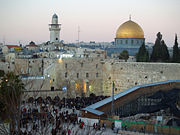
Jerusalem
Although millions have observed “Palm Sunday” today, did you know that Jesus’ entry into Jerusalem that is now commonly called Palm Sunday did not happen on a Sunday?
Also, did you know that ‘Palm Sunday’ was not observed by the early church? Some believe that it began in Mesopotamia in the late fourth century. However, Roman Catholics did not seem to adopt it until much later.
The Catholic Encyclopedia notes:
Binterim, V, i, 173, on the authority of Severus, Patriarch of Antioch, and of Josue Stylites, states that Peter Bishop of Edessa, about 397 ordered the benediction of the palms for all the churches of Mesopotamia. The ceremonies had their origin most probably in Jerusalem. In the “Peregrinatio Sylviæ”, undertaken between 378 and 394…
In the three oldest Roman Sacramentaries no mention is found of either the benediction of the palms or the procession. The earliest notice is in the “Gregorianum” used in France in the ninth and tenth centuries.
Growing up Catholic, I remember getting palm leaves on “Palm Sunday”. Palm Sunday is claimed to be the day that Jesus rode into Jerusalem on a donkey. It certainly, even according to Catholic sources, was not an original apostolic practice. But is what is being observed even related to what something that happened on a Sunday?
No.
To prove this, let’s start the sequence:
1 Then, six days before the Passover, Jesus came to Bethany…(John 12:1).
Since Passover is on the 14th of Nisan, subtracting six days bringing us back to the 8th of Nisan (if it was six nights before the evening of 14th, as Jesus arrived for dinner, technically it could have been on the 7th in the evening). Jesus apparently arrived in Jerusalem on a donkey the next day (which is either the morning of the 8th or 9th):
12 The next day a great multitude that had come to the feast, when they heard that Jesus was coming to Jerusalem, 13 took branches of palm trees and went out to meet Him, and cried out:
“Hosanna!
‘Blessed is He who comes in the name of the Lord!’
The King of Israel!”14 Then Jesus, when He had found a young donkey, sat on it; as it is written:
15 “Fear not, daughter of Zion;
Behold, your King is coming,
Sitting on a donkey’s colt.” (John 12:12-15).
Since Jesus died on what we call Wednesday on the 14th of Nisan, the 8th of Nisan would have been a Thursday and the 9th of Nisan would have been a Friday. Thus, there was no “Palm Sunday”. It seems to have been a “Palm Thursday” or “Palm Friday”.
It would seem that next day (Friday/Saturday) is when He went to the Temple, overthrough the money-changers, and was praised by the children (Matthew 21:12-16).
The Old Testament Passover lamb was selected on the 10th of the month (Exodus 12:3), and this may have been symbolically fulfilled by Jesus by entering the Temple on the 10th. Another reason, to conclude that this is so, is because in the Old Testament the lamb was kept until the 14th (Exodus 12:6), and in Luke’s account, Jesus continued teaching daily in the Temple (Luke 19:47; 22:53), until the time He partook of Passover (which was the 14th).
Now, the Christian Passover, which Jesus, the apostles, and the early Christians all observed (and are told to do so in the Bible) is tonight. Yet, probably none who observed Palm Sunday (which neither the Bible nor the early church enjoined) will actually observe Passover (which both the Bible nor the early church enjoined).
Something to think about.
Some articles of possibly related interest may include:
What Happened in the Crucifixion Week? How long are three days and three nights? Was Palm Sunday on a Saturday? Did Jesus die on “Good Friday”? Was the resurrection on Sunday? Do you really know? Who determined the date of Easter?
Is There “An Annual Worship Calendar” In the Bible? This paper provides a biblical and historical critique of several articles, including one by the Tkach WCG which states that this should be a local decision. What do the Holy Days mean? Also you can click here for the calendar of Holy Days.
Passover and the Early Church Did the early Christians observe Passover? What did Jesus and Paul teach? Why did Jesus die for our sins?
Melito’s Homily on the Passover This is one of the earliest Christian writings about the Passover. This also includes what Apollinaris wrote on the Passover as well.
Should Christians Keep the Days of Unleavened Bread? Do they have any use or meaning now? What is leaven? This article supplies some biblical answers.
The History of Early Christianity Are you aware that what most people believe is not what truly happened to the true Christian church? Do you know where the early church was based? Do you know what were the doctrines of the early church? Is your faith really based upon the truth or compromise?
 |
Tweet |
|