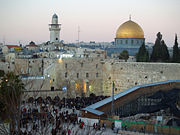
Jerusalem
Today is claimed to be ‘Palm Sunday’:
Notice a report about it from before:
Pope Francis celebrated his first Palm Sunday Mass in St. Peter’s Square…Palm Sunday recalls Jesus’ entry into Jerusalem but its Gospel also recounts how he was betrayed by one of his apostles and ultimately sentenced to death on a cross. http://www.foxnews.com/world/2013/03/24/francis-leads-palm-sunday-mass-in-st-peter-square-opening-holy-week-for-church/#ixzz2OSt2qtLx
Although millions have observed “Palm Sunday” today, did you know that Jesus’ entry into Jerusalem that is now commonly called Palm Sunday may or may not have happened on a Sunday? (Note: This article was updated in 2026.)
Also, did you know that ‘Palm Sunday’ was not observed by the early church? Some believe that it began in Mesopotamia in the late fourth century. However, Roman Catholics did not seem to adopt it until much later.
The Catholic Encyclopedia notes:
Binterim, V, i, 173, on the authority of Severus, Patriarch of Antioch, and of Josue Stylites, states that Peter Bishop of Edessa, about 397 ordered the benediction of the palms for all the churches of Mesopotamia. The ceremonies had their origin most probably in Jerusalem. In the “Peregrinatio Sylviæ”, undertaken between 378 and 394…
In the three oldest Roman Sacramentaries no mention is found of either the benediction of the palms or the procession. The earliest notice is in the “Gregorianum” used in France in the ninth and tenth centuries.
Growing up Roman Catholic, I remember receiving palm branches on “Palm Sunday.” According to tradition, Palm Sunday commemorates the day Jesus rode into Jerusalem on a donkey. It certainly was not an original apostolic observance, even according to Roman Catholic sources. But an important question remains: did the event being commemorated actually occur on a Sunday?
It depends on how the chronology of the final week is understood.
John begins the sequence by writing:
“Then, six days before the Passover, Jesus came to Bethany…” (John 12:1).
If “the Passover” refers to the Passover on the 14th of Nisan, counting back six days brings us to the 8th of Nisan. John continues:
“There they made Him a supper…” (John 12:2).
Since supper would have been eaten after sunset, this would have been the beginning of the 9th of Nisan according to biblical reckoning, in which each day begins at sunset.
John next records:
“Now a great many of the Jews knew that He was there; and they came, not for Jesus’ sake only, but that they might also see Lazarus, whom He had raised from the dead. But the chief priests plotted to put Lazarus to death also, because on account of him many of the Jews went away and believed in Jesus” (John 12:9–11).
John does not specify whether these events occurred later that same day or during the following daylight portion of the 9th. If they occurred on the 9th, then the following passage would naturally describe events on the 10th of Nisan:
“The next day a great multitude that had come to the feast, when they heard that Jesus was coming to Jerusalem, took branches of palm trees and went out to meet Him, and cried out:
‘Hosanna!
Blessed is He who comes in the name of the Lord!
The King of Israel!’Then Jesus, when He had found a young donkey, sat on it; as it is written:
‘Fear not, daughter of Zion;
Behold, your King is coming,
Sitting on a donkey’s colt’” (John 12:12–15).
The Gospel accounts indicate that either that day or the following day Jesus entered the Temple, drove out the money changers, and was praised by the children (Matthew 21:12–16).
This chronology is significant because the Passover lamb was to be selected on the 10th day of the first month:
“On the tenth day of this month every man shall take for himself a lamb…” (Exodus 12:3).
The lamb was then kept until the 14th:
“…and the whole assembly of the congregation of Israel shall kill it at twilight” (Exodus 12:6).
If Jesus’ triumphal entry occurred on the 10th of Nisan, it would provide a fitting symbolic parallel to the selection of the Passover lamb. Likewise, Luke records that Jesus continued teaching daily in the Temple (Luke 19:47; cf. 22:53) until the Passover, corresponding to the period during which the Passover lamb was kept before being sacrificed. If His entry was on the 9th (a Saturday), then it would be logical to suspect that if He entered the Temple the 10th that such was the fulfillment of Exodus 12:3.
This also presents an interesting chronological question for those who maintain the traditional Good Friday chronology. Many Roman Catholic commentators associate the triumphal entry with the selection of the Passover lamb on the 10th of Nisan.
However, if Jesus was crucified on a Friday, as Roman Catholics assert, the crucifixion would not have fallen on the 14th of Nisan under that reconstruction. By contrast, the chronology of a Wednesday, 14th-of-Nisan crucifixion preserves both the symbolism of the lamb being selected on the 10th and sacrificed on the 14th.
It should be noted that writers from the former Worldwide Church of God have not been unanimous on this point. At least one concluded that the events commemorated as Palm Sunday actually occurred on a Sunday, while another, Dean Blackwell, associated them with a Sabbath.
One factor that may favor a Sunday chronology is the use of palm branches. The Gospel accounts describe people taking and spreading palm branches before Jesus as He entered Jerusalem. Given the many Sabbath restrictions observed by the Jews of Jesus’ day, gathering and using palm branches in this manner seems less likely to have occurred on the weekly Sabbath. While it cannot be ruled out that the branches were obtained and used on a Sabbath, a Sunday setting appears to be the more probable conclusion.
Now, the Christian Passover, which Jesus, the apostles, and the early Christians all observed (and are told to do so in the Bible) is Thursday after sunset. Yet, probably none who observed Palm Sunday (which neither the Bible nor the early church enjoined) will actually observe the true Christian Passover (which both the Bible and the early church enjoined).
Something to think about.
Some links of possibly related interest may include:
What Happened in the Crucifixion Week? How long are three days and three nights? Was Palm Sunday on a Saturday? Did Jesus die on “Good Friday”? Was the resurrection on Sunday? Do you really know? Who determined the date of Easter?
Holy Day Calendar This is a listing of the biblical holy days through 2024, with their Roman calendar dates. They are really hard to observe if you do not know when they occur 🙂 In the Spanish/Español/Castellano language: Calendario de los Días Santos. In Mandarin Chinese: 何日是神的圣日? 这里是一份神的圣日日历从2013年至2024年。.
Is There “An Annual Worship Calendar” In the Bible? This paper provides a biblical and historical critique of several articles, including one by the Tkach WCG which states that this should be a local decision. What do the Holy Days mean? Also you can click here for the calendar of Holy Days.
Keeping Passover and the Days of Unleavened Bread How should Christians keep Passover, especially if they are by themselves. Why does the Church of God not require lambs for Passover? How does one keep the Days of Unleavened Bread? For a step-by-step video for Christians to keep it, check out CCOG Passover Service.
Preparing for Passover The Apostle Paul taught that Christians should examine themselves prior to taking Passover. This YouTube video sermon gives suggestions on how to prepare.
Passover and the Early Church Did the early Christians observe Passover? What did Jesus and Paul teach? Why did Jesus die for our sins? There is also a detailed YouTube video available titled History of the Christian Passover.
Melito’s Homily on the Passover This is one of the earliest Christian writings about the Passover. This also includes what Apollinaris wrote on the Passover as well. Here is a related sermon, also titled Melito’s Homily on the Passover.
TPM: Passover on the 14th or 15th? While the real COG observes Passover on the 14th, some observe it on the 15th. Why is the 14th correct? A related sermon is titled Is Passover on the 14th or 15th for Christians?
Should Christians Keep the Days of Unleavened Bread? Do they have any use or meaning now? What is leaven? This article supplies some biblical answers. Here is a YouTube video intended to be viewed for the first day of unleavened bread: Christians and the Days of Unleavened Bread.
Where is the True Christian Church Today? This free online pdf booklet answers that question and includes 18 proofs, clues, and signs to identify the true vs. false Christian church. Plus 7 proofs, clues, and signs to help identify Laodicean churches. A related sermon is also available: Where is the True Christian Church? Here is a link to the booklet in the Spanish language: ¿Dónde está la verdadera Iglesia cristiana de hoy?
Continuing History of the Church of God This pdf booklet is a historical overview of the true Church of God and some of its main opponents from c. 31 A.D. to 2014. Two related sermon links would include Continuing History of the Church of God: c. 31 to c. 300 A.D. and Continuing History of the Church of God: 4th-16th Centuries. In Spanish: Marque aquí para ver el pdf folleto: Continuación de la Historia de la Iglesia de Dios.
The History of Early Christianity Are you aware that what most people believe is not what truly happened to the true Christian church? Do you know where the early church was based? Do you know what were the doctrines of the early church? Is your faith really based upon the truth or compromise?