‘ Day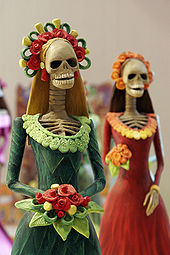
Day of the Dead decorations
(Tomascastelazo)
Many Greco-Roman-Protestants plan to celebrate Halloween tonight.
It is not a biblical nor a Christian holiday.
All Souls’ Day is basically a Roman Catholic, and not a biblical, holiday and is endorsed by the Church of Rome:
ALL SOULS Day. A solemn commemoration of, and prayer for, all the souls in Purgatory, which the Church makes on the second of November. (Addis W, Arnold T. Catholic Dictionary, 6th ed. The Catholic Publication Society Co, 1887. Nihil Obstat. EDUARDUS S. KEOGH, CONG. ORAT., Censor Deputatu Imprimatur. HENRICUS EDUARDUS, CARD. ARCHIEP. WESTMONAST. Die 18 Dec., 1883. Imprimatur. John Card. McCloskey, Archbishop of New York. Feb. 14, 1884. Copyright, Lawrence Kehoe, 1884/1887. p20)
Here is what The Catholic Encyclopedia reports about it and a related practice:
All Soul’s Day
The commemoration of all the faithful departed is celebrated by the Church on 2 November, or, if this be a Sunday or a solemnity, on 3 November. The Office of the Dead must be recited by the clergy and all the Masses are to be of Requiem, except one of the current feast, where this is of obligation.
The theological basis for the feast is the doctrine that the souls which, on departing from the body, are not perfectly cleansed from venial sins, or have not fully atoned for past transgressions, are debarred from the Beatific Vision, and that the faithful on earth can help them by prayers, almsdeeds and especially by the sacrifice of the Mass. (See PURGATORY.)
In the early days of Christianity the names of the departed brethren were entered in the diptychs. Later, in the sixth century, it was customary in Benedictine monasteries to hold a commemoration of the deceased members at Whitsuntide. In Spain there was such a day on Saturday before Sexagesima or before Pentecost, at the time of St. Isidore (d. 636). In Germany there existed (according to the testimony of Widukind, Abbot of Corvey, c. 980) a time-honoured ceremony of praying to the dead on 1 October. This was accepted and sanctified by the Church. St. Odilo of Cluny (d. 1048) ordered the commemoration of all the faithful departed to be held annually in the monasteries of his congregation. Thence it spread among the other congregations of the Benedictines and among the Carthusians.
Of the dioceses, Liège was the first to adopt it under Bishop Notger (d. 1008). It is then found in the martyrology of St. Protadius of Besançon (1053-66). Bishop Otricus (1120-25) introduced it into Milan for the 15 October. In Spain, Portugal, and Latin America, priests on this day say three Masses. A similar concession for the entire world was asked of Pope Leo XIII. He would not grant the favour but ordered a special Requiem on Sunday, 30 September, 1888.
In the Greek Rite this commemoration is held on the eve of Sexagesima Sunday, or on the eve of Pentecost. The Armenians celebrate the passover of the dead on the day after Easter. (Mershman, Francis. “All Souls’ Day.” The Catholic Encyclopedia. Vol. 1. Nihil Obstat. March 1, 1907. Remy Lafort, S.T.D., Censor. Imprimatur. +John Cardinal Farley, Archbishop of New York. New York: Robert Appleton Company, 1907. 6 Aug. 2013 <http://www.newadvent.org/cathen/01315b.htm>)
A diptych is a sort of notebook…The liturgical use of diptychs offers considerable interest. In the early Christian ages it was customary to write on diptychs the names of those, living or dead, who were considered as members of the Church a signal evidence of the doctrine of the Communion of Saints. Hence the terms “diptychs of the living” and “diptychs of the dead.” Such liturgical diptychs varied in shape and dimension. Their use (sacrae tabulae, matriculae, libri vivorum et mortuorum) is attested in the writings of St. Cyprian (third century) and by the history of St. John Chrysostom (fourth century), nor did they disappear from the churches until the twelfth century in the West and the fourteenth century in the East. (Maere, René. “Diptych.” The Catholic Encyclopedia. Vol. 5. Nihil Obstat. May 1, 1909. Remy Lafort, Censor. Imprimatur. +John M. Farley, Archbishop of New York. New York: Robert Appleton Company, 1909. 6 Aug. 2013 <http://www.newadvent.org/cathen/05022a.htm>)
So, from the above we see that All Souls’ Day is not part of original Christianity and the date has varied. The Roman Catholic practices to it are related to its purgatory doctrine, which is something that did not get developed until many centuries after Jesus–neither purgatory nor All Souls Day were endorsed by the original Church of God (see Did the Early Church Teach Purgatory?). And those in the Continuing Church of God do not endorse it to this day.
Notice another belief associated with All Souls’ Day:
On November 1, All Saints’ Day, adult spirits return, drawn by the ofrendas (altars with offerings), which serve as thresholds between this world and the next…A chair near the altar allows family members to visit with the dead before they depart on November 2nd, when the altar is taken down. The fragile paper decorations, like the transience of flowers, incense, and food, are reminders of the fleeting nature of life. Altars are reminders that the dead are welcomed by the living and continue to have a relationship with us as a natural part of life itself. (Andrade M. The Day of the Dead. http://www.burkemuseum.org/static/RR/DOFD/dofd2.htm. viewed 08/06/13)
Souls are not departing on this day as many falsely believe.
These “festivals of the dead” turn people away from God’s plan of salvation as laid forth by His Holy Days. And these death festivals encourage people to commune with, appease, serve and even worship the dead.
Speaking of the dead, notice also the following:
History of Day of the Dead ~ Día de los Muertos
Day of the Dead is an interesting holiday celebrated in central and southern Mexico during the chilly days of November 1 & 2. Even though this coincides with the Catholic holiday called All Soul’s & All Saint’s Day, the indigenous people have combined this with their own ancient beliefs of honoring their deceased loved ones.
They believe that the gates of heaven are opened at midnight on October 31, and the spirits of all deceased children (angelitos) are allowed to reunite with their families for 24 hours. On November 2, the spirits of the adults come down to enjoy the festivities that are prepared for them. http://www.mexicansugarskull.com/support/dodhistory.html accessed 10/29/16
Of course none of those beliefs about deceased children reuniting for 24 hours are true. But the Church of Rome allows them.
Regarding the Day of the Dead, Wikipedia reports:
Day of the Dead (Spanish: Día de Muertos) is a Mexican holiday celebrated throughout Mexico and around the world in other cultures. The holiday focuses on gatherings of family and friends to pray for and remember friends and family members who have died. It is particularly celebrated in Mexico, where it is a national holiday, and all banks are closed. The celebration takes place on November 1 and 2, in connection with the Catholic holidays of All Saints’ Day and All Souls’ Day. Traditions connected with the holiday include building private altars honoring the deceased using sugar skulls, marigolds, and the favorite foods and beverages of the departed and visiting graves with these as gifts. They also leave possessions of the deceased.
Scholars trace the origins of the modern Mexican holiday to indigenous observances dating back hundreds of years and to an Aztec festival dedicated to the goddess Mictecacihuatl. The holiday has spread throughout the world: In Brazil, Dia de Finados is a public holiday that many Brazilians celebrate by visiting cemeteries and churches. In Spain, there are festivals and parades, and, at the end of the day, people gather at cemeteries and pray for their dead loved ones. Similar observances occur elsewhere in Europe, and similarly themed celebrations appear in many Asian and African cultures.
The Day of the Dead is clearly a pagan holiday. Perhaps I should mention that in San Diego last month, as well as in other places in California, I have seen more and more promotion of the Day of the Dead/Día de Muertos. Its observance seems to becoming more publicly popular in this state.
Christians who wish to remain faithful to the original apostolic faith will not observe All Souls’ Day, All Saints’ Day, the Day of the Dead nor endorse purgatory, but endorse God’s Holy Days (see also Should You Observe God’s Holy Days or Demonic Holidays?).
Some items of related interest may include:
Halloween is Pagan Many accept that the origins are pagan. But did you know that the Church of Rome applauds that? A related sermon is available titled: Halloween: A Pagan Threat!
All Saints’ Day, the Day of the Dead, and All Souls’ Day When did “All Saints Day” and the “Day of the Dead” begin? “What about All Soul’s Day”? Here is a link to a related sermo: All Hallowed Saints’ Day of the Dead.
Is Halloween Holy Time for Christians? Here are some historical and biblical insight on this question. There are many cultures that have celebrations and observances that are similar to some associated with Halloween. What did the Druids do? Is Halloween one of the most important holidays for Satanists? Do the Japanese, Indians, and Chinese have any practices that are similar to some associated with Halloween? Does the Bible endorse or condemn practices that are associated with Halloween? Here is a link to a related sermon: Let’s Get Real About Halloween. Here are links to three related sermonette length videos: Debunking 17 reasons to celebrate Halloween, Halloween: Are there 7 reasons for Christians to celebrate it?, and International ‘Halloween’ Should Christians observe Halloween?
Debunking 17 reasons to celebrate Halloween What is Halloween? What do Druids and saints have to do with it? Does the Bible endorse Halloween? When did people start to observe it? Should Christians celebrate it? It seems like more reasons are given by some Protestants and Catholics each year to observe it. In this video, Dr. Thiel gives 17 reasons that have been given to celebrate Halloween and debunks each of them from the Bible. Three reasons he debunks have been promoted by the actor Kirk Cameron–with others from pastors and religious writers. He also debunks what could be called an 18th reason from a Catholic source–plus cites Catholic sources (including the Vatican) opposed to its observance.
Do You Practice Mithraism? Many practices and doctrines that mainstream so-called Christian groups have are the same or similar to those of the sun-god Mithras. December 25th was celebrated as his birthday. Do you follow Mithraism combined with the Bible or original Christianity? A sermon video from Vatican City is titled Church of Rome, Mithras, and Isis?
Hope of Salvation: How the Continuing Church of God Differs from Protestantism The CCOG is NOT Protestant. This free online book explains how the real Church of God differs from mainstream/traditional Protestants. Several sermons related to the free book are also available: Protestant, Baptist, and CCOG History; The First Protestant, God’s Command, Grace, & Character; The New Testament, Martin Luther, and the Canon; Eucharist, Passover, and Easter; Views of Jews, Lost Tribes, Warfare, & Baptism; Scripture vs. Tradition, Sabbath vs. Sunday; Church Services, Sunday, Heaven, and God’s Plan; Seventh Day Baptists/Adventists/Messianics: Protestant or COG?; Millennial Kingdom of God and God’s Plan of Salvation; Crosses, Trees, Tithes, and Unclean Meats; The Godhead and the Trinity; Fleeing or Rapture?; and Ecumenism, Rome, and CCOG Differences.
Is There “An Annual Worship Calendar” In the Bible? This paper provides a biblical and historical critique of several articles, including one by the Tkach WCG which states that this should be a local decision. What do the Holy Days mean?
Holy Day Calendar This is a listing of the biblical holy days through 2033, with their Roman calendar dates. They are really hard to observe if you do not know when they occur ? In the Spanish/Español/Castellano language: Calendario de los Días Santos. In Mandarin Chinese: 何日是神的圣日? 这里是一份神的圣日日历从2013年至2024年。.
Hanukkah: Jewish Christmas and Hidden Key to Prophecy? Originally a Jewish national holiday, has Hanukkah morphed into a Jewish Christmas? Does it hold hidden secrets to prophecy? Here is a related video: Hanukkah, Tradition, and Prophecy.
Canadian & Philadelphian Mummers Parades: Another tie to Saturnalia In Canada there is a ’12 days of Christmas’ celebration involving Mummers. In Philadelphia, a parade is held on New Years. Does this come from the Bible or where?
Was Jesus Born in the Grotto of the Nativity? Was Jesus born in a below ground cave? Was Jesus born below the “Church of the Nativity”? Were the wise men there?
How did December 25th become Christmas? Was Jesus born then? If not, why December 25?
Is Keeping Christmas a Sin? Is keeping Christmas acceptable for true Christians? What are some scriptures to consider?
What Does the Roman Catholic Church Teach About Christmas and the Holy Days? Do you know what the Roman Catholic Church says were the original Christian holy days? Was Christmas among them? Is December 25th Jesus’ birthday or that of the sun god? Here is a link to a related sermon: What do Catholic and other scholars teach about Christmas?
Beliefs of the Original Catholic Church: Could a remnant group have continuing apostolic succession? Did the original “catholic church” have doctrines held by the Continuing Church of God? Did Church of God leaders uses the term “catholic church” to ever describe the church they were part of? Here are links to related sermons: Original Catholic Church of God?, Original Catholic Doctrine: Creed, Liturgy, Baptism, Passover, What Type of Catholic was Polycarp of Smyrna?, Tradition, Holy Days, Salvation, Dress, & Celibacy, Early Heresies and Heretics, Doctrines: 3 Days, Abortion, Ecumenism, Meats, Tithes, Crosses, Destiny, and more, Saturday or Sunday?, The Godhead, Apostolic Laying on of Hands Succession, Church in the Wilderness Apostolic Succession List, Holy Mother Church and Heresies, and Lying Wonders and Original Beliefs. Here is a link to that book in the Spanish language: Creencias de la iglesia Católica original.
Did Early Christians Celebrate Birthdays? Did biblical era Jews celebrate birthdays? Who originally celebrated birthdays? When did many that profess Christ begin birthday celebrations? A related sermon video is available and is titled: Birthdays, Christians, and December 25th.
International ‘Halloween’ Should Christians observe Halloween? There are many cultures that have celebrations and observances that are similar to some associated with Halloween. What did the Druids do? Is Halloween one of the most important holidays for Satanists? Do the Japanese, Indians, and Chinese have any practices that are similar to some associated with Halloween? Does the Bible endorse or condemn practices that are associated with Halloween? This is a video.
Should You Keep God’s Holy Days or Demonic Holidays? This is a free pdf booklet explaining what the Bible and history shows about God’s Holy Days and popular holidays. Two related sermon would be Which Spring Days should Christians observe? and Fall Holy Days for Christians.
Beliefs of the Original Catholic Church: Could a remnant group have continuing apostolic succession? Did the original “catholic church” have doctrines held by the Continuing Church of God? Did Church of God leaders uses the term “catholic church” to ever describe the church they were part of? Here are links to related sermons: Original Catholic Church of God?, Original Catholic Doctrine: Creed, Liturgy, Baptism, Passover, What Type of Catholic was Polycarp of Smyrna?, Tradition, Holy Days, Salvation, Dress, & Celibacy, Early Heresies and Heretics, Doctrines: 3 Days, Abortion, Ecumenism, Meats, Tithes, Crosses, Destiny, and more, Saturday or Sunday?, The Godhead, Apostolic Laying on of Hands Succession, Church in the Wilderness Apostolic Succession List, Holy Mother Church and Heresies, and Lying Wonders and Original Beliefs. Here is a link to that book in the Spanish language: Creencias de la iglesia Católica original.