Comments Concerning the 20th Century
Related to the Church of God, Seventh Day (CG7) in the 1920s and 1930s, India was reached:
1922: Activity Expands...Some 150 letters were sent to prospective ministers in foreign fields...western and eastern India, South America, and other places...These were Sabbath-keeping ministers...Elder A. Jacobs reported from India...
By 1923, the "Big Push" was going at full gallop...Arrangements were being made to print Church of God literature in Norwegian, Swedish, Danish, German, and Chinese, as well as two languages in India...In 1923...There were two missionaries established in India, A. Jacobs and D. Israel.
1933...Church of God elders...V. Amos, India..N.P. Daniel, India...V.J. Benjamin, India {,} B. Israel, South India...V.J. Joseph, India (Nickels R.C. History of the Seventh Day Church of God. 1988, pp. 98-100,106,147-150)
The elders listed in 1933 were selected to be part of a temporary group called "The Seventy," which was drawn by a lottery of sorts--as those selected were a slightly less than 1/2 of the CG7 eldership at the time, there were likely more ministers in India by 1933 than these listed.
In 1933, God used Herbert W. Armstrong (who was then a minister associated with the Church of God, Seventh Day) to raise up the Philadelphia era of the Church of God. After being on the radio for a while, Herbert Armstrong called the group he led the Radio Church of God and then in the 1960s the name was changed to Worldwide Church of God (WCG).
In the later portion of the 20th century, those in the old WCG had many contacts with those in India. WCG had many congregations throughout India. I met WCG ministers from India and Sri Lanka back then.
Perhaps it should be mentioned here that Indian peoples are not limited to the current nation of India alone. In addition to India, Pakistan, Bangladesh, and Sri Lanka are predominantly composed of Indian peoples. I have met an Indian ministers in various COG groups in locations such as Malaysia and Sri Lanka. Having traveled to many lands, I have come across significant Indian populations in South Africa, Fiji, Malaysia, and parts of the Caribbean. It is also believed that many of the peoples of Bhutan, Nepal, and Myan Mar (Burma) have ancestry at least partially related to the Indian peoples. People in all of those lands either have been to Continuing Church of God's official www.ccog.org and/or the COGwriter websites.
And some are in various Churches of God--including scores with Continuing Church of God.
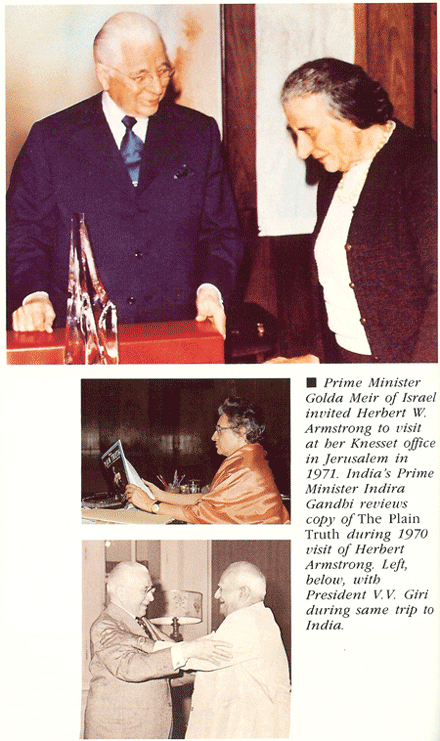
During the 20th century, the founder of the Worldwide Church of God, Herbert W. Armstrong, had many contacts with the leadership in India. He personally met India's prime minister and also met many other officials from India. In 1956 he reported:
We were on the three superpower bands of Radio Ceylon. From this we received considerable mail from far-off Burma, Malaya and Singapore. Also from India, Ceylon, and portions of eastern Africa (Armstrong HW. As quoted in Chapter 62 of The Autobiography of Herbert W. Armstrong, Volume II).
So in the 1950's the true gospel was being broadcast across many areas of Indian populations.
Through his personal contacts, Herbert W. Armstrong attempted to get out the message of the coming kingdom of God to as much of the leadership in India as possible. Here is a report in Chapter 77 of the second volume of his autobiography which mentioned some of his trips to Indian countries:
In Ceylon I had a ... meeting with the Prime Minister, in the living room of her official residence, Friday afternoon. Last night (Saturday night) my daughter and I ... were guests at dinner at "Queen's House," residence of the Governor General. It is really a palace -- quite huge for a private residence. It was built over 400 years ago by the Dutch, when they were in control of Ceylon, before it came into British hands. Ceylon is now independent, but a member of the British Commonwealth. The Governor General is appointed by Queen Elizabeth of England.
We had been invited to Ceylon by the Prime Minister, Mrs. Sirimavo Bandaranaike, through the Ceylon High Commissioner (same level as Ambassador) to India, at New Delhi. The High Commissioner accompanied us on our plane to Colombo. I will give you a report of the meeting with the Prime Minister in the Personal article in the May Plain Truth. I just thought in this more personal and confidential letter to our inner family of Co-Workers you might enjoy some of the more personal highlights.
At the dinner at "Queen's House" last night besides our party, were the Governor General and his wife, his Chief Aide and wife, and the High Commissioner of Ceylon from New Delhi.
This morning, we brought the High Commissioner with us as far as Bombay, where he caught a commercial flight back to New Delhi. We have had to make the one fuel stop between Bombay and Israel, at Teheran. While we were on the ground at Bombay, one of our Indian Co-Workers who is a mechanic with Indian Airlines, recognized our plane, and came aboard for a few minutes' visit. I have met him two or three times before. His daughter graduated from Ambassador College, English campus, and until her marriage was also a faculty member.
Earlier, at New Delhi, I had another visit with President V.V. Giri, and also a meeting with our U.S. Ambassador Keating. He is the former Senator from New York. I am sorry that there have recently been more or less strained relations between the Governments of India and the United States. For that reason protocol made it inadvisable for me to see Mrs. Gandhi, the Indian Prime Minister, when I had had a talk with our American Ambassador on the same visit.
However, at New Delhi we were entertained twice at the home of the Executive Secretary to the President, Dr. Singh -- and there we met two or three maharajahs...
One of the most helpful people in our worldwide work has been Dr. Negendra Singh of New Delhi. He is a recent appointee as judge of the World Court at The Hague -- a position of great worldwide power and importance, due to the fact that the nations have feared to defy a decision made by this World Court. The court's sole power is its moral power -- but that has proved very great. Prior to his high appointment, Dr. Singh was Executive Secretary to President V.V. Giri of India. He has been a guest speaker before Ambassador College students and faculty at all three campuses.
On Thursday night, March 8, Dr. and Mrs. Singh were our dinner guests at our hotel. On Friday, March 9, was a luncheon in my honor at Dr. Singh's residence. Two distinguished guests present were His Excellency Abdul Hakim Tabibi, the Ambassador from Afghanistan, and the Ambassador from Ethiopia, Getachew Mekasha...
At Dr. Singh's residence I met the younger son of Prime Minister Indira Gandhi. This young man was trained as an engineer in India and trained on the job in the Rolls-Royce factory in England. He is presently embarking on a private enterprise to produce an all-India automobile of the Volkswagen type. His name is Sanjay Gandhi. He extended an invitation to our party to dine at the Prime Minister's home on our trip in May.
Dr. Singh also invited us to visit the World Court at The Hague on our May trip.
At 10 a.m. March 11, we were again airborne for Jakarta, on the island of Java, in Indonesia. It was a six-hour forty-minute flight nonstop -- lasting virtually all day...
December 24, 1976...
I think over, in my mind, about many I have known, some closely and intimately -- now gone!...There was President Rahman of Bangladesh...There have been others, affectionate friends of mine, whose terms of office have expired, such as V.V. Giri, ex-President of India...
(Armstrong HW. Co-Worker letter dated March 26, 1972 and events of June 1972 and December 1976 as quoted in Chapters 77 and 80 of The Autobiography of Herbert W. Armstrong, Volume II).
In Sri Lanka, various Church of God groups have members that meet for Sabbath services in Colombo (I have personally attended church services on the Sabbath in Colombo Sri Lanka--though it was many years ago and more recently we in the Continuing Church of God have been contacted by one or more from there).
Herbert W. Armstrong made other trips to Sri Lanka.
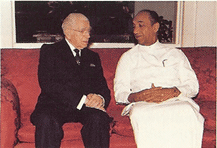
Herbert W. Armstrong meeting with then Sri Lanka President Jayewardene
Herbert W. Armstrong made other trips to India and met with various leaders there:
In 1984 Herbert Armstrong went to Nepal:
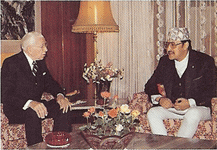
Herbert W. Armstrong meeting with then King Birendra
In addition to congregations in Myanmar, South Africa, the Caribbean, and Sri Lanka, the Church of God also has had members in India. Since the death of Herbert Armstrong in 1986, the Laodicean era of the Church of God has dominated.
The remaining Philadelphia portion of the Church of God has been in a transition since. In the late 20th and early 21st centuries, some evangelists that Herbert Armstrong ordained apostasized, some became heretical, while others tried to be faithful, yet all who had seemed to have been part of that era ultimately compromised in various ways.
The 21st Century and the Continuing Church of God
On December 28, 2012, because of improper actions by one or more evangelists, it was necessary for the Continuing Church of God (CCCOG) to form as a separate legal entity. Within days of making placing the www.ccog.org website online, it began to get visitors from India. On February 26, 2013, CCOG was contacted by a Sabbath and Holy Day observing pastor in India who wanted to work with CCOG to better get the gospel out to the people of India. The following week, CCOG began to send regular email updates to India. On May 13, 2013, the Continuing Church of God was able to secure the URL www.ccog.in as part of its plans to reach India.
On July 13, 2013 an agreement to send our Bible News Prophecy magazines to India was made; with the first ones mailed on July 19, 2013.
Also on July 13, 2013, the CCOG received a request to produce a magazine in the Telugu language for use in India. This request was agreed to on July 14, 2013. Additionally, on July 14, 2013 steps were taken to finalize the initial home page of the www.ccog.in URL which had been reserved to use as soon as it could be specifically utilized. During that week, the new India website, www.ccog.in went live. Over time, it is hope to have more information specific to India, such as congregational locations and information in one or more languages other than English (we are looking into Telugu and possibly Hindi and, even though it is not strictly Indian, possibly also Jingpho which is spoken in Kachiland). The is one item up in Hindi, a translation of the book, The Mystery of the Ages.
In late 2018, a group from India that had been emailing us since late 2012 declared that after much review, that they wanted to be part of the Continuing Church of God. They paid the costs of a visit from a CCOG elder.
One time Continuing Church of God elder, the late Alexsandar ‘Sasha’ Veljic who lived in Serbia, went to Manipur, India. He sent me several emails that he said to combined parts of them. So, I did and he enthusiastically approved the following for public distribution on January 13, 2019:
Dear Bob,
As soon as I arrived, I met with 8 members of Church of God. I told them the purpose of my visit and why I came. I also told them that I could see with corresponding with Sani Mao that they are well established in the doctrines of the Bible, so that I will endeavor to give them messages that will corroborate their faith. That was met with thrill. If there is one word to describe that group of people, the first thought that comes to my mind is – ZEAL! And no wonder that they wanted to associate with us for the zeal is one of the characteristics of the Philadelphia church. As far as I could assess, their mutual relations are on the same level. It brings a great joy to my heart that those people fast twice a month and they get together on those occasions. They all confirmed to me that Sani Mao has been serving them faithfully for years and that they are all here due to what God has done through that man. On the other hand, they are responsive and helpful and they have been keeping the Feast in a very organized manner, so I would add that the government of God, such as should be administered in the proper way, has been present in this group all along.
The whole structure is there, but this group has been waiting, with a great discipline, to have an a ministerial approval. They were very worried that I might not come as they are expecting that help from me. Sani Mao talked to me on Friday evening about my ordination and his correspondence on that matter. Now we talked about it alive, so that I could better understand motives and reasonings on his part. As I have already established, he is man of one wife and he has never been divorced. His wife and him are both employed by the government, which speaks loudly of their reputation.
I feel that these people have been yearning for my visit to be approved as full-fledged part of the true community of the Philadelphia remnant. I live far away and so do you. But, they already have everything in place to operate as the Church of God and for that they do not seek, nor do they expect any financial support. I am, for example, deeply impressed at how faithfully and in an organized manner they kept the Feast for years, being cut off by their former Church organization, and enduring and waiting for my visit. At certain moments I even feel uncomfortable with the level of trust and respect they show me (I surely am not worthy of that). However, while I am here, I want to do my part and leave this community at peace and see it thrive with God’s merciful help here in the second populous nation in the world.
Now, I remembered that there was that accusation about them having Pentecostal spirit, or Pentecostal behavior. You can rest assured that I would not have hesitated to correct that and put things in order had that be true. Now that I have had a Sabbath services with them, I understand better the things. There is nothing Pentecostal in terms of “speaking in the tongues”, or a disorder at services. On the contrary, there is peace and order. Perhaps there is some intensity of emotions in the air, with which a Westerner might not be comfortable with. But, as for me, I am perfectly comfortable with that.
I want to assure you that I am well taken care of. To all my questions I get very detailed answers. I haven’t noticed any half truths. I am only afraid of mosquitoes. The weather is beautiful, so my windows were open, and then in the evening the room was full of them. Sani Mao and I killed most of them. One remained hidden. I managed to kill it later at night when I talked to the congregation in Serbia on Friday evening (Serbian time).
A few more things I need to bring to your attention.
1. Sani Mao related to me how they had become spiritual orphans when they were abandoned by LCG. Other than the unfounded accusation about Pentecostalism, a LCG minister made derogatory comments about women. That their place is to wash the cups. He would not accept that a woman might have a dream coming from God, such as we know that has happened in our CCOG history. And so, when LCG announced that there was no LCG in India, that came out of the blue and has devastated these people.
2. Coercive hierarchical control. They were told not to get together for Bible studies, or when they fast with no Scriptural explanation whatsoever and contrary to what we are told in the Book of Hebrews.
3. I had another baptism counseling session after the Sabbath. A young man was present as an interpreter. After counseling, he told me that LCG always had short counseling and would dismiss people. I just don’t understand such an approach. When I counsel people, I try to bring up the important points for their salvation. I also asked questions. I let them talk to me. I need to see if they are repentant to be baptized. Sani Mao’s daughter, for example, asked me several questions from the Scriptures seeking help to defend her belief against here Protestant peers who mock her beliefs. I also read some scriptures related to baptism. I never limit counseling time. I let it continue until all relevant points have been exhausted. That is new to this group as well. But I would find it highly disrespectful to just have short counseling and then dismiss them.Now, having said all this, I need to tell you that I prayed and thought about ordinations. After getting your approval, which I read on the Sabbath morning, I realized there is no more reason to wait and delay. The intensity of prayer and faith that these people had about me coming – and I came against all the odds – and them hanging in and enduring all that they have, made me convinced finally that I couldn’t leave them orphans in spiritual terms. Plus, on Friday, during a counseling session, one of the members here said he had a dream before my coming. A hand on which an oil was poured was there to anoint Sani Mao. And that member told others not to worry, that I would come against all odds. Also, after his dream, his Bible was opened to Romans 5:4. When I read that verse, I realized it aptly describes Sani Mao. Therefore, when he came to pick me up for the Sabbath, I asked him if he had any objections to being ordained on this Sabbath. He didn’t have any, even though he was surprised that I would do it during this visit. He said he thought it would take some time. I didn’t see any reason to take any more time.
And so, after the Sabbath services and refreshments, I have ordained Sani Mao a deacon. I also called all baptized men to join me on the stage and follow me in laying hands on Sani Mao as a symbolic consent of the entire congregation to having now finally the government of God restored in India. After that act, Sani Mao addressed the congregation briefly and, as he admitted, for the first time he broke in tears in front of that group. I also announced that I want to bless the children after ordination ceremony, so that the ladies would be prepared for that. And I was about to that, but realizing what a great emotional thing Sani Mao’s ordination has been for both the congregation and me, I stepped in to make another announcement.
I said that we better prepare emotionally for something else and that I made a decision based on what I feel God led me to. And I said that I have decided to anoint Mary, Sani Mao’s wife as a deaconess next Sabbath. That announcement came a bolt from heaven. Sani Mao’s wife was shocked and then she broke into tears. Almost all the ladies in the congregation wept silently as I explained the reasons. I see that a strong presence of the ladies in the congregation. I could feel that their involvement has kept that congregation together and that such thing had to be recognized by God somehow. I asked God to show me what to do about it, and then Mary came to mind. I considered some other ladies as well, those that I met, however I felt that Mary was a strong example of the faith and that she should be ordained. That I didn’t make a mistake in that judgement it was confirmed when the anointing for illnesses came later and Mary related her health problems, but she also enumerated the cases when she was supernaturally healed without medical intervention. Besides her other illnesses, she was cured of a womb cancer.
So, after giving this message of preparation for the next Sabbath, all the children, small ones and even some bigger ones, encouraged by their mothers and aunts, came forward and knelt. I pronounced a blessing on them and asked the Eternal to protect them and be with them in this spiritually evil and dangerous society. Following that, I announced that those who may have ailments should ask to be anointed. A good portion of the congregation came forward. They all knelt spontaneously and so did I with them. First I anointed males so that they could be watching over children and do other needed things. Then I anointed all the ladies that came forward. With short breaks between prayers and anointing, I think it probably took about 45 minutes to one hour to complete all that.
We have videoed my sermon with translation to Manipuri language, so part of that can be used for Behind the Works Feast video.
January 12, 2019, goes down into history as an important date in the history of (Continuing) Church of God and in the history of God’s people in India.
With my best regards,
Sasha
Manipur is located in the extreme east of India.
I personally have been in email communication with Sani Mao for years. We were pleased when they decided to ask to become part of CCOG. Some details of that were reported in the CCOG: Letter to the Brethren: December 13, 2018.
I also ordained Sani Mao an elder in a visit to Thailand in 2025.
Currently, many Indians who wish to learn more about the plan of God and God's truth now have access to it on the internet.Tens of thousands of articles at the www.cogwriter.com and www.ccog.org websites have been accessed by people in India (according to AW stats), thousands of articles have also been accessed by people in Pakistan, Sri Lanka, Bangladesh, Nepal, & Bhutan, plus printed literature has been sent to India.
These are great steps, but additional, and hopefully more direct, witness will be made to the Indian people in the future. The plans that CCOG has to lead the final phase of the work will help accomplish that.
What God's plan for humanity, including those in India, is also discussed in the articles Universal Salvation? There Are Hundreds of Verses in the Bible Supporting the Doctrine of True Apocatastasis and Hope of Salvation: How the Continuing Church of God differ from most Protestants.
Roman Catholic, Hindu, and Islamic Prophetic Comments
Biblical and Roman Catholic prophecies suggest that most in India will end up supporting a European power that they should not support--perhaps as early as 2025--though that seems too early. For details, please watch India, Prophecy, and the Beast in 2025? and/or see the article India and the Beast of Revelation 13 and Will the Interfaith Movement Lead to Peace or Sudden Destruction?
Roman Catholics have a plan for India, and it is not a good one.
Cardinal La Roque (c. 18th century): A regeneration of Faith will appear in Asia (Culleton, R. Gerald. The Prophets and Our Times. Nihil Obstat: L. Arvin. Imprimatur: Philip G. Scher, Bishop of Monterey-Fresno, November 15, 1941. Reprint 1974, TAN Books, Rockford (IL), p. 193)
Elizabeth Canori-Mora (died 1825):...Such is the glorious triumph reserved for the Catholic Church; she shall be praised, honored and esteemed by all men. All men shall become Catholics, and shall acknowledge the Pope as Vicar of Jesus Christ." (Connor, Edward. Prophecy for Today. Imprimatur + A.J. Willinger, Bishop of Monterey-Fresno; Reprint: Tan Books and Publishers, Rockford (IL), 1984, p.24)
Pope Leo XIII (1893): The Orient, courageously and successfully explored by the Portuguese, is coveted by many today for its lucrative trade. We, however, have a more noble purpose in mind...To take care, therefore, of the preservation and propagation of the Catholic religion among the Hindus, a Hindu clergy has to be formed that could administer the sacraments and govern the Christian people properly, no matter how menacing the times...Be sure that the role of Christianity in such remote regions becomes well known. Make your people understand that something must be done for the Hindus (Leo XIII. AD EXTREMAS ON SEMINARIES FOR NATIVE CLERGY. Encyclical of Pope Leo XIII promulgated on June 24, 1893. http://www.vatican.va/holy_father/leo_xiii/encyclicals/documents/hf_l-xiii_enc_24061893_ad-extremas_en.html viewed 07/19/09).
Zenit reported the following in an interview with a Hindu leader:
October 29, 2015
With Nostra Aetate, the Roman Catholic Church has set an example and other religions should likewise open their doors.
This was the sentiment of Hindu Swami Chidananda Saraswati, as he praised the spirit of Nostra Aetate, and the leadership, warmth and humility of Pope Francis. Nostra Aetate was promulgated by Pope Paul VI on Oct. 28, 1965, and on Wednesday, Pope Francis held an “interreligious general audience” to mark the anniversary. As the Second Vatican Council’s Declaration on the Church’s relation to Non-Christian religions, the document condemned anti-semitism in all its forms and signified an opening or widening of relations with other religions.
In this interview with ZENIT, Saraswati, founder and trustee of the Fowai Forum, speaks on the landmark document’s impact and how the conference held on it this week at Rome’s Gregorian University will have a lasting impact. …
ZENIT: How do you feel the conference held at the Gregorian has had an effect and how do you believe it has brought attention to Nostra Aetate?
Saraswati: This conference has been a beautiful experience. It has been a great privilege to have taken part in it. Three days commemorating the 50-year anniversary of Nostra Aetate. Nostra Aetate is a wonderful document. Its spirit is great, inviting all religions, in fact, to become friends. Of course, it primarily opens the doors of the Catholic religion to other religions, to have dialogue with non-Christian religions, but if you see the spirit of it and slightly elaborate on the content of it, it is like an ideal, exemplary document for any religion to operate primarily in the same way. By declaring Nostra Aetate, the Roman Catholic Church has definitely set an example. People, other religions, should also open their doors. …
ZENIT: Do you see this interreligious dialogue with helping combat violence?
Saraswati: I think if we work together we can also work on this terrorist problem too and change their hearts. All they need is a little bit of relocation. I think they are jobless and that is why they are doing all these things. http://www.zenit.org/en/articles/interview-hindu-leader-catholic-church-sets-example-other-religions-should-follow
Of course, Hindus are not the only ones the Church of Rome is reaching out to:
October 28, 2015
“We are brothers,” Pope Francis affirmed while reflecting today on the 50th anniversary of the proclamation of Nostra Aetate, the Second Vatican Council’s Declaration on the Church’s Relation to Non-Christian Religions. …
In the Pope’s address, he expressed that the Second Vatican Council’s Declaration was “an expression of the Church’s esteem for the followers of other religious traditions, and her openness to dialogue in the service of understanding and friendship.”
In this regard, he stressed, we have seen much progress over the past 50 years. In a special way, he noted, we give thanks to God for the significant advances made in relations between Christians and Jews, and between Christians and Muslims. http://www.zenit.org/en/articles/at-general-audience-pope-gives-thanks-for-significant-advances-in-relations-with-jews-muslims
The interfaith movement is going forward with the Vatican its chief cheerleader.
Will most of the over 1 billion Hindus (most of whom who live in India) accept, for a time, the final Beast power who is aligned with the final Antichrist? Will most of the over 1.6 billion Muslims temporarily go along with this?
Bible prophecy strongly suggests yes.
The Vatican's basic plan is to compromise with the Hindus and push them towards statues claimed to be Mary, the Mother of Jesus:
Jaffa, Israel, Aug 2, 2013 / 04:10 am (CNA/EWTN News).- Preparations for the Feast of the Nativity of Mary this September are already underway in the Holy Land, particularly among Indian migrant workers.
“Mother Mary is revered with great devotion by the Indian community as a mother and a spiritual figure of maternal protection,” said Friar Jayaseellan Pitchaimuthu OFM, head of the Indian Chaplaincy in Holy Land.
She is acknowledged as the “protector and patroness” of the Indian Chaplaincy in Holy Land because she is a “model” for the migrants, he told CNA. He noted that the Holy Family took refuge in Egypt for safety and settled for livelihood in Nazareth, and that Jesus carried out his apostolic mission in Judea, Galilee and Jerusalem.
Many Indian Catholic migrant workers “seek grace and invoke (Mary’s) motherly protection,” he said…
The friar explained that the Marian feast day is particularly important in the Indian context because of its relation to other faiths.
Members of other religions, including Hindus and Muslims, “regard Marian devotions in esteem,” he said.
Thousands of devotees – both Catholics and non-Catholics – flock every week to the Marian apparition site at Velankanni, near Chennai in South India, and other shines that have recorded various miracles, he said.
In this way, the friar explained, “Marian devotion also leads to a platform for inter-religious dialogue.” (Gonzales AA. Indian migrants in Holy Land prepare for Marian feast. CNA, August 2, 2013. http://www.catholicnewsagency.com/news/indian-migrants-in-holy-land-prepare-for-marian-feast)
There basically is an ecumenical Roman Catholic plan that expects to use ‘Mary’ to reach those of Indian heritage. But this is a false gospel (cf. Galatians 1:6-7). the Church of Rome has long had plans and beliefs that they would get more Indians to be part of their church and have believed that utilizing versions of statues claimed to be Mary would help them. Notice the following confirmation of several of those points from my book Fatima Shock! (note: Fulton Sheen was a very famous Catholic archbishop, see Fulton Sheen, ‘Mary,’ and the End Times):
Archbishop Sheen essentially thought that the appearance in Fatima was to also ultimately result in Muslims (and possibly Hindus) accepting his faith. Notice that he also wrote:
Our missionaries report the most extraordinary reaction of these peoples as the Pilgrim statue of Our Lady of Fatima was carried through the East. At the edge of Nepal, three hundred Catholics were joined by three thousand Hindus and Moslems, as four elephants carried the statue to the little church for Rosary and Benediction…The final evidence of the relationship of the village of Fatima to the Moslems is the enthusiastic reception that the Moslems in Africa and India and elsewhere gave to the pilgrim statue of Our Lady of Fatima…
Missionaries in the future will, more and more…be successful in the measure they preach Our Lady of Fatima….
Archbishop Sheen also wrote:
At Patna, the Brahman Hindu governor of the province visited the church and prayed before the statue of Our Lady. In one tiny village of Kesra Mec, more than twenty-four thousand people came to see the statue.
But, that is not an isolated incident. Notice the following account of a group of Hindus who visited Cova da Iria in 2004:
Hindus…were allowed to conduct a pagan prayer chant at the altar in the sanctuary of the Little Chapel of the Apparitions…on May 5, 2004…a national television station in Portugal broadcast that a group of Hindus from Lisbon was allowed to commandeer the Shrine for a pagan prayer chant, with the Hindu “priest” standing at the Catholic altar invoking false gods in the causes of peace, while the Hindu congregation in the Little Chapel responded with a chant. This is a desecration…since Sacred Scripture teaches “the gods of the Gentiles are devils” (Psalm 95:5)
This Hindu ceremony, as expected, upset some Catholics. (Note that Psalm 95:5 in the DRB is Psalm 96:5 in the NJB/NKJV which use the word “idols” instead of “devils.”)
Eastern Signs and Faiths
While “Mary” is known throughout the Middle East and West, she is less known, though revered by some like a goddess, in Eastern religions:
Hindus, Buddhists, Muslims and other pilgrims regularly worship at famous Roman Catholic shrines to the Virgin Mary such as Lourdes in France and Fatima in Portugal…Many venerate her like one of their own goddesses.
…those in various Eastern faiths can be intrigued by the feminine, and may be highly impacted by public alleged Marian apparition(s) in the future. But, no Buddhist, Taoist, Muslim, Hindu, Protestant, Mormon, Catholic, or anyone else should. (Thiel B. Fatima Shock! Nazarene Books, 2012)
Jesus’ mother Mary is not to be venerated like pagan goddesses, but often is.
Furthermore, perhaps something else should be pointed out here. Even though we have seen nationalistic Hindu persecution against non-Hindu religions in India, Hindus tend to like cooperation and tend to be interested in interfaith matters e.g. see Hindu leader at Vatican believes religions should follow Church of Rome’s example). A while ago, I was speaking to a Hindu on the island of Bali in Indonesia. I asked told him that the Church of Rome believes that one day, the Hindus would support it. I asked him if he and other Hindus would possibly do that. He told me that he felt, that yes, under the right circumstances, Hindus could support some type of Western religion. He said it was a matter of trust and that if the Hindus decided that they could trust the Church of Rome, then they would somehow support it.
What about Pakistan?
As an Islamic nation, and since some of the descendants of Phut are shown as part of a failed confederation involving Egypt in Ezekiel 30:1-9 and this appears to be an Islamic confederation, it is likely that Pakistan, to a degree, may support the King of the South in Daniel 11:40--though probably not too closely. Doing it too closely will be a mistake. Pakistan may actually directly or indirectly temporarily support the final King of the South to the point that it may even provide some nuclear support (see Pakistan’s Nuclear Weapons, Saudi Arabia, and the King of the South). Yet, since the "European beast," who is also the final King of the North will defeat the King of the South, Pakistan will likely suppress its ties to Islam around that time--at least for a while.
In 2026, Pakistan became part of the Mecca Defense Alliance, and hence looks like it will provide support for the coming King of the South (see Saudi Arabia, Turkey, and Pakistan sign military alliance–another ‘King of the South’ step?).
The World Will Worship the Beast
Notice that the Bible teaches:
3b And all the world marveled and followed the beast. 4 So they worshiped the dragon who gave authority to the beast; and they worshiped the beast... 7b And authority was given him over every tribe, tongue, and nation. 8 All who dwell on the earth will worship him, whose names have not been written in the Book of Life of the Lamb slain from the foundation of the world. (Revelation 13:3-4,7-8).
However this worship of the coming beast power will not last--thus various ones of Indian backgrounds will sadly be part of this.
Yet, according to the Bible, those from Bangladesh, India, Pakistan, and Sri Lanka will likely rebel (Revelation 9 & 16). Even some Catholic writings support that:
Countess Francesca de Brilliante (20th Century). "I see yellow warriors and red warriors marching against Europe. Europe will be completely covered with a yellow fog that will kill the cattle in the fields. Those nations that rebelled against the law of Christ will perish by fire. Europe will then be too large for them who survive (Dupont, Yves. Catholic Prophecy: The Coming Chastisement. TAN Books, Rockford (IL), 1973, p. 78).
Nostradamus (16th century): Meanwhile the great Asiatic Empire will spread across the sea and continents to destroy the Christian world (Culleton, p. 168).
It seems likely that to fulfill Daniel 11:44 and Revelation 16:12, that those of Indian heritage will actually cooperate militarily against the future European Beast power. And they will do this apparently by supporting a coming confederation biblically known as the "kings of the east" (Revelation 16:12).
More on how those of Indian ancestry while be affected according to prophecy is also discussed in the article, Asia in Prophecy.
Russia and China (who has some hesitation) have been working to get India and Pakistan to have a greater role of the Shanghai Cooperation Organisation (SCO) with them (http://rt.com/politics/russia-sco-pakistan-india-lavrov-076/). SCO is "a China backed security forum was set up in Shanghai in 2001. Its members included Russia, China, Uzbekistan, Kazakhstan, Tajikistan and Kyrgyzstan" (http://ibnlive.in.com/generalnewsfeed/news/china-welcomes-proposed-accession-of-india-in-sco/1002465.html). India itself has decided to push for a greater role in SCO itself:
NEW DELHI: India will pitch for a greater role in the six-nation Shanghai Cooperation Organisation (SCO) and an expanded partnership with it in stabilising Afghanistan when External Affairs Minister S.M. Krishna goes to Beijing to participate in the grouping's 12th summit June 6-7. (India to pitch for larger role at SCO summit. India Times, May 27, 2012. http://articles.economictimes.indiatimes.com/2012-05-27/news/31868432_1_sco-shanghai-cooperation-organisation-observer-status)
While it may not get full SCO membership when the group meets in June, India wants to join in exercises of massive air and ground offensives aimed at going after the militants.
Sources point out that this will be the first time India will be involved in bloc war games...Russia has been a major proponent of India’s active membership in the SCO. (India cozies up to Russia, China. WND, May 26, 2012. http://www.wnd.com/2012/05/india-cozies-up-to-russia-china/)
Yes, India is planning to participate more militarily with Russia and China--this is consistent with Bible prophecy (Revelation 9:13-18, 16:12-16; Daniel 11:44; Jeremiah 50:41-43). Notice a prophecy from Jeremiah:
50:41 "Behold, a people shall come from the north,
And a great nation and many kings
Shall be raised up from the ends of the earth.
42 They shall hold the bow and the lance;
They are cruel and shall not show mercy.
Their voice shall roar like the sea;
They shall ride on horses,
Set in array, like a man for the battle,
Against you, O daughter of Babylon.43 "The king of Babylon has heard the report about them,
And his hands grow feeble;
Anguish has taken hold of him,
Pangs as of a woman in childbirth ..."(Jeremiah 50:41-43).
The people from the north are apparently Russian (see also Russia: Its Origins and Prophesied Future), but notice that it has an army with "many kings" from "the ends of the earth." India is the southern end of part of Asia. The "king of Babylon" above is the European King of the North who will be invaded (Daniel 11:44).
India, like China, is producing more males than females (Sahni D. India Census Reflects a Grim Reality for Girls. March 31, 2011. http://blogs.wsj.com/indiarealtime/2011/03/31/india-census-reflects-a-grim-reality-for-girls/), and this may be another part of the reason that it might be part of the 200,000,000 man army that the Book of Revelation warns about (Revelation 9:13-18). If so, many millions will die.
However, war is not the ultimate destiny for Indians. Deification is. And although they will have to be converted to Christianity and accept Jesus (Acts 4:10-12), nearly all Hindus, Moslems, Buddhists, and others of Indian heritage (or any other ethnicity) will do so.
The ultimate destiny for all of those of Indian heritage will be to be called into the kingdom of God. For details, please see Universal Salvation? There Are Hundreds of Verses in the Bible Supporting the Doctrine of True Apocatastasis.
Conclusion