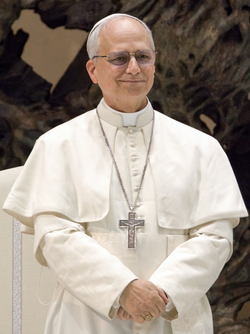
Pope Leo XIV
(Photo from via Wikipedia)
Zenit.org, a pro-Vatican news agency, posted that Pope Leo XIV said the following:
Dear brothers and sisters, good morning and welcome! Continuing our reading of the Conciliar Constitution Dei Verbum on Divine Revelation, today we will reflect on the relationship between Sacred Scripture and Tradition. …
It is what the Second Vatican Council affirms, using an evocative image: “There exists a close connection and communication between sacred tradition and Sacred Scripture. For both of them, flowing from the same divine wellspring, in a certain way merge into a unity and tend toward the same end” (Dei Verbum, 9). Ecclesial Tradition branches out throughout history through the Church, which preserves, interprets and embodies the Word of God. The Catechism of the Catholic Church (cf. no. 113) refers, in this regard, to a motto of the Church Fathers: “Sacred Scripture is written principally in the Church’s heart rather than in documents and records”, that is, in the sacred text. …
The Word of God, then, is not fossilized, but rather it is a living and organic reality that develops and grows in Tradition. …
In conclusion, dear friends, let us listen once more to Dei Verbum, which exalts the interweaving of Sacred Scripture and Tradition: it affirms that they “are so linked and joined together that they cannot stand independently, and together, each in their own way, under the action of the one Holy Spirit, they contribute effectively to the salvation of souls” (cf. no. 10).
What is the relationship between Sacred Scripture and Tradition? Pope Leo XIV responds. ZENIT – English, https://zenit.org/2026/01/28/what-is-the-relationship-between-sacred-scripture-and-tradition-pope-leo-xiv-responds/)
Pope Leo seems to push the view that through tradition, his church is adding to the words of God.
Even if Greco-Roman Catholicism claims revelation ended with the apostles, it still treats later church tradition as authoritative for doctrine, something Scripture itself never grants.
The Bible warns against adding to the word of God:
2 You shall not add to the word which I command you, nor take from it, that you may keep the commandments of the Lord your God which I command you. (Deuteronomy 4:2)
5 Every word of God is pure;
He is a shield to those who put their trust in Him.
6 Do not add to His words,
Lest He rebuke you, and you be found a liar. (Proverbs 30:5-6)6 Now these things, brethren, I have figuratively transferred to myself and Apollos for your sakes, that you may learn in us not to think beyond what is written, (1 Corinthians 4:6)
18 For I testify to everyone who hears the words of the prophecy of this book: If anyone adds to these things, God will add to him the plagues that are written in this book; 19 and if anyone takes away from the words of the book of this prophecy, God shall take away his part from the Book of Life, from the holy city, and from the things which are written in this book. (Revelation 22:18-19)
Of course, Pope Leo is not the only one to suggest that adding to the word of God is acceptable.
Nearly all in the Roman Catholic Church accept that doctrine comes from the Living Magisterium which is basically a combination of the portions of the Bible and its own traditions that the leadership has decided is important. Officially according to Vatican II, the Roman Catholic Church bases its teachings on what has been called:
Sacred Scripture and Sacred Tradition (Dogmatic Constitution on Divine Revelation, Dei Verbum #9, Vatican Council II. As quoted in Birch D.A. Trial, Tribulation & Triumph. Queenship Publishing Co, 1996; p.5).
Part of the reason for this is based on the findings of the Council of Trent that was held in the mid 16th Century. The Catholic Encyclopedia reports:
The Council, as is evident, held that there are Divine traditions not contained in Holy Scripture, revelations made to the Apostles either orally by Jesus Christ or by the inspiration of the Holy Ghost and transmitted by the Apostles to the Church. Holy Scripture is therefore not the only theological source of the Revelation made by God to His Church. Side by side with Scripture there is tradition, side by side with the written revelation there is the oral revelation. This granted, it is impossible to be satisfied with the Bible alone for the solution of all dogmatic questions (Bainvel J. Transcribed by Tomas Hancil. Tradition and Living Magisterium. The Catholic Encyclopedia, Volume XV, Copyright © 1912 by Robert Appleton Company. Online Edition Copyright © 2003 by K. Knight Nihil. Obstat, October 1, 1912. Remy Lafort, S.T.D., Censor Imprimatur. +John Cardinal Farley, Archbishop of New York).
Now the Vatican placed something at its website that it expects its people to accept:
With firm faith, I also believe everything contained in the word of God, whether written or handed down in Tradition, which the Church, either by a solemn judgment or by the ordinary and universal Magisterium, sets forth to be believed as divinely revealed.
I also firmly accept and hold each and everything definitively proposed by the Church regarding teaching on faith and morals.
Moreover, I adhere with religious submission of will and intellect to the teachings which either the Roman Pontiff or the College of Bishops enunciate when they exercise their authentic Magisterium, even if they do not intend to proclaim these teachings by a definitive act. (Ratzinger J., Cardinal. CONGREGATION FOR THE DOCTRINE OF THE FAITH PROFESSION OF FAITH. 9 January 1989. http://www.vatican.va/roman_curia/congregations/cfaith/documents/rc_con_cfaith_doc_1998_professio-fidei_en.html accessed 01/02/19)
So, it is claimed that tradition must be firmly believed by Roman Catholics.
The Eastern Orthodox Church also places a very high opinion on tradition (Ware T. The Orthodox Church. Penguin Book, St. Ives (England), 1997, p.195-207). Partially because of this, they have overlooked the original meaning of their own language for words such as stauros (see What is the Origin of the Cross as a ‘Christian’ Symbol?) and Kuriaki (see Another Look at the Didache, Ignatius, and the Sabbath).
The Roman Catholic, as well as Orthodox, position seems to be that since during most of the time the original Apostles were alive there was not a complete New Testament, that the early church relied heavily on oral teachings (which it often calls traditions or oral revelations) transmitted by Jesus and the Apostles. And this is of course true.
Karl Keating, the president of Catholic Answers, wrote the following:
It is true that Catholics do not think that revelation ended with what is in the New Testament. They believe, however, that it ended up with the death of the last apostle … study the first chapter of any elemental theological work by a Catholic. Every discussion of revelation notes that revelation ended when the last apostle died. (Keating Karl. Catholicism and fundamentalism: the attack on “Romanism” by “Bible Christians.” Ignatius Press, 1988, p. 151)
Similarly, the Catechism of the Catholic Church teaches:
81 “Sacred Scripture is the speech of God as it is put down in writing under the breath of the Holy Spirit.”
“And [Holy] Tradition transmits in its entirety the Word of God which has been entrusted to the apostles by Christ the Lord and the Holy Spirit. (Catechism of the Catholic Church. Imprimi Potest + Joseph Cardinal Ratzinger. Image Books by Doubleday, NY 2003, p. 31).
83 The Tradition here in question comes from the apostles and hands on what they received from Jesus’ teaching and example and what they learned from the Holy Spirit. (Catechism of the Catholic Church. Imprimi Potest + Joseph Cardinal Ratzinger. Image Books by Doubleday, NY 2003, p. 31).
Yet, Roman Catholics (and often the Orthodox) normally accept later “traditions” as valid even though their scholars acknowledge that they were not part of the revelation in the New Testament or from the original apostles. Even Protestant scholars often appeal to post-apostolic tradition. As do those associated with the Mormons and the Seventh-day Adventists.
However, it is not the proper Christian position that tradition is on par with scripture.
Paul wrote to Timothy,
…you have known the Holy Scriptures, which are able to make you wise for salvation through faith which is in Christ Jesus. All Scripture is given by inspiration of God, and is profitable for doctrine, for reproof, for correction, for instruction in righteousness, that the man of God may be complete, thoroughly equipped for every good work (2 Timothy 3:15-17).
No similar or parallel statement is ever made about tradition.
The Apostle Paul makes it clear that doctrine comes from the scriptures and that the scriptures themselves are there so “that the man of God may be complete.”
Note that tradition is not needed for the man of God to be complete nor needed to be “thoroughly equipped for every good work”.
Also note that the Holy Scriptures themselves, and not tradition, are able to make one “wise for salvation through faith which is in Christ Jesus”. Thus, perhaps the most dogmatic issues in the Bible CAN be determined from the Bible WITHOUT tradition.
Paul also taught,
2 Preach the word! (2 Timothy 4:2)
17 So then faith comes by hearing, and hearing by the word of God (Romans 10:17).
Notice that hearing (and even faith) comes from the word of God, not traditions.
Paul also taught that his oral teachings do not contradict his letters,
11 Let such a person consider this, that what we are in word by letters when we are absent, such we will also be in deed when we are present (2 Corinthians 10:11).
It is also important to note that Peter refers to Paul’s letters as scripture (2 Peter 3:15-16).
When Paul taught (even though he did learn some things directly from Jesus) he normally based his teachings on the scriptures,
2 Then Paul, as his custom was, went in to them, and for three Sabbaths reasoned with them from the Scriptures (Acts 17:2).
It is interesting to note that Paul also taught,
24 Not that we have dominion over your faith, but are fellow workers for your joy; for by faith you stand (2 Corinthians 1:24).
This suggests that he was teaching that his (or any other apostles) oral teachings do not have dominion over scripture.
Paul also warned about tradition:
8 Beware lest anyone cheat you through philosophy and empty deceit, according to the tradition of men, according to the basic principles of the world, and not according to Christ (Colossians 2:8).
This warning from Paul seems to be saying that traditions that are “not according to Christ” may deceive some and that Christians need to be on guard against it. While some traditions can have value, traditions that contradict biblical instruction cannot be considered “according to Christ.”
Paul also warned that there are:
13 … are false apostles, deceitful workers, transforming themselves into apostles of Christ. 14 And no wonder! For Satan himself transforms himself into an angel of light. 15 Therefore it is no great thing if his ministers also transform themselves into ministers of righteousness, whose end will be according to their works (2 Corinthians 11:13-15).
Paul had ran into teachers who taught idle traditions of men and warned that some were impacted by them:
5 Now the purpose of the commandment is love from a pure heart, from a good conscience, and from sincere faith, 6 from which some, having strayed, have turned aside to idle talk, 7 desiring to be teachers of the law, understanding neither what they say nor the things which they affirm. (1 Timothy 1:5-7)
20 … Guard what was committed to your trust, avoiding the profane and idle babblings and contradictions of what is falsely called knowledge — 21 by professing it some have strayed concerning the faith. (1 Timothy 6:20-21)
Various ones wanted to teach things that were not part of the original faith–sadly some, even in Paul’s day, strayed from that–as many have throughout the church age even till now (see also the free eBook: Beliefs of the Original Catholic Church: Could a remnant group have continuing apostolic succession?).
Christians are to follow Christ. What did Jesus teach?
Consider what Jesus taught:
31 Then Jesus said to those Jews who believed Him, “If you abide in My word, you are My disciples indeed. 32 And you shall know the truth, and the truth shall make you free.” (John 8:31-32)
Jesus was speaking to Jews who often accepted tradition above the word of God. He wanted to set them free. He also made clear that His true followers were set apart by the word of God:
17 Sanctify them by Your truth. Your word is truth. (John 17:12)
Also, notice the following from the Old Testament:
160 The entirety of Your word is truth, (Psalm 119:160)
21 … the Scripture of Truth. (Daniel 10:21)
Jesus also taught:
35 … Scripture cannot be broken (John 10:35)
Hence, do not accept traditions and declarations that oppose scripture.
Even in Jesus’ day, religious leaders sadly, “loved the praise of men more than the praise of God” (John 12:43).
Matthew 15:1-3 states:
Then the scribes and Pharisees who were from Jerusalem came to Jesus, saying, “Why do Your disciples transgress the tradition of the elders? For they do not wash their hands when they eat bread.” He answered and said to them, “Why do you also transgress the commandment of God because of your tradition?”
Jesus further told them:
“Thus you have made the commandment of God of no effect by your tradition. Hypocrites! Well did Isaiah prophesy about you, saying: ‘These people draw near to Me with their mouth, And honor Me with their lips, But their heart is far from Me. And in vain they worship Me, Teaching as doctrines the commandments of men‘ ” (Matthew 15:6-9).
Mark records the same incident where Jesus condemned religious leaders who treated inherited tradition as binding doctrine, declaring that such tradition can nullify the Word of God (Mark 7:1–13).
This establishes an important principle for Christians: tradition must always be judged by Scripture, never placed beside it as equal authority.
It may be of interest to note that according to Smith’s Bible Dictionary:
The fundamental principle of the Pharisees…is that…there was an oral law to complete and explain the written law, given to Moses.
In other words, the Pharisees were a group of religious leaders who said that one needed to rely on oral tradition to complete the written word of God. And, as we saw above, Jesus condemned them for this. The same is true of the Messianic Jews (Messianic Judaism Beliefs Differ from the Continuing Church of God) and even Laodicean Christians (such as the identity of the ‘man of sin,’ ‘nations’ of Revelation 17:12-13, and the deal of Daniel 9:27, to cite only three examples).
Perhaps the verse from Isaiah Jesus referred to should also be quoted:
13 Therefore the LORD said: “Inasmuch as these people draw near with their mouths And honor Me with their lips, But have removed their hearts far from Me, And their fear toward Me is taught by the commandment of men (Isaiah 29:13).
Hence both in the Old Testament and New Testament we are warned that traditions are not to be valued to the degree that the word of God should be. Many are afraid to believe God above traditions (see also Christian courage vs. cowardice).
Notice also the following:
1 You shall not circulate a false report. Do not put your hand with the wicked to be an unrighteous witness. 2 You shall not follow a crowd to do evil; (Exodus 23:1-2)
Those who push traditions over the word of God are circulating a false report. Do not tell yourself it is right to follow the crowd who accepts anti-biblical traditions.
Isaiah was also inspired to write:
9 Whom will he teach knowledge? And whom will he make to understand the message? 10 .. For precept must be upon precept, precept upon precept, Line upon line, line upon line, Here a little, there a little (Isaiah 28:9-10).
It should be noted that the Interlinear Bible translates word ‘knowledge’ (the Hebrew word shemuw’ ah) as doctrine. Isaiah also says that since this is how the word of the LORD is to be understood, that many will not understand correctly (vs. 13). Hence both the Old Testament and the New Testament (2 Timothy 3:16) say doctrine is to come from the Bible. Though one may need to look in many places (here a little and there a little) to properly understand.
Pope Leo XIV referred to ‘fathers’ of his church. But are their traditions supposed to be above or equal to scripture?
No!
Consider that in the late second century there was Melito. He was a bishop of Sardis and is considered to be a saint by both the Catholics of Rome and the Eastern Orthodox. He mocked those who clung to traditions as hypocrites:
Again, there are persons who say: Whatsoever our fathers have bequeathed to us, that we reverence. Therefore, of course, it is, that those whose fathers have bequeathed them poverty strive to become rich! and those whose fathers did not instruct them, desire to be instructed, and to learn that which their fathers knew not! And why, forsooth, do the children of the blind see, and the children of the lame walk? Nay, it is not well for a man to follow his predecessors, if they be those whose course was evil; but rather that we should turn from that path of theirs, lest that which befell our predecessors should bring disaster upon us also. (Melito. Translation by Roberts and Donaldson. A DISCOURSE WHICH WAS IN THE PRESENCE OF ANTONINUS CAESAR, AND HE EXHORTED THE SAID CAESAR TO ACQUAINT HIMSELF WITH GOD, AND SHOWED TO HIM THE WAY OF TRUTH. Online version copyright © 2001 Peter Kirby. http://www.earlychristianwritings.com/text/melito.html 9/04/05).
Since Melito is considered to be both a saint and a ‘father’ of the Church by those Catholics and Orthodox, then they should heed what he said.
Christians are to be set apart by the truth, which is the word of God:
17 Sanctify them by Your truth. Your word is truth. (John 17:17)
31 … “If you abide in My word, you are My disciples indeed. 32 And you shall know the truth, and the truth shall make you free.” (John 8:31-32)
The Bible never teaches that traditions of men are truth.
UPDATE 02/01/26: We just uploaded the following related video:
Pope Leo on Tradition and Scripture
Does the truth matter? Does the Bible matter? What did Pope Leo XIV state about sacred scripture and tradition? What about ‘church fathers’? Are sacred scripture and tradition equal? Is it all right if I add line upon line to the written word of God? Is it alright if I add one small precept on top of another small precept to the book of Revelation? Is it alright if the Roman Catholic church adds line upon line because of tradition? What did bishop Melito of Sardis write about accepting traditions in the second century A.D.? Is it okay if the Protestant churches add precept upon precept? Do they? Do the Greco-Roman Catholic and Protestant churches essentially add to the written word of God? What if they do? What if your church adds to the word of God? Would it matter to you if they did? Would it matter to God? What do the scriptures say? Are they sufficiently complete for salvation or is tradition also a biblical requirement? What did the Apostle Paul write about “all scripture” in 2 Timothy 3:16-17 and “the tradition of men” in Colossians 2:8? Listen as Dr. Thiel cites scripture after scripture warning delivered by Jesus Christ as well as through the apostles about the dangers of obeying the traditions of men rather than the commandments of God, and teaching others to do the same. Might doing that affect your name being written in the Book of Life?

Here is a link to our video: Pope Leo on on Tradition and Scripture.
Notice no matter how smart or religious someone may seem, the Bible clearly teaches:
4 Indeed, let God be true but every man a liar. (Romans 3:4)
Believe the word of God over traditions of men.
Scripture teaches that God’s written word is sufficient, authoritative, and complete for doctrine and salvation.
Jesus and the apostles warned repeatedly against elevating human tradition to divine status.
Therefore, any system that places later church tradition alongside Scripture as a source of revelation contradicts the biblical model.
Tradition may be useful historically, but it must always be judged by Scripture, never placed above it or beside it as equal authority.
Some items of related interest may include:
Tradition and Scripture: From the Bible and Church Writings Are traditions on equal par with scripture? Many believe that is what Peter, John, and Paul taught. But did they? Two related sermons are available Scripture and Traditions and Tradition and Scripture.
Who Gave the World the Bible? The Canon: Why do we have the books we now do in the Bible? Is the Bible complete? Are there lost gospels? What about the Apocrypha? Is the Septuagint better than the Masoretic text? What about the Textus Receptus vs. Nestle Alland? Was the New Testament written in Greek, Aramaic, or Hebrew? Which translations are based upon the best ancient text? Did the true Church of God have the canon from the beginning? Here are links to related sermons: Let’s Talk About the Bible, The Books of the Old Testament, The Septuagint and its Apocrypha, Masoretic Text of the Old Testament, and Lost Books of the Bible, and Let’s Talk About the New Testament, The New Testament Canon From the Beginning, English Versions of the Bible and How Did We Get Them?, What was the Original Language of the New Testament?, Original Order of the Books of the Bible, and Who Gave the World the Bible? Who Had the Chain of Custody?
The Last Pope of the Malachy Prophecies: Do Biblical and Greco-Roman Catholic Prophecies Point to Pope Leo XIV? This 154 page book has biblical and Greco-Roman Catholic prophecies related to the last pope, an antipope who will be the final Antichrist.