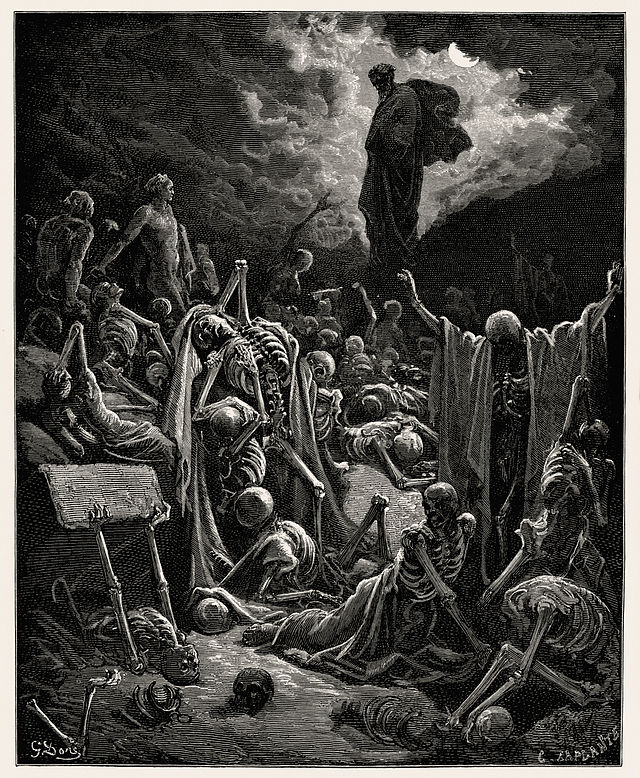
Valley of The Dry Bones of Ezekiel 37
(rendering by Gustave Doré)
From sunset this evening through sunset October 3, 2026 is a Holy Day often called the Last Great Day. It helps picture an important part of God’s plan of salvation.
This eighth day, the day which immediately follows the seven days of the Feast of Tabernacles, pictures the completion of the plan of redemption.
The “Book of Life” — typifying salvation — will be opened (Revelation 20:12). This is just prior to the new heaven and the new earth (Revelation 21:1). The Jews call this festival Shemini ‘Azeret, which means “eighth day of assembly” (also implying that the previous seven days of the Feast of Tabernacles were days of assembly).
The Temple Institute sent out the following in its newsletter today:
Jews started to call it Shemini ‘Azeret. Shemini, Sh’mini, or Shmini (שְּׁמִינִי) is the Hebrew word for “eighth” and ‘azeret means a time of assembly. Or, in other words, the eighth holy convocation.
The Jewish Encyclopedia of 1906 states:
SHEMINI ‘AZERET
Eighth day of Sukkot, “‘azeret” being the name given to it in Lev. xxiii. 36; Num. xxix. 35; Neh. viii. 18; II Chron. vii. 9. The eighth day of Sukkot is not mentioned in Deut. xvi., and is found only in those parts of the Bible known as the Priestly Code. Like “‘azarah” (Amos v. 21; Isa. i. 13; Joel i. 14), “‘azeret” denotes “day of assembly,” from “‘azar” = “to hold back” or “keep in”; hence also the name “‘azeret” given to the seventh day of Pesah (Deut. xvi. 8). Owing, however, to the fact that both the eighth day of Sukkot and the seventh day of Pesah are called “‘azeret,” the name was taken to mean “the closing festival.”
During the time of the Second Temple, Shebu’ot received the specific name of “‘Azarta” (Josephus, “Ant.” iii. 10, § 6; Pes. 42b, 68b), said to signify “the closing feast” of Passover (see Pesik. 193a). Commenting upon this fact, the Rabbis say (ib.): “The closing feast of Sukkot ought rightly to have been, like that of Pesah, on the fiftieth day; but, in order not to force the people to make another journey to Jerusalem in the rainy season, God fixed it as early as the eighth day.” Another comment upon the name “‘azeret” is as follows (ib.): “Whenever the people of Israel assemble in the houses of worship and instruction, God ‘keeps in’ His Shekinah with them.” For the meaning of “‘azar” Judges xiii. 15 is referred to. This is further illustrated by the following similitude (ib.): “A king gives to a large circle of friends a banquet which lasts seven days. When these have expired he says to his son: ‘During these days of feasting we have had little opportunity of enjoying each other’s company. Tarry [“be kept back” = “he’azer”] a day longer, that we may rejoice while holding a simple feast together.’ So God speaks to Israel thus: ‘During the seven days the Sukkot feast with its seventy bullocks for sacrifice was meant for the seventy nations [see Nations and Languages] of the world. Let this eighth day be a simple feast with one bullock and one ram as a sacrifice to express thy unique relation to Me'” (comp. Num. xxix. 35-37).
The peculiarities of Shemini ‘Azeret in the liturgy are the following:
- 1. It bears the name given above, with the word “hag” (feast) either inserted between its parts or added at the end. It is thus distinguished from Sukkot.
- 2. In the “Kiddush” at the evening meal thanks are given for having reached this season (“zeman”). This is not done on the seventh day of the Passover.
- 3. Hallel is read unabridged. Many persons eat in the “sukkah” or booth, but no one recites the benediction over the command to sit therein (Suk.47a).
- 4. The Book of Ecclesiastes is deemed the proper reading for the day, professedly on account of the words (xi. 2) “give a share to seven, even to eight” therein contained. In the German liturgy phrases from this book are worked into the “piyyutim” for the day.
- 5. The reading from the Pentateuch (first scroll) embraces the list of festivals given in Deuteronomy, closing with xvi. 17, though this day is not mentioned therein. It begins at xiv. 22—in some congregations only on the Sabbath, in which case it begins on week-days at xv. 19. In Palestine, where since the influx of the exiles from Spain are observed the one-year cycle and single feast-days, the closing lesson of the Pentateuch is read, followed by Gen. i. 1-ii. 3; that is, the lessons which during exile belong to Simhat Torah. From the second scroll Num. xxix. 35-37 is read; the prophetic lesson is I Kings viii. 54-66.
- 6. In the German ritual a memorial service for the dead is added (see Hazkarat Neshamot).
- 7. The winter, or, in Mishnah phrase, the “rainy” season, begins with the additional prayer of this day (see Geshem). (Shemini ‘Azeret. Jewish Encyclopedia of 1906. http://www.jewishencyclopedia.com/articles/13559-shemini-azeret viewed 09/19/14)
“The present-day celebration of Shemini ‘Asseret includes a prayer for abundant rains” (Shemini ‘Asseret in the Tenakh. Judaic Seminar Volume 6 Number 60. http://shamash.org/tanach/tanach/commentary/j-seminar/volume6/v6n60 ;5/20/03).
The Jews also teach “azeret is used in Numbers 29:35. It’s a time for judgment. Its judged for water” (Explaining Shemini Azeret. Hillel’s Joseph Meyerhoft Center for Jewish Learning. http://216.239.39.100/search?q=cache:xy-74RBIrDAJ:www.hillel.org/Hillel/NewHille.nsf/fcb8259ca861ae57852567d30043ba26/01e33713b517b64f85256c3a0057f951/%24FILE/shemini_atzeret.pdf+Explaining+Shemini+Atzeret&hl=en&ie=UTF-8, June 4 2003).
We in the Continuing Church of God teach it pictures the time of the great white throne judgment, where the Holy Spirit, symbolozed by Jesus in John 7:37 will be made available to the vast majority of human beings.
Getting back to the Jewish (or phrase of praise), it is always done on Shemini Atzeret:
Mashiv HaRuach U’Morid HaGeshem” is inserted into the blessing “describing” His indescribable Might, as the Source of life-giving rain. You are eternally mighty, my Lord, the Resuscitator of the dead are You; abundantly able to save” (“Mashiv HaRuach U’Morid HaGeshem” The Jewish Prayer for Wind and Rain (scanned material from ArtScroll Sukkot Machzor) http://www.ou.org/chagim/shmini-simchat/windnrain.htm#1, June 10, 2003).
“The Mishnah explains that rain during Sukkot would drench the lattice-roofed sukkah, and so would feel to those who were living there like a curse rather than a blessing. So the prayer for rain should wait till the sukkah dwelling was complete” (SEED FOR WINTER — SH’MINI ATZERET, CHAPTER IV: From Seasons of Our Joy (Beacon, 1990) By Arthur Waskow. http://www.shalomctr.org/html/seas45.html, June 13, 2003).
Shemini ‘azeret basically means the eighth day of assembly in Hebrew. Here is one thing that Jews in Germany have done on it and some other days:
HAZKARAT NESHAMOT:
Memorial service, held, according to the German ritual, after the readings of the Law and the Prophets in the morning service on the eighth day of Pesah, the second of Pentecost, the eighth of Sukkot (Shemini ‘Azeret), and the Day of Atonement. In memory of a father the following is recited:
“May God remember the soul of my respected father,–, son of–, who has gone to his eternal home; on whose behalf I vow as alms–; may his soul be bound up in the bundle of life [see I Sam. xxv. 29] with the souls of Abraham, Isaac, and Jacob, Sarah, Rebekah, Rachel, and Leah, and all other righteous men and women that are in the Garden of Eden, and let us say, Amen.”
The same prayer is recited in memory of a mother, with a change in gender; he whose father and mother are dead says both prayers. There is another formula for grandparents and for other kindred, and a special prayer for such as have died as martyrs for the faith. (Hazkarat Neshamot. Jewish Encyclopedia of 1906. http://www.jewishencyclopedia.com/articles/7421-hazkarat-neshamot viewed 09/19/14)
Christians use the term ‘the last great day’ because of what Jesus said on it:
37 On the last day, that great day of the feast, Jesus stood and cried out, saying, “If anyone thirsts, let him come to Me and drink. 38 He who believes in Me, as the Scripture has said, out of his heart will flow rivers of living water.” (John 7:37-38)
God’s Holy Days lay out parts of His plan of salvation that most do not understand. It is a marvelous and loving plan.
God has a plan.
Revelation 21:6 shows:
6 And He said to me, “It is done! I am the Alpha and the Omega, the Beginning and the End. I will give of the fountain of the water of life freely to him who thirsts…”
Does this sound like Jesus intends that salvation will be available to all or only a relative few?
2 Corinthians 5:14-15, Paul teaches:
14 For the love of Christ compels us, because we judge thus: that if One died for all, then all died; 15 and He died for all, that those who live should live no longer for themselves, but for Him who died for them and rose again.
Notice that Paul clearly teaches that Jesus has died for all. Not a few elect (like the Calvinists teach), not the relative few that accept Christ in this age (as most Protestant/Baptist/Evangelicals teach), not a minority of humankind (as most Roman Catholics teach).
For Jesus to die for all, ALL must have an opportunity for salvation. And since God is all knowing, certainly He knows how to have a plan of salvation where the most possible will be saved.
God is love (1 John 4) and God’s plan is one of love. God is wise enough to have a plan of salvation that makes sense and actually works!
But most do not understand God’s plan or the timing of it.
Here is a sermon for this day made in 2026 in Brisbane, Australia:
God’s Plan for Salvation for the Bulk of Humanity Makes Sense
Will God offer salvation to all that ever lived or just the called of this age? Are there hundreds of scriptures that many have overlooked or misunderstood that teach the truth about God’s loving plan of salvation? Would not a God of love have a plan of salvation that makes sense? Was Jesus referring to this when He spoke on the Last Great Day of the Feast? Did early Christians, and even some Jewish sages, understand and teach any of this? Will all flesh see the salvation of God? Will those blinded be forgiven? When will this happen? What about sinners who were killed in Sodom and Gomorrah? Does God have a plan to save those who died and are lost? Are sinners going to suffer torment for eternity? When? Does the Bible show that nations that were afar off will come to the knowledge of the truth? Will people actually have to repent–and will most do so after the second resurrection? What about mercy? What about judgment? Dr. Thiel addresses these matters and more.

Here is a link to that sermon: God’s Plan for Salvation for the Bulk of Humanity Makes Sense.
Some items of related interest may include:
The Last Great Day: Shemini ‘Azeret What is the ‘eighth day’ of the Feast? What does it help picture? A sermon on this topic is also available: Shemini Azaret: The Last Great Day.
Hope of Salvation: How the Continuing Church of God Differs from Protestantism The CCOG is NOT Protestant. This free online book explains how the real Church of God differs from mainstream/traditional Protestants. Several sermons related to the free book are also available: Protestant, Baptist, and CCOG History; The First Protestant, God’s Command, Grace, & Character; The New Testament, Martin Luther, and the Canon; Eucharist, Passover, and Easter; Views of Jews, Lost Tribes, Warfare, & Baptism; Scripture vs. Tradition, Sabbath vs. Sunday; Church Services, Sunday, Heaven, and God’s Plan; Seventh Day Baptists/Adventists/Messianics: Protestant or COG?; Millennial Kingdom of God and God’s Plan of Salvation; Crosses, Trees, Tithes, and Unclean Meats; The Godhead and the Trinity; Fleeing or Rapture?; and Ecumenism, Rome, and CCOG Differences.
Beliefs of the Original Catholic Church. Did the original “catholic church” have doctrines held by the Continuing Church of God? Did Church of God leaders uses the term “catholic church” to ever describe the church they were part of? Here are links to related sermons: Original Catholic Church of God?, Original Catholic Doctrine: Creed, Liturgy, Baptism, Passover, What Type of Catholic was Polycarp of Smyrna?, Tradition, Holy Days, Salvation, Dress, & Celibacy, Early Heresies and Heretics, Doctrines: 3 Days, Abortion, Ecumenism, Meats, Tithes, Crosses, Destiny, and more, Saturday or Sunday?, The Godhead, Apostolic Laying on of Hands Succession, Church in the Wilderness Apostolic Succession List, Holy Mother Church and Heresies, and Lying Wonders and Original Beliefs.
Is God Calling You? This booklet discusses topics including calling, election, and selection. If God is calling you, how will you respond? Here is are links to related sermons: Christian Election: Is God Calling YOU? and Predestination and Your Selection. A short animation is also available: Is God Calling You?
Should You Observe God’s Holy Days or Demonic Holidays? This is a free pdf booklet explaining what the Bible and history shows about God’s Holy Days and popular holidays. Two related sermon would be Which Spring Days should Christians observe? and Fall Holy Days for Christians.
John Calvin, Calvinism, TULIP, and What is Predestination? Who was John Calvin? Did he believe in sola Scriptura or did he hold to unbiblical doctrines? TULIP analyzed. A sermonette related to this is also available: Tulip Predestination?
What is the Meaning of Life? Who does God say is happy? What is your ultimate destiny? Do you really know? Does God actually have a plan for YOU personally? If you would like to watch videos covering subjects of this article, you can click on the following links: Why YOU? Why Do YOU Suffer? and What is the meaning of your life?
Teachings of the Church of Jesus Christ of Latter Day Saints (LDS) and the Continuing Church of God The genuine Church of God is not related to the Mormons and this article explains some differences and a couple of similarities. Also, might certain LDS prophecies apply to Mitt Romney? A sermon of related interest is available: Mormon vs. Church of God Teachings.
Some Similarities and Differences Between the Eastern Orthodox Church and the Continuing Church of God Both groups claim to be the original church, but both groups have differing ways to claim it. Both groups have some amazing similarities and some major differences. Do you know what they are? Here is a link to a related sermon: Eastern Orthodox 40+ Similar Beliefs to the CCOG.
Which Is Faithful: The Roman Catholic Church or the Continuing Church of God? Do you know that both groups shared a lot of the earliest teachings? Do you know which church changed? Do you know which group is most faithful to the teachings of the apostolic church? Which group best represents true Christianity? This documented article answers those questions.
Did the Early Church Teach Purgatory? Is there a place called purgatory? Does God have a plan to help those who did not become saints in this life?
What is Limbo? Is There Such a Place as Limbo? What Happens to Babies When They Die? When did Limbo start being taught? What is the truth about dead babies?
Did Early Christians Observe the Fall Holy Days? The ‘Fall’ Holy Days come every year in September and/or October on the Roman calendar. Some call them Jewish holidays, but they were kept by Jesus, the apostles, and their early faithful followers. Should you keep them? What does the Bible teach? What do records of church history teach? What does the Bible teach about the Feasts of Trumpets, Atonement, Tabernacles, and the Last Great Day? Here is a link to a related sermon: Should you keep the Fall Holy Days?
What is the Unpardonable Sin? What is it? Can you repent of it? Do you know what it is and how to avoid it?
Is There “An Annual Worship Calendar” In the Bible? This paper provides a biblical and historical critique of several articles, including one by the Tkach WCG which states that this should be a local decision. What do the Holy Days mean? Also you can click here for the calendar of Holy Days.
Universal OFFER of Salvation, Apokatastasis: Can God save the lost in an age to come? Hundreds of scriptures reveal God’s plan of salvation Will all get a fair chance at salvation? This free book is packed with scriptures showing that God does intend to offer salvation to all who ever lived–the elect in this age, and the rest in the age to come. Here is a link to a related sermon series: Universal Offer of Salvation 1: Apocatastasis, Universal Offer of Salvation 2: Jesus Desires All to be Saved, Mysteries of the Great White Throne Judgment (Universal Offer of Salvation part 3), Is God Fair, Will God Pardon the Ignorant?, Can God Save Your Relatives?, Babies, Limbo, Purgatory and God’s Plan, and ‘By the Mouth of All His Holy Prophets’.
All the Prophets Spoke of Apocatastasis The Apostle Peter said all the prophets spoke about “apokatastasis. Do you know what that is? Watch also ‘By the Mouth of All His Holy Prophets’.
The Feast of Tabernacles: A Time for Christians? Is this pilgrimage holy day still valid? Does it teach anything relevant for today’s Christians? What is the Last Great Day? What do these days teach? Here is a link to a sermon about Last Great Day.
Holy Day Calendar This is a listing of the biblical holy days through 2033, with their Roman calendar dates. They are really hard to observe if you do not know when they occur 🙂 In the Spanish/Español/Castellano language: Calendario de los Días Santos. In Mandarin Chinese: 何日是神的圣日? 这里是一份神