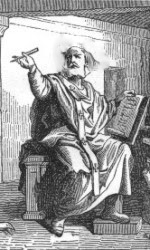
Artist’s portrayal Lucian of Antioch
(Modified from free-images.com)
The Catholics of Rome consider January 7th as the day to honor Lucian of Antioch. This should seem to be somewhat odd to them.
Why?
Because the historical records that have been preserved show that Lucian held doctrines we are teaching in the Continuing Church of God, which are now opposed by the Church of Rome. He also did not hold Protestant views.
The Protestant scholar Philip Schaff wrote this:
Lucian of Antioch
Lucian was an eminent presbyter of Antioch and martyr of the Diocletian persecution, renewed by Maximin. Very little is known of him. He was transported from Antioch to Nicomedia, where the emperor then resided, made a noble confession of his faith before the judge and died under the tortures in prison (311). His memory was celebrated in Antioch on the 7th of January. His piety was of the severely ascetic type.
His memory was obscured by the suspicion of unsoundness in the faith. Eusebius twice mentions him and his glorious martyrdom, but is silent about his theological opinions. Alexander of Alexandria, in an encyclical of 321, associates him with Paul of Samosata and makes him responsible for the Arian heresy; he also says that he was excommunicated or kept aloof from the church (ἀποσυνάγωγος ἔμεινε) during the episcopate of Domnus, Timaeus, and Cyrillus …
Lucianus is known also by his critical revision of the text of the Septuagint and the Greek Testament. Jerome mentions that copies were known in his day as “exemplaria Lucianea,” but in other places he speaks rather disparagingly of the texts of Lucian, and of Hesychius, a bishop of Egypt (who distinguished himself in the same field). In the absence of definite information it is impossible to decide the merits of his critical labors. His Hebrew scholarship is uncertain, and hence we do not know whether his revision of the Septuagint was made from the original…(Schaff, Philip, History of the Christian Church, Lucian of Antioch (Oak Harbor, WA: Logos Research Systems, Inc.) 1997. This material has been carefully compared, corrected, and emended –according to the 1910 edition of Charles Scribner’s Sons — by The Electronic Bible Society, Dallas, TX, 1998)
Like Ignatius, Polycarp, Melito, Apollinaris would be considered a binitarian/semi-arian. However, those associated with the Catholics of Rome and the Eastern Orthodox accepted the trinitarian position of Theodosius which they adopted in 381.
Notice what the Roman Catholic Cardinal Newman wrote:
Lucian, who schismatized or was excommunicated on his deposition, held heretical tenets of a diametrically opposite nature, that is, such as were afterwards called Semi-Arian; Paulus himself advocating a doctrine which nearly resembled what is commonly called the Sabellian.
More shall be said concerning Paulus of Samosata presently; but now let us advance to the history of this Lucian, a man of learning, and at length a martyr, but who may almost be considered the author of Arianism … that during the times of the three bishops who successively followed Paulus, Lucian was under excommunication. The Catholics too, are silent in his vindication, and some of them actually admit his unsoundness in faith … (Cardinal Newman, John Henry. The Arians of the Fourth Century. Longmans, Green, & Co., New York, 1908, p.7)
I would rather direct the reader’s attention to the particular form which the Antiochene corruptions seem to have assumed, viz., that of Judaism… (Cardinal Newman, John Henry. The Arians of the Fourth Century. Longmans, Green, & Co., New York, 1908, p.9)
Although some Eastern Orthodox claim Lucian reconciled with them in 285 (Sanidopoulos J. The Orthodoxy of Lucian of Antioch. ORTHODOX CHRISTIANITY THEN AND NOW, October 15, 2009 https://www.johnsanidopoulos.com/2009/10/orthodoxy-of-lucian-of-antioch.html#:~:text=Church%20authorities%20officially%20accepted%20a,.%2C%209%3A6), there does not look to be any real proof of that. Furthermore, in 321 A.D. he was listed as an apostate by Alexander of Alexandria in 321 (Encyclical Letter of Alexander, Archbishop of Alexandria, upon his Deposition and Excommunication of Arius, 321). Hence, that is evidence that Lucian was NOT ever “reconciled” with the Greco-Roman confederation that was emerging in the 3rd and 4th centuries.
The Continuing Church of God has published some information on Lucian in two of its free e-books. Here is information found in Beliefs of the Original Catholic Church: Could a remnant group have continuing apostolic succession?:
In the late 3rd through early 4th century, there was a church leader known as Lucian of Antioch. Lucian was not in communion with the succession of at least three Greco-Roman bishops of Antioch, had a school based on literal biblical interpretation, “savoured of Judaism,” and was “Semi-Arian” (binitarian) (Newman JH, Cardinal. The Arians of the Fourth Century. Longmans, Green, & Co., New York, 1908, pp. 5, 9, 277, 406). Lucian reportedly was a Sabbatarian (Wilkinson BG. The Truth Triumphant. TEACH Services, Reprint 1994, pp. 55-57; Kohen E. History of the Byzantine Jews. University Press of America, 2007, p. 53).
In a seemingly 4th century creed ascribed to him, Lucian (or perhaps penned by a disciple) used the term “Catholic Church of God” (Schaff P. The Creeds of Christendom: The Greek and Latin creeds, with translations, Volume II. Harper and Brothers, 1877, pp. 28-29). This would not seem to have been a reference to the Greco-Roman churches as Lucian opposed the Alexandrian school which they encouraged. Lucian looks to have been a Church of God leader.
Lucian’s Creed seems to be the oldest known document with the exact expression “Catholic Church of God.” Although as shown already, Ignatius implied that as he used both “church of God” and “catholic Church” expressions in his 2nd century Letter to the Smyrnaeans. …
Perhaps it should be emphasized that the school in Antioch that Lucian ran was opposed to the allegorical and semi-Gnostic school of Alexandria. The schools were NOT in true communion with each other. …
It should be clear that no later than the early 3rd century (but most likely by the mid-late 2nd century) those in Asia Minor and Antioch were not in communion with those of Rome, Jerusalem, and Alexandria. Rome was also supportive of the ‘allegorical’ school of Alexandria that Origen was part of, but not of the ‘literal’ school that Lucian of Antioch was associated with in the 3rd century. Origen also supported infant baptism that was not supported by those of Asia Minor or Antioch. …
Although there are contradictory reports about him and his theology (like him supposedly reconciling with the area’s Greco-Roman Bishop while still reportedly maintaining his binitarianism, Sabbath-keeping, biblical literalism, etc.), he looks to probably have been a COG leader. If so, Lucian may be one who held the succession mantle from about 275 through his martyrdom in 312. …
Lucian himself, improves Greek Septuagint by using Hebrew Masoretic documents and also edits the ‘Traditional Text’ of the Greek New Testament. …
It should be noted, however, that during the time of Asclepiades the Confessor we assert that there were Christian leaders in Antioch of Syria that did not follow him. We feel that later leaders that are NOT on the Orthodox succession lists, such as perhaps Lucian (270-312) who looked to have held COG doctrines, would have had God’s faithful succession—the succession we in the CCOG would consider as the standard. That position is consistent with the following:
Jewish Christianity … up to the fourth century, the followers of Jesus who observed ritual practices of the Mosaic Law and preserved theological traditions of Judaic origin had notable communities in Syria – (Myllykoski M. James the Just in History and Tradition: Perspectives of Past and Present Scholarship. Currents in Biblical Research, 2006, Vol. 5.1: 73-122)
Hence, we believe that there were ‘Judaic‘ Syrian Antiochians in our 3rd and 4th century succession lists (some whose names are known, with others unknown), which is consistent with some available historical claims. …
Apostolic Succession List as put together by the Continuing Church of God
c. 31 – c. 64-68 Apostle Peter
c. 67 – c. 98-102 Apostle John
c. 100 – c. 157 Polycarp of Smyrna
c. 157 – c. 160 Thraseas of Smyrna
c. 160 – c. 167 Sagaris of Laodicea
c. 167 – c. 170 Papirius of Smyrna
c. 170 – c. 180 Melito of Sardis
c. 180 – c. 200 Polycrates of Ephesus
c. 200 – c. 220 Camerius of Smyrna
c. 220 – c. 254 Nepos of Arsinoe
c. 254 – c. 275 Unnamed Antiochian(s) or possibly Dorotheus
c. 275 – 312 Lucian of Antioch …In the 3rd and 4th centuries, Lucian of Antioch was also known to be binitarian (Newman JH, Cardinal. The Arians of the Fourth Century, pp. 277, 406). …
Notice this condemnation by a Roman Catholic Cardinal for holding the original view of the Godhead:
Lucian, who schismatized or was excommunicated on his deposition, held heretical tenets of a diametrically opposite nature, that is, such as were afterwards called Semi-Arian . . . I would rather direct the reader’s attention to the particular form which the Antiochene corruptions seem to have assumed, viz., that of Judaism . . . (Newman JH, Cardinal. The Arians of the Fourth Century, pp. 7,9).
This is showing that there were people in the Antioch area in the 3rd and 4th centuries that held to some form of Judeao-Christianity, as well to binitarianism, in the late 3rd entury according to Catholic sources, who were not part of the group in communion with Rome and Alexandria.
Here is something from a later book put out by the Continuing Church of God titled Mysteries of God: What is God?:
The following is claimed to be the Creed of Lucian of Antioch (it surfaced a couple of decades after he was martyred)—if Lucian was the actual writer, it may be the oldest written creed:
We believe in one God, the Father Almighty; And in the Lord Jesus Christ, his Son, who was begotten of him before all ages, the Divine Logos, through whom all things were made, both those in the heavens and those on the earth; who came down and was made flesh; and suffered; and rose again; and ascended to the heavens; and shall come again to judge the quick and the dead. And in the Holy Ghost; and in the resurrection of the flesh; and in the life of the world to come; and in a kingdom of heaven; and in one Catholic Church of God which extends to the ends of the earth. (Schaff P. The Creeds of Christendom: The Greek and Latin creeds, with translations, Volume II. Harper and Brothers, 1877, pp. 28-29)
Note: While Jesus was not physically begotten until about nine months before His human birth, the plan for His birth existed before the ages of the earth began (cf. Revelation 13:8). Note also that the original Greek text, καθολικὴν ἐκκλησίαν τοῦ θεοῦ, does not separately capitalize ‘Catholic Church.’
Yet it is interesting that what may be the oldest ‘creed’ refers to the catholic church of God as well as teaches that Jesus was made flesh.
Lucian of Antioch was not in communion with the Greco-Roman bishops of Antioch nor those of Alexandria, and yet he is considered a saint by the Greco-Romans. Although there are contradictory reports about him and his theology (like him supposedly reconciling with the area’s Greco-Roman Bishop while still reportedly maintaining his binitarianism, Sabbath-keeping, biblical literalism, etc.), he held COG doctrines. Lucian looks to be the one who held the church leadership succession mantle from about 275 through his martyrdom in 312. …
[T]here were people in the Antioch area in the 3rd and 4th centuries that held to some form of Judeao-Christianity, as well to binitarianism. And who, according to Roman Catholic sources, were not part of the group in communion with Rome and Alexandria. Furthermore, in 321 A.D. Lucian was listed as an apostate by Alexander of Alexandria (Encyclical Letter of Alexander, Archbishop of Alexandria, upon his Deposition and Excommunication of Arius, 321). Hence, Lucian was not considered to have reconciled with the Greco-Roman confederation before his death—though he is claimed to be a saint by the modern Greco-Roman Catholic churches.
The Catholic Encyclopedia states:
Lucian of Antioch … Though he cannot be accused of having shared the theological views of Paul of Samosata, he fell under suspicion at the time of Paul’s condemnation, and was compelled to sever his communion with the Church … The opposition to the allegorizing tendencies of the Alexandrines centred in him. He rejected this system entirely and propounded a system of literal interpretation … (Healy PJ. Lucian of Antioch. The Catholic Encyclopedia)
Yes, those who literally believed scripture were condemned by the allegorists. Lucian was probably considered to be a type of ‘Paulician,’ which is a name the Greco-Romans assigned to people with beliefs like his. …
Here is a list of early binitarians and trinitarians with their respective centuries:
Binitarians Trinitarians
Ignatius 1st/2nd Valentinus 2nd
Polycarp 1st/2nd Montanus 2nd
Justin Martyr 2nd Tertullian 2nd/3rd
Athenagoras 2nd
Melito 2nd
Theophilus 2nd
Irenaeus 2nd
Hippolytus 3rd
Lucian 3rd/4th
Eusebius 4thEveryone in that binitarian list is considered to be a saint by at least some of the Greco-Roman Catholics, whereas those listed as trinitarians are ALL considered to be heretics/apostates by the Greco-Roman Catholics. This should help show all willing to believe the truth that early professor of Jesus were binitarian, not trinitarian. …
5. Council of Tarsus (358 or later)
- Supported the Semi-Arian position with a creed about the same as the Council of Anycyra. It declared that the Lucian creed should be the guide (Sozomen. Ecclesiastical History, Book VI, Chapter 11) …
The two earliest know creeds (the Old Roman Form and Creed of Lucian) were not trinitarian. …
In the late 3rd through early 4th century, there was a church leader known as Lucian of Antioch. Lucian was not in communion with the succession of at least three Greco-Roman bishops of Antioch, had a school based on literal biblical interpretation, “savoured of Judaism,” and was “Semi-Arian” (binitarian) (Newman JH, Cardinal. The Arians of the Fourth Century. Longmans, Green, & Co., New York, 1908, pp. 5, 9, 277, 406). Lucian reportedly was a Sabbatarian (Wilkinson BG. The Truth Triumphant. 1944. TEACH Services, Reprint 1994, pp. 55-57; Kohen E. History of the Byzantine Jews. University Press of America, 2007, p. 53).
In a seemingly 4th century creed ascribed to him, Lucian (or perhaps penned by a disciple) used the term “Catholic Church of God” (Schaff P. The Creeds of Christendom: The Greek and Latin creeds, with translations, Volume II. Harper and Brothers, 1877, pp. 28-29). This would not seem to have been a reference to the Greco-Roman churches as Lucian opposed the Alexandrian school which they encouraged. Lucian looks to have been a Church of God leader.
Lucian’s Creed seems to be the oldest known document with the exact expression “Catholic Church of God.” Although as shown already, Ignatius implied that as he used both “church of God” and “catholic Church” expressions in his 2nd century Letter to the Smyrnaeans.
Paulicians?
On February 27, 380, Roman Emperor Theodosius decreed only those who accepted his trinitarian creed could call themselves “Catholic Christians.”
However, some of those who disagreed with Theodosius still used it after Theodosius’ decree. Fred Conybeare reported that in the Middle Ages the Paulicians of Armenia continued to state,“They were the ‘holy, universal, and apostolic Church,’ founded by Jesus Christ and his apostles” (Conybeare, p. xxxiii). Those called Paulicians opposed Sunday observance and the Greco-Roman festivals, while apparently observing the seventh-day Sabbath (Ibid, pp. clii, cxciii).
Also, notice this about them:
They called themselves the Apostolic Catholic church, but … nicknamed Paulicians by their enemies … (Paulicians. The Encyclopaedia Britannica: Mun to Pay. 1911, p. 961; Blackwell D. A HANDBOOK OF CHURCH HISTORY: A Thesis Presented to the Faculty of the Ambassador College Graduate School of Theology. April 1973, p.29)
In Kurtz’s Church History, article Nostic and Manichean Heretics:
The Catholics, this sect called Romans, gave them the name Paulicians. (Blackwell, p. 48)
The Paulicians claimed to be THE “holy universal and apostolic church” founded by Jesus Christ and his apostles. Of the false churches, they would say: “We do not belong to these, for they have long ago broken connection with the church.” (Lesson 50 – I Will Build My Church, Part 2. 58 Lesson: Ambassador College Bible Correspondence Course, 1965)
So, while the biblical name of the true church was Church of God, the term catholic was also associated with the faithful as well as others who adopted that name.
Lucian had to deal with the allegorical scholars of his day.
He and his school stood opposed to them.
His non-trinitarian creed proclaimed the catholic Church of God.
Lucian stood for the original view of the Godhead and looks to have kept the seventh-day Sabbath. Since he reportedly had Judeo-practices, it can be safely assumed he did not eat biblically unclean meat.
Because of those differences, he could not have been in communion with the Greco-Roman churches, which helps explain why the Alexandrian Archbishop Alexander denounced him as apostate. Yet, the Greco-Roman Catholics now claim him as one of their saints.
Lucian was martyred by the Roman Emperor Maximus.
Decades AFTER his martyrdom, let me add that the trinitarian Emperor Theodosius declared that the Paulicians and others who did not accept his trinitarian decree could no longer use the term “catholic”
Lucian, though a well known Church of God leader, faced tests and challenges.
Jesus prophesied the following:
21 “Now brother will deliver up brother to death, and a father his child; and children will rise up against parents and cause them to be put to death. 22 And you will be hated by all for My name’s sake. But he who endures to the end will be saved.” (Matthew 10:21-22)
While we do not know who betrayed him, Lucian endured to the end.
So, we know that Lucian would be saved.
If you, too are a true Church of God Christian, and you endure to the end, you will be able to meet Lucian after the second resurrection.
Some items of possibly related interest may include the following:
Lucian of Antioch He was an early church leader that ran a school promoting scripture over allegory and tradition. He also held a binitarian view of the Godhead.
Mysteries of God: What is God? Is God omniscient, omnipresent, and omnipotent? Does the Godhead consist of a closed trinity or an expanding family?
Some Similarities and Differences Between the Eastern Orthodox Church and the Continuing Church of God Both groups claim to be the original church, but both groups have differing ways to claim it. Both groups have some amazing similarities and some major differences. Do you know what they are? Here is a link to a related sermon: Eastern Orthodox 40+ Similar Beliefs to the CCOG.
Beliefs of the Original Catholic Church: Could a remnant group have continuing apostolic succession? Did the original “catholic church” have doctrines held by the Continuing Church of God? Did Church of God leaders uses the term “catholic church” to ever describe the church they were part of? Here are links to related sermons: Original Catholic Church of God?, Original Catholic Doctrine: Creed, Liturgy, Baptism, Passover, What Type of Catholic was Polycarp of Smyrna?, Tradition, Holy Days, Salvation, Dress, & Celibacy, Early Heresies and Heretics, Doctrines: 3 Days, Abortion, Ecumenism, Meats, Tithes, Crosses, Destiny, and more, Saturday or Sunday?, The Godhead, Apostolic Laying on of Hands Succession, Church in the Wilderness Apostolic Succession List, Holy Mother Church and Heresies, and Lying Wonders and Original Beliefs. Here is a link to that book in the Spanish language: Creencias de la iglesia Católica original.
Hope of Salvation: How the Continuing Church of God Differs from Protestantism The CCOG is NOT Protestant. This free online book explains how the real Church of God differs from mainstream/traditional Protestants. Several sermons related to the free book are also available: Protestant, Baptist, and CCOG History; The First Protestant, God’s Command, Grace, & Character; The New Testament, Martin Luther, and the Canon; Eucharist, Passover, and Easter; Views of Jews, Lost Tribes, Warfare, & Baptism; Scripture vs. Tradition, Sabbath vs. Sunday; Church Services, Sunday, Heaven, and God’s Plan; Seventh Day Baptists/Adventists/Messianics: Protestant or COG?; Millennial Kingdom of God and God’s Plan of Salvation; Crosses, Trees, Tithes, and Unclean Meats; The Godhead and the Trinity; Fleeing or Rapture?; and Ecumenism, Rome, and CCOG Differences.
Tradition and Scripture: From the Bible and Church Writings Are traditions on equal par with scripture? Many believe that is what Peter, John, and Paul taught. But did they? Two related sermons are available Scripture and Traditions and Tradition and Scripture.
Hope of Salvation: How the Continuing Church of God Differs from Protestantism The CCOG is NOT Protestant. This free online book explains how the real Church of God differs from mainstream/traditional Protestants. Several sermons related to the free book are also available: Protestant, Baptist, and CCOG History; The First Protestant, God’s Command, Grace, & Character; The New Testament, Martin Luther, and the Canon; Eucharist, Passover, and Easter; Views of Jews, Lost Tribes, Warfare, & Baptism; Scripture vs. Tradition, Sabbath vs. Sunday; Church Services, Sunday, Heaven, and God’s Plan; Seventh Day Baptists/Adventists/Messianics: Protestant or COG?; Millennial Kingdom of God and God’s Plan of Salvation; Crosses, Trees, Tithes, and Unclean Meats; The Godhead and the Trinity; Fleeing or Rapture?; and Ecumenism, Rome, and CCOG Differences.
Where is the True Christian Church Today? This free online pdf booklet answers that question and includes 18 proofs, clues, and signs to identify the true vs. false Christian church. Plus 7 proofs, clues, and signs to help identify Laodicean churches. A related sermon is also available: Where is the True Christian Church? Here is a link to the booklet in the Spanish language: ¿Dónde está la verdadera Iglesia cristiana de hoy? Here is a link in the German language: WO IST DIE WAHRE CHRISTLICHE KIRCHE HEUTE? Here is a link in the French language: Où est la vraie Église Chrétienne aujourd’hui?
Continuing History of the Church of God This pdf booklet is a historical overview of the true Church of God and some of its main opponents from Acts 2 to the 21st century. Related sermon links include Continuing History of the Church of God: c. 31 to c. 300 A.D. and Continuing History of the Church of God: 4th-16th Centuries and Continuing History of the Church of God: 17th-20th Centuries. The booklet is available in Spanish: Continuación de la Historia de la Iglesia de Dios, German: Kontinuierliche Geschichte der Kirche Gottes, French: L’Histoire Continue de l’Église de Dieu and Ekegusii Omogano Bw’ekanisa Ya Nyasae Egendererete.
The History of Early Christianity Are you aware that what most people believe is not what truly happened to the true Christian church? Do you know where the early church was based? Do you know what were the doctrines of the early church? Is your faith really based upon the truth or compromise?