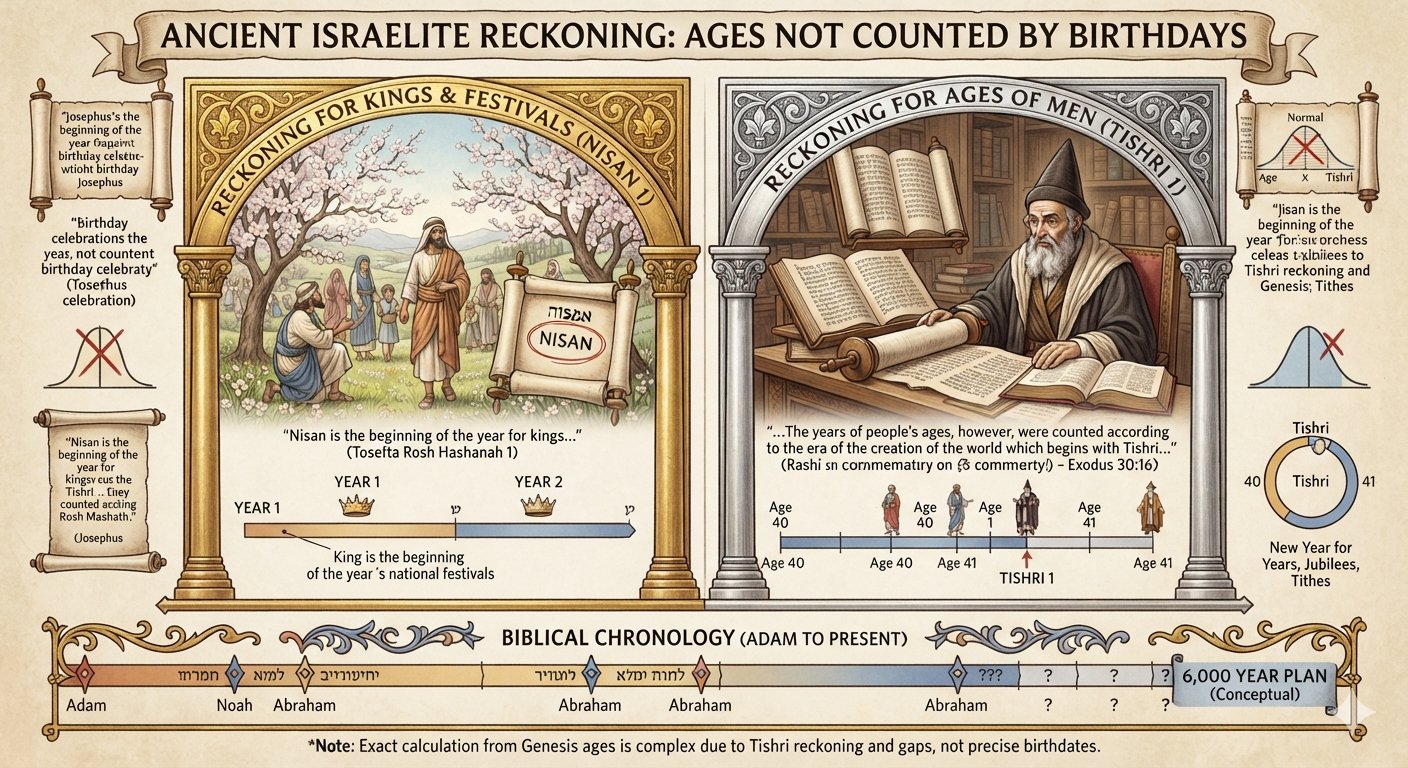
(COGwriter directed illustration)
Various ones have attempted to calculate the amount of time from Adam to present.
But, by failing to take into consideration how the ancient Israelites counted personal ages and the reigns of kings complicates this more than most understand.
As many are aware, anciently the children of Israel did not celebrate birthdays. This was confirmed by the first century A.D. historian Josephus who wrote:
Nay, indeed, the law does not permit us to make festivals at the birth of our children, and thereby afford occasion of drinking to excess (Josephus. Translated by W. Whiston. Against Apion, Book II, Chapter 26. Extracted from Josephus Complete Works, Kregel Publications, Grand Rapids (MI), 14th printing, 1977, p. 632).
Now although there is no specific command against the celebration of birthdays in the Bible, the Jewish custom in those days was apparently based on the negative occurrences in the Bible surrounding birthdays, as well as the astrological implications of the celebration of birthdays (pagan practices, like astrology, were specifically prohibited in the law–see also OMENS? DIVINATION? HOROSCOPES? THE ORIGIN OF ASTROLOGY).
Because they did NOT celebrate birthdays, this looks to have been a factor in not necessarily using them to calculate someone’s actual age.
Today, a woman asked me about a statements in my article Could God Have a 6,000 Year Plan? What Year Does the 6,000 Years End?:
While the Bible tells the ages of fathers when they begot sons, it seems illogical to conclude that the fathers and sons were all born on the same calendar date–people were not all born on the same ‘birthday’ calendar date. Hence, although the straight calculations based upon the ages listed in Genesis is correct assuming what is called a ‘normal distribution’ of data, the data pool is small enough that the results could be statistically expected to be other than ‘normal.’
It is not certain that a rounding for ‘normal distribution’ was used. Instead, the ages of the ancients when they begat sons could instead be based upon their calculated ages based upon a Spring or Fall date. The Jewish Encyclopedia points out “The Rabbis recognize four beginnings of the year from different standpoints: (1) the 1st of Nisan for regnal dating; it was based on the Exodus (comp. 1 Kings vi. 1); (2) the 1st of Tishri, as, agricultural New-Year the beginning of the harvest (Ex. xxiii. 16, xxxiv. 22); (3) the 1st of Elul for reckoning tithes of cattle (R. Eleazer, however, would reckon these from the 1st of Tishri); and (4) the 1st, or, according to Bet Hillel, the 15th of Shebaṭ, the New-Year for Trees.” (http://www.jewishencyclopedia.com/articles/11499-new-year#anchor3). What does that mean, it means that the first year in the calculation of the ancients may have been counted from their first approximate month of Abib or Tishri, hence leading to a significant overcounting of their ages based upon how we now calculate age. The Bible is not clear which method was used.
Basically, she wanted an old source that pointed to the Jews not calculating birthdays on their individual calendar dates.
Since the Jews did not celebrate individual birthdays (though some calculated them based on their actual day of birth), their ages could nevertheless be reckoned according to the calendar year, particularly from Tishri 1 or 1 Nisan.
So, here is an older Jewish source from the Jewish scholar Rashi (1040-1104) that supports the 1 Tishri view:
As far as the years of men’s ages are concerned they were counted in the same year, but reckoning from the time of the exodus from Egypt they were two different years in which the censuses were held. For when we speak of a period beginning with the exodus from Egypt, which took place in Nisan, we calculate from Nisan, as we have learned in Treatise Rosh Hashanah 2b. Consequently the Tabernacle was being built in the first year and was erected in the second year, because a new year began on the first of Nisan following the exodus. The years of people’s ages, however, were counted according to the era of the creation of the world which begins with Tishri, consequently from this point of view both censuses took place in the same year (Rashi on Exodus 30:16. M. Rosenbaum and A.M. Silbermann, London, 1929-1934. https://www.sefaria.org/Rashi_on_Exodus.30.16.1?lang=bi&with=all&lang2=en)
Nisan was the first month of the Spring time and Tishri is considered the first month of the Fall (though it can begin before the Fall equinox).
So, that makes calculating the total of the ages from Adam through others in the Book of Genesis not as precise as many hope that it is.
Furthermore, the reigns of kings is also an issue. Notice something from the Jewish Talmud from the mid 3rd century A.D.:
Nisan is the beginning of the year for kings and for [the three pilgrimage] festivals and for months and for the collection of shekels and there are those who say even for home rentals. How is it the beginning for kings? If a king dies in Adar and they appoint a successor while it is still Adar, a year of reigning is counted for the former king and the current one. [Similarly], if a king dies in Nisan and they appoint a successor while it is still Nisan a year [of reigning] is counted for the former king and the current one. [However], if a king dies in Adar and they appoint a successor only in Nisan, the first year is counted for the first king and the second is counted for the second king. …
Tishrei is the New Year for years and for remissions and for jubilees, for planting and for vegetables and for tithes, and for vows. … On Rosh Hashanah, all the people of the world pass before Him … (Tosefta Rosh Hashanah 1. Sefaria Community Translation)
While some may say, why can’t we just use the Bible to calculate the time from Adam to present, that overlooks what the ages of many ancients years of reign in scripture actually represent.
Additionally, we need to ignore the Jewish claim that the year is 5787.
Why?
Because it is off by 2 centuries–and Jewish scholars admit that it is off by 165 years (but it is off a bit more than that).
More details are in the article: Could God Have a 6,000 Year Plan? What Year Does the 6,000 Years End?
That being said, Christians, of course, also believe the New Testament.
There is additional information, as well as clues, in there which should be taken into account.
Related to that, as well as some Jewish errors, we put together the following related video:
14:55Year 5787 or 5991 or 5995?
What biblical year is it? The Jews call the year that runs from sunset 11 September 2026 through sunset 1 October 2027 the year 5787. Supposedly that goes back to Genesis 1. Yet, Jewish scholars admit that the count most Jews use, which is in something called the ‘Seder Olam Rabbah’ is off by 164 or 165 years. Jewish tradition also teaches that the Messiah will come at the end of 6,000 years. Rabbi Mendel Kessin says that will be in the year 2240. But is that right, since Jewish scholars realize that the chronology in the ‘Seder Olam Rabbah’ does not agree with records of history? What if the 6,000 years ends over two centuries earlier? Did God have the Jewish Rabbi Akiva and others deliberately change the date chronology in the 2nd century A.D.? Or perhaps, as some have suggested, they changed the Jewish chronology because prophecies in the 9th chapter of the Book of Daniel pointed to Jesus being the Messiah and they did not want people to look to him, but instead to Simon Bar Kochba? Did that result in the death of over one million Jews? The Apostles Peter and Paul pointed to Jesus being around in the “last days.” If that was near the end of day 4 of 6 one thousand year day or the beginning of the 5th of those days, when would we expect the 6000 years to end, and Jesus to possibly occur, such as in 2031 or by 2035? Based on scriptures in the Old and New Testaments, as well as historical records, might it now be the year 5991 or even 5995? If Jesus was resurrected between A.D. 31-35, would that point to His return by 2035 if there is a 6,000 year plan? Dr. Thiel addresses these points in this video.

Here is a link to our video: Year 5787 or 5991 or 5995?
Some items of possibly related interest may include:
Could God Have a 6,000 Year Plan? What Year Does the 6,000 Years End? Was a 6000 year time allowed for humans to rule followed by a literal thousand year reign of Christ on Earth taught by the early Christians? Does God have 7,000 year plan? What year may the six thousand years of human rule end? Why is the Jews’ claimed year off by two centuries? When will Jesus return? 2033, 2035, or 2036 or? There is also a video titled: When Does the 6000 Years End? 2031? 2035? Here is a link to the article in Spanish: ¿Tiene Dios un plan de 6,000 años?
When Will the Great Tribulation Begin? Can the Great Tribulation begin today? What happens before the Great Tribulation in the “beginning of sorrows”? What happens in the Great Tribulation and the Day of the Lord? Is this the time of the Gentiles? When is the earliest that the Great Tribulation can begin? What is the Day of the Lord? Who are the 144,000?
Proof Jesus is the Messiah This free book has over 200 Hebrew prophecies were fulfilled by Jesus. Plus, His arrival was consistent with specific prophecies and even Jewish interpretations of prophecy. Here are links to seven related sermons: Proof Jesus is the Messiah, Prophecies of Jesus’ birth, timing, and death, Jesus’ prophesied divinity, 200+ OT prophecies Jesus filled; Plus prophecies He made, Why Don’t Jews Accept Jesus?, Daniel 9, Jews, and Jesus, and Facts and Atheists’ Delusions About Jesus. Plus the links to two sermonettes: Luke’s census: Any historical evidence? and Muslims believe Jesus is the Messiah, but … These videos cover nearly all of the book, plus have some information not in the book. We also have the book translated in the Spanish PRUEBA de que JESÚS es el MESÍAS and French PREUVES QUE JÉSUS EST LE MESSIE languages. We also have the following video in Spanish: ¿Por qué los Judíos no aceptan a Jesús?