A reader sent me a link to the following:
On September 16, Leo XIV added his signature to a document produced by the Dicasteries for the Doctrine of the Faith, for the Promotion of Christian Unity, and for Interreligious Dialogue: “A Journey of Hope: Sixty Years of Interreligious Dialogue and Fraternity in the Light of the Conciliar Declaration Nostra Aetate.” The sixty-paragraph document outlines the history of Vatican II’s Nostra Aetate and the ways in which interreligious dialogue has developed since its promulgation. …
Paragraph 22 of the new document may surprise some readers because it appears to defend Catholic orthodoxy, especially with its final sentence. However, this paragraph also refers to dialogue as “an indispensable condition for coexistence within pluralistic societies”:
“In continuity with the Second Vatican Council, these texts articulate two inseparable requirements whose relevance remains undiminished. To those who might be tempted to insist exclusively on the obligation to proclaim Christ, they recall that Nostra Aetate also affirms the necessity of dialogue with other religious traditions, since such dialogue is now ‘a part of the Church’s evangelizing mission.’ Conversely, to those who tend to relativize their own religious identity, the same Declaration recalls the need for fidelity to Jesus Christ, ‘the Way, the Truth, and the Life’ (Jn 14:6). Dialogue, therefore, presupposes a clear awareness of one’s own religious and cultural identity, together with a genuine openness to otherness, which is an indispensable condition for coexistence within pluralistic societies. It must be free of ambiguity, avoiding relativism and syncretism, with the fullest possible affirmation of identity and the fullest possible commitment to dialogue.” (22)
This insistence on dialogue in service of religious pluralism is itself anti-Catholic because supporting pluralism cannot be a legitimate goal of Catholic missionary work. In religious discussions with non-Catholics, one cannot simultaneously avoid relativism and uphold pluralism — a Catholic must choose between (a) affirming that the Catholic Faith is the true religion to which God wants all souls to adhere, and (b) denying or obscuring this truth.
Moreover, in his One Hundred Years of Modernism, Fr. Dominique Bourmaud explained why the ideas in this paragraph 22 of the new document follow Freemasonry:
“The intention of the late Pope [John Paul II] was neither conversion nor syncretism but ‘legitimate pluralism,’ according to which all religions offer their prayers for peace in a profound fidelity to their respective religious traditions. In reality, this ‘legitimate pluralism’ is only a euphemism for the syncretism so hastily denied. There is nothing legitimate about a pluralism of credos unless we consider the essence of religion and the only common ground to be a certain impulse toward the divine. By that definition, Lucifer is certainly the most religious of all creatures, for he most ardently desired to become God. The central theme at every interreligious meeting is the moral unity of all religions, which implies that none of them is given precedence. From the outset, the exclusivity and the veracity of the Church of Jesus Christ are cast aside. Such is precisely the definition of Freemasonry, which claims that its moral code and religion are rich because they are not exclusive. Catholics, Orthodox, Protestants, Jews, Moslems, Hindus, Buddhists, free-thinkers, and free-believers–to each his first name, but all carry the great family name of Freemason.”
As we can see, the anti-Catholic support of pluralism is an evil that certainly predates Leo and even Francis. As the new document suggests, this was built into Nostra Aetate. …
Whereas paragraph 22 included some Catholic elements, paragraph 32 eschews Catholicism altogether:
“Nevertheless, it is important to remember that ‘dialogue is not a magic formula.’ It does not happen on its own, and those who engage in it must be neither naïve nor blindly idealistic: they are called to be the ‘heroes of the future.’ Rejecting both withdrawal into identity and the logic of aggression, they undertake a middle path, which is demanding yet fruitful: the path of patiently building human fraternity. A fundamental principle must always guide their actions: the awareness that believing in God and worshiping him does not necessarily guarantee a life in accordance with his will. Hence arises the importance of a universal criterion of discernment that can be found in the sacred texts of the various religions: namely, whether one welcomes or rejects the wounded person lying by the roadside. Concrete concern for the most vulnerable is the essential measure by which the integrity of every project—whether political, economic, social, academic, religious, or cultural—must be judged. The poor, in all the forms their vulnerability may take, are the compass that allows us to know whether we are moving in the right direction.” (32)
The key to understanding this paragraph is the reference to “the sacred texts of various religions.” This reference approaches blasphemy of itself but the context makes it even worse because it posits that “concern for the most vulnerable” is the way in which we can discern whether or not a person is doing God’s will. …
Lest anyone miss the point, paragraph 58 of the new document emphasizes that it is a moral imperative to overcome our prejudices against the religious beliefs of others: :
“In a world that is both profoundly interconnected and also deeply fragmented, the message of Nostra Aetate remains highly relevant. Fraternity among believers of different religious traditions is not merely an ideal, but a moral, spiritual, and social imperative. Faced with contemporary challenges—religious extremism, global migration, secularization, and ecological and social crises—religions are called to transform the world and society so that they may become fraternal expressions of God’s will. This commitment necessarily involves a renewed education in dialogue, especially among younger generations, to overcome fears and prejudices and to foster a genuine culture of encounter.” (58)
Gone is the truth that Catholicism is the only religion positively willed by God. 09/17/26 https://www.remnantnewspaper.com/leo-xiv-new-document-religious-pluralism-nostra-aetate/
While a lot of that sounds technical, the push to equate “the sacred texts of various religions” goes against the Bible.
As far as THE ORIGINAL CATHOLIC faith goes, those connected to the Church of Rome, including those who consider themselves some type of traditionalist Catholic, do not understand nor practice it. This is documented by quoting people that the Greco-Roman Catholics consider saints and/or scholars in our free eBook: Beliefs of the Original Catholic Church: Could a remnant group have continuing apostolic succession?
Regarding ‘Greco-Roman saints’ and the ecumenical movement, notice the following:
Pope Leo working on “ecumenism of the saints”
Leo XIV extended a particularly warm greeting to Armenian Patriarch Aram I, … This May 20, 2026, the Pope said that the patriarch’s visit to Rome is an opportunity to “strengthen the bonds of unity that already exist between us, as we move towards full communion between our Churches.” …
During the past 30 years, various popes have decided to include Orthodox saints in the Roman Martyrology, and this is being called an “ecumenism of the saints.” …
Speaking first in Italian and then in English, the Pope noted his gratitude for the work toward Christian unity, https://aleteia.org/2026/05/20/pope-leo-working-on-ecumenism-of-the-saints/
Regarding Pope Leo and unity, LifeSiteNews posted the following this past Spring:
Leo XIV’s pre-papal writings reveal a theology of unity at any cost
5 May 2026
VATICAN CITY (LifeSiteNews) — Newly published writings from before Leo XIV became Pope shed new light on his theological formation, including an interpretation of Benedict XVI’s famous Regensburg address through a sociological lens, downplaying what Benedict himself framed as a metaphysical crisis of Western civilization.
On May 4, 2026, the Vatican Publishing House released Free Under Grace, a volume collecting homilies and addresses delivered by Robert Francis Prevost, now Pope Leo XIV, during his tenure as prior general of the Augustinian Order. …
According to then-Fr. Prevost, “the point central to the discourse of Benedict XVI … is that the West, if it does not recover a vision of God, cannot initiate a fruitful dialogue with the great cultures of the world that possess a profound religious conviction about reality.” …
Prevost states that, in his view, the central concern of the Regensburg address was widely misunderstood in public debate. He emphasizes that the lecture focused on the inability of Western societies to engage in meaningful dialogue with religious cultures if they lack a living awareness of God. He reinforces this reading by recalling Benedict XVI’s own words shortly before the Bavarian trip, noting that in the contemporary West, “believing has become more difficult,” since “the world in which we find ourselves is made entirely by ourselves and in it God, so to speak, no longer appears directly.”
The same text situates this interpretation within the broader condition of the Church in Europe, which Prevost describes as marked by secularization and decline. He reports that “European societies, which fifty years ago were more than 80% Christian, today have turned their backs on Christianity and show no interest in it,” and adds that in such a context, religion is increasingly relegated to the private sphere: “You are free to believe or not to believe in God, but this should not in any way be manifested in social life.” He further observes structural difficulties affecting religious life, including aging communities and decreasing vocations.
Prevost also refers to demographic and social trends, noting that “eighteen European countries register a negative natural balance [more deaths than births]” and that “no country in Western Europe has a fertility rate at replacement level.” …
The text published in the book instead reveals how Prevost’s problematic idea – that unity must be sought at all costs, not only among Catholics or Christians but even among different religions – is deeply rooted in his personal and theological formation. https://www.lifesitenews.com/analysis/leo-xivs-pre-papal-writings-reveal-a-theology-of-unity-at-any-cost/
LifeSiteNews is an anti-abortion, semi-Roman Catholic website. I say semi-Roman Catholic because it was not a fan of Pope Francis, nor is it much of a fan of Pope Leo XIV.
That said, Pope Leo XIV has pushed an ecumenical and interfaith agenda.
Notice something from April:
April 15, 2026
Pope Leo XIV has hailed “communion between Christians and Muslims” in a message published on X during his apostolic visit to Algeria.
On April 13, Pope Leo published a message on the social media platform X while in Algiers, Algeria, where he had arrived the same day for the first papal visit in the country’s history, calling for “communion between Christians and Muslims” under the patronage of the Virgin Mary, and presenting this as a sign of unity in a world marked by division and conflict.
“Communion between Christians and Muslims takes shape under the mantle of Our Lady of Africa,” Leo wrote. “Here, in Algeria, the maternal love of Lalla Meryem gathers everyone as children, within our rich diversity, in our shared aspiration for dignity, love, justice, and peace. In a world where division and wars sow pain and death, living in unity and peace is a compelling sign.” https://actssocial.com/news/pope-leo-xiv-hails-communion-between-christi
Notice that “Mary’ is part of an interfaith plan by the Vatican and the Muslims.
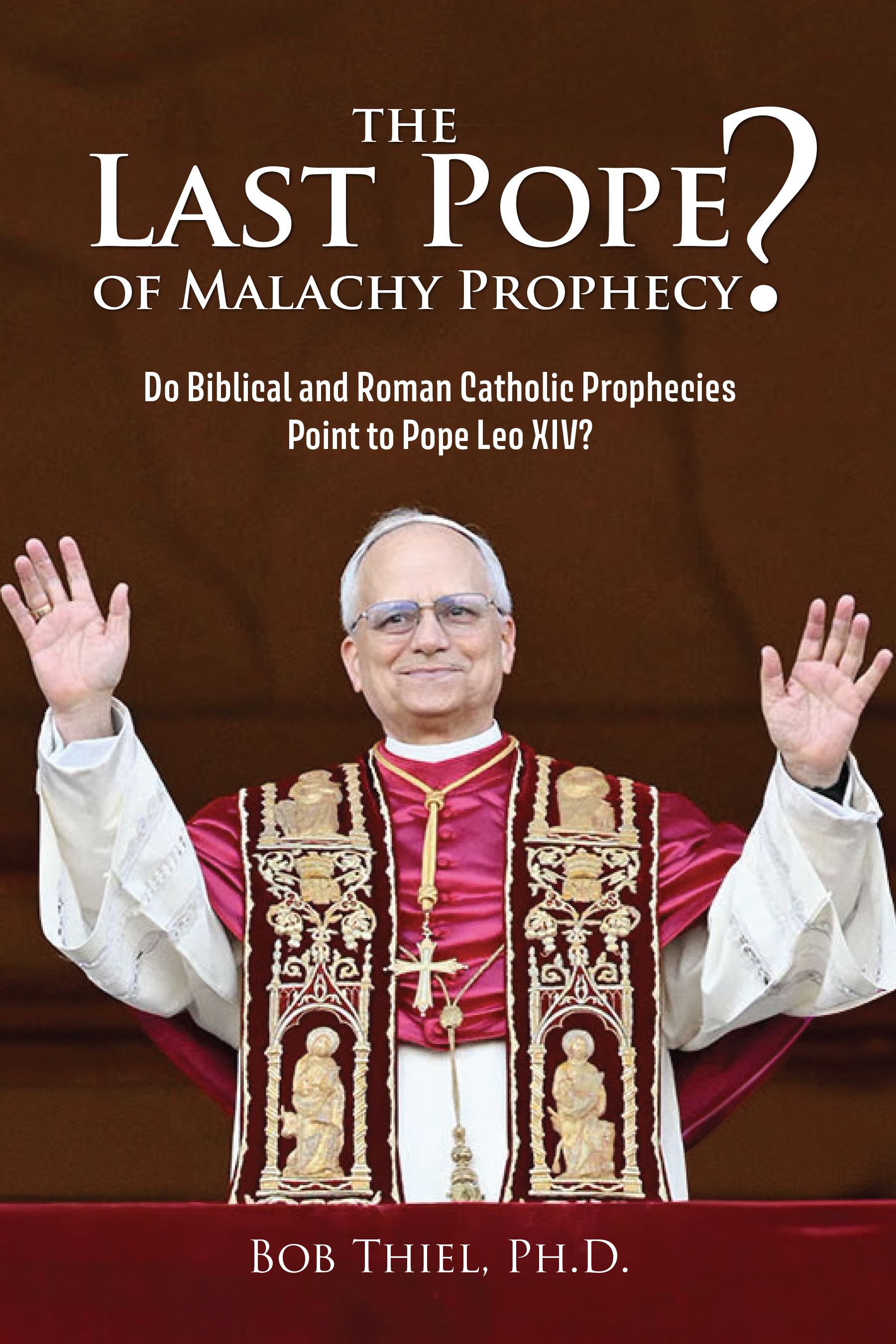
As far as Robert Prevost, now Pope Leo XIV, being ecumenical and Marian, in my free eBook book titled, The Last Pope of the Malachy Prophecies: Do Biblical and Greco-Roman Catholic Prophecies Point to Pope Leo XIV?, I have the following:
Prior to becoming pope, Leo XIII helped arrange an ecumenical meeting which has been called the First Vatican Council.
Robert Prevost, himself was born in Chicago, Illinois on September 14, 1955, the son of Louis Marius Prevost and Mildred Martinez. He is the first ever pope from the United States. Robert Prevost is a dual citizen as he also holds a Peruvian passport.
His father is of French and Italian ancestry, which could be interpreted that he is some type of Roman,[i] ethnically, from Italy. But also in the sense that parts of France and Italy were long in the so-called Holy Roman Empire. Expect, that if there is a long reign, Pope Leo XIV to promote Europe and a type of revived ‘Holy Roman Empire.’
He served as Bishop of Chiclayo in Peru from 2015 to 2023, and was general of the Order of Saint Augustine from 2001 to 2013. Spanish Augustinians first went to Peru in 1551. The order has, in particular, spread internationally the veneration of the ‘Mary’ under the title of Our Lady of Good Counsel.
There have been complaints that Robert Prevost was too tolerant of and not punitive enough against a couple of clergy members involved in sexual abuse.[ii] But that is not an uncommon charge against American bishops. …
Leo XIV will take some Marian-type steps if he reigns very long.
Upon becoming Pope Leo XIV, he called for people to build bridges through dialogue. [iii] Note that the term Ponifex Maximus literally means “Greatest Bridge Builder.”
Leo XIV will be ecumenical. And, because of the Augustine Order connection, militant in some ways.
[i] Pope Leo XIV. Wikipedia, accessed May 8, 2025
[ii] Pope Leo XIV. Wikipedia, accessed May 8, 2025
[iii] Primeras palabras del Papa León XIV: “El mundo necesita su luz.” Societad, May 8, 2025
So, he has taken ecumenical, interfaith, and Marian steps.
As far as ecumenical ones go, consider that within a week of becoming pontiff, Pope Leo met with eastern Roman Catholic churches (see Pope Leo XIV met with ‘Churches of the East’–what did 1st century Christians believe?). He urged them to hold fast to their traditions–yet sadly, they changed from the original faith (watch: Original Church of the East). He also has taken steps with the Eastern Orthodox, Protestants, and others. He met with the new female archbishop of the Anglican Church just over a week ago (see Pope Leo XIV meets with Sarah Mullahay: Is he promoting both an ecumenical and globalist agenda?).
Might he unify Rome with the Eastern Orthodox?
Consider the following:
Pope Leo’s first papal trip signals desire to bridge Catholic-Orthodox divides
November 14, 2025
Pope Leo XIV is set to touch down in Istanbul at the end of November … one of the most significant aspects of his visit will be joint ceremonies with Bartholomew I, ecumenical patriarch of Constantinople and one of Eastern Orthodox Christianity’s chief spiritual leaders. … ecumenically minded leaders in both Orthodox and Catholic churches have continued to work on bridging the centuries-old divisions between the churches. https://religionnews.com/2025/11/14/pope-leos-first-papal-trip-signals-desire-to-bridge-catholic-orthodox-divides/
There is a Roman Catholic prophecy about one who, if the prediction is correct, will unite the Eastern Orthodox with the Roman Catholics, and then be followed by the final, last, pope:
Abbott Joachim (died 1202): A remarkable Pope will be seated on the pontifical throne, under special protection of the angels … he shall recover the states of the Church, and reunite the exiled temporal powers. As the only Pastor, he shall reunite the Eastern to the Western Church … Through him the East and West shall be in ever lasting concord. The city of Babylon shall then be the head and guide of the world … A man of remarkable sanctity will be his successor in the Pontifical chair. Through him God will work so many prodigies that all men shall revere him.
Even though the Bible warns against end time Babylon (cf. Revelation 18:4; Jeremiah 50,51), Abbot Joachim is trying to teach that it is good. But my point is that there is evidence that Pope Leo XIV is working on an ecumenical agenda which includes the Eastern Orthodox.
The following was written in the late 20th century by a member of the Orthodox Church and is warning people that false apparitions claiming to be Mary will lead to people to Antichrist:
“Mother goddesses” known in the ancient world were not just confined to the Near East and Mediterranean but are universal. The Kogi Indians, among whom we lived in Columbia, worship a spirit called Nabuba, the “Ancient Mother.” When Roman Catholics missionaries attempted to evangelize the Kogi in the last century, they used a not-uncommon strategy for drawing pagan peoples into Rome’s fold: rather than explaining the differences between the pagan mysthology and Christian truth, they found “equivalences,” Christ, under this syncretistic view, corresponds to the Kogi Sejukukui (a trickster god who faked his own death by hiding in a cave), while Nabuba is said to be the Virgin Mary. This confusion has led the Kogis to call their pagan temples “cansamaria,” a corruption of “casa de Maria” (house of Mary).
Given these Roman Catholic “evangelistic methods” of more than a century ago, it is it any wonder that contemporary “apparitions” of Mary are invariably accompanied by ecumenistic messages promoting the idea that all religions are equally valid and Orthodox Christianity is but one “path” among many? A recent issue of Orthodox Tradition (1966) contains the account of Matushka (wife of a Russian Orthodox priest) Katherine Swanson’s trip to Medjugorje, Croatia, to investigate the most famous of the recent cases of apparitions of Mary in the Roman Catholic world. In it she recounts a telling episode:
Our guide took our group for an audience with the “seers.” During this audience, a pilgrim asked one of the children the following questions: “Does the Virgin say that the Catholic Church is the true church?” The response given by the child provides clear evidence of the ecumenical content and religious relativism which, oddly enough, increasingly mark the “revelations” at Medjugorje: “Our Blessed Mother says that all religions are equally pleasing to God.“
The Life magazine article, then, is yet another contribution to this line of thought. Given the idea that all paths are equally valid, then all “Marys” are equally valid, too. The author describes several of the Marys of our times: Miearculous Mary (such as at Medjugorje), Mediator Mary (Who, as the author quotes Fr. Andrew Greeley saying, lets people into Heaven through the “back door”), (Editors notes: the Orthodox Church of course never taught about the “back door”, and of course one only prays that this is a matter of a figure of speech, but let us not dwell on the “back door”, but the gates of Paradise, the Kingdom of our God). Mediator Mary of the feminists, and Mother Mary. This last one, Mother Mary, is the role which the author considers the most appealing to non-Catholics: “The emotional need for her is so irresistible to a troubled world that people without an obvious link to the Virgin are being drawn to her. It is known that Muslins revere Mary as a pure and holy saint…Interdenominational Marian prayer groups are springing up throughout the world. Many Protestants, even some who still reject notions of a supernatural Virgin, miss Mary.”
To which Mary are Muslims and Protestants being drawn? The Protestant Reformation rejected the distorted view of Mary which had developed in the West since the Schism of 1054, and which would ultimately result in the Roman Church’s proclamation of their dogma of the Immaculate Conception. But Protestantism did not just reject the Western view of Mary; it ignored Her altogether, in effect denying Her role in the Incarnation and, consequently, the part She plays in our salvation. As Rome began to see her more and more as a “goddess,” a fourth Hypostasis of the Trinity, as it were, the Protestants reacted by down playing Her position and refusing to honor Her at all, this in spite of the Gospel words:“All Generations Shall Call Me Blessed.”
Today, as heterodox Christians become more and more ecumenist and work toward creating a “One World Church,” the search has begun for a Mary of universal recognition, one who will appeal not only to those who bear the name Christian, but apparently to Muslims and others as well, just as attempts are likewise being made to identify the “new Christ” with the Muslim concept of their coming Mahdi and with the Messiah still awaited by the Jews. This, of course, will be no Christ at all but the antichrist.
(Jackson P. ORTHODOX LIFE., No. I, 1997., Brotherhood of Saint Job of Pochaev at Holy Trinity Monastery, Jordanville, N.Y. pp. 18-22. http://fr-d-serfes.org/orthodox/theotokos.htm viewed 05/11/09)
‘Mary’ is a tool that the Vatican has long hoped would help its interfaith and ecumenical agendas.
While Pope Francis took ecumenical steps, could Pope Leo XIV be the one that will seal unity with the Eastern Orthodox Catholics?
He may well be.
What I wish he would do, is to heed the following scripture–which is shown below from two Roman Catholic translations of the Bible:
3 Dearly beloved, taking all care to write unto you concerning your common salvation, I was under a necessity to write unto you: to beseech you to contend earnestly for the faith once delivered to the saints. (Jude 3, DRB)
3 My dear friends, at a time when I was eagerly looking forward to writing to you about the salvation that we all share, I felt that I must write to you encouraging you to fight hard for the faith which has been once and for all entrusted to God’s holy people. (Jude 3, NJB)
If Pope Leo XIV would really do that, it would be an exciting and great course of action.
He hinted that the churches of the east, that are in communion with Rome, should do that–and they should.
But the Church of Rome, as well as all other churches, should do so as well.
Since then, the calls for unity between the Roman and Eastern Orthodox Catholics, as well as the Protestants, have intensified.
Doctrinal compromise is expected.
I pray that Pope Leo will not go in that direction as that will NOT bring true unity of faith–which is something that does not happen until Christians are perfected (Ephesians 4:13) which will not occur until AFTER Jesus returns.
Until that time, faithful Christians are told to be separate from those who do not actually believe the true faith (2 Corinthians 6:14-17).
Some items of related interest may include:
Early Christianity in Edessa and the Church of the East Could there have been Christian leaders there? Might Judas of Jerusalem went there? Could Macarius have been a faithful Christian?Here is a link to a related sermon video: Original Church of the East.
Beliefs of the Original Catholic Church: Could a remnant group have continuing apostolic succession? Did the original “catholic church” have doctrines held by the Continuing Church of God? Did Church of God leaders uses the term “catholic church” to ever describe the church they were part of? Here are links to related sermons: Original Catholic Church of God?, Original Catholic Doctrine: Creed, Liturgy, Baptism, Passover, What Type of Catholic was Polycarp of Smyrna?, Tradition, Holy Days, Salvation, Dress, & Celibacy, Early Heresies and Heretics, Doctrines: 3 Days, Abortion, Ecumenism, Meats, Tithes, Crosses, Destiny, and more, Saturday or Sunday?, The Godhead, Apostolic Laying on of Hands Succession, Church in the Wilderness Apostolic Succession List, Holy Mother Church and Heresies, and Lying Wonders and Original Beliefs. Here is a link to that book in the Spanish language: Creencias de la iglesia Católica original.
The Last Pope of the Malachy Prophecies: Do Biblical and Greco-Roman Catholic Prophecies Point to Pope Leo XIV? This free 154 page book has biblical and Greco-Roman Catholic prophecies related to the last pope, an antipope who will be the final Antichrist.