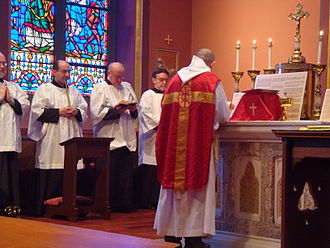
Priest conducting Latin Mass (Photo Boston from via Wikipedia)
Although Pope Leo XIV warned them not to do it, a ‘Latin Mass’ group consecrated some to be bishops:
Vatican declares Society of St. Pius X in schism, excommunicates bishops
July 2, 2026
VATICAN CITY — The Vatican responded aggressively Thursday to a traditionalist society that consecrated bishops without the pope’s consent, declaring the Society of St. Pius X in schism, excommunicating its bishops and priests and warning its faithful they too face the harshest sanctions in the Catholic Church.
The Vatican’s doctrine office went above and beyond the minimal sanctions foreseen by the church’s canon law to respond to the consecrations Wednesday of four new bishops at the society’s Econe, Switzerland, seminary.
The society, known by its acronym SSPX, celebrates the ancient Latin Mass and opposes the modernizing reforms of the Catholic Church, which it considers to be rife with heresies and errors and has accused of straying from the Catholic faith.
During a ritual-filled, five-hour Mass on Wednesday, attended by some 15,500 people and their children, the SSPX consecrated four new bishops in direct defiance of Pope Leo XIV, who had urged the SSPX to hold off for the sake of the church’s unity. https://www.npr.org/2026/07/02/nx-s1-5878916/vatican-society-of-st-pius-x-in-schism
A headline from the New York Times states this is the ‘Biggest Schism in 156 years.”
Here is more about that schism along with the official decree of excommunication:
July 2, 2026
VATICAN CITY (LifeSiteNews) — The Vatican has declared that the Society of St. Pius X no longer offers licit sacraments after bishops, clergy and – under certain conditions – lay members of the Society of St. Pius X were excommunicated following the consecration of four bishops without papal approval. …
The decree, signed by DDF Prefect Cardinal Victor Manuel Fernández, secretary for the dicastery’s Disciplinary Section Archbishop John Kennedy, and secretary for the Doctrinal Section Monsignor Armando Matteo, states:
Despite the warnings addressed to the Superior General of the Priestly Society of Saint Pius X, Bishop Alfonso de Galarreta, having carried out an act of a schismatic nature by conferring episcopal consecration on four priests without pontifical mandate and against the will of the Supreme Pontiff, has incurred ipso facto the penalties established by can. 1387 and can. 1364 §1 of the 2021 Code of Canon Law.
I therefore declare, for all juridical purposes, that the aforementioned Bishop Alfonso de Galarreta, as well as Pascal Schreiber, Michael Goldade, Michel Poinsinet de Sivry, and Marc Hanappier, have ipso facto incurred the latae sententiae excommunication reserved to the Apostolic See.
I further declare that Bishop Bernard Fellay, having directly participated in the liturgical celebration as co‑consecrator and thereby publicly adhered to the schismatic act, has incurred the latae sententiae excommunication foreseen by can. 1364 §1 CIC 2021.
Clerics and lay faithful are admonished not to adhere to the schism of the Priestly Society of Saint Pius X, for they would ipso facto incur the penalty of latae sententiae excommunication.
WATCH: Society of Saint Pius X consecrates four bishops
Soon after, the Dicastery for the Doctrine of the Faith issued an explanatory note outlining the reasons for its decision. The note stated that efforts spanning several decades to restore full communion “between the Catholic Church and the movement founded by Archbishop Marcel Lefebvre had not succeeded.” https://www.lifesitenews.com/news/vatican-rules-sspx-confessions-marriages-invalid-after-schism-declaration/
While Pope Benedict XVI was favorable towards Latin Mass, Pope Francis had taken steps against it (see Leaked document suggests that Pope Francis did not tell the truth about ‘Latin Mass,’ but many proponents of it seem not to understand it was NOT the original language of church services).
Although some Roman Catholics believe that the original Christians held “mass’ in Latin, that is simply not true.
Several weeks ago, I was speaking to a Roman Catholic priest about the Latin Mass issue, and he fully agreed with me that Latin Mass was not original–he and I both knew that history demonstrated that the original Christian church services would have been in Aramaic with Greek the next language used by many.
Furthermore, here is some information on Latin Mass and the liturgy from my free eBook, Beliefs of the Original Catholic Church:
Latin Mass and Liturgic Changes
Despite the view of some Roman ‘traditionalists,’ the original church liturgy was not in Latin nor did it resemble Roman Catholic mass. Notice three Roman Catholic reports:
In the third and fourth centuries A.D. … Latin began to replace Greek as the common language of the Roman world and soon became the language of the liturgy. Exactly how this change in the liturgy came about is uncertain. … Because Christians had not used Latin for worship prior to this, words had to be adapted or imported (often from Greek) to express Christian ideas, beginning the development of an ecclesiastical form of Latin. There is also evidence that the Roman Canon was influenced by prayers from the Eastern churches. (Tufano VM. When did we start celebrating Mass in Latin? US Catholic, June 18, 2010)
The word Mass (missa) first established itself as the general designation for the Eucharistic Sacrifice in the West after the time of Pope Gregory the Great (d. 604), … Mass goes back in … a custom that takes us at once into the third century (Pohle J. Sacrifice of the Mass. The Catholic Encyclopedia)
Roman Mass … and the established customs became “ritualized” over the centuries. … As early as the fourth century, fixed liturgical rites can be found in the Church. (The Traditional Latin Mass: A Brief History. MyCatholicSource.com, accessed 09/22/20)
Some assert Latin Mass began to be used by the Roman Bishop Victor c. 190. But even if the early use of Latin in the late 2nd century is true (and using the common language of an area for church services makes sense), Latin still was not the original language of original church services—that was Aramaic/Hebrew. However, Greek quickly became used as the New Testament epistles—which were written in Greek—help demonstrate.
Not only were original church services not in Latin, according to The Catholic Encyclopedia, they were not called Mass until the 7th century. Furthermore, as many rituals in Latin Mass came from the 3rd and 4th centuries, those practices were not really a part of the regular original services.
Roman Catholic sources clearly teach that ritualized Latin Mass was a change from the original catholic liturgy. More changes occurred in the 13th through 15th centuries (Jedin H, ed. History of the Church, Volume 2. Crossroad, New York, 1993, p. 326).
The Eastern Orthodox, also, have freely admitted that their liturgy CHANGED. Notice this from one of their writers:
The liturgical practices of the church at Antioch did not stagnate. As does every early tradition of the church, the liturgy continued to expand in content and meaning. (Lucas J. Liturgical Pattern and Experience in First Century Antioch. By the Waters: Selected Works by Students of St. Tikhon’s Orthodox Theological Seminary, vol 7, Fall 2008, pp. 40-52)
The original church liturgy did not have much resemblance to Eastern Orthodox services, which begin and end with the “signing of the cross.” The teaching that the “liturgical practices of the church at Antioch did not stagnate” demonstrates that what ended up in Antioch changed—hence the Eastern Orthodox admit that what they now have is NOT the original catholic liturgy.
Some claim that they follow the “Divine Liturgy of St. James.” However, that was not original, nor did James come up with it as The Catholic Encyclopedia and the OrthodoxWiki also understand:
… the famous liturgy of St. James. That it was actually composed by St. James the Less, as first Bishop of Jerusalem, is not now believed by any one; (Fortescue A. Liturgy of Jerusalem. The Catholic Encyclopedia)
The general scholarly consensus is that this liturgy originated in Jerusalem during the late fourth or early fifth century. It quickly became the primary liturgy in Jerusalem and Antioch. Although it was later superseded in Jerusalem and Antioch by the Liturgy of St. Basil and the Liturgy of St. John Chrysostom, it had already spread to other areas of the Church. (Liturgy of St. James. OrthodoxWiki, accessed 06/04/21)
So, what the Eastern Orthodox now do was not original.
Unlike how Eastern Orthodox church service were conducted, there were no icons, incense, signing of the cross, or leavened bread as part of the original church services. Nor “chanting” sermons nor hymns sung to Mary. None of the known current Eastern Orthodox litanies (‘petitions’ recited by the clergy and responded to in a recurring formula by the people) were originally used by early Christians either.
The CCOG {Continuing Church of God} maintains it has continued the original catholic church practices when it comes to church services, or the liturgy.
So, no, Latin mass is not an original tradition of the catholic church–but a change in liturgy.
Now, what about original church services?
Here is information on that from my free eBook, Beliefs of the Original Catholic Church:
What were early church services like?
Scripture-focused.
Teaching in harmony with scriptures (Eusebius, p. 112) is what the original liturgy (or format of services) was based on. Notice something about Polycarp and his teachings:
For he would extend his discourse to great length on diverse subjects, and from the actual Scripture which was read he would furnish edification with all demonstration and conviction …
And on the sabbath, when prayer had been made long time on bended knee, he, as was his custom, got up to read; and every eye was fixed upon him. Now the lesson was the Epistles of Paul (Life of Polycarp, Chapter 24. From J. B. Lightfoot, The Apostolic Fathers, vol. 3.2, 1889, pp. 488-506)
As far as the original church services, Polycarp taught using actual scriptures and did so on the Sabbath (Saturday).
Bishop Melito of Sardis (considered a Greco-Roman and COG saint) said during a church service:
First of all, the Scripture about the Hebrew Exodus has been read and the words of the mystery have been explained as to how the sheep was sacrificed and the people were saved. (Melito, Homily on the Passover, Verse 1)
This is of liturgical interest as it shows that the Old Testament was being read, and that Melito may not have been the only speaker and that church service included more than one sermon message.
This is consistent with the Continuing Church of God practice of having a sermonette and sermon or two “split-sermons” as part of weekly church services.
Here is something from a Roman Catholic writer about the early church services, which for this purpose could also be called their ‘liturgy’:
The primary points of contact for our knowledge of the first century liturgy lie on one end with the Jewish liturgies, and the little data which can be gleaned from the New Testament, and … a few texts, reliable but vague, from the second and third century that help us piece together the puzzle. …
The Judeo-Centricity of Early Christianity
- For about the first 10 years of Christianity, it was almost exclusively composed of Jewish converts.
- The early Christians were in the habit of attending temple …
- The early Christians continued celebrating in the Synagogues alongside the Jews on the Sabbath for several years in some places.
- Up to nineteen years after Christ’s resurrection, new converts to Christianity, generally speaking, had to convert to Judaism before becoming Christian. Namely, they were to be circumcised, to eat Kosher, and to follow the Mosaic Law …
‘Synaxis’ is the Greek word meaning “meeting” and is the organic continuity of the Saturday Synagogue worship. When the Christians were no longer allowed in the synagogues, they continued celebrating approximately the same rite with added Christian developments and themes (like using the New Testament). The original liturgies would have been held, like the synagogue service, in Hebrew, and some of the words, like “amen” and “hallelujah,” survive to this day. In the early part of the first century, it is unlikely that the Synaxis would have been recognizably different from the Synagogue service except for the setting. …
Basic Structure
- Greeting and Response (The Lord be with you – or Peace be unto you)
- Lections & Psalmody (The Jews read in order of descending importance, starting with the Pentateuch. The early Christian kept the original order of the Synagogue, but as Christian Scripture became available, it was tacked on at the end. Thus the order of importance became reversed for Christians. They read in ascending order of importance)
Old Testament Reading
ii. Psalmody (or chanted Psalm)
iii. New Testament Reading (sometimes included non-canonical books like 1 Clement)
iv. Psalmody
v. Gospel Reading- Homily (Bishop delivers while seated)
- Dismissal of Catechumens by Deacon
- Intercessory Prayers of the Faithful
- Dismissal of the Faithful
Occasionally a collection would be taken for the poor at the end. …
By the end of the first century, the standard Christian liturgical observations would be as follows. On Saturday, you would attend the Synaxis.
(Troutman TA. Christian Worship in the First Century. Called to Communion. © 2017 June 17, 2010. http://www.calledtocommunion.com/2010/06/christian-worship-in-the-first-century/#footnote_2_5127 accessed 07/06/20)
(Note: The term catechuman refers to a Christian convert who is under instruction before baptism.)
While some of the above details can be debated, yes, original church services (called the Synaxis above—synaxis means ‘congregating’ or ‘meeting’) were on Saturday. In time, the Greco-Romans adopted Sunday (with the Greeks retaining some aspects on Saturday), but the faithful in Judea/Palestine, Asia Minor, Antioch, Mesopotamia, etc. held to Saturday.
In the CCOG, similar to the previous listed “liturgy,” we have three sets of hymns/psalms, a short message, a sermon/homily, and a closing prayer. We accept Jesus’ “once for all” sacrifice (Romans 6:10), hence do not attempt to repeat it (though we do observe an annual Christian Passover service). We also have an opening prayer, as well as announcements, both of which likely were also part of the early Christian liturgy.
There was no daily nor weekly “sacrifice” of Jesus—which is consistent with scriptures like:
10 For the death that He died, He died to sin once for all; (Romans 6:10, OSB)
24 … Christ … 25 … does not have to offer himself again and again, as the high priest goes into the sanctuary year after year with the blood that is not his own, 26 or else he would have had to suffer over and over again since the world began. As it is, he has made his appearance once and for all, at the end of the last age, to do away with sin by sacrificing himself. (Hebrews 9:24-26, NJB)
10 And this will was for us to be made holy by the offering of the body of Jesus Christ made once and for all. (Hebrews 10:10, NJB)
So, no, early Christians did not have a “mass” where Jesus was regularly sacrificed. The New Testament is clear that Jesus was only sacrificed once.
This is known, of course, to Roman Catholic writers. Here is something from one of them:
The Letter to the Hebrews makes clear that Jesus definitively ended the need for the repetitive animal sacrifices of Temple worship, when he suffered and died once for all (Heb. 7:27). In doing so, he culminated his one Sacrifice of Calvary in everlasting glory in the heavenly sanctuary, not a mere earthly one, (Hebrews 8:1-3; 9:11-12, 23-24); (Nash T. Divinely Planned Obsolescence. The Catholic World Report, December 3, 2017).
Yes, Jesus was sacrificed once, and does not need to be sacrificed again. The Christian Passover is a memorial of the event, not a repeating of it.
It took centuries before the Roman Catholic Church instituted what is now commonly referred to as the “sacrifice of the Mass” (Pohle J. Sacrifice of the Mass. The Catholic Encyclopedia).
So, the liturgy of the original church services did not resemble those of the Roman Catholic Church.
Yet, they do resemble those of the Continuing Church of God.
So, if the SSPX wants the original, it needs to change.
Improper worship is condemned by Jesus. Notice something in the Continuing Church of God booklet Prayer: What Does the Bible Teach?:
Notice what Jesus Himself taught:
23 But the hour is coming, and now is, when the true worshipers will worship the Father in spirit and truth; for the Father is seeking such to worship Him. 24 God is Spirit, and those who worship Him must worship in spirit and truth. (John 4:23-24)
Many think that it does not matter what or how they worship, only that they make some attempt. That is not what Jesus said that the Father wants.
Jesus also taught:
8 “These people draw near to Me with their mouth, And honor Me with their lips, But their heart is far from Me. 9 And in vain they worship Me, Teaching as doctrines the commandments of men.” (Matthew 15:8-9)
(Thiel B. Prayer: What Does the Bible Teach? Nazarene Books, 2015).
To learn more about what the Bible teaches about prayer, check out our free online booklet Prayer: What Does the Bible Teach?
Now, one thing that the Priestly Society of Saint Pius X is correct about is that the Church of Rome has adopted many changes and heresies that were NOT part of the original catholic church.
Notice a chart of early changes from the free documented eBook: Beliefs of the Original Catholic Church:
Chart of Early Heretics/Heresies Generally First Denounced by Leaders of Asia Minor
2nd Century Heretic Heresy Heretic/Heresy Denounced by Asia Minor Leaders Tolerated by Rome
Simon Magus,* Nicolaitans,* Marcion, Montanus, Valentinus Promoted a different gospel. Peter (Acts 8:20-23), Paul (2 Corinthians 11:4; Galatians 1:8), Church of God in Ephesus (Revelation 2:6), Polycarp, Melito, Thraseas, and Theophilus. Variations of the different gospels have been accepted by essentially all of the Greco-Roman Catholic and Protestant faiths. Cerinthus Excessive allegory, improper tradition, improper festivals, and apparitions as sources of doctrine. Apostle John in Ephesus. Variations adopted by Greco-Roman Catholic and Protestant faiths. Marcus of Jerusalem Sabbath, Passover on the 14th, and Unclean Meat avoidance not required. Nazarenes who fled as they were not allowed back in Jerusalem. Some ended up in Asia Minor. Marcus’ changes are still tolerated by the Greco-Roman Catholic and Protestant faiths. Marcion Sabbath and Ten Com- mandments done away. c. 155 A.D. by Polycarp and later by Theophilus and Serapion. Rome tolerates anti-Sabbath teaching to this day. Marcion Jesus not coming for millennial reign. c. 170 A.D. by Melito. c. 180 Marcion excommunicat-ed, but heresy later accepted. Valentinus God is three hypostases. c. 155 A.D. by Polycarp. Still accepted; adopted by Council in 381. Valentinus and Anicetus Traditions in conflict with the Bible can be source of doctrine. c. 155 A.D. by Polycarp; c. 170 A.D. by Melito. c. 180 A.D. Valentinus was excommunicat-ed, but heresy still accepted. Anicetus, Victor, and some other early Roman leaders Passover is on Sunday. c. 155 A.D. by Polycarp; c. 195 A.D. by Polycrates.
Still accepted. Montanus False prophecies. c. 157 A.D. by Thraseas, 177 by a synod in Asia Minor, and later others, like Apollonius, Apolinarius, and Serapion. c. 206-218 A.D. Montanists finally denounced. Montanus God is Father, Son, and Holy Spirit. c. 157 A.D. by Thraseas, etc. Later adopted and now still accepted. Tradition originated in the false “Gospel of James” circa 120-200 A.D. Mary remained a virgin after giving birth to Jesus or Mary is a perpetual virgin. c. 200 by some in Asia Minor and Jewish-Christians. Adopted as the 5th General Council of Constantinople in 553 granted “perpetual virgin” title to Mary. Now a Roman dogma. Noetus/
SabelliusFather is same as Son. c. 200 by Smyrna presbyters. c. 220 A.D. finally denounced; though a version still accepted. “Gospel of Peter” Considering false gospel as scripture. c. 200 by Serapion of Antioch. Probably into 4th century. Origen of Alexandria Bible should be interpreted allegorically. 3rd century by Nepos of Arsinoe and Lucian of Antioch. Often still accepted. Platonic-Gnostic and pagan sources, including Justin Martyr claiming Plato. Cross is a Christian religious symbol of signing and/or veneration. c. 4th-7th centuries by Paulicians and Cathari of Armenia and Asia Minor. It could have been denounced prior, but the practice was not so widespread in Asia Minor earlier. This heresy started to appear in the 2nd century and was essentially finally formally adopted at a council in 843. * While these were originally 1st century heretics, their heresies lasted and versions of them were denounced in Asia Minor/Antioch in the 2nd century and by other COG leaders in later centuries. Although Greco-Roman supporting leaders outside of Asia Minor/Antioch sometimes denounced these particular heretics, their churches often ended up adopting portions of their heresies. 3rd century African Bishop Nepos stood for the millennium and the Bible and denounced allegorical Greco-Roman opponents (ChapmanJ. Dionysius of Alexandria. The Catholic Encyclopedia). There were other heresies introduced in the 2nd to 4th centuries that were never accepted by the faithful Quartodeciman successors to the 2nd century Asia Minor leaders, as they did not teach the Jewish apocrypha, special dress for the clergy, clerical celibacy, immortal souls going to heaven, baptism by sprinkling, unclean meat consumption, military service for Christians, a mystic Eucharist, or a winter holiday somewhat coinciding with Saturnalia/Mithra ceremonies, etc. Even certain Catholic/Orthodox “saints” in the first few centuries originally condemned many of those particular doctrines. Variations of such teachings are now accepted by the Roman and Eastern Orthodox Catholics.
Historical evidence shows that leaders in Asia Minor denounced heresies generally before Rome did. And sadly, Rome adopted or later accepted some version of many of these denounced heresies.
Would the leaders of the true Church be more likely to tolerate or denounce heretics? The answer should be obvious (and to those it is not, recall that Jesus, Peter, Paul, Jude, John and others denounced false religious leaders in the New Testament).
The Church of Rome has not held to many of the beliefs and practices of the original catholic church.
In one of the last books of the Bible, the Apostle Jude was inspired to tell Christians to:
3 … contend for the faith once delivered to the saints (Jude 3, DRB)
3 … fight hard for the faith which was once for all delivered to the saints. (Jude 3, EOB)
We in the Continuing Church of God hold to the original Christian beliefs and are contending earnestly for them.
And we have free information for any who wish to strive to do so.
Some items of possibly related interest may include the following:
What was the Liturgy of the Early Church? Were early church services mainly scriptural, emotional, or sacramental? Who follows the basic original liturgy today? A related video is also available: What were early Christian church services like?
Prayer: What Does the Bible Teach? This contains 28 biblically-based tips on improving the effectiveness of your prayers. This is a pdf. A related sermon is available and titled: What Does the Bible Teach About Prayer?
What Should I Pray About? An old article by Lynn Torrance on prayer. Here is a link to it in Mandarin Chinese 我应该祷告什么?
Importance of Fasting An old article by Herbert W. Armstrong on this subject. Here is a link to it in Mandarin Chinese 禁食的重要性.
What was the Liturgy of the Early Church? Were early church services mainly scriptural, emotional, or sacramental? Who follows the basic original liturgy today? A related video is also available: What were early Christian church services like?
Beliefs of the Original Catholic Church. Did the original “catholic church” have doctrines held by the Continuing Church of God? Did Church of God leaders uses the term “catholic church” to ever describe the church they were part of? Here are links to related sermons: Original Catholic Church of God?, Original Catholic Doctrine: Creed, Liturgy, Baptism, Passover, What Type of Catholic was Polycarp of Smyrna?, Tradition, Holy Days, Salvation, Dress, & Celibacy, Early Heresies and Heretics, Doctrines: 3 Days, Abortion, Ecumenism, Meats, Tithes, Crosses, Destiny, and more, Saturday or Sunday?, The Godhead, Apostolic Laying on of Hands Succession, Church in the Wilderness Apostolic Succession List, Holy Mother Church and Heresies, and Lying Wonders and Original Beliefs.
Which Is Faithful: The Roman Catholic Church or the Continuing Church of God? Do you know that both groups shared a lot of the earliest teachings? Do you know which church changed? Do you know which group is most faithful to the teachings of the apostolic church? Which group best represents true Christianity? This documented article answers those questions.
Should You Observe God’s Holy Days or Demonic Holidays? This is a free pdf booklet explaining what the Bible and history shows about God’s Holy Days and popular holidays.
Do You Practice Mithraism? Many practices and doctrines that mainstream so-called Christian groups have are the same or similar to those of the sun-god Mithras. December 25th was celebrated as his birthday. Do you follow Mithraism combined with the Bible or original Christianity? A sermon video from Vatican City is titled Church of Rome, Mithras, and Isis?
Faith for those God has Called and Chosen What is faith? Can faith be increased? Are you saved by faith? What about works? Do Christians need to keep the Ten Commandments? What is the ‘faith chapter’? How do the just live by faith? Is faith one of the weightier matters of the law? How does faith come? Here is a link to a pdf. booklet titled Faith for Those God has Called and Chosen. Marque aquí para ver el pdf folleto: Fe para aquellos que Dios ha llamado y escogido.Here is a link to a related sermon titled: Faith for the Called and Chosen. Here is a link to shorter version of the written article in Mandarin Chinese 一篇关于信仰的小文章
Were the Early Duties of Elders/Pastors Mainly Sacramental? What was their Dress? Were the duties of the clergy primarily pastoral or sacramental? Did the clergy dress with special liturgical vestments? Can “bishops” be disqualified as ministers of Christ based on their head coverings?
Where is the True Christian Church Today? This free online pdf booklet answers that question and includes 18 proofs, clues, and signs to identify the true vs. false Christian church. Plus 7 proofs, clues, and signs to help identify Laodicean churches. A related sermon is also available: Where is the True Christian Church? Here is a link to the booklet in the Spanish language: ¿Dónde está la verdadera Iglesia cristiana de hoy? Here is a link in the German language: WO IST DIE WAHRE CHRISTLICHE KIRCHE HEUTE? Here is a link in the French language: Où est la vraie Église Chrétienne aujourd’hui?
Continuing History of the Church of God This pdf booklet is a historical overview of the true Church of God and some of its main opponents from Acts 2 to the 21st century. Related sermon links include Continuing History of the Church of God: c. 31 to c. 300 A.D. and Continuing History of the Church of God: 4th-16th Centuries and Continuing History of the Church of God: 17th-20th Centuries. The booklet is available in Spanish: Continuación de la Historia de la Iglesia de Dios, German: Kontinuierliche Geschichte der Kirche Gottes, and Ekegusii Omogano Bw’ekanisa Ya Nyasae Egendererete.