In his newsletter today, former Roman Catholic, now evangelical Protestant, Mike Gendron had the following:
As I studied the Scriptures, I soon realized that the only two things in this world that are eternal are the souls of men and the Word of God (Luke 21:33; Daniel 12:2-3). I learned that everything else will be burned up and only what is done for Christ will last (2 Pet. 3:10; 1 Cor. 3:12-14). These truths from God’s Word brought me under great conviction and changed the course of my life. I wanted to spend the remaining years of my life sharing the eternal Word of God with the eternal souls of men.
The Eternal Souls of Men Are in Two Groups
According to God’s eternal Word, all the souls of men are divided into two groups (Mat. 25:46). A few are on the narrow way destined for heaven; while many are on the broad way destined for hell (Mat. 7:13-14). Some are forgiven and justified by God’s grace and mercy; others are guilty and condemned by God’s justice (Rom. 3:10-28). Some are spiritually alive in Christ; others are spiritually dead in sin (Eph. 2:1-5). Some rejoice that they have been born again; others will wish they had never been born (1 Pet. 1:3; Mat. 26:24).
Many People Do Not Take Eternity Seriously
Tragically, many people go to their grave having been deceived about their eternal destiny. Their lack of concern and lack of interest for the truth is disturbing and lamentable as they chase after the worldly pleasures of this life. It is puzzling how many people spend an inordinate amount of time investigating things of temporal value, but when it comes to seeking wisdom about where they will spend eternity, they cannot be bothered. This is because no one seeks after the true God (Rom. 3:11).
Mike Gendron is correct that many people do not take eternity seriously.
But he is wrong that there are only two groups of humans.
According to the Bible, it can be broadly stated that there are three.
Furthermore, according to Greco-Roman Catholic scholars, the Christians that kept closest to the Apostle John’s practices (sometimes called Nazarenes or Judaeo-Christians) did understand that there were three resurrections.
Here is what the Roman Catholic scholar Bagatti wrote related to a late fourth century Greco-Roman bishop:
St. Gregory of Nyssa … he himself was not considered a true Christian by some who held the three resurrections, the millenarianism, the restoration of the Temple with bloody sacrifices; these are all doctrines of the Judaeo-Christians (Bagatti, Bellarmino. Translated by Eugene Hoade. The Church from the Circumcision. Nihil obstat: Marcus Adinolfi, 13 Maii 1970. Imprimi potest: Herminius Roncari, 14 Junii 1970. Imprimatur: +Albertus Gori, die 26 Junii 1970. Franciscan Printing Press, Jerusalem, 1971, p.11).
Here is some of what the Greek Orthodox Gregory actually wrote:
And what means this opposing array of new Altars? Do we announce another Jesus? Do we hint at another? Do we produce other scriptures? Have any of ourselves dared to say “Mother of Man” of the Holy Virgin, the Mother of God : which is what we hear that some of them say without restraint? Do we romance about three Resurrections ? Do we promise the gluttony of the Millennium? Do we declare that the Jewish animal-sacrifices shall be restored? Do we lower men’s hopes again to the Jerusalem below, imagining its rebuilding with stones of a more brilliant material? (Gregory of Nyssa. Letter 17 to Eustathia, Ambrosia, and Basilissa. Translated by William Moore. From Nicene and Post-Nicene Fathers, Second Series, Vol. 5. Edited by Philip Schaff and Henry Wace. (Buffalo, NY: Christian Literature Publishing Co., 1893)
So, near the end of the 4th century there were people that did not consider that the Constantinian Greco-Romans were Christians and they held to the doctrine of three resurrections. Like the Judea-Christians mentioned above, we in the Continuing Church of God do believe in the three resurrections, millenarianism, the restoration of bloody sacrifices (but we do not believe that a Temple has to be rebuilt in this age for that to occur–nor is it clear that was a required position by the Judaeo-Christians of the late 4th century), we do accept that sacrifices will occur in the millennium as per Zechariah 14:21, and we oppose the need for new altars in which the Greco-Romans believe that they are regularly sacrificing Jesus on (the Bible says Jesus only needed to be sacrificed once–Romans 6:10; Hebrews 7:27; 9:12; 10:10). While we do teach that Mary was the mother of Jesus and that Jesus is now God, since Mary cannot grant divinity and Jesus emptied Himself of His divinity when He came in the flesh (Philippians 2:7) and did not retain it until after His resurrection (cf. John 20:28), we do not use the expression “Mother of God” to describe Mary (see also Mary, the Mother of Jesus and the Apparitions).
There is an unusual writing known as the Testimony of Benjamin (likely between 1st and 2nd century A.D.–believed to have probably written by a Jew who professed Christianity) that tells of a sequence of three resurrections (two translations shown below):
Then you shall see Enoch, Noah and Shem and Abraham and Isaac and Jacob raised up at the right hand with rejoicing. Then we also shall be raised, each over our tribe (σχῆπτρν)…then all shall also be raised up some to glory and some to dishonor. (Chapter 10:6-8. As cited in Taylor JE. The Body in Biblical, Christian and Jewish Texts Volume 85 of The Library of Second Temple Studies. Bloomsbury Publishing, 2014, p. 136)
Keep the commandments of God until the Lord shall reveal His salvation to all nations. Then shall you see Enoch, Noah, and Shem, and Abraham, and Isaac, and Jacob, arising on the right hand in gladness. Then shall we also arise, each one over our tribe, worshipping the King of heaven, who appeared upon the earth in the form of a man of humility. And as many as believed on Him on the earth shall rejoice with Him; and then shall all men arise, some unto glory and some unto shame. (The Testaments of the Twelve Patriarchs. Translated by Robert Sinker. From Ante-Nicene Fathers, Vol. 8. Edited by Alexander Roberts, James Donaldson, and A. Cleveland Coxe. (Buffalo, NY: Christian Literature Publishing Co., 1886)
The Testimony of Benjamin seems to possibly separate the first resurrection between God’s converted people of the Old and New Testament and does not make a full biblical distinction about the other resurrections.
Before going further, it should be noted that some theologians do realize that the Bible teaches three resurrections. Here is something from the 19th century related to that:
Rev xx. … In this chapter there are THREE resurrections mentioned. The first takes place before or at the Millennium, the second immediately after it, and the third not until the end of the season that succeeds the Millenninm. It is evident, from the language that these are distinct and separate resurrections. (The Original Secession Magazine. Publisher J. Maclaren, 1866. Original from the New York Public Library. Digitized Aug 31, 2006, pp. 274-275)
Here is something written about dispensationalist Protestants:
Dispensationalism teaches three resurrections: those before the Millennium, those after the Millennium and those at the Revelation. Older Premillennialists believe that only the righteous before the Millennium and the unrighteous after the Millennium will be resurrected. (Dispensationalism and United States Foreign Policy with Israel. Contributor The University of Texas at Arlington. Political Science. Publisher ProQuest, 2008 p. 12)
Interestingly, one 19th century writer claimed that if you take the Bible literally, you would have to accept that there are three resurrections:
The theorists of the literal school lose all the righteous except martyrs and confessors; else they must have three resurrections — one for the martyrs and confessors; one a thousand years after, for the rest of the saints; and one some time later. (The Christian Messenger and Reformer. Churches of Christ, May 1843, p. 79)
And since we in the Continuing Church of God generally take the Bible literally (unless something allegorical is clearly being referred to), we do teach three resurrections, similar to that which was written above, except that we include the saints dead or alive at the time of the the first resurrection, will be in the first resurrection. The “rest of the dead” are in the second resurrection per Revelation 20:5.
Let it be noted that Jewish sources somewhat point to three resurrections as they point to three groups of people.
Notice the following:
The Talmud . . . says that on Rosh Hashana, God inscribes everyone’s name into one of three books. The righteous go into the Book of Life, the evil go into the Book of Death, and those in-between have judgment suspended until Yom Kippur.
In actuality, the vast majority of us are neither totally good nor bad. We’re more like 50/50, so we have a few more days until Yom Kippur to tip the scales. (Book of Life. Ask the Rabbi. https://aish.com/book-of-life/ viewed 09/18/25)
That said, the idea of three groups is also consistent with the doctrine that there are three resurrections. With the second resurrection being associated with likely occuring on the Last Great Day, which Jews now call Shemini Atzeret.
JUDGMENT OF HOSHANA RABBA and SHEMINI ATZERET
by Rabbi Chaviv DaneshRabbi Kruspedai said in the name of Rabbi Yochanan:Three books are opened on Rosh Hashana. One [book] for the completely wicked, one [book] for the completely righteous, and one [book] for the intermediate. The completely righteous are written and sealed right away for life, the completely wicked are written and sealed right away for death, and the intermediates are held in balance from Rosh Hashana until Yom Kippur. If they merit, they are written for life, and if they don’t merit they are written for death (Rosh Hashana 16b).
The deeper sources add that the judgment still continues until Shemini Atzeret. According to these sources, on Rosh Hashana one is judged and his verdict is written, on Yom Kippur his verdict is sealed, and at midnight on Hoshana Rabba his verdict is sealed with an additional outer seal, and the papers containing his verdict are given over to the messengers who will carry them out. These messengers though are not allowed to carry out the verdict until Shemini Atzeret (see Shlah, Masechet Succah, Perek Torah Ohr 70, Ben Ish Chai I V’zot Habracha 2 and Kaf HaChaim 664:1-5, 18-19 who quote the Zohar and the Arizal). (Danish C, rabbi. JUDGMENT OF HOSHANA RABBA and SHEMINI ATZERET. 12 October 2019 / 13 Tishri 5780, © 1995-2025 Ohr Somayach International https://ohr.edu/8567/print?utm_source=chatgpt.com).
The Bible shows that the incorrigibly wicked will be tossed in the ‘lake of fire’ after the third resurrection, and that is called the second death (Revelation 20:14).
The Bible shows that the people God called in this age will be blessed and part of the first resurrection and reign for 1,000 years per Revelation 20:4-6.
The “rest of the dead” do not live again until after the thousand years are finished (Revelation 20:5), and they get judged at the great white throne judgment (Revelation 20:11-13).
The “rest of the dead” appear to be consistent with those that Jewish leaders have labeled as “in-between” or “intermediate.” Their resurrection looks to take place on the Last Great Day, which is called Shemini Atzeret in Hebrew.
In a newsletter last year, Mike Gendron had the following:
How Can Sinners Escape Divine Justice?
Divine justice is a central theme in the Bible because it reflects God’s holy and righteous character and His commitment to uphold moral order. Justice is a foundational characteristic of God’s relationship with humanity. His punishment of sin is necessary for justice to be upheld according to His perfect and righteous standards. Everyone needs to know that they are accountable to their Creator, who requires us to be perfect as He is perfect (Mat. 5:48). Since this is impossible, our only hope is to trust the crucified Savior, who died as a substitute for sinners to satisfy divine justice (Isaiah 53:4-11). His resurrection assures us that divine justice was satisfied (Rom. 4:25). There is now no condemnation for those who are in Christ Jesus (Rom. 8:1). His righteousness has been given as a gift to all who believe (Rom. 5:16-18).
Divine Justice Must Be Satisfied
Divine justice must be satisfied because our holy and righteous judge in heaven must punish every sin that has been committed by everyone who has ever lived. We know that any judge who pardons law-breakers and lets the guilty go free is not a righteous judge. But God, in His profound wisdom, provided one specific way to pardon sinners that would not violate His righteous and holy attributes. In His love and mercy, He graciously provided a sinless substitute to die in the place of sinners to satisfy divine justice. The same God whose justice demands satisfaction for our sin made satisfaction by offering Himself for those who trust Him. The world needs to know that divine justice for sin must be satisfied and there is only one way to escape it.
How Can God Be Just and Justify the Unjust?
Jesus was born to die. “The Son of Man came…to give his life as a ransom for many” (Mark 10:45). This was to demonstrate His righteousness so that he might be just and the justifier of the one who has faith in Jesus (Rom. 3:26). Since all have sinned and broken God’s laws, divine justice had to be satisfied by Christ before forgiveness could be applied to sinners. By dying as a substitute for sinners, the Lord Jesus paid the eternal debt for sin and satisfied all the demands of divine justice so that He could extend mercy and grace to those who trust Him. Man can never DO what Christ has Done. He died “once for all, the just for the unjust, so that He might bring us to God, having been put to death in the flesh, but made alive in the Spirit” (1 Pet. 3:18).
Divine Justice at the Great White Throne
Those who reject the Lord Jesus as their substitute will come face to face with Him at the Great White Throne judgment (Rev. 20:11-15). Since they did not trust Him as a gracious and loving Savior, He will be their holy and righteous judge. Divine justice will be dispensed in the eternal fires of hell. The punishment and separation from God will be everlasting because every sin is committed against an infinitely holy and majestic God. There will be no escape because God is “a consuming fire” (Heb. 12:29).
Let’s look at some of the above in the light of scripture.
First of all, the main theme of the Bible is NOT justice per se, but love.
In John 3:16-17, Jesus said:
16 For God so loved the world that He gave His only begotten Son, that whoever believes in Him should not perish but have everlasting life. 17 For God did not send His Son into the world to condemn the world, but that the world through Him might be saved.
Notice that love was the motivator for God to send His Son to die so that the world may not be condemned but may be saved.
Furthermore, Mike Gendron quoted 1 Peter 3:18 which shows that Jesus did die for the unjust.
Secondly, what about mercy?
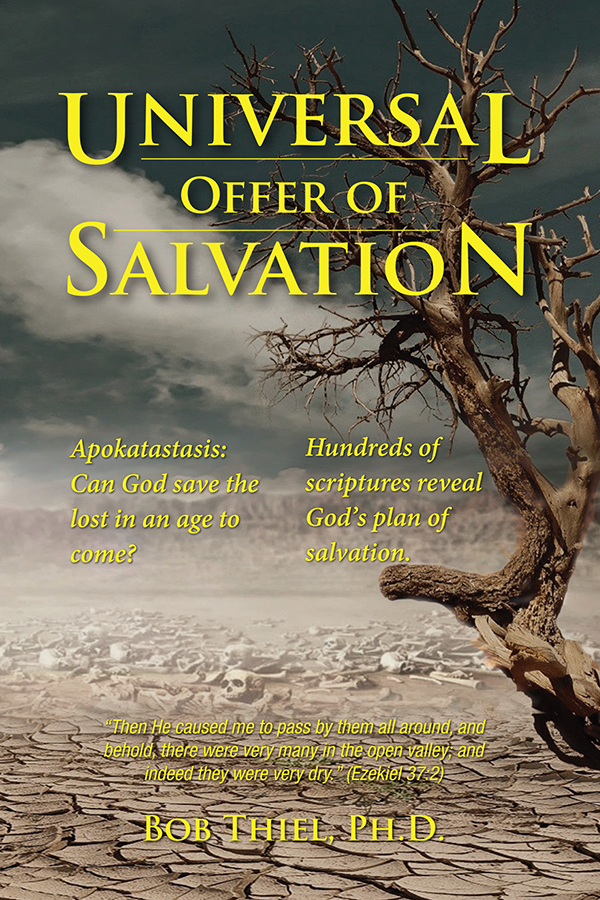
Notice some scriptures and comments in our free online e-book Universal OFFER of Salvation, Apokatastasis: Can God save the lost in an age to come? Hundreds of scriptures reveal God’s plan of salvation:
Mercy is so important, that the English term ‘mercy’ is shown 282 times in the NKJV of the Bible and 289 in the Douay-Rheims Bible.
Notice, for one other example, how Jesus referred to it in Matthew 23:23:
23 … the weightier matters of the law: justice and mercy and faith.
Mercy is one of the weightier matters of the law. It is more important than most realize.
It has been claimed that “The Mercy Seat of the Holy of Holies was the earthly representation of the very Throne of GOD in heaven” (Armstrong HW. Plain Truth, June 1967). The expression ‘mercy seat’ is used 28 times in the Bible (NKJV). It is shown as a place that God speaks from (Exodus 25:22).
Does God have a mercy seat because He expects to mainly provide eternal condemnation at the white throne judgment of Revelation 20 like many seem to think?
Obviously, since there is a mercy seat (cf. Exodus 25:17-22; Hebrews 9:5), this is a clue that God plans to have mercy.
While judgment will happen in Revelation 20:11-12 and people will be found guilty (as “all have sinned and fallen short of the glory of God” per Romans 3:23), it will not be for eternal condemnation.
Why? Because, God will plead with His handiwork (Jeremiah 25:31), and mercy triumphs over judgment (James 2:13).
Is not that what mercy is for?
The Merriam-Webster Dictionary defines mercy as:
compassion or forbearance shown especially to an offender or to one subject to one’s power
also: lenient or compassionate treatment …
a blessing that is an act of divine favor or compassion
Furthermore, mercy is not just for those who are truly Christians in this age.
While God has mercy on those called now, God will also have mercy on those not called to be firstfruits in this age.
But, this teaching is hard for many to understand now as Romans 11:30-33 teaches:
30 For as you were once disobedient to God, yet have now obtained mercy through their disobedience, 31 even so these also have now been disobedient, that through the mercy shown you they also may obtain mercy. 32 For God has committed them all to disobedience, that He might have mercy on all. 33 Oh, the depth of the riches both of the wisdom and knowledge of God! How unsearchable are His judgments and His ways past finding out!
Notice that God’s plan ‘has committed them all to disobedience, that He might have mercy on all’. Also notice that Paul is teaching that God’s mercy and judgment is apparently not easy for most to figure out.
Is it someone’s fault that they were born in an area that no one knew or taught Christ? Or if Christ was taught, He and God’s plan were not properly taught?
God knew that most would not at first obey, but that He has a plan to have mercy on them.
Thus it should be clear that God INTENTIONALLY is allowing some to be disobedient now, so that they will get mercy later and that those called now (the firstfruits) will have mercy now.
And God has done this so that He might have mercy on all–this apparently could not have happened any better way. The only way for God to have mercy on ALL is for salvation to be offered to all in a manner they can properly comprehend.
Yet, these concepts are offensive to many.
Because of their traditions, miseducation, biases, and pride, many cannot accept that God is so merciful.
Most who followed Jesus were offended after He spoke and turned away from Him, despite seeing miracles (see John 6:1-66). Most will not believe what we in the Continuing Church of God point out that the Bible teaches–this includes most who claim to believe the Bible.
Yet, it is only those who intentionally reject God’s mercy, who will be destroyed in the lake of fire, the second death (Revelation 20:14) to put them out of their misery (cf. Revelation 21:4).
Thirdly, does the Bible teach that the unrepentant will continue to burn in eternal torment?
No.
While Mike Gendron referred to the fact of a “consuming fire” in Hebrews 12:29, he seems not to consider that a CONSUMING FIRE, consumes, burns things up.
[C]onsistent with Jesus’ words in Matthew 10:28, the wicked who will not repent and support God’s Kingdom will be condemned (John 5:28-29), burnt up (Revelation 20:14), annihilated, totally destroyed:
1 Do not fret because of evildoers, Nor be envious of the workers of iniquity. 2 For they shall soon be cut down like the grass, And wither as the green herb. …
9 For evildoers shall be cut off; But those who wait on the Lord, They shall inherit the earth. 10 For yet a little while and the wicked shall be no more; Indeed, you will look carefully for his place, But it shall be no more. …
20 But the wicked shall perish; And the enemies of the Lord, Like the splendor of the meadows, shall vanish. Into smoke they shall vanish away. …
38 But the transgressors shall be destroyed together; The future of the wicked shall be cut off. (Psalm 37:1-2,9-10,20,38)
4 You love all devouring words, You deceitful tongue. 5 God shall likewise destroy you forever; (Psalm 52:4-5)
2 As smoke is driven away, So drive them away; As wax melts before the fire, So let the wicked perish at the presence of God. (Psalm 68:2)
1 “For behold, the day is coming, Burning like an oven, And all the proud, yes, all who do wickedly will be stubble. And the day which is coming shall burn them up,” Says the Lord of hosts,
“That will leave them neither root nor branch. 2 But to you who fear My name The Sun of Righteousness shall arise With healing in His wings; And you shall go out And grow fat like stall-fed calves. 3 You shall trample the wicked, For they shall be ashes under the soles of your feet On the day that I do this,” Says the Lord of hosts. (Malachi 4:1-3)The Bible calls this the ‘second death’:
11… He who overcomes shall not be hurt by the second death. (Revelation 2:11)
6 Blessed and holy is he who has part in the first resurrection. Over such the second death has no power, but they shall be priests of God and of Christ, and shall reign with Him a thousand years. (Revelation 20:6)
14 Then Death and Hades were cast into the lake of fire. This is the second death. (Revelation 20:14)
8 But the cowardly, unbelieving, abominable, murderers, sexually immoral, sorcerers, idolaters, and all liars shall have their part in the lake which burns with fire and brimstone, which is the second death. (Revelation 21:8)
Thus, it is a type of death, but permanent. Note: The fact of the boy God had Elijah raise (1 Kings 17:17-22), Lazarus who Jesus raised from the dead, (John 11:11-44), and all those who were raised after Jesus was executed (Matthew 27:52-53) shows that human beings can physically die more than once. For those who have been resurrected to physical life prior to the 21st century, their experiencing physical death again is NOT the second death of Revelation 20:14 and Matthew 10:28. THE SECOND DEATH IS DEFINED IN REVELATION 20:14 AS WHEN DEATH AND HADES ARE CAST INTO THE LAKE OF FIRE. It is not a reference to any humans who, after being resurrected, die again.
Now, the permanent second death, is not eternal torturing like many claim. Jesus came so we would not have to PERISH, but have eternal life:
16 For God so loved the world that He gave His only begotten Son, that whoever believes in Him should not perish but have everlasting life. (John 3:16)
23 For the wages of sin is death, but the gift of God is eternal life in Christ Jesus our Lord. (Romans 6:23)
27 And as it is appointed for men to die once, but after this the judgment, (Hebrews 9:27)
Jesus did not come so that people would not experience physical death—He came to help prevent the second death (Revelation 20:14).
And since the Apostle Paul was inspired to write that it is appointed for people to die (Hebrews 9:27), the PERISHING in John 3:16 has to do with what happens after the resurrections.
James 5:11 states:
1 Indeed we count them blessed who endure. You have heard of the perseverance of Job and seen the end intended by the Lord–that the Lord is very compassionate and merciful.
Permanent torment is not merciful nor very compassionate–but putting the wicked permanently out of their misery is. God is very compassionate and merciful.
Nahum 1:12 teaches:
12 Though I have afflicted you, I will afflict you no more;
Thus, this prophetic book is teaching that there is not a permanent, torturing affliction.
Revelation 21:4 teaches:
4 And God will wipe away every tear from their eyes; there shall be no more death, nor sorrow, nor crying. There shall be no more pain, for the former things have passed away.” 5 Then He who sat on the throne said, “Behold, I make all things new.” And He said to me, “Write, for these words are true and faithful.”
There will be no more death, sorrow, crying, or pain. Thus, there will not be an ever-burning torment and torture of sinners throughout eternity. All things will become new.
Remember that Malachi 4:1-3 teaches that the wicked (those who will not repent) will be burned up and will be ashes (see also Luke 13:1-3; Matthew 10:28). This is not an everlasting torment, but a destruction of those that refuse God.
Fourthly, here is some information on the Great White Throne Judgement from the free e-book Universal OFFER of Salvation, Apokatastasis: Can God save the lost in an age to come? Hundreds of scriptures reveal God’s plan of salvation:
The Great White Throne Judgment and the One Hundred Year Period
The Bible tells of a time when the saints of the house of God—the Christians—will be resurrected and be part of the Millennium, but that the rest of the dead will be resurrected later:
4 And I saw thrones, and they sat on them, and judgment was committed to them. Then I saw the souls of those who had been beheaded for their witness to Jesus and for the word of God, who had not worshiped the beast or his image, and had not received his mark on their foreheads or on their hands. And they lived and reigned with Christ for a thousand years. 5 But the rest of the dead did not live again until the thousand years were finished. This is the first resurrection. 6 Blessed and holy is he who has part in the first resurrection. Over such the second death has no power, but they shall be priests of God and of Christ, and shall reign with Him a thousand years. (Revelation 20:4-6)
Satan will not be a problem for one thousand years as he will be bound (Revelation 20:1-2). After that thousand years, he will be released for a “little while” (Revelation 20:3,7-10; which could be consistent with the idea of a time gap that Jewish sage Rabbi Joshua ben Levi placed between the seventh day of the Feast of Tabernacles and the next day in Midrash Pesikta Rabbati 30, Tanchuma, parshat Pinchas). And after the “little while,” but before the second resurrection, Satan will be put into the “lake of fire” (Revelation 20:10).
Those who live during the Millennium will have their opportunity to participate in the salvation process. They will have their opportunity to grow spiritually toward spiritual birth into the God Family.
However, what happens to those who had already died without having truly understood God’s truth?
The Bible then tells of a time called the great white throne judgment, which happens after the second resurrection:
11 Then I saw a great white throne and Him who sat on it, from whose face the earth and the heaven fled away. And there was found no place for them. 12 And I saw the dead, small and great, standing before God, and books were opened. And another book was opened, which is the Book of Life. And the dead were judged according to their works, by the things which were written in the books. (Revelation 20:11-12)
So, the Bible tells of judgment for those not judged by God in this life. And that books would be opened. Yes, people will be found guilty of sin (cf. Romans 3:23), but remember, that eternal life will be granted to repentant sinners who accept Jesus (Romans 6:23).
Now, according to David Jeremiah, a well-known evangelical minister, all who come before the white throne judgment are essentially doomed. Here is some of what he wrote:
Revelation 20. The Great White Throne Judgment is an event where those that did not know Jesus as their Savior during their life will come before the Lord and be judged by Christ. …
We see Buddhists and Muslims and Hindus and Protestants and Catholics and Baptists and Presbyterians. … What will happen to these religious people when they stand before God? … Let the Lord Jesus answer that question. “Many will say to Me in that day, ‘Lord, Lord, have we not prophesied in Your name, cast out demons in Your name, and done many wonders in Your name?’ And then I will declare to them, ‘I never knew you; depart from Me, you who practice lawlessness!’ (Matthew 7:21-23) …
If we come to the end of our life and we haven’t accepted Him, the Bible says our name is blotted out of the Book of Life … (Jeremiah D. What is the Great White Throne Judgment in Revelation? https://davidjeremiah.blog/what-is-the-great-white-throne-judgment-in-revelation/ accessed 06/26/19)
Despite David Jeremiah’s last claim, the Bible does NOT say those who were not called in this age are automatically “blotted out” of the Book of Life. Now it is true that many religious people practice lawlessness. To learn more about that, David Jeremiah (and others) should read our free online book: The Ten Commandments: The Decalogue, Christianity, and the Beast.
Sadly, many have been given wrong teachings about the Great White Throne Judgment. Its purpose is not to permanently doom those who had not known the true Christ.
The Bible teaches:
2 … You are a gracious and merciful God (Jonah 4:2)
And that mercy “triumphs over judgment” (James 2:13).
Now let’s notice something in contrast to David Jeremiah’s view from the old Radio Church of God:
Revelation 20: 11-12 says about this RESURRECTION: “. . . and I saw a great white throne . . , and I saw the dead, small and great, stand before God . . .” these people are STANDING-A RESURRECTION–”. . . and the dead were judged out of those things which were written in the books.” JUDGMENT! Even the WORST of the sinners who never had a chance will be in this RESURRECTION, for even the inhabitants of SODOM will be there! “When thy daughters, Sodom and her daughters, shall return to their former estate, and Samaria and her daughters shall return to their former estate . . . then thou (Jerusalem) shall return to your former estate.” (Ezekiel 16:55.) Isaiah 65:20 indicates ALL will live to be a hundred years old in this age at this time. (When Will the UNCONVERTED Be Resurrected? Plain Truth, February-March 1954)
And we in the CCOG concur that sinners will get their opportunity during the time of the great white throne judgment. Notice, also what the Apostle Paul wrote related to one who was sexually immoral:
5 deliver such a one to Satan for the destruction of the flesh, that his spirit may be saved in the day of the Lord Jesus. (1 Corinthians 5:5)
Yes, the Apostle Paul pointed out that sinner—and by implication others—still had an opportunity for salvation.
Furthermore, while some will consider these teachings as “unorthodox,” let me show quotes from their leaders also found in the book Universal OFFER of Salvation, Apokatastasis: Can God save the lost in an age to come? Hundreds of scriptures reveal God’s plan of salvation:
Notice something from an Eastern Orthodox bishop from the late 20th century:
There is no terrorism in the Orthodox doctrine of God … several of the Fathers have none the less believed that in the end all will be reconciled to God. It is heretical to say that all must be saved, for this is to deny free will; but it is a legitimate hope that all may be saved. Until the Last Day come, we must not despair of anyone’s salvation, but must long and pray for the reconciliation of all without exception (Ware, 262).
So, the belief that the Last Day, which is considered the time of the White Throne Judgment, salvation may still be available is held by at least some of the Eastern Orthodox. The comment about ‘the Fathers’ is referring to the fact that Eastern Orthodox saints and leaders taught it over a thousand years ago.
As far as the timing goes, scripture is clear that the white throne judgment happens after the resurrection of ‘the rest of the dead’:
5 But the rest of the dead did not live again until the thousand years were finished. … 11 Then I saw a great white throne and Him who sat on it, from whose face the earth and the heaven fled away. And there was found no place for them. (Revelation 20:5, 11)
Thus, at least some of the Eastern Orthodox agree that there is a possibility of salvation after one has died in this age.
Orthodox Archpriest George Florovsky observed:
St. Gregory of Nyssa anticipated a kind of universal conversion of souls in the afterlife, when the Truth of God will be revealed and manifested with compelling evidence …
God respects human freedom, as St. Irenaeus once said … The Last Judgment remains a mystery. (Florovsky G. The last things and the last events. Originally written no later than 1979. Missionary Leaflet # E95h Holy Protection Russian Orthodox Church. Los Angeles. Editor: Bishop Alexander (Mileant) http://www.fatheralexander.org/booklets/english/last_events_florovsky_e.htm#n3 viewed 06/07/09).
Orthodox priest Thomas Hopko stated:
There is no clear dogmatic teaching of our Orthodox Church on death and what happens when we die. … Furthermore, there are questions about the soul after death and the intermediate state (i.e. the period between when we die and the world’s end). (Life after death … Mysteries beyond the grave. Transcript of a talk given in Brisbane Australia during October, 1999)
Dr. Amir Azarvan wrote:
The orthodox have little assurance concerning the age to come. They do, however, have a profound hope in the resurrection from the dead … (Azarvan A. Re-Introducing Christianity: An Eastern Apologia for a Western Audience. Wipf and Stock Publishers, 2016, p. 185)
Orthodox eschatology (prophetic teachings) remains a mystery to the Orthodox as they tend to admit that they do not understand much of it–but at least some of them do realize that God’s plan of salvation is not limited the way that most Protestants seem to believe that it is.
Now, if the Eastern Orthodox observed all the biblical holy days, including the Last Great Day, God’s plan of salvation would not be such a mystery to them (for some details, check out the free online book: Should You Keep God’s Holy Days or Demonic Holidays?).
God’s plan of salvation does not need to be a mystery to you.
There really are three groups of people now:
- Those called in this age.
- Those who commit the unpardonable sin.
- Everyone else, which are basically the bulk of all humanity.
Finally, while the Bible does teach of judgment, it teaches love and mercy.
The Apostle James was inspired to write:
13 … Mercy triumphs over judgment. (James 2:13)
Oddly, most who profess Christianity seem not to understand what that means–but you can!
Some items of related interest may include:
Universal OFFER of Salvation, Apokatastasis: Can God save the lost in an age to come? Hundreds of scriptures reveal God’s plan of salvation Will all get a fair chance at salvation? This free book is packed with scriptures showing that God does intend to offer salvation to all who ever lived–the elect in this age, and the rest in the age to come. Here is a link to a related sermon series: Universal Offer of Salvation 1: Apocatastasis, Universal Offer of Salvation 2: Jesus Desires All to be Saved, Mysteries of the Great White Throne Judgment (Universal Offer of Salvation part 3), Is God Fair?, Will God Pardon the Ignorant?, Can God Save Your Relatives?, Babies, Limbo, Purgatory and God’s Plan, and ‘By the Mouth of All His Holy Prophets’.The Last Great Day: Shemini ‘Azeret What is the ‘eighth day’ of the Feast? What does it help picture? A sermon on this topic is also available: Shemini Azaret: The Last Great Day.
The MYSTERY of GOD’s PLAN Why Did God Create Anything? Why did God make you? This free online book helps answers some of the biggest questions that human have.
What Happens After Death? Is death like sleep, or is that a cultic idea? Can you speak to the dead? Here is a link to a related sermon: What really happens after death?
The Second Death The New Testament speaks of something called the “second death.” Who will be subject to it? How does it end? Here is a link to a related sermon: First death, Second death.
Study the Bible Course Lesson 15: What is “Hell”? What are the different words translated as “hell” in English? Does Gehenna mean something different than Hades. What happens? What about worms dying not?Is God Calling You? This booklet discusses topics including calling, election, and selection. If God is calling you, how will you respond? Here is are links to related sermons: Christian Election: Is God Calling YOU? and Predestination and Your Selection; here is a message in Spanish: Me Está Llamando Dios Hoy? A short animation is also available: Is God Calling You?
Beliefs of the Original Catholic Church: Could a remnant group have continuing apostolic succession? Did the original “catholic church” have doctrines held by the Continuing Church of God? Did Church of God leaders uses the term “catholic church” to ever describe the church they were part of? Here are links to related sermons: Original Catholic Church of God?, Original Catholic Doctrine: Creed, Liturgy, Baptism, Passover, What Type of Catholic was Polycarp of Smyrna?, Tradition, Holy Days, Salvation, Dress, & Celibacy, Early Heresies and Heretics, Doctrines: 3 Days, Abortion, Ecumenism, Meats, Tithes, Crosses, Destiny, and more, Saturday or Sunday?, The Godhead, Apostolic Laying on of Hands Succession, Church in the Wilderness Apostolic Succession List, Holy Mother Church and Heresies, and Lying Wonders and Original Beliefs. Here is a link to that book in the Spanish language: Creencias de la iglesia Católica original.
Hope of Salvation: How the Continuing Church of God Differs from Protestantism The CCOG is NOT Protestant. This free online book explains how the real Church of God differs from mainstream/traditional Protestants. Several sermons related to the free book are also available: Protestant, Baptist, and CCOG History; The First Protestant, God’s Command, Grace, & Character; The New Testament, Martin Luther, and the Canon; Eucharist, Passover, and Easter; Views of Jews, Lost Tribes, Warfare, & Baptism; Scripture vs. Tradition, Sabbath vs. Sunday; Church Services, Sunday, Heaven, and God’s Plan; Seventh Day Baptists/Adventists/Messianics: Protestant or COG?; Millennial Kingdom of God and God’s Plan of Salvation; Crosses, Trees, Tithes, and Unclean Meats; The Godhead and the Trinity; Fleeing or Rapture?; and Ecumenism, Rome, and CCOG Differences.