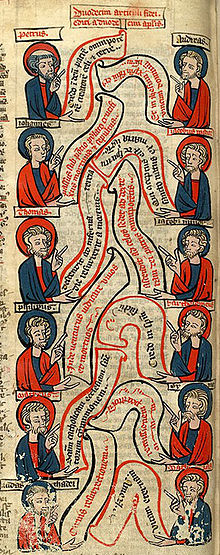
13th century artist depiction of claimed origin of the “Apostles’ Creed”
Pope Leo recently marked the 1700th anniversary of Emperor Constantine’s Council of Nicea:
Pope Leo XIV Marks Nicaea Anniversary, Urges Christians to Overcome Divisions
Pope Leo XIV commemorated the 1700th anniversary of the First Council of Nicaea on Friday in the Turkish city historically known as the birthplace of the Nicene Creed, calling Christians to overcome “the scandal of divisions” and to renew their commitment to unity.
The Pope spoke during an ecumenical prayer service held at the archaeological site of the ancient Basilica of Saint Neophytos on the shore of Lake Iznik, southeast of Istanbul. The gathering marked one of the most symbolic moments of his apostolic visit to Turkey, which has focused heavily on ecumenical and interreligious outreach.
“We are all invited to overcome the scandal of divisions,” he said, urging Christians to nurture “the desire for unity for which the Lord Jesus prayed and gave his life.”
Pope Leo and Ecumenical Patriarch Bartholomew I, considered first among equals among Eastern Orthodox bishops, were welcomed by two senior Orthodox bishops before proceeding to a platform beside the submerged ruins of the basilica. The two leaders stood before icons of Christ and of the council and lit candles together. 11/30/25 https://www.ncregister.com/cna/pope-leo-xiv-marks-nicaea-anniversary-urges-christians-to-overcome-divisions
Notice also the following:
Pope Leo XIV’s Nicaea moment and the missing Filioque
Pope Leo XIV joined Orthodox, Oriental Orthodox and Protestant leaders in Turkey … to commemorate the 1,700th anniversary of the First Ecumenical Council, marking one of the most symbolically charged ecumenical gatherings of his pontificate.
The prayer service, held in modern-day Iznik, which used to be Nicea, brought together twenty-seven heads of Churches and Christian communities in a setting uniquely associated with the earliest definitions of Christian doctrine. …
During the liturgy, the Pope and the assembled leaders recited the Niceno-Constantinopolitan Creed in English, using the original Greek form without the Filioque clause.
The joint recitation rendered the line concerning the Holy Spirit as “who proceeds from the Father”, omitting the Latin tradition’s “and the Son”.
In his prepared address, Pope Leo XIV thanked Ecumenical Patriarch Bartholomew I for what he described as the Patriarch’s “great wisdom and foresight” in calling Christian leaders to mark the anniversary together.
Reflecting on the Council of Nicaea, the Pope said the gathering “invites all Christians to ask ourselves who Jesus Christ is for us personally”, warning that reducing Christ to “a charismatic leader or superman” leads only to confusion.
The event followed closely on the release of the Pope’s new apostolic letter, In Unitate Fidei, published earlier in the week. Near its conclusion, the letter quotes in its footnotes that the Creed uses the Eastern form without the Filioque. A footnote explains that the phrase “is not found in the text of Constantinople” and is “a subject of Orthodox-Catholic dialogue”.
As the service concluded, the leaders prayed together for reconciliation and the strengthening of Christian unity, with Pope Leo XIV expressing hope that the Nicaea commemoration would bear “abundant fruits of peace”.
For some Catholics, the Pope praying the Niceno-Constantinopolitan Creed in Nicaea without the Filioque may be a head scratcher in terms of how far can genuine ecumenism can go before it becomes something else.
This matters, because the Church is not merely a diplomatic actor among others. She teaches the truth about God and the human person, and her unity is rooted not in sentiment but in doctrine.
When the Pope and the Ecumenical Patriarch recite together “the Holy Spirit … who proceeds from the Father”, while omitting the Latin tradition’s confession “and the Son”, the gesture is immediately read not merely as hospitality but as a theological signal.
For a Church increasingly pressured to dilute doctrine for consensus, the stakes are unmistakably high.
What is at stake is that the prayer at Iznik cannot be understood only as a theological dispute or an ecumenism courtesy. It reveals a deeper pattern in the Church’s post-conciliar instinct, an instinct to heal division through symbolic conciliation, even when those symbols touch the very formulations defended by a millennium of saints, councils and popes.
At its core, the event demonstrated how the Church is living through a renewed struggle over the meaning of unity: unity in truth versus unity by accommodation.
The Pope’s decision to pray the Creed in it the non-Filioque form, together with the content of his apostolic letter In Unitate Fidei, has brought that struggle into sudden clarity.
Beyond the prayer event, if one looks at a thousand years of Church history, the West has confessed the Spirit’s procession as “from the Father and the Son”.
This is not something minor, rather a pillar of Western Trinitarian theology, defended by Saint Augustine, Ambrose, Leo the Great, the councils of Toledo and the entire medieval tradition.
Pope Leo I taught in 447 that those who deny that the Spirit proceeds from both are guilty of an “impious” error. The councils of Toledo inserted the clause to combat Arianism. And when the entered the Roman liturgy in 1014, it did so as a crystallisation of Western faith, not as an arbitrary embellishment.
So when the Pope prays the Creed publicly beside Patriarch Bartholomew without the Filioque phrase, Catholics naturally ask, what exactly is being signalled? 11/29/25 https://thecatholicherald.com/article/pope-leo-xivs-nicaea-moment-and-the-missing-filioque
I have long reported that the Church of Rome would compromise on the filioque matter. Here is a link to something from 2008: Meeting with the Orthodox in Constantinople.
The Catholic Encyclopedia states:
Filioque is a theological formula of great dogmatic and historical importance. On the one hand, it expresses the Procession of the Holy Ghost from both Father and Son as one Principle; on the other, it was the occasion of the Greek schism (Maas A.J. Filioque, 1909).
Eastern Orthodox writers (like Timothy Ware), and others, have suggested that this clause is supportive of binitarianism, and thus should not be accepted by the Roman Catholic Church who insisted on this addition to the original Nicene Creed.
The ”filioque” clause states that the Holy Spirit, “proceeds from the Father and the Son“.
Notice scriptures that support that the Holy Spirit proceeds from Jesus the Lamb of God:
26. But when the Comforter has come, which I will send to you from the Father, even the Spirit of the truth, which proceeds from the Father, that one shall bear witness of Me. (John 15:26, AFV)
7. But I am telling you the truth. It is profitable for you that I go away because if I do not go away, the Comforter will not come to you. However, if I go, I will send it to you. (John 16:7, A Faithful Version)
22 And when He had said this, He breathed on them, and said to them, ‘Receive the Holy Spirit.’ (John 20:22, NKJV)
33 Therefore being exalted to the right hand of God, and having received from the Father the promise of the Holy Spirit, He poured out this which you now see and hear.” (Acts 2:33, NKJV)
9 But you are not in the flesh but in the Spirit, if indeed the Spirit of God dwells in you. Now if anyone does not have the Spirit of Christ, he is not His.” (Romans 8:9, NKJV)
1 And he showed me a pure river of water of life, clear as crystal, proceeding from the throne of God and of the Lamb. (Revelation 22:1, NKJV)
And while this was known from the beginning, the Church of Rome still understood part of that from the Middle Ages to present.
The Catholic Encyclopedia also basically agrees as it states:
The dogma of the double Procession of the Holy Ghost from Father and Son as one Principle is directly opposed to the error that the Holy Ghost proceeds from the Father, not from the Son. Neither dogma nor error created much difficulty during the course of the first four centuries…As to the Sacred scripture, the inspired writers call the holy Ghost the Spirit of the Son (Gal., iv, 6), the spirit of Christ (Rom., viii, 9), the Spirit of Jesus Christ (Phil., i, 19), just as they call Him the Spirit of the Father (Matt., x, 20) and the Spirit of God (I Cor., ii, ll). Hence they attribute to the Holy Ghost the same relation to the Son as to the Father. Again, according to Sacred Scripture, the Son sends the Holy Ghost (Luke, xxiv, 49; John, xv, 26; xvi, 7; xx, 22; Acts, ii, 33,; Tit., iii.6)…as the Father sends the Holy Ghost (John, xiv, 26) (Maas A.J. Filioque, 1909).
I would agree that the above quote is true and in accordance with history and with scripture. But who will change on this, the Vatican or the Orthodox?
Someone has to for unity to occur.
Based on what I was told in 2008, plus what happened with Pope Leo XIV, I would say that the Roman Catholics are the most likely–which betrays the Bible and its own pronouncements.
Yes, the ecumenical agenda is anti-biblical, and this is just another example of why.
That being said, the so-called Nicene Creed was not the original creed and has various issues.
The Eastern Orthodox correctly claim that the Roman Catholics added the filioque clause, the reality is that particular creed which they use was also not original, but basically was the result of the Council of Constantinople in 381 A.D.
The Continuing Church of God (CCOG) has the following video for our Bible News Prophecy program:
Roman and Eastern Orthodox Catholics, Lutherans, and various others except versions of something referred to as the “Apostles’ Creed.” Were any of these creeds actually spoken by the original apostles? Do any of the creeds come directly from the Bible? When was the Nicene Creed adopted? How important is that to the Greek Orthodox? What did Emperor Theodosius do in 380 A.D.? Was Jesus’ claimed descent into Hades part of it? What about the sequel to the movie, ‘The Passion of the Christ’? What about the so-called filioque clause? What is the creed at the website of the Vatican? Which ‘creed’ is considered to be the oldest? What does the creed known as the “old Roman form” actually state? Was the ‘Roman’ creed directly taken from writings of Irenaeus of Lyon, Marcellus of Ancyra, Tertullian of Carthage, Origen of Alexandia, and the ‘antipope’ Novation? Were the early creeds trinitarian? What about Gregory Thaumatugis? When was the ‘Received Creed’ developed? What about the Athanasian Creed? Is there an Antioch creed? What did the so-called “Constantinople Creed” state that former Nazarenes were supposed to declare? Why should anyone care about any of these creeds? Dr. Thiel addresses these issues and more.

Here is a link to a our BNP video: The Original Apostle’s Creed?
The Continuing Church of God later put out this sermon from its ContinuingCOG channel which has more about the creeds and the ones considered to be the oldest:
The Bible teaches that God is one. The Bible also uses plural terms for the Godhead. How is God one? Is God one being like the unitarians teach? One trinity like many believe? Or is God one family, consisting of the Father and Son, with true Christians to be born into that family after the resurrection? What are the oldest ‘creeds’? Were the earliest creeds binitarian or trinitarian? Was what is called the ‘Nicene Creed’ original? What about the ‘Creed of Lucian’? Do scholars admit that the Bible supports a binitarian or trinitarian view of the Godhead? What about early leaders considered to be saints by the Greco-Roman Catholics? Do the Hebrew scriptures and the words of Jesus teach that in a marriage, two people are one? Does God want godly offspring? Is Jesus Melchizedek, our High Priest, and the Rock of Matthew 16? Did John Chrysostom teach that the “keys” were given to the Apostle John? Could there be two ‘Yahwehs’? Dr. Thiel covers these matters and more in his third sermon covering the mysteries of God.

Here is a link to our sermon video: How is God One? Creeds?
Some items of related interest may include:
What Was the Original Apostles’ Creed? What is the Nicene Creed? Did the original apostles write a creed? When was the first creed written? Are the creeds commonly used by the Eastern Orthodox or Roman Catholics original? Here is a link to a related video: The Original Apostle’s Creed?
Why Should American Catholics Fear Unity with the Orthodox? (And the Protestants) Are the current ecumenical meetings a good thing or will they result in disaster? Is doctrinal compromise good? Here is a link to a related video Should you be concerned about the ecumenical movement?
Will the Interfaith Movement Lead to Peace or Sudden Destruction? Is the interfaith movement going to lead to lasting peace or is it warned against? A video sermon of related interest is: Will the Interfaith Movement lead to World War III? and three video sermonette are also available: Pope Francis signs ‘one world religion’ document! and The Chrislam Cross and the Interfaith Movement and Do You Know That Babylon is Forming?
Will the Interfaith Movement Lead to Peace or Sudden Destruction? Is the interfaith movement going to lead to lasting peace or is it warned against? A video sermon of related interest is: Will the Interfaith Movement lead to World War III? and a video sermon is also available: Do You Know That Babylon is Forming?
Hope of Salvation: How the Continuing Church of God differs from most Protestants How the real Church of God differs from mainstream/traditional Protestants, is perhaps the question I am asked most by those without a Church of God background. As far as some changes affecting Protestantism, watch the video Charismatic Kenneth Copeland and Anglican Tony Palmer: Protestants Beware! [Português: Esperança do salvação: Como a igreja do deus difere da maioria de protestantes]. Several related sermon are also available: Protestant, Baptist, and CCOG History, The First Protestant, God’s Command, Grace, & Character, The New Testament, Martin Luther, and the Canon, and How Does the Church of God Differ from Protestantism?
Beliefs of the Original Catholic Church: Could a remnant group have continuing apostolic succession? Did the original “catholic church” have doctrines held by the Continuing Church of God? Did Church of God leaders uses the term “catholic church” to ever describe the church they were part of? Here are links to related sermons: Original Catholic Church of God?, Original Catholic Doctrine: Creed, Liturgy, Baptism, Passover, What Type of Catholic was Polycarp of Smyrna?, Tradition, Holy Days, Salvation, Dress, & Celibacy, Early Heresies and Heretics, Doctrines: 3 Days, Abortion, Ecumenism, Meats, Tithes, Crosses, Destiny, and more, Saturday or Sunday?, The Godhead, Apostolic Laying on of Hands Succession, Church in the Wilderness Apostolic Succession List, Holy Mother Church and Heresies, and Lying Wonders and Original Beliefs. Here is a link to that book in the Spanish language: Creencias de la iglesia Católica original.