Logos of the SDBs
Were there always ‘baptists’ since the beginning of the church age as some claim?
Well, that depends on how you define baptist.
If the definition of baptist is one who practices baptism by immersion, then the answer is yes.
What about the denomination called Baptists, do they have doctrinal continuity with the original Christian church?
No.
As it turns out, various Baptist historians write from the perspective that Baptists existed independently from Roman Catholicism and existed prior to the Protestant Reformation.
Some have a Baptist perpetuity (sometimes called ‘successionst’) view, which is the claim Baptists have existed since Pentecost in the 2nd chapter of the Book of Acts.
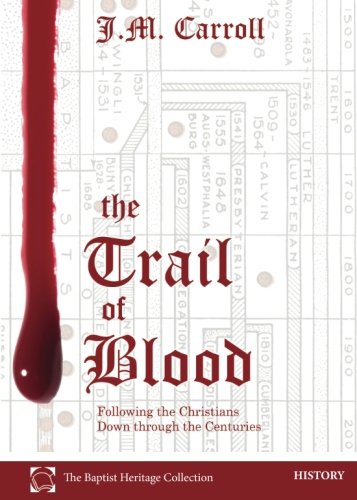
The perpetuity view is often identified with The Trail of Blood, a booklet containing five lectures by Dr. James Milton Carrol published in 1931. That booklet claims perpetuity, but an honest reading of it leads to the general conclusion that there are no details to show that Dr. Carroll proved his point on the perpetuity of his faith from the time of Jesus (it mainly points to infant baptism not becoming an issue until after the rise of Emperor Constantine, and persecutions which came to those who disagreed after that). Yet, despite lack of proof, many Baptists still believe it.
The Trail of Blood also contains the following:
In the first two centuries the individual churches rapidly multiplied and some of the earlier ones, such as Jerusalem, Antioch, Ephesus, Corinth, etc., grew … serious error to begin creeping in … the loyal churches declared non-fellowship for those churches which accepted and practiced … errors …
It should be pointed that that while the bulk of Ephesus and Antioch looks to have remained faithful until sometime into the 3rd century (and with the leaders from those areas refuting erroneous changes), Jerusalem and Corinth had mainly apostatized before the end of the 2nd century.
Furthermore, it should be pointed out that in The Trail of Blood, most of the “loyal churches” that Dr. Carroll claims became separate from Rome were NOT actually “loyal” churches (the truly loyal ones never became part of the Greco-Roman confederacy).
Here is a Baptist claim about early groups that supposedly were “Baptist”:
Novatians were Baptists … They continued on as Anabaptists … Hassell lists them right along with the other Baptists of the other ages. “Among the persecuted people of God have been the Novatians, Donatists, Cathari, Paterines, Paulicians, Petrobrusians, Henricans, Arnoldists, Albigenses, Waldenses, Lollards, Mennonites and Baptists, nearly all of whom were occasionally designated Anabaptists or Re-Baptizers by their enemies, because they disregarded infant or unregenerate baptism, and baptized all adults, whether previously baptized or not, who, upon a credible profession of faith, applied to them for membership in their churches -thus insisting upon a spiritual or regenerate church membership, the First and Most Important Mark of the Apostolic Church.” (Hissel B. Baptist History Notebook, 3rd ed. Baptist Training Center, 2017, p. 115-116)
While some of those groups held ‘Baptist doctrines,’ many did not. For example, the Cathari and the Paterines considered the cross to be the “mark of the Beast” (Schaff, Philip, History of the Christian Church, Chapter X; Jones W. The history of the Christian church from the birth of Christ to the xviii. century, Volumes 1-2, 3rd edition. R.W. Pomeroy, 1832, p. 289), yet modern Baptists use crosses as a religious symbol. For another example, the faithful among the Waldenses paid multiple tithes, kept the Sabbath, would not keep Easter, etc. (LESSON 51, AMBASSADOR COLLEGE BIBLE CORRESPONDENCE COURSE “And the woman fled into the wilderness, where she hath a place …” Rev. 12:6, 1968)—they were most certainly not modern Baptists.
Now, here is an assessment from Baptist Pastor Tyler Robbins of certain Baptists claiming the Novatians:
Were the Novatians Baptists? Many Baptists like to claim the Novatians as their own. … If the Novatians cannot be claimed as direct descendants, can they be claimed as the distant spiritual kin of modern-day Baptists? Some Baptists would agree.
Much of what has been written of the Novatians by Baptists of any stripe is at best a gloss, and at worst completely incorrect. As an example of the latter, G.H. Orchard, a Landmarkist, wrote (1855):
One Novatian, a presbyter in the church of Rome, strongly opposed the readmission of apostates, but he was not successful. … Novatian, with every considerate person, was disgusted with the hasty admission of such apostates to communion, and with the conduct of many pastors, who were more concerned about numbers than purity of communion. (p. 53)
J.M. Carrol, in his infamous treatise Trail of Blood, declared that when the errors of compromised local church autonomy, infant baptism and baptismal regeneration crept into true churches, the Novatian Baptists sallied forth for the cause of ecclesiastical purity:
Some of the churches vigorously repudiated them. So much so that in A.D. 251, the loyal churches declared non-fellowship for those churches which accepted and practiced these errors. And thus came about the first real official separation among the churches. (2013, Kindle Locations 294-295)
Jack Hoad, a solid historian, likewise missed the boat when he wrote that Novatians were “making a strong protest against the same moral laxity and the weak, almost non-existent disciplinary standards in the churches” (1986, p. 30). Thomas Armitage observed that “[t]he Novatians demanded pure Churches which enforced strict discipline, and so were called Puritans” (178).
All of these brief characterizations are wrong. …
Dionysius … claimed that Novatian plied gullible men with liberal amounts of alcohol and “compelled” them to support his rival claim to the Bishopric (6.43.9-10, NPNF2, 1:288)! (Robbins T. Were the Novations Early Baptists? Sharper Iron, October 8, 2014)
Novatian himself was baptized by pouring, not immersion, and (3) his baptism was not conducted as a public testimony of his new-found faith—it was done in private, upon a sickbed. … Novatian’s church believed the Holy Spirit was bestowed after baptism and after confirmation by the bishop. Cornelius, Novatian’s own successor, criticized him for (1) his irregular baptism, and (2) not having been confirmed. This is not the portrait of a Baptist crusader. (Robbins T. Were the Novatians Early Baptists? Part 2. Sharper Iron, October 17, 2014)
Tyler Robbins is correct that Novatian, who came from the Church of Rome, was not a faithful Christian He is considered the second “antipope” by the Church of Rome, and that church claims Novatian declared himself pope in 251 (Antipope. The Catholic Encyclopedia. New York: Robert Appleton Company, 1907). His faith did not hold to many original Christian teachings. But The Trail of Blood points to his 251 declaration to improperly support the Baptist claim of perpetuity.
It should also be pointed out that Dr. Carroll’s Trail of Blood, booklet opposes actual apostolic succession, as it states:
Baptists do not believe in Apostolic Succession.
Since it is true that the groups that tend to call themselves Baptists do not have true apostolic succession, obviously they should not claim perpetuity.
Here are some inaccurate perpetuity/successionist assertions by the 19th century Baptist minister G.H. Orchard:
the Baptists may be considered as the only Christian community which has stood since the times of the Apostles … all Christian communities during the first three centuries were of the Baptist denomination … The oriental Baptist Churches, with their successors the Paulicians, continued in their purity until the tenth century when these people visited France … where they flourished until the crusader army scattered or drown in blood … offending professors. (Orchard GH. A Concise History of Foreign Baptists. George Wightman Paternoster Row, London, 1838, p. v)
There are many issues with his assertions. The historical reality is that while all faithful Christians believed in baptism by immersion for the repentant, the “oriental … Churches” (meaning those in Asia Minor) held many doctrines that the modern Baptists oppose (which our free eBook will go into in more detail: Hope of Salvation: How the Continuing Church of God Differs from Protestantism). Their “successors” called the Paulicians, for example, were binitarian (Gregory of Nyssa. On the Holy Spirit, Against the Followers of Macedonius. In Nicene and Post-Nicene Fathers, Series Two, Volume 5. Edited by Philip Schaff and Henry Wace. American Edition, 1893), kept Passover on the 14th day of the first month on the biblical calendar (Conybeare F.C. The Key of Truth: A Manual of the Paulician Church of Armenia. Clarendon Press, Oxford, 1898, p. clii) as stated in scripture (e.g. Leviticus 23:5 ). Whereas Baptists call Passover “Easter” and keep it on Sunday, while the Paulicians kept the seventh-day Sabbath while opposing Sunday (ibid pp. clii, cxciii), did not keep Christmas (ibid pp. clii, cxciii), and the faithful ones who were called Paulicians were also pacifists (Fortesque A. Transcribed by Richard L. George. Paulicians. The Catholic Encyclopedia, Volume XI. Copyright © 1911 by Robert Appleton Company). And while we in CCOG would agree that those were original and pure Christian doctrines, Baptists do not hold to them (although those called Seventh-Day Baptists do often strive to keep the Sabbath).
In his book, Baptist minister G.H. Orchard also claimed “primitive Baptists” essentially began with John the Baptist (ibid, p. 1). Then he later included as “primitive Baptists” Ignatius of Antioch (p. 13), Polycarp of Smyrna (p. 18), Justin Martyr (p. 22), Irenaeus of Lyon (p. 24), Clement of Alexandria (p. 25), and Theophilus of Antioch (p. 26). He also considered writings of John Chrysostom (p. 41) and Augustine of Hippo (p. 44) as “testimonies of the Fathers” and called them “great men” (p.47). Although Baptists claim souls go to heaven when they die, Justin Martyr asserted that those who teach that are not Christians (Justin. Dialogue with Trypho. Chapter 80).
The reality is that not all (if any) of those “primitive Baptist” ministers G.H. Orchard claimed to be Baptists actually held many “Baptist” doctrines. But since relatively few people know much about those early leaders, various Baptists have failed to realize that they held to many doctrines that modern Baptists do not hold.
Consider the following that John the Baptist was prophesied to do:
79 To give light to those who sit in darkness and the shadow of death, To guide our feet into the way of peace. (Luke 1:79)
So, John the Baptist was expected to guide God’s followers into the way of peace. Now, notice his response to soldiers:
14 Likewise the soldiers asked him, saying, “And what shall we do?”
So he said to them, “Do not intimidate anyone or accuse falsely, and be content with your wages” (Luke 3:14).
The word translated as “intimidate” is the Greek word diaseio which the KJV translates as “violence.” Strong’s Exhaustive Concordance translates it “to shake thoroughly, to intimidate, to do violence to.” It comes from two Greek words diagnosis and seio; diagnosis is translated as examination and seio as to rock, agitate, to throw in a tremor. There is no way a soldier cannot ‘agitate/intimidate’ if they are trying to kill someone.
Thus, John the Baptist’s statement here shows that military violence was not for the future followers of God. While early professors of Christ understood that, sadly, most groups who claim Christianity, including modern Baptists, have not understood that. This is one of many ways that modern Baptists do not follow the teachings or practices of John the Baptist.
Furthermore, some leaders that Baptist minister G.H. Orchard referred to in his book were certainly not real Christians. One, Justin Martyr, reported that he lived in no outward way different than the pagans (Dialogue with Trypho. Chapter 10), contrary to the Apostle Paul’s teaching in Ephesians 4:17. Two people that G.H. Orchard called “great men,” John Chrysostom and Augustine, not only were not real Christians, they both taught infant baptism!
There was no historical perpetuity for what are now the bulk of Baptists. Yet, it is still asserted at times.
Notice the following claims from a 20th century article by Baptist B.M. Cedarholm:
Historians testify that local churches; which hold the doctrines, beliefs, and practices of today’s Bible-believing, separatist Baptists; have had continuous existence since the days of Christ. This cannot be said of any other church, churches, or religious organization. … “as far back as 100 A.D., although without doubt there were Baptist churches then, as all Christians were then Baptists.” (Cedarholm BM, editor. Historical Statements Concerning Baptists and their Origins)
If you were to read that entire article edited by the Baptist B.M. Cedarholm, you would see that it mostly quotes Protestant theologians over the centuries of a Baptist persuasion who agree with part of the initial statement. But they offer no proof. Nor do they provide a real list of beliefs early ‘Baptists’ held that current Baptists hold. While it is true that all early Christians endorsed baptism, early Christians simply held many doctrines that are in conflict with 21st century Baptists. Modern Baptists who learn of their teachings, many of which are in this book, would not consider their churches the same as those in 100 A.D.
At least partially because King Henry VIII and early Lutherans condemned Anabaptists in the 16th century, Baptists have not always embraced the title Protestant. Yet, modern Baptists agree more with the Protestants than the Anabaptists of old on some of the teachings and practices the Lutherans condemned the Anabaptists for (including the refusal of military service, not being involved in worldly politics, teaching annihilation of the unrepentant, and that the resurrected saints shall take possession of the kingdoms of the world before the second resurrection of the dead—though some Baptists might believe that last point).
It may be because of their differences from the old Anabaptists that the Baptist perpetuity view of history is properly rejected by many modern Baptists.
However, on the Internet in the 21st century, you can still find Baptist ministers who assert their modern religion has true perpetuity without real proof, such as the following (bolding in original):
Calvary Baptist Church believes that the Lord Jesus started the first church – during His earthly ministry. We do not believe that the church started on the Day of Pentecost, but at least three years earlier, and we further believe that Jesus promised His church a continued existence – i.e. perpetuity. … Baptistic churches have existed from the time of Christ to the present day. Those churches have borne many different names in various places. One such name was “Anabaptist (Oldfield KD, pastor. Summary of our Doctrines. http://idahobaptist.com/about/ accessed 01/20/20)
Some of God’s People were known as Novatians … In about the year 250, … there was a man in Rome who was converted to Christ while on his death bed. Novatian had been a well-known and distinguished Pagan philosopher. … Novatian was one of several elders in the church at Rome before the formation of Roman Catholicism. (Oldfield KD, pastor. Some of God’s People were known as Novatians. Calvary Independent Baptists Church. Post Falls, Idaho. May 2, 2016.)
It should be pointed out that by 250 A.D., the Church of Rome had already changed on many doctrines and was aligned with regions dominated by apostates, such as Alexandria, Jerusalem, and by that time, Antioch. Second century “oriental” Church of God leaders, such as Polycarp and Polycrates, had chastised Roman bishops for their inappropriate change of the date of Passover. Furthermore, by including the Roman Novatians, Baptists have proven, by their perpetuity declarations, that they do not have original perpetuity.
Now, instead of claiming doctrinal perpetuity from the original New Testament church, the late Baptist minister and civil rights activist, Martin Luther King, Jr., correctly concluded that his church (and other Greco-Roman-Protestant churches) adopted many traditions that they incorporated from Mithraism (King ML. The papers of Martin Luther King, Jr, Volume 4. Clayborne Carson, Ralph Luker, Penny A. Russell editors/compliers. University of California Press, 1992, pp. 222, 224, 307, 309).
Yes, it is a documented fact that modern Baptists adopted beliefs that the early oriental churches and their faithful successors did not hold.
Yet, what are some of the ramifications if the Baptists actually had doctrinal continuity with unknown groups (or portions of known groups) throughout history?
Well, that would be a total of much less than 1% of the world’s population during the church age (the time from Acts 2 to present). So since Baptists do not teach God will offer salvation to all, either in this age or the age to come, either the Baptists are teaching that well over 99% of the population will be permanently lost—as they were not their type of Baptist—or if non-Baptists are also to be saved, that perpetuity teaching means it does not matter if one is a Baptist to be saved. It is most likely the latter position (based on various Baptist statements, including those from the late Billy Graham), which makes them like Evangelical Protestants (who also hold to the position that most who ever lived will not be saved).
Practically speaking, modern Baptists tend to hold essentially Protestant doctrinal views, generally in line with Evangelical Protestants. Because of that, they will tend to be grouped in with them in this book. They do NOT have the same hope of salvation that we in the CCOG hold to (for details, see the free online book: Universal OFFER of Salvation, Apokatastasis: Can God save the lost in an age to come? Hundreds of scriptures reveal God’s plan of salvation).
Although they claim a long history, in their claims they include early Sabbath keepers who do not hold their present doctrines like 4th century Semi-Arians in Armenia and 6th century Holy Day keepers in the British isles (Davis, Tamar. A General History of the Sabbatarian Churches. 1851; Reprinted 1995 by Commonwealth Publishing, Salt Lake City, pp. 20, 108). The SDBs are trinitarian (Stillman W. Miscellaneous Compositions in Poetry and Prose. F.H. Bacon, New-London 1852; pp. 3-4) and do not keep the biblical holy days. They also include earlier groups who accepted “church eras” (Davis, p. 31) as well as those who called themselves “Church of God” and not Seventh Day Baptist (Duggar, pp. 275-277).
What about the Seventh Day Baptists?
The late COG historian Richard Nickels made several points about the SDBs and history:
Seventh Day Baptists cannot validly claim exclusive “ownership” of the history of Sabbatarians. SDB’s today do not agree doctrinally with their Sabbatarian ancestors! Actually, today’s faithful Church of God brethren are doctrinally closer to early English and American Sabbath-keepers than are today’s liberal SDB’s. Early American Sabbatarians rejected Trinity and immortal soul teaching, eschewed Christmas and Easter, promoted their faith much more than SDB’s do today, and traced their spiritual ancestry directly to English Lollards, Waldensians, and the first century Church … The oldest existing Seventh Day Baptist Church, the Mill Yard Church in London, England, began during the mid 1600’s. The Mill Yard Church has apparently always kept the “Lord’s Supper” on the fourteenth day of the first Hebrew month, but almost no American SDB churches have followed this practice. Today, SDB’s accept Christmas, the Trinity, and immortal soul teaching. (Nickels R. Six Papers on the History of the Church of God. Sharing & Giving, Neck City (MO), 1993, p. 83).
In the late 1700s, those now called Seventh Day Baptists adopted Protestant positions and also started calling themselves Sabbatarian Baptists. They began to use the title Reverend for their ministers (Randolph CF. A History of the Seventh Day Baptists in West Virginia, 1905. Reprint 2005. Heritage Books, Westminster (MD), p. 28), insist on the immortality of the soul (Dugger AN, Dodd CO. A History of True Religion, 3rd ed. Jerusalem, 1972. Church of God, 7th Day. 1990 reprint, p. 277; Randolf, p. 87), put steeples on their church buildings (Randolf pages 74a, 100a, 160a, 208a, 214a, 238a, and 242a of church buildings without steeples, but shows steeples on pages 104a, 106a, 246a, and 344a), and became separate from Church of God brethren that they claim to have been their ancestors (Stillman, pp. 3-4; Randolf, p. 87).
By 1808, many SDBs considered Protestants to be true Christian brothers (Randolph, pp. 138-140). Essentially, SDBs are Protestants, with their main difference that they go to church on Saturday.
What about the modern SDBs?
Here is a 21st century report about the SDBs:
Are Christians wrong to worship on Sunday when the biblical Sabbath is Saturday? Rob Appel, executive director of the Seventh Day Baptist General Conference answers with a question of his own: “What day did Christ go to church? Saturday. OK, let’s be Christ like.”
… Saturday worship is not a definitive marker over which the church is willing to fight.
“It’s not a big thing,” said Appel … “We are Baptist,” Appel said. “We just have a different day of worship” … North American churches once called Sabbath Baptists organized as a Conference in 1802. Although “we’ve been around a long time … we’re small.” Appel attributes stunted growth in part to “our own fear.”
Early members were persecuted because of their Sabbath worship, which prompted “a tendency to keep to ourselves.”
“That mentality permeated from generation to generation,” he said. “We don’t feel that anymore …”…
Seventh Day Baptists leave women’s ordination up to the local church. The Conference has issued no statement on ordination, although it has accredited some female pastors …
The Sabbath theology takes second place, or third …
“We’re Baptists first,” Kersten said. “When I send kids off to college, I encourage them to keep the Sabbath and find a good Sunday Baptist Church.” He said there are “so many theological problems” in other Sabbatarian groups that “Baptist” is more important than Saturday worship. (Jameson N. ‘Baptist’ comes first for Seventh Day Baptists. Associated Baptist Press, June 29, 2011. This article was commissioned by the North American Baptist Fellowship)
There is no historical evidence that early SDBs ordained any women, and there is evidence that they would take stronger stands on the Sabbath than they now do.
The “theological problems” that all the Baptists have with groups like the Continuing Church of God include the fact that we have retained historical Christian beliefs on matters such as the Godhead, salvation, and other doctrines they do not hold.
The Continuing Church of God has the following related sermon on its ContinuingCOG channel:
Although Seventh Day Baptists (SDBs), Seventh-day Adventist (SDAs), and Messianic Jews keep some version of the seventh day Sabbath, are they Protestant or Church of God. What do they claim? What do they teach? What do SDAs and Messianic Jews teach about their history? Do SDBs cite groups who held Church of God (COG) and not SDB doctrines? Which group teaches the original biblical Christian faith? How do the SDAs, Messianics, and SDBs agree with Protestants on issues such as salvation, history, and the Godhead, which differ greatly from the Continuing Church of God (CCOG)? Are there really 613 laws of the Torah? Are the 613 mist What are 28 ways the SDBs differ from the CCOG? Are ‘Black Israelites’ right about Jesus being a black African? Was the Day of Atonement on October 22, 1844 according to Rabbinical or Karaite Jews? Did the SDAs or COG come out of the Millerite movement? Did Ellen White make false prophecies that she insisted came from God? If so, what were some of them? Did the SDA church send out literature it knew was clearly wrong? Was Ellen G. White’s sanctuary interpretation the “complete system of truth”? Did SDAs once teach crosses were pagan, but now include them in their official logo? Which of the 4 churches (SDB,SDA, Messianic, CCOG) doctrines have the most biblical and historical support? Dr. Thiel addresses these issues and more.

Here is a link to the sermon video: Seventh Day Baptists/Adventists/Messianics: Protestant or COG?
Anyway, if baptism by immersion is the only criteria for being a ‘baptist,’ then yes, there has been perpetuity since the start of the Christian church.
However, because they do not hold to numerous doctrines that the early church held, as well as the true Church of God throughout history, no the denominations called Baptist do not have perpetuity.
The first Christians:
- Kept the 7th day Sabbath
- Kept Passover on the 14th and not Easter Sunday
- Did not eat biblically unclean meat
- Were not accepting of Emperor Theodosius’ trinity
- Opposed military service for Christians
- Did not teach humans had immortal souls
- Taught that resurrected saints would reign on the earth before the second resurrection
- Taught that God will call others to salvation in the ‘age to come’
We in the Continuing Church of God still hold to these beliefs. Plus, we have detailed documented free literature available for any who wish to prove this for themselves (e.g. see our free eBook: Hope of Salvation: How the Continuing Church of God Differs from Protestantism).
UPDATE 11/30/25: We just uploaded the following related video:
The Truth About Baptist History
Some in the denominational faith of the Baptist religion claim continuity and obedience to Christ from even before the foundation of the church at Pentecost. But is their claim valid? If their claim is that they practice baptism then, yes, their claim is valid. But what about obedience and doctrine? Does the Baptist faith believe what Jesus believed? Does the Baptist faith do what Jesus did? But does the claim to continuity merely require baptism while adhering to doctrines never practiced or taught by Jesus Christ or the apostles or the church founded on Pentecost? Hardly. What is the real history of the Baptist faith as chronicled by some leading scholars and practitioners of that faith? What are the beliefs they really practice? Were some who they claim to be their spiritual ancestors have actually been Church of God? Could the Baptist faith be classified as simply another belief system related to the Protestant movement? Watch this video and listen as Dr. Thiel shines the light of Biblical knowledge and understanding on the faith and practices of the early church. The time is at hand.

Here is a link to our video: The Truth About Baptist History.
The late Herbert W. Armstrong pointed out:
The … CHURCH OF GOD … is in direct continuous succession from the apostolic Church founded by Christ A.D. 31 (Armstrong HW. Why The Church? Good News, August 14, 1978)
The true Church continued, a tiny “little flock,” almost unnoticed by the world … (Armstrong HW. The Church They Couldn’t Destroy. Good News, December 1981)
So, if you are Baptist (or any other non-Church of God faith), I urge you to be like the Bereans of old (Acts 17:10-11) and search the scriptures (as well as facts about church history) to see if these things are so.
Some items of possibly related interest may include:
Hope of Salvation: How the Continuing Church of God Differs from Protestantism The CCOG is NOT Protestant. This free online book explains how the real Church of God differs from mainstream/traditional Protestants. Several sermons related to the free book are also available: Protestant, Baptist, and CCOG History; The First Protestant, God’s Command, Grace, & Character; The New Testament, Martin Luther, and the Canon; Eucharist, Passover, and Easter; Views of Jews, Lost Tribes, Warfare, & Baptism; Scripture vs. Tradition, Sabbath vs. Sunday; Church Services, Sunday, Heaven, and God’s Plan; Seventh Day Baptists/Adventists/Messianics: Protestant or COG?; Millennial Kingdom of God and God’s Plan of Salvation; Crosses, Trees, Tithes, and Unclean Meats; The Godhead and the Trinity; Fleeing or Rapture?; and Ecumenism, Rome, and CCOG Differences.
Seventh Day Baptists are Protestant, not Church of God This article explains reasons why Baptists, include seventh day ones (SDBs) do not have the historical and doctrinal ties to the original church that many have claimed. Here are two related sermons in the English language: Seventh Day Baptists/Adventists/Messianics: Protestant or COG? and Protestant, Baptist, and CCOG History.
What is the Origin of the Cross as a ‘Christian’ Symbol? Was the cross used as a venerated symbol by the early Church? Two related YouTube videos would be Beware of the ‘Ecumenical Cross’, The Chrislam Cross and the Interfaith Movement, and Origin of the Cross.
Mysteries of God. What is God? This free e-book answers many questions, such as is God omniscient, omnipresent, and omnipotent? Does the Godhead consist of a closed trinity or an expanding family? Here are links to related sermons: Mysteries: Is God Omnipotent, Omnipresent, and Omniscient? and Where Did God Come From? What Does God Look Like? and How is God One? Creeds? and Jesus and Trinitarian Mythology and Mysteries: The Holy Spirit and God’s Names and Kingdom and Mysteries of the Gospel and Deification.
Military Service and the Churches of God: Do Real Christians Participate in Carnal Warfare or Encourage Violence? Here are current and historical perspectives on a matter which show the beliefs of the true church on military participation. Is war proper for Christians? A related sermon would be: Christians, Violence, and Military Service.