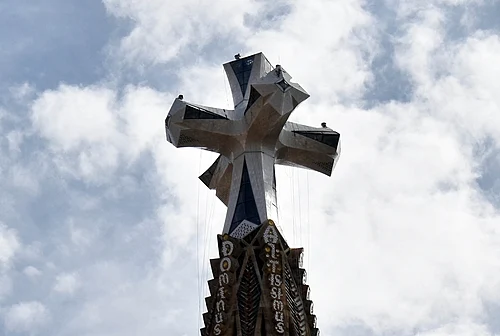
Top of tower of the Sagrada Familia
(Photo by Canaan via Wikipedia)
The Sagrada Familia basilica is now believed to be the tallest church in the world.
Pope Leo XIV consecrated it today:
BARCELONA, Spain (AP) — Pope Leo XIV celebrated the Sagrada Familia Basilica as a masterpiece of “stones, colors and light,” as he marked the centenary of the death of its architect, Antoni Gaudí, with a Mass on Wednesday under its soaring sandcastle spires.
Leo called Gaudí’s unfinished temple, one of the world’s most visited monuments, a “sign of unity and harmony for all of Spain,” an ongoing building project like the lifelong journey all Christians make to find God.
“We are all the living stones of this edifice,” Leo said from the altar of the basilica, with Spanish King Felipe VI and Queen Letizia sitting to his side and a hundreds-strong choir filling the soaring basilica with song. …
Tens of thousands of people lined the streets around Sagrada Familia for the event, with streets closed to traffic and a heavy police presence, given the attendance of the royal couple and Prime Minister Pedro Sánchez. The crowds remained to watch a light show that was to accompany Leo’s consecration of the basilica’s final Tower of Jesus Christ that has made it the world’s tallest church. https://apnews.com/article/spain-pope-leo-sagrada-familia-barcelona-gaudi-a1b69601917ab4709959c4628a4995b6
In February the cross at the top tower was installed. NBC News referred to is as a “gigantic five-story ceramic cross” (https://www.nbcnews.com/world/spain/pope-leo-barcelona-spain-sagrada-familia-cathedral-basilica-rcna349049).
Here is more about the cross:
For decades, cranes and construction frames have been part of the basilica’s silhouette. But as workers remove the protective structures surrounding the Tower of Jesus Christ, the monumental cross designed by Antoni Gaudí can now be seen clearly from the streets below.
The cross itself is immense: 17 meters (55 feet) high and 13.5 meters (44 feet) wide. Clad in glass and white enameled ceramic, it forms a luminous crown atop the tallest part of the basilica. …
The cross was conceived to glow day and night, with glass surfaces intended to catch sunlight during the day and illumination after dark. The aim was simple but profound: that the sign of Christ would be visible across Barcelona. https://aleteia.org/2026/03/16/incredible-to-see-cross-finally-appears-over-sagrada-familia/
More than 144 years after construction began, the world’s tallest church reached its final height of 566 feet upon the installation of its last major structural element, a cross atop the central Tower of Jesus Christ, in February. …
With its brilliant white surface reflecting the searing Spanish sun, the cross that crowns the Tower of Jesus Christ (the other 17 towers are dedicated to the 12 apostles, four Evangelists and the Virgin Mary) is as tall as a five-story building and weighs around 100 tons. Installing it was a complex, months-long process.
According to Mauricio Cortés, the architect responsible, Gaudí had imagined a reflective cross that shone during the day and illuminated the skyline at night. Cortés, like all his predecessors, faced two major challenges: remaining faithful to Gaudí’s vision while satisfying stringent engineering requirements (in this case, keeping the spire relatively lightweight).
The cross was manufactured in Germany and delivered to Spain in 14 prefabricated sections made from concrete and stainless steel. The latter material, while not widely used in Gaudí’s time, provided the necessary strength while reducing overall weight. This convergence of history and modernity was one of the many delicate compromises required to bring the architect’s scheme to life.
Once in Barcelona, each section was lifted via crane onto a workshop located 200 feet above ground, directly on top of the basilica’s central nave. There, workers finished the pieces with stone interiors, enameled white ceramic cladding and windows made from locally sourced glass, before the structure was assembled and raised into position.
“Obviously, the times have changed — the technology has evolved, as have the regulations,” Cortés said, touring CNN through the basilica ahead of the inauguration. But the Mexican architect is confident that the church remains true to Gaudí’s original vision. “We believe we’re pretty close to (his plans for) the exterior, for sure,” he added. https://www.cnn.com/2026/06/08/style/sagrada-familia-barcelona-tower-jesus-christ-intl
Let me add that it was not until about 200 – 210 A.D. do we see writings (like from Tertullian) suggesting that a cross is a sign of Jesus.
A writing that may have been improperly ascribed to Hippolytus of Rome of the 3rd century claimed, “Ye were marked with the seal of my cross, but ye deleted it by your hardness of heart” (Hippolytus. On the End of the World. Appendix to part II. Of the works of Hippolytus. Containing dubious and spurious pieces. Section XLVIII. Ante-Nicene Christian library: translations of the writings of the Fathers down to A.D. 325, Volume 9. T. and T. Clark, 1872, p. 129). This seems to suggest that the author considered that a cross was a good mark. But Jesus never said anything like that.
The Greek goddess Diana was often portrayed with a cross above her head looking very much like later medieval portrayals of the “Virgin Mary.” But the original usage seems to be even older.
Perhaps, a few statements from the 19th century historian Alexander Hislop may be helpful for some:
In the Papal system as is well known, the sign of the cross and the image of the cross are all in all. No prayer can be said, no worship engaged in, no step almost can be taken, without the frequent use of the sign of the cross. The cross is looked upon as the grand charm, as the great refuge in every season of danger, in every hour of temptation as the infallible preservative from all the powers of darkness. The cross is adored with all the homage due only to the Most High and for any one to call it, in the hearing of a genuine Romanist, by the Scriptural term, “the accursed tree,” is a mortal offence. …
The same sign of the cross that Rome now worships was used in the Babylonian Mysteries, was applied by Paganism to the same magic purposes, was honoured with the same honours. That which is now called the Christian cross was originally no Christian emblem at all, but was the mystic Tau of the Chaldeans and Egyptians–the true original form of the letter T–the initial of the name of Tammuz…That mystic Tau was marked in baptism on the foreheads of those initiated in the Mysteries, * and was used in every variety of way as a most sacred symbol…To identify Tammuz with the sun it was joined sometimes to the circle of the sun; sometimes it was inserted in the circle…The mystic Tau, as the symbol of the great divinity, was called “the sign of life”; it was used as an amulet over the heart; it was marked on the official garments of the priests, as on the official garments of the priests of Rome; it was borne by kings in their hand, as a token of their dignity or divinely-conferred authority. The Vestal virgins of Pagan Rome wore it suspended from their necklaces, as the nuns do now. The Egyptians did the same, and many of the barbarous nations with whom they had intercourse, as the Egyptian monuments bear witness…The cross thus widely worshipped, or regarded as a sacred emblem, was the unequivocal symbol of Bacchus, the Babylonian Messiah, for he was represented with a head-band covered with crosses…
The first form of that which is called the Christian Cross, found on Christian monuments there, is the unequivocal Pagan Tau, or Egyptian “Sign of life.” Let the reader peruse the following statement of Sir G. Wilkinson: “A still more curious fact may be mentioned respecting this hieroglyphical character [the Tau], that the early Christians of Egypt adopted it in lieu of the cross, which was afterwards substituted for it, prefixing it to inscriptions in the same manner as the cross in later times. For, though Dr. Young had some scruples in believing the statement of Sir A. Edmonstone, that it holds that position in the sepulchres of the great Oasis, I can attest that such is the case, and that numerous inscriptions, headed by the Tau, are preserved to the present day on early Christian monuments.” The drift of this statement is evidently this, that in Egypt the earliest form of that which has since been called the cross, was no other than the “Crux Ansata,” or “Sign of life,” borne by Osiris and all the Egyptian gods; that the ansa or “handle” was afterwards dispensed with, and that it became the simple Tau, or ordinary cross, as it appears at this day, and that the design of its first employment on the sepulchres, therefore, could have no reference to the crucifixion of the Nazarene, but was simply the result of the attachment to old and long-cherished Pagan symbols, which is always strong in those who, with the adoption of the Christian name and profession, are still, to a large extent, Pagan in heart and feeling. This, and this only, is the origin of the worship of the “cross.” …
It is certain that the X was the symbol of the god Ham in Egypt, and as such was exhibited on the breast of his image. Whichever view be taken, however, of Constantine’s sincerity, the supposed Divine warrant for reverencing the sign of the cross entirely falls to the ground. In regard to the X, there is no doubt that, by the Christians who knew nothing of secret plots or devices, it was generally taken, as Lactantius declares, as equivalent to the name of “Christ.” In this view, therefore, it had no very great attractions for the Pagans, who, even in worshipping Horus, had always been accustomed to make use of the mystic tau or cross, as the “sign of life,” or the magical charm that secured all that was good, and warded off everything that was evil. When, therefore, multitudes of the Pagans, on the conversion of Constantine, flocked into the Church, like the semi-Pagans of Egypt, they brought along with them their predilection for the old symbol. The consequence was, that in no great length of time, as apostacy proceeded, the X which in itself was not an unnatural symbol of Christ, the true Messiah, and which had once been regarded as such, was allowed to go entirely into disuse, and the Tau, the sign of the cross, the indisputable sign of Tammuz, the false Messiah, was everywhere substituted in its stead. …
The cross thus widely worshipped, or regarded as a sacred emblem, was the unequivocal symbol of Bacchus, the Babylonian Messiah, for he was represented with a head-band covered with crosses.
(Hislop A. The Two Babylons. Chapter V, Section VI, The Sign of the Cross. pp. 197-201)
These statements hopefully show everyone that the use of the cross can clearly be an idol for billions of people on the earth today. Does anyone really feel that God wanted Christians to venerate the object that was used to torture His Son? (Note the idea of Jesus being killed on an ‘accursed tree’ comes from Galatians 3:13).
Crosses were a pagan symbol that some who compromised with pagans adopted.
Church of God groups have historically avoided the use of a cross as a religious symbol. Some of our spiritual ancestors went so far as to declared the cross the mark of the Beast:
About the year 1040, the Paterines had become very numerous at Milan, which was their principal residence, and here they flourished at least two hundred years. They…they rejected not only Jerome of Syria, Augustine of Africa, and Gregory of Rome, but Ambrose of Milan ; considering them, and other pretended fathers, as corrupters of Christianity…They called [the adoration of] the cross the mark of the beast (Jones W. The history of the Christian church from the birth of Christ to the xviii. century, Volumes 1-2, 3rd edition. R.W. Pomeroy, 1832. Original from Harvard University, Digitized, Feb 6, 2009, p. 289).
…the Cathari also renounced priestly vestments, altars, and crosses as idolatrous. They called the cross the mark of the beast, and declared it had no more virtue than a ribbon for binding the hair (Schaff, Philip, History of the Christian Church, Chapter X).
It is of historical interest to note the following doctrinal admissions in the article on the Paulicians in The Catholic Encyclopedia (bolding mine):
They honoured not the Cross, but only the book of the Gospel … Since Gibbon the Paulicians have often been described as a survival of early and pure Christianity, godly folk who clung to the Gospel, rejecting later superstitions, who were grossly calumniated by their opponents …
Puritans were also opposed to crosses, but in time those that melded in with Protestants adopted them.
Yet, the Church of God remained opposed.
In the 19th century, a Church of God related publication had the following:
Now this mark in the forehead, we say is the ‘Cross’, for it is a mark or sign of … the first beast. … The cross we see on yonder meeting house … in reality a sign or demonstration of Saton’s victory … Therefore those that make the cross their household God, pocket companion wear it in their foreheads, &c, shew their true character, and that of their master; that he was a murderer from the beginning, and abode not in the truth. (Clark E. The Beast and his Image. The Messenger of Truth. November 2, 1854, p. 2)
Regarding crosses, in the 19th century, Ellen G. White of the SDA church wrote:
Papists place crosses upon their churches, upon their altars, and upon their garments. Everywhere is seen the insignia of the cross. Everywhere it is outwardly honored and exalted. But the teachings of Christ are buried beneath a mass of senseless traditions, false interpretations, and rigorous exactions. … The worship of images and relics, the invocation of saints, and the exaltation of the pope, are devices of Satan to attract the minds of the people from God and from His Son. (White EG. The Great Controversy Between Christ and Satan. Guttenberg Project edition, p. 590)
How was that interpreted?
Historically our Adventist church viewed the cross as a pagan symbol (Bacchiochi S. Is the Cross a Pagan Symbol? Endtime Issues Newsletter, 124, 2005, p. 17)
But that changed and since no later than 1997 a cross containing logo has been in use by the official SDA church.

Some have indicated part of the reason that church did that was to make the SDAs more acceptable to other Protestants and Rome (cf. Nyazika P. The Final Call. Lulu.com, pp. 131, 176).
The SDAs were not the only one to change. The LDS (Mormons) have as well.
The following came out in July of 2011:
All of us have passed by churches that have a cross on their steeples or cupolas, and we’ve all seen people wearing a necklace with a cross, indicating they are Christian or a member of a certain Christian denomination. Some of our new members may even continue to wear a cross, feeling that it connects them with their past or other religious traditions.
We may wonder why we Latter-day Saints don’t place a cross on our churches or wear a cross to show that we are Christians, thereby making it easier for others to identify in whom we believe. …
We are Christians in the true inward sense, and we display Christ to the world through our lives, our message, and our love rather than through a symbol whereby we are identified. https://www.churchofjesuschrist.org/study/ensign/2011/07/the-meaning-of-the-cross-for-latter-day-saints?lang=eng
Now, notice what happened in 2026 with the LDS:
On March 25, 2026, the church announced the installation of a cross-centric statue on Temple Square. To be clear, the image—which depicts Jesus carrying the cross—isn’t terribly dissimilar from images with which LDS folks may be accustomed in other contexts. But when coupled with an increasingly public embrace of mainstream Christian Easter traditions,[1] it seems to mark a notable change of tone for the church generally and Temple Square specifically, particularly when it comes to cross-related imagery (a change that has been gaining momentum over the last few years, in my view).
Previously, most imagery on Temple Square tended to focus on non-cross-related imagery, opting instead for images of Jesus performing miracles, teaching, or as a resurrected being. …
Now, visitors to Temple Square will be initially greeted with cross-imagery that feels and looks like it could be placed as comfortably in a Catholic Cathedral as it could be in a Protestant mega-church. (To be clear, I don’t mean that in any way that is disparaging—it’s a beautiful piece of art; my point is only that it is a piece that would resonate with most Christians, regardless of denomination.) https://bycommonconsent.com/2026/03/27/lds-church-and-the-cross-new-statues-on-temple-square/
So, the Mormons want to move closer to the other religions of this world.
The SDAs also adopted the trinity which they initially taught against, which combined with their cross adoption, makes them more “acceptable” to the Greco-Roman Catholic and Protestant churches. The Mormons long taught a version of the trinity.
The Apostle John warned:
15 Do not love the world or the things in the world. If anyone loves the world, the love of the Father is not in him. 16 For all that is in the world — the lust of the flesh, the lust of the eyes, and the pride of life — is not of the Father but is of the world. (1 John 2:15-16)
Yet, the Greco-Roman Catholics, Protestants (which includes the SDAs) and the LDS do not seem to realize that their cross positions are in line with the things in the world.
The Bible is clear that God is against the Beast & False Prophet’s mark, as the ones who will reign with Jesus will have refused the mark (Revelation 20:4).
Roman Catholics commonly teach:
The sign of the cross is the mark of Christians. (Signs And Symbolism Of Baptism. Roman Catholic Mission of Turks and Caycos Islands. http://www.catholic.tc/sacrament_baptism_provo.html viewed 05/16/10; Sacraments. Cong Cross, the Neale. https://congcrossnealeparish.com/baptism/#:~:text=The%20sign%20of%20the%20cross,overcome%20the%20sufferings%20of%20life. viewed 05/03/24)
The 17th century Anglican Bishop Ezekiel Hopkins claimed “the cross is our mark” (Hopkins E. The works of the Right Reverend Father in God, Ezekiel Hopkins…now first collected, Volume 3. L. B. Seeley, 1809, p. 356).
That said, Notice something else from a Protestant writer:
Ezekiel 9:4 …What is the mark that God sets on His people? … The mark that God puts on His people is a spiritual mark. It is the cross! (Northrop J. America Prepare to Meet thy God. (c) Prince of Peace Church. December 2025, pp. 95, 97, 98)
Thus, Greco-Roman Catholics, Protestants, and even the LDS may be being set up to accept crosses in the end time as a/the mark of the Beast.
Some items of related interest may include:
Europa, the Beast, and the Book of Revelation discusses the largest church since the second/third century, which in a real sense is the eighth church mentioned in the Book of Revelation (it also endorses “eighth day” worship). What church would support the Beast? Here is a link to a video titled: Europe and the ‘Holy Roman Empire’.
Beliefs of the Original Catholic Church: Could a remnant group have continuing apostolic succession? Did the original “catholic church” have doctrines held by the Continuing Church of God? Did Church of God leaders uses the term “catholic church” to ever describe the church they were part of? Here are links to related sermons: Original Catholic Church of God?, Original Catholic Doctrine: Creed, Liturgy, Baptism, Passover, What Type of Catholic was Polycarp of Smyrna?, Tradition, Holy Days, Salvation, Dress, & Celibacy, Early Heresies and Heretics, Doctrines: 3 Days, Abortion, Ecumenism, Meats, Tithes, Crosses, Destiny, and more, Saturday or Sunday?, The Godhead, Apostolic Laying on of Hands Succession, Church in the Wilderness Apostolic Succession List, Holy Mother Church and Heresies, and Lying Wonders and Original Beliefs. Here is a link to that book in the Spanish language: Creencias de la iglesia Católica original.
What is the Origin of the Cross as a Claimed ‘Christian’ Symbol? Was the cross used as a venerated symbol by the early Church? Three related YouTube videos would be Beware of the ‘Ecumenical Cross’, The Chrislam Cross and the Interfaith Movement, and Origin of the Cross.
Early Christianity in Edessa and the Church of the East Could there have been Christian leaders there? Might Judas of Jerusalem went there? Could Macarius have been a faithful Christian?Here is a link to a related sermon video: Original Church of the East.
Hope of Salvation: How the Continuing Church of God Differs from Protestantism The CCOG is NOT Protestant. This free online book explains how the real Church of God differs from mainstream/traditional Protestants. Several sermons related to the free book are also available: Protestant, Baptist, and CCOG History; The First Protestant, God’s Command, Grace, & Character; The New Testament, Martin Luther, and the Canon; Eucharist, Passover, and Easter; Views of Jews, Lost Tribes, Warfare, & Baptism; Scripture vs. Tradition, Sabbath vs. Sunday; Church Services, Sunday, Heaven, and God’s Plan; Seventh Day Baptists/Adventists/Messianics: Protestant or COG?; Millennial Kingdom of God and God’s Plan of Salvation; Crosses, Trees, Tithes, and Unclean Meats; The Godhead and the Trinity; Fleeing or Rapture?; and Ecumenism, Rome, and CCOG Differences.
The Last Pope of the Malachy Prophecies: Do Biblical and Greco-Roman Catholic Prophecies Point to Pope Leo XIV? This 154 page book has biblical and Greco-Roman Catholic prophecies related to the last pope, an antipope who will be the final Antichrist.