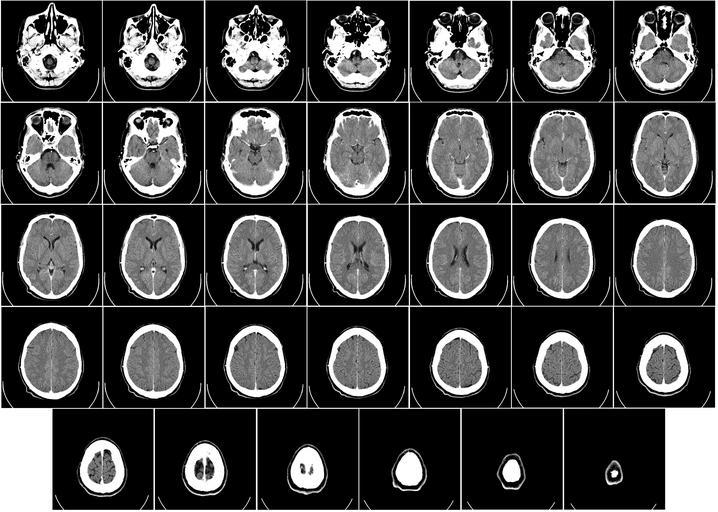
Brain scan images (PublicDomainPictures)
Some scientists believe they have found a protein that ages the brain:
Blocking This One Protein Restores Aging Brains
August 23, 2025
Researchers at UC San Francisco have uncovered a surprising culprit in brain aging: a protein called FTL1.
In aging mice, too much of this protein weakened memory and disrupted neural connections. But when scientists blocked FTL1, the mice’s brains regained youthful function, and their memory tests dramatically improved.
Aging Hits the Hippocampus Hard
Aging takes a heavy toll on the hippocampus, the part of the brain that drives learning and memory. …
Mimicking Old Age in Young Brains
Older mice showed higher levels of FTL1, fewer connections between hippocampal neurons, and weaker memory performance. When researchers artificially boosted FTL1 in young mice, their brains and behavior quickly started to resemble those of much older animals.
In cell culture experiments, neurons engineered to produce large amounts of FTL1 developed abnormally. Instead of growing complex, branching neurites, they formed only simple, single-armed extensions.
Reversing Memory Decline by Lowering FTL1
When scientists reduced FTL1 in the hippocampus of aged mice, the results flipped. Their neurons made more connections, and the animals significantly improved on memory tests.
“It is truly a reversal of impairments,” said Saul Villeda, PhD, associate director of the UCSF Bakar Aging Research Institute and senior author of the paper, which appears in Nature Aging on August 19. “It’s much more than merely delaying or preventing symptoms.” https://scitechdaily.com/blocking-this-one-protein-restores-aging-brains/
It is one thing to isolate and experiment with mice. It is another to come up with a safe procedure for humans.
That said, other research shows that there are things you can do to improve brain health.
Notice the following:
Food for thought: Researchers weigh in on the best diet for a healthy and active brain
The brain gets slower and smaller as we age.
August 20, 2025
The key to a healthy and active brain in later life? What you put on your plate.
As we age, our brains age with us. The process starts in the 30s and 40s, affecting areas responsible for learning and memory.
This can cause older adults to have a shortened attention span and difficulty remembering names or words. Brain cells also start to produce a compound that can be a hallmark of Alzheimer’s disease, according to Columbia University.
However, nutrients found in certain foods have been shown to slow this process, and eating one diet in particular has excellent brain benefits.
“The positive effect the Mediterranean diet has on brain health is increasingly recognized,” dietitian Nichola Ludlam-Raine told Healthline. “It’s supported by a growing body of evidence linking its nutrient profile to cognitive function and neuro-protection.” …
The Mediterranean diet is packed with anti-inflammatory foods, such as nuts, olives, and tomatoes. It emphasizes plants and healthy fats, including extra virgin olive oil.
Inflammation in healthy tissues is tied to chronic disease, and has also been linked to Alzheimer’s in multiple studies over the past decade. …
Fish is a key part of the diet with salmon and sardines rich in omega-3 fatty acids. These healthy fats have been found to reduce levels of the damaging protein linked to Alzheimer’s disease, according to Harvard Medical School. …
Berries also delay memory decline, according to a study at Harvard’s Brigham and Women’s Hospital. A high intake — about 7.5 cups of a month — is the magic number.
Eating just one serving of leafy green vegetables per day also has memory-preserving benefits, researchers from Chicago’s Rush University found. …
Overly sugary, salty, processed, and fatty foods, such as ice cream, hot dogs, and pizza can increase inflammation throughout the body. https://www.the-independent.com/life-style/health-and-families/brain-food-diet-nutrition-b2810403.html
Real foods and real food nutrients are helpful for brain health. I also had a paper published decades ago related to that– Can Cognitive Deterioration Associated with Down Syndrome be Reduced?
I also like bovine brain supplements for brain health.
That said, exercise is also good for your brain:
Exercise benefits muscles and individual neurons
November 14, 2024
MIT engineers have found that exercise not only benefits muscles but also promotes the growth of individual neurons. When muscles contract during exercise, they release myokines—biochemical signals that stimulate neurons to grow four times farther than those not exposed to these signals. Additionally, neurons respond to the physical impact of exercise, such as being stretched and pulled during movement, which also promotes growth. https://www.inceptivemind.com/blurb/exercise-benefits-muscles-individual-neurons/
When muscles work out, they help neurons to grow, a new study shows
There’s no doubt that exercise does a body good. Regular activity not only strengthens muscles but can bolster our bones, blood vessels, and immune system.
Now, MIT engineers have found that exercise can also have benefits at the level of individual neurons. …
Surprisingly, the researchers also found that neurons respond not only to the biochemical signals of exercise but also to its physical impacts. The team observed that when neurons are repeatedly pulled back and forth, similarly to how muscles contract and expand during exercise, the neurons grow just as much as when they are exposed to a muscle’s myokines. …
Now that the group has shown that exercising muscle can promote nerve growth at the cellular level, they plan to study how targeted muscle stimulation can be used to grow and heal damaged nerves, and restore mobility for people who are living with a neurodegenerative disease such as ALS.
“This is just our first step toward understanding and controlling exercise as medicine,” Raman says. https://news.mit.edu/2024/when-muscles-work-out-they-help-neurons-grow-1112
This Is Your Brain on Exercise
Our bodies, including our brains, were fine-tuned for endurance activities over millennia of stalking and chasing down prey. “We’ve engineered that out of our lives now,” says Charles Hillman, a psychology professor at Northeastern University who has spent decades studying the link between exercise and cognition. The toll our relatively new sedentary lifestyle takes on our bodies is clear: For the first time in U.S. history, younger generations are expected to live shorter, unhealthier lives than their parents.
… according to Richard Maddock, a professor of psychiatry at the University of California, Davis. “There is a very consistent finding that the brain works better after exercise,” Maddock says. … Your brain becomes much more active during exercise, “perhaps more active than at any other time,” says Maddock. One way neurons communicate is with electrical pulses, and sometimes entire networks of neurons fire in unison, like a group of soccer fans chanting together at a game. These synchronized pulses are known colloquially as brain waves. Different kinds of brain waves, characterized by the number of times they oscillate in a single second, are linked to one’s mental state and mood. Lower-frequency waves occur when we’re running on autopilot: brushing our teeth, driving, or sleeping, for example. Higher-frequency waves, known as beta waves, occur when we’re awake and mentally engaged and are associated with attention, memory, and information processing. …
During exercise, the brain becomes much more receptive to incoming information, leading to measurable changes in vision. …
The benefits of exercise to your brain may begin as soon as your heart rate begins to rise. Imagine, if you will, climbing onto your bike for a morning ride and pedaling at a tough but sustainable clip. Your breath becomes faster and heavier as your lungs struggle to meet the oxygen demands of the body in motion. Your heart rate climbs as it pumps oxygenated blood around the body and into the brain. And in much the same way that your muscles demand more energy during exercise, the brain begins gobbling up glucose or other carbohydrates when the body is in motion.
“In the past, nobody had any idea what the brain was doing with all this fuel,” says Maddock. …
A few things happen in the exerciser’s brain that make the organ appear younger. …
“Exercise is a potential prophylactic against some aspects of age-related cognitive decline,” Giesbrecht says. “When you think of the fact that we have an aging demographic and the high prevalence of depression, there might be simpler treatments out there, like exercise.” https://getpocket.com/explore/item/this-is-your-brain-on-exercise?utm_source=pocket-newtab accessed 11/19/19
One of the more unusual statements above was “For the first time in U.S. history, younger generations are expected to live shorter, unhealthier lives than their parents.”
Lack of exercise is a factor in that, as would be consumption of less natural foods, as well as environmental pollutants.
The Bible itself warns about obesity, getting fat, being physically lazy, and excessive eating.
The New Testament says that bodily exercise can help (1 Timothy 4:8), yet most Americans do not get enough physical activity.
The Continuing Church of God (CCOG) has the following video on our Bible News Prophecy YouTube channel:
A 2019 report shows that Americans are becoming sedentary. Since it is a physical thing, should Christians be concerned about exercise? Could not exercising possibly be a sin? What did the ‘Plain Truth’ magazine report about exercise? What is the US CDC reporting about exercise? Can exercise help prevent diabetes, heart disease, and obesity? Can exercise help sleep, endurance, and aging? Are there scriptures about exercise and health? What about laziness? What are some of the risks and benefits of exercise? Dr. Thiel addresses these subjects and more.

Here is a link to our video: The Plain Truth About Exercise.
All of us are aging, and exercise also helps us to be able to be more active and slows down certain negative aspects of aging.
Related to aging, the Continuing Church of God (CCOG) put together the following video on our Bible News Prophecy YouTube channel:
Let’s Talk About Aging
Could you have the wrong attitude about aging and the elderly? Should your goal to be to retire and cease being productive? What did Herbert W. Armstrong say about it? What does the Bible say about aging? Is it better to listen to God when you are in your youth? What about later? Since physical life is temporary, should that motivate us to better obey God? What are some things we can do physically in order to be healthier? What about avoiding things like smoking, too much alcohol, and obesity? What about spiritual things such as prayer, Bible study, paying attention to church services, and fasting? Are there benefits from responding to God sooner than later? Who is Jesus, the author of ETERNAL SALVATION, for? Steve Dupuie and Dr. Thiel go over these matters.

Here is a link to our video: Let’s Talk About Aging.
Anyway, yes, nearly everyone can take steps to improve their physical health. Exercise and dietary factors can make a big difference.
However, remember that the Apostle Paul wrote:
7 … exercise yourself toward godliness. 8 For bodily exercise profits a little, but godliness is profitable for all things, having promise of the life that now is and of that which is to come. (1 Timothy 4:7-8)
While physical exercise has value, it does not stop aging nor bring eternal life.
That said, “exercise yourself toward godliness.” Everyone can take steps to improve their spiritual health, and should be doing that every day.
Some items of possibly related interest may include:
Should Christians Exercise? What does the Bible teach? What are some of the benefits and risks of exercise? Here is a link to a related video: The Plain Truth About Exercise.
Christian Health Matters Should Christians be concerned about their health? Does the Bible give any food and health guidelines? Here are links to three related sermons: Let’s Talk About Food, Evil is Affecting the Food Supply, and Let’s Talk About Health
Obesity, processed foods, health risks, and the Bible Does the Bible warn about the consequences of being obese? Is overeating dangerous? Is gluttony condemned? What diseases are associated with eating too much refined foods? A related video would be Eating Right, Eating Too Much, and Prophecy.
Is God Calling You? This booklet discusses topics including calling, election, and selection. If God is calling you, how will you respond? Here is are links to related sermons: Christian Election: Is God Calling YOU? and Predestination and Your Selection; here is a message in Spanish: Me Está Llamando Dios Hoy? A short animation is also available: Is God Calling You?
Christian Repentance Do you know what repentance is? Is it really necessary for salvation? Two related sermons about this are also available: Real Repentance and Real Christian Repentance.
About Baptism Should you be baptized? Could baptism be necessary for salvation? Who should baptize and how should it be done? Here is a link to a related sermon: Let’s Talk About Baptism and Baptism, Infants, Fire, & the Second Death.
Christians: Ambassadors for the Kingdom of God, Biblical instructions on living as a Christian This is a scripture-filled booklet for those wishing to live as a real Christian. A related sermon is also available: Christians are Ambassadors for the Kingdom of God.