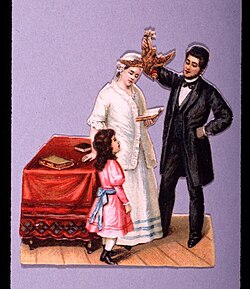
Lithograph of Kapparot, late 19th/early 20th century
(Photo via Wikipedia)
Certain Jews have an unusual ceremony they conduct the evening starting the Day of Atonement, which they call Yom Kippur.
Kapparot (Hebrew: כפרות, Ashkenazi transliteration: Kapporois, Kapores) is a customary atonement ritual practiced by some Orthodox Jews on the eve of Yom Kippur. This is a practice in which either money is waved over a person’s head and then donated to charity, or a chicken is waved over the head and then slaughtered in accordance with halachic rules and donated to the hungry.[1] It is important to clarify that it is not a sacrifice as it is not even an offering and it can be eaten just as any other chicken.[2] (Kapparot. Wikipedia, accessed 10/02/25)
Here is more information about it:
Kapparot: The Yom Kippur Tradition of Chicken Twirling
Aug. 31, 2021
By Lawrence Goodman
For some 1,000 years, many Jews have observed the same ritual every Yom Kippur Eve — waving a chicken over their head.
The practice is called kapparot (atonements) in Hebrew and “shluggen kappores” in Yiddish. Shluggen means beating or hitting, which is not what the ceremony entails, but probably what it feels like to the chicken. …
According to Professor of Classical Rabbinic Literature Reuven Kimelman, kapparot involves swinging a living chicken three times around your head while reciting a prayer. Traditionally, men use roosters and women hens, though pregnant women use both in case they’re having a boy. After the ceremony, the animal is slaughtered according to Jewish law.
Today, money is sometimes substituted for the chicken. Afterward, the cash may be given to charity. …
No one is sure. It’s not mentioned in the Torah or Talmud. The first reference appears in the 9th century in a responsa, a kind of question-and-answer session, with the scholar Amram ben Sheshna. As head of a revered Babylonian academy, Sheshna was considered a great sage, but when asked about kapparot’s origin, he said, “For we do not know.”
Historians believe it probably began several centuries before Sheshna’s commentary and then became widespread, requiring the rabbis to devise an ex post facto explanation. Sheshna said it derived from a practice in the ancient temple, where a goat bearing the sins of the people was sent into the wilderness to die. But after the destruction of the Temple, Jews were prohibited from carrying out the practices once done there. Sheshna said kapparot was a convenient workaround with another animal.
But why a chicken?
Yom Kippur is the day when God decides whether you will live or die based on your and others’ sins. As it happens, the word for rooster is gever, which can also mean man. Kimelman said this made it possible to see the chicken as a stand-in for a human being (in addition to being a stand-in for a goat). The practice could potentially save your life, it was believed. As the kapparot prayer states, “And may this rooster go on to death so that this person may remain alive.”
What happened to the dead chicken?
In the Middle Ages, its entrails were tossed on the roofs of houses for other animals to devour. According to the 20th-century scholar Jacob Lauterbach, this appeased Satan, who was believed to dwell on rooftops and apparently really liked raw chicken.
In his 2011 book, “The Shtiebelization of Modern Jewry,” the scholar Simcha Fishbane claims that tossing the entrails was done for the exact opposite reason. Rabbis worried that kapparot would feed antisemitic tropes about Jews engaging in magic or sorcery. Bird remains left outside would be quickly devoured by insects and other animals, making it impossible for Gentiles to gather any incriminating evidence.
Jews later started donating the chicken to charity. Kimelman says it counted for one last good deed before God decided your fate on Yom Kippur. https://www.brandeis.edu/jewish-experience/holidays-religious-traditions/2021/august/kapparot-the-yom-kippur-tradition-of-chicken-twirling.html
The original rites and practices for the Day of Atonement are set forth in the sixteenth chapter of Leviticus (cf. Exodus 30:10; Leviticus 23:27-31, 25:9; Numbers 29:7-11). It is considered to be a time for fasting, during which no food or drink are to be consumed:
26 And the LORD spoke to Moses, saying: “Also the tenth day of this seventh month shall be the Day of Atonement. 27 It shall be a holy convocation for you; you shall afflict your souls…32 It shall be to you a sabbath of solemn rest, and you shall afflict your souls; on the ninth day of the month at evening, from evening to evening, you shall celebrate your sabbath (Leviticus 23:26-27,32).
This is historically how the phrase “afflict your souls” has been interpreted by the Jewish community to mean fasting (this is also verified by such passages as Psalm 35:13; 69:10 and Isaiah 58:5), unless one is somehow ill, and thus is already afflicted. Evening to evening means from sunset to sunset. Jews tend to fast, but added the chicken ceremony
In the New Testament, the Day of Atonement is referred to as “the Fast” (Acts 27:9). The fact that this day was referred to that way (or even at all) is an indication that it was observed by Christians after Christ’s resurrection. The Bible clearly shows that so-called Jewish holy days, such as Pentecost were observed by Christians after Jesus’ resurrection (Acts 2:1).
While Jews do not have a full understanding of the Day of Atonement, because they do not accept the sacrifice of Jesus, you can know more of what the day really means.
Those who have more interest may wish to study the following:
The Meaning of Atonement That was the title of a sermon by Herbert W. Armstrong gave on September 20, 1980. The article is based on that and has been expanded with updates and additional scriptures. Here is a link to a related sermon video: The Meaning of Atonement.
The Day of Atonement–Its Christian Significance The Jews call it Yom Kippur, Christians “The Day of Atonement.” Does it have any relevance for Christians today? What is the Jubilee? Is fasting healthy? Here is a link to a sermon: Day of Atonement: How Jesus fulfilled His part for the Atonement. Here is a link to a related article in the Spanish language: El Día de Expiación –Su significado cristiano.
Is God Calling You? This booklet discusses topics including calling, election, and selection. If God is calling you, how will you respond? Here is are links to related sermons: Christian Election: Is God Calling YOU? and Predestination and Your Selection. A short animation is also available: Is God Calling You?
Christian Repentance Do you know what repentance is? Is it really necessary for salvation? Two related sermons about this are also available: Real Repentance and Real Christian Repentance.
The Atonement Plan How does the Day of Atonement tie into God’s plan of salvation? Two sermons of related interest are available God’s Atonement and Fasting Plan and God’s Atonement Plan.
Proof Jesus is the Messiah This free book has over 200 Hebrew prophecies were fulfilled by Jesus. Plus, His arrival was consistent with specific prophecies and even Jewish interpretations of prophecy. Here are links to seven related sermons: Proof Jesus is the Messiah, Prophecies of Jesus’ birth, timing, and death, Jesus’ prophesied divinity, 200+ OT prophecies Jesus filled; Plus prophecies He made, Why Don’t Jews Accept Jesus?, Daniel 9, Jews, and Jesus, and Facts and Atheists’ Delusions About Jesus. Plus the links to two sermonettes: Luke’s census: Any historical evidence? and Muslims believe Jesus is the Messiah, but … These videos cover nearly all of the book, plus have some information not in the book.
Universal OFFER of Salvation, Apokatastasis: Can God save the lost in an age to come? Hundreds of scriptures reveal God’s plan of salvation Will all get a fair chance at salvation? This free book is packed with scriptures showing that God does intend to offer salvation to all who ever lived–the elect in this age, and the rest in the age to come. Here is a link to a related sermon series: Universal Offer of Salvation 1: Apocatastasis, Universal Offer of Salvation 2: Jesus Desires All to be Saved, Mysteries of the Great White Throne Judgment (Universal Offer of Salvation part 3), Is God Fair, Will God Pardon the Ignorant?, Can God Save Your Relatives?, Babies, Limbo, Purgatory and God’s Plan, and ‘By the Mouth of All His Holy Prophets’.
Holy Day Calendar This is a listing of the biblical holy days through 2033, with their Roman calendar dates. They are really hard to observe if you do not know when they occur 🙂 In the Spanish/Español/Castellano language: Calendario de los Días Santos. In Mandarin Chinese: 何日是神的圣日? 这里是一份神的圣日日历从2013年至2024年。.