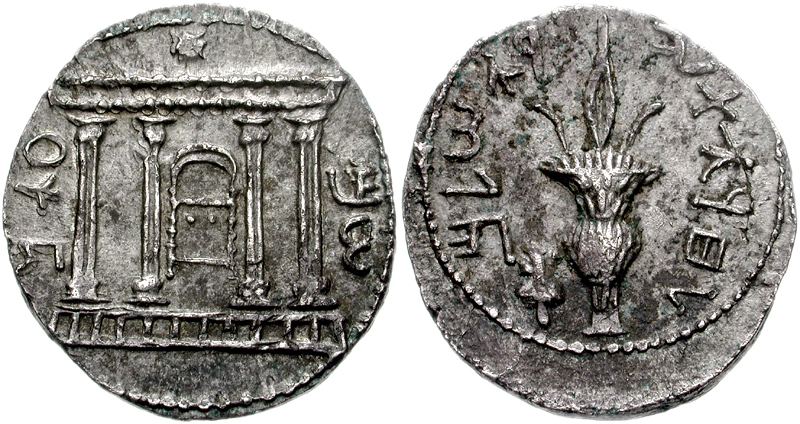
Bar Kokhba coin (CNG)
In its most recent newsletter, the Temple Institute had a link to the following:
EMPEROR HADRIAN GREENLIGHTS THE REBUILDING OF THE TEMPLE!
Roman Emperor Hadrian, who ruled from 117 to 138, hoping to gain the cooperation of the Jews during the first years of his reign issued a decree allowing Jews to return to Jerusalem and even to rebuild the Holy Temple. The Jews responded with great excitement and began practical preparations for the rebuilding, only to witness the decree rescinded after Samaritan informers convinced Hadrian that the Jews would repay Hadrian’s benevolence with rebellion.
This series of events, which took place during the lifetime of Rabbi Yehoshua ben Hananiah, is recorded (Genesis Rabba 64.10):
“In the days of Rabbi Yehoshua ben Chananya, the evil empire decreed that the Temple should be constructed. Papus and Lulyanus set tables from Akko to Antioch, and they provided those ascending from the exile with silver and gold, and all their needs. The Samaritans went and said: “Let it be known to the king…that [if] this rebellious city is built, and its walls finished, they will not pay minda, belo, or halakh” (Ezra 4:12–13) – minda is property tax, belo is poll tax, and halakh is head tax. He said to them: ‘What can I do, I issued a decree.’ They said to him: ‘Send and say to them: Either move it from its place, or add five cubits to it, or subtract five cubits from it, and they will relent on their own.’ The assembly of Israel were gathered together in the Beit Rimon valley. When those missives arrived, they began weeping. They wanted to rebel against the empire…”
The Samaritans knew that the Temple needed to be rebuilt in its precise former location and even a minor change in location was unacceptable to Israel.
Hadrian, for his part, drastically changed his approach to the Jews and he soon after prohibited the study of Torah, forbade the use of the Hebrew calendar, and executed many Jewish sages. The Bar Kochba revolt would soon after break out. 07/17/25 https://www.facebook.com/photo/?fbid=1159213482904614&set=a.627296572762977
This is interesting for several reasons.
Emperor Hadrian came to power after Emperor Trajan. Which was shortly after the Trajanic wars of 115-117 (also known as the Kitos War) where certain Jews revolted across several provinces in the Eastern Mediterranean, as well as in Egypt and Libya.
Emperor Trajan apparently felt his first rebuilding edict could calm matters down. But, he had changes.
And in 130 CE, Hadrian visited the Eastern Mediterranean and decided to rebuild the ruined city of Jerusalem as the Roman colony of Aelia Capitolina. The Jews then instituted the Bar Kokhba revolt, which was final major Jewish uprising and last organized attempt to regain national independence from the old Roman Empire.
In an older newsletter, the Temple Institute had the following:
Iyar 21, 5780/May 15, 2020 …
Rare Coin From Bar-Kokhba Revolt Unearthed Near The Temple Mount In Jerusalem: ‘Year 2 of the Freedom of Israel’. Archaeologists unearth coin dating back to Bar Kochba revolt which reads “Return to Israel”, “Jerusalem”. In honor of Lag B’Omer, the Israel Antiquities Authority on Monday revealed a rare bronze coin from the period of the Bar Kokhba revolt (circa 132 CE).
The above newsletter linked to a Facebook page, which also had with the following:
The obverse of the coin is decorated with a cluster of grapes and the inscription “Year Two of the Freedom of Israel” and the reverse side features a palm tree and the inscription “Jerusalem.”
Coins from the period of the Bar Kokhba revolt, which declared the rebels’ purpose – to liberate Jerusalem from Roman occupation after the destruction of the city – are well-known in archaeology. Discovering such coins helps researchers map out the revolt, which took place approximately 1,900 years ago. …
Despite their desire to do so, the Bar Kokhba rebels failed to breach the boundaries of ancient Jerusalem. This fact gives rise to the question of how four coins from the revolt period still managed to make their way into the city. …
In the archaeological and historical research based on the testimony of the Roman historian Cassius Dio, it is accepted that the Bar Kokhba revolt broke out in 132 CE, after Emperor Hadrian declared the establishment of a Roman colony called “Aelia Capitolina.”
This colony was built on the ruins of Jewish Jerusalem and began with the construction of a temple dedicated to the god Jupiter on the Temple Mount. The establishment of the Roman city and the construction of an idolatrous temple in place of the Jewish Temple, in addition to restrictive religious decrees, distressed the Jewish population that had remained in Judea. This launched a widespread revolt against the Roman government under the leadership of Shimon Ben-Kosiba, known as “Bar Kokhba.”
The revolt itself lasted about five years, causing heavy casualties among the Roman legions – so much so that they had to deploy large military units from around the Roman Empire to complete their ranks. The revolt ended with the destruction of hundreds of Jewish communities and villages that took part in the revolt. However, Bar Kokhba remains etched into the memory of the Jewish nation as a historical hero. https://www.facebook.com/templeinstitute/posts/10151385393639969?__tn__=K-R
So, Bar Kokhba is considered a national hero.
Well, at the time he rose up, he was promoted as the prophesied Messiah.
While actions by Emperor Hadrian were a factor, another one is that Jewish leaders did not want more Jews to accept Jesus as the Messiah.
In order to promote Simon Bar Kochba, they actually changed certain historical dates to try to use Daniel 9 to point to him.
The Jews still use the false dates to present, even though Jewish scholars realize the intentional error.
Related to this, the Continuing Church of God (CCOG) put together the following video on our Bible News Prophecy YouTube channel several years ago:
Jewish Year 5779 or 5990?
According to the Jewish ‘Seder Olam Rabbah’ the period from sunset 9 September 2018 to 29 September 2019 is the year 5779 Anno Mundi (age of the world). However, the Jewish Encyclopedia, secular scholars, and modern Jewish experts have all claimed that the count is off between 164 to 200 plus years. Are we closer to the year 5990 than 5779 since Adam and Eve left the Garden of Eden? Why would the Seder Olam be off by so much? Does any of this have anything to do with deceit and pointing to the false ‘messiah’ Simon Bar Kochba? Was the Messiah supposed to come after 4000 or 6000 years? Does Daniel 9:26 clearly point to Jesus? Dr. Thiel refers to Jewish accepted and other sources to answer these questions? An article of related interest is available titled Does God Have a 6,000 Year Plan? What Year Does the 6,000 Years End?

Here is a link to the sermonette video: Jewish Year 5779 or 5990?
The Bar Kochba revolt resulted in millions dying through war, famine, and pestilence.
Jesus warned that false messiahs would arise (Matthew 24:24).
Bar Kokhba was a false messiah.
While Emperor Hadrian did not accept Simon Bar Kochba as the true Messiah, he did not accept Jesus either, but you should.
Anyway, as the result of the Jewish revolt and a later edict by Emperor Hadrian, there ended up being a split in Jerusalem between the faithful, who had to flee, and the apostates, who due to cowardice, etc. adopted Sunday, unclean meats, and stopped keeping the Holy Days as the Bible commanded.
That cowardice also spread to Rome and elsewhere and was a factor in the acceptance of Sunday as well as the change of the date of Passover to Sunday.
There were many ramifications of Emperor Hadrian’s edicts and most of the professing Christian world has been affected by the fall out of them to this day.
Some items of possibly related interest may include:
Marcus of Jerusalem: Apostolic successor or apostate? Marcus is claimed to have been the 16th bishop of Jerusalem, but did he get his position from faithfulness or political compromise?
Did Early Christians Celebrate Easter? If not, when did this happen? Where did Easter come from? Is Easter supposed to be Passover? What do scholars and the Bible reveal? Here is a link to a related video: Amazing Facts About Easter.
Sunday and Christianity Was Sunday observed by the apostolic and true post-apostolic Christians? Who clearly endorsed Sunday? What relevance is the first or the “eighth” day? A related sermon is also available: Sunday: First and Eighth Day?
Proof Jesus is the Messiah This free book has over 200 Hebrew prophecies were fulfilled by Jesus. Plus, His arrival was consistent with specific prophecies and even Jewish interpretations of prophecy. Here are links to seven related sermons: Proof Jesus is the Messiah, Prophecies of Jesus’ birth, timing, and death, Jesus’ prophesied divinity, 200+ OT prophecies Jesus filled; Plus prophecies He made, Why Don’t Jews Accept Jesus?, Daniel 9, Jews, and Jesus, and Facts and Atheists’ Delusions About Jesus. Plus the links to two sermonettes: Luke’s census: Any historical evidence? and Muslims believe Jesus is the Messiah, but … These videos cover nearly all of the book, plus have some information not in the book. We also have the book translated in the Spanish PRUEBA de que JESÚS es el MESÍAS and French PREUVES QUE JÉSUS EST LE MESSIE languages.
Could God Have a 6,000 Year Plan? What Year Does the 6,000 Years End? Was a 6000 year time allowed for humans to rule followed by a literal thousand year reign of Christ on Earth taught by the early Christians? Does God have 7,000 year plan? What year may the six thousand years of human rule end? Why is the Jews’ claimed year off by two centuries? When will Jesus return? 2032, 2035, or 2036 or? There is also a video titled: When Does the 6000 Years End? 2031? 2035? Here is a link to the article in Spanish: ¿Tiene Dios un plan de 6,000 años?
Why is a Jewish Temple in Jerusalem Not Required? Although people like Timothy LaHaye teach a third Jewish temple is required, who is ‘the temple of God” in the New Testament? Does the Bible require a rebuilt Jewish Temple? Here is a related item in the Spanish language ¿Por qué no se requiere un templo judío en Jerusalén? Here is a link to two sermons The Temple, Prophecy, and the Work and God’s Temple in Prophecy. And here is a version of the latter one in the Spanish: El templo de Dios en profecía.
Beliefs of the Original Catholic Church: Could a remnant group have continuing apostolic succession? Did the original “catholic church” have doctrines held by the Continuing Church of God? Did Church of God leaders uses the term “catholic church” to ever describe the church they were part of? Here are links to related sermons: Original Catholic Church of God?, Original Catholic Doctrine: Creed, Liturgy, Baptism, Passover, What Type of Catholic was Polycarp of Smyrna?, Tradition, Holy Days, Salvation, Dress, & Celibacy, Early Heresies and Heretics, Doctrines: 3 Days, Abortion, Ecumenism, Meats, Tithes, Crosses, Destiny, and more, Saturday or Sunday?, The Godhead, Apostolic Laying on of Hands Succession, Church in the Wilderness Apostolic Succession List, Holy Mother Church and Heresies, and Lying Wonders and Original Beliefs. Here is a link to that book in the Spanish language: Creencias de la iglesia Católica original.