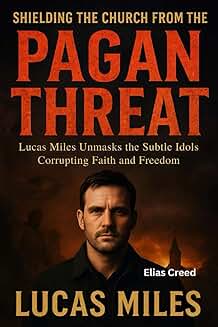
While watching the news, I learned that the recently assassinated Charlie Kirk had written the forward to a new book called Shielding the Church from the Pagan Threat. Here is some of what he wrote:
“Don’t just read Pagan Threat — internalize what it has to say. Then, share its message with your Christian friends, before they are seduced by Paganism themselves. We have a faith and a country to save.” 09/16/25 https://www.newsmax.com/politics/charlie-kirk-lucas-miles-pagan-threat/2025/09/14/id/1226368/?utm_source=chatgpt.com
“In today’s America, the Christian faithful are faced with a terrifying and broad array of dangers and threats. We are menaced not by new false gods, but by the return of demons from long ago.” 09/10/25 https://www.pbs.org/newshour/politics/charlie-kirk-dead-at-31-trump-says
Here is something related to Lucas Miles, the author of the book, on the murdering of Charlie Kirk:
Lucas Miles declares that it was the “pagan threat that took Charlie [Kirk’s] life,” 09/16/25 https://www.peoplefor.org/rightwingwatch/inspired-demons
Here is some of what Amazon has about the book:
The greatest danger to the church today isn’t persecution from the outside — it’s infiltration from within.
In Shielding the Church from the Pagan Threat, pastor and cultural commentator Lucas Miles unmasks the subtle idols corrupting faith and freedom in America. These idols don’t arrive as carved statues but as seductive ideologies disguised as “justice,” “progress,” and “tolerance.” They infiltrate pulpits, media, schools, and politics — reshaping hearts, rewriting truth, and weakening the body of Christ.
Although I am not advocating reading the book called Shielding the Church from the Pagan Threat, the reality is that most who profess Christianity have already been “seduced by Paganism themselves” (including often with idols), although they do not realize it. The “pagan threat” to Christianity has been going on from New Testament times, and not just from “woke type” modern positions.
Instead of “Shielding the Church from the Pagan Threat,” faithful Christians should be exposing the pagan practices and doctrines that the world’s versions of Christianity have adopted.
And although Charlie Kirk advocated keeping the seventh-day Sabbath (see Did you know that Charlie Kirk kept the Sabbath?), he also pushed Marianism (see https://x.com/CatholicArena/status/1965886123999363506?ref_src=twsrc%5Etfw%7Ctwcamp%5Etweetembed%7Ctwterm%5E1965886123999363506%7Ctwgr%5E%7Ctwcon%5Es1_c10&ref_url=https%3A%2F%2Fcatholicvote.org%2Fcharlie-kirk-showed-deep-respect-toward-catholic-faith%2F), which basically came from paganism.
The book Shielding the Church from the Pagan Threat seems to be focused on warning against certain sins and tactics that those on the politically “woke” left have been using. And certainly, sins should be called out (Isaiah 58:1).
But the “pagan threat” has already affected the world’s churches.
One such threat, which is somewhat pointed to in Shielding the Church from the Pagan Threat, has long been the acceptance of the philosophical positions held by much of the “educated” class.
This has been the case throughout the entire church age.
This may have been an issue with Simon Magus in the 8th chapter of the Book of Acts. And it was something that the Apostle Paul warned against as he had encountered it:
8 Beware lest anyone cheat you through philosophy and empty deceit, according to the tradition of men, according to the basic principles of the world, and not according to Christ. (Colossians 2:8)
5 Now the purpose of the commandment is love from a pure heart, from a good conscience, and from sincere faith, 6 from which some, having strayed, have turned aside to idle talk, 7 desiring to be teachers of the law, understanding neither what they say nor the things which they affirm. (1 Timothy 1:5-7)
20 … Guard what was committed to your trust, avoiding the profane and idle babblings and contradictions of what is falsely called knowledge — 21 by professing it some have strayed concerning the faith. (1 Timothy 6:20-21)
The empty deceit (vanity) of human philosophy and falsely claimed knowledge definitely was an issue in the New Testament. The false knowledge that the educated of the world promoted has long been harmful–and even contributed to people straying in the Apostle Paul’s time.
And it also became an issue for the Christian church in the second century, as well as later.
Three such people were Marcion of Sinope (see Marcion: The First Protestant?), Justin the philosopher (later known as Justin Martyr, see Justin Martyr: Saint, Heretic, or Apostate?), and Origen of Alexandria:
Like most other educated Christians, Marcion was influenced by philosophical conceptions of his time. (Mitchell MM, Young FM, eds. THE CAMBRIDGE HISTORY OF CHRISTIANITY, VOLUME 1 Origins to Constantine. Cambridge University Press, 2006, p. 198)
Justin did not perceive any difference between Christian and Platonist teaching, … like other educated Christians of his age. (Mitchell, p. 444)
Eusebius speaks of the many educated people who came to Origen’s school … HE 6.18. …. Origen replying to Celsus c.248 describes how an increasing number of educated individuals were becoming Christians … C. Cels. 3.9.(Mitchell, pp. 492, 511)
People like Marcion, Justin, and Origen did not care for various parts of the Bible. They also taught against accepting what the original Christians believed and promoted more on an allegorical approach to scripture.
This led not only to the loss of doctrine, but also set the stage for various pagan doctrines to be accepted by the emerging Greco-Roman church confederation of their time.
Faithful Church of God leader, Polycarp of Smyrna, warned against “the vanity of many and their false doctrines” (Polycarp. Letter to the Philippians, Chapter VII). The Bible itself warns:
1 You shall not circulate a false report. Do not put your hand with the wicked to be an unrighteous witness. 2 You shall not follow a crowd to do evil; (Exodus 23:1-2)
Yet those who push worldly knowledge and/or traditions over the word of God are circulating false reports. They are being wicked, unrighteous witnesses. Real Christians are not to follow the crowd who accepts evil falsehoods.
Instead, history shows that Church of God leaders such as Serapion of Antioch, Theophilus of Antioch, and Polycarp all denounced Marcion.
Around the beginning of the third century, faithful Church of God leader, Serapion of Antioch, warned against the “lying confederacy”(Serapion. From the epistle to Caricus and Ponticus. The Ante-Nicene Fathers: Translations of the Writings of the Fathers Down to A.D. 325. Roberts & Donaldson) he saw forming among the Greco-Romans.
Church of God leader Nepos from the area of Arsinoe in North Africa denounced the allegorical approach to scripture that people like Origen of Alexandria promoted, and the Greco-Roman churches were accepting (see also What is the Appropriate Form of Biblical Interpretation?).
After Nepo’s death in the 3rd century, a student of Origen of Alexander named Gregory the Wonder Worker began to push Marianism as well as the pagan trinity.
Gregory’s approaches and methods were then accepted by the Greco-Roman churches.
Although in the 3rd and 4th centuries, Church of God leader Lucian of Antioch also fought against the allegorical approach to reading the Bible, the allegorists gained in influence.
Notice an additional explanation for why there were changes to the original faith given by the late Roman Catholic Cardinal Newman:
Confiding then in the power of Christianity to resist the infection of evil, and to transmute the very instruments and appendages of demon-worship to evangelical use, … the rulers of the Church from early times were prepared, should the occasion arise, to adopt, to imitate, or to sanctify the existing rites and customs of the population, as well as the philosophy of the educated class.
St. Gregory Thaumaturgus supplies the first instance of this economy. … The bodies of the Martyrs were distributed in different places, and the people assembled and made merry, as the year came round, holding festival in their honour. This indeed was a proof of his great wisdom … for, perceiving that the childish and untrained populace were retained in their idolatrous error by creature comforts, in order that what was of first importance should at any rate be secured to them, viz. that they should look to God in place of their vain rites, he allowed them to be merry, jovial, and gay at the monuments of the holy Martyrs, as if their behaviour would in time undergo a spontaneous change into greater seriousness and strictness, since faith would lead them to it; which has actually been the happy issue in that population, all carnal gratification having turned into a spiritual form of rejoicing.”
There is no reason to suppose that the licence here spoken of passed the limits of harmless though rude festivity; for it is observable that the same reason, the need of holydays for the multitude, is assigned by Origen, St. Gregory’s master, to explain the establishment of the Lord’s Day also, and the Paschal and the Pentecostal festivals, which have never been viewed as unlawful compliances; and, moreover, the people were in fact eventually reclaimed from their gross habits by his indulgent policy, a successful issue which could not have followed an accommodation to what was sinful. (Newman JH, Cardinal. An Essay on the Development of Christian Doctrine. J. Toovey, 1845, p. 358).
Cardinal Newman explained pagan items were considered to be an evangelical tool (ibid, p. 358). Please understand that the appeal to “the philosophy of the educated class” means that pagan philosophy (as taught by the ancient Greeks and Romans, and expanded by people like Clement and Origen) was to be accepted.
Furthermore, we see that Gregory Thaumaturgus (as known as “Gregory the Wonder Worker”) decided that it would be a good evangelizing tool to be a friend of the world allow pagan and other demonic worship practices. Gregory was a major compromiser whose actions later provided support for others to compromise and change even more from the original catholic faith.
The Apostles James and Paul warned against such:
4 Adulterers, know you not that the friendship of this world is the enemy of God? Whosoever therefore will be a friend of this world, becometh an enemy of God.
5 Or do you think that the scripture saith in vain: To envy doth the spirit covet which dwelleth in you? (James 4:4-5, DRB)
20 But the things which the heathens sacrifice, they sacrifice to devils, and not to God. And I would not that you should be made partakers with devils. 21 You cannot drink the chalice of the Lord, and the chalice of devils: you cannot be partakers of the table of the Lord, and of the table of devils. (1 Corinthians 10:20-21, DRB)
20 [No], but I say that the things which the Gentiles sacrifice, they sacrifice to demons, not to God, and I do not want you to have fellowship with demons. 21 You cannot drink from the cup of the Lord and also from the cup of demons. You cannot partake of the table of the Lord and of the table of demons as well. (1 Corinthians 10:20-21, EOB)
Should you heed the Apostles James and Paul or someone who took steps in opposition to the Bible’s teachings?
Gregory of Neocæsarea was a student of Origen. He also claimed that it was an angel who had been with him since his youth and had him study under Origen (Gregory of Neocæsarea. Oration and Panegyric Addressed to Origen. Translated by S.D.F. Salmond. From Ante-Nicene Fathers, Vol. 6. Edited by Alexander Roberts, James Donaldson, and A. Cleveland Coxe. Buffalo, NY: Christian Literature Publishing Co., 1886).
Gregory promoted many changed doctrines. He did not stand for the original faith, nor the teachings of the many of the faithful that the Greco-Romans have called “church fathers.” His was NOT part of the true “Holy Mother Church.”
And the acceptance of paganism of the Greco-Roman Catholic churches did not stop with him.
Pagan doctrines related to heaven (see Did Early Christians Teach They Were Going to Heaven?), the immortality of the soul (see Did Early Christians Believe that Humans Possessed Immortality?), the eating of unclean animals (see The New Testament Church, History, and Unclean Meats), and the acceptance of violent sports (see Is American Football Evil?) were adopted by most who claimed to be Christian.
In the 4th century, Emperor Constantine pushed his idea of the Godhead (see Did the True Church Ever Teach a Trinity?), made the day of the sun a holiday (see Sunday and Christianity), and made the birthday of the pagan sun god Mithra a holiday on December 25th to supposedly honor the birth of Jesus (see What Does the Roman Catholic Church Teach About Christmas and the Holy Days?), and pushed idols and relics like the cross (see What is the Origin of the Cross as a Claimed ‘Christian’ Symbol?). Most Protestants have accepted these aspects of Mithratic paganism.
Furthermore, instead of preaching the “gospel of peace” (Romans 10:15; Ephesians 6:15), Emperor Constantine persuaded the Greco-Roman confederation of churches to become militaristic–the Mitratic faith was pro-militarism (see also Do You Practice Mithraism?). A position that Martin Luther and his followers have also held to this day (see also Military Service and the Churches of God: Do Real Christians Participate in Carnal Warfare or Encourage Violence?).
As far as pushing paganism, notice the following from a Roman Catholic writer:
Nov. 1st was the day of the Celtic Summer’s End feast of Samhain, the day when the dead returned to the earth. We have retained some of these pagan elements to Halloween, as is true of Christmas and Easter.
Why would a pope put the Catholic celebration of the dead on top of the pagans’ celebrations of the dead? Because the Catholic feasts are in continuity and fulfill the meaning of the pagan ones… (Killian Brian. Halloween, as autumn celebration, reminder God’s name is hallowed. Catholic Online International News. 10/31/06. http://www.catholic.org/international/international_story.php?id=21818).
Consider the following words of Nehemiah:
29 Remember them, O my God, because they have defiled the priesthood and the covenant of the priesthood and the Levites.
30 Thus I cleansed them of everything pagan. (Nehemiah 13:29-30)
Nehemiah was a leader that God appointed and he rightly stood against foreign pagan contamination that affected what was supposed to be the religion of God’s people. Today, as the New Testament also supports (e.g. 1 Corinthians 10:21), true Christian ministers are to stand against pagan contamination.
The Bible teaches the following:
2 Thus saith the LORD, Learn not the way of the heathen, and be not dismayed at the signs of heaven; for the heathen are dismayed at them.
3 For the customs of the people are vain: (Jeremiah 10:2-3, KJV)
Or as the NET Bible puts it:
2 The Lord says,
“Do not start following pagan religious practices.
Do not be in awe of signs that occur in the sky
even though the nations hold them in awe.
3 For the religion of these people is worthless. (Jeremiah 10:2-3, NET)
It is vain and worthless to observe pagan holidays.
Christians are to be separate from the world and paganism.
14 Do not be unequally yoked together with unbelievers. For what fellowship has righteousness with lawlessness? And what communion has light with darkness? 15 And what accord has Christ with Belial? Or what part has a believer with an unbeliever? 16 And what agreement has the temple of God with idols? For you are the temple of the living God. As God has said:
“I will dwell in them
And walk among them.
I will be their God,
And they shall be My people.”17 Therefore
“Come out from among them
And be separate, says the Lord.
Do not touch what is unclean,
And I will receive you.” (2 Corinthians 6:14-17)
The Bible teaches:
10 Finally, my brethren, be strong in the Lord and in the power of His might. 11 Put on the whole armor of God, that you may be able to stand against the wiles of the devil. 12 For we do not wrestle against flesh and blood, but against principalities, against powers, against the rulers of the darkness of this age, against spiritual hosts of wickedness in the heavenly places. 13 Therefore take up the whole armor of God, that you may be able to withstand in the evil day, and having done all, to stand.
14 Stand therefore, having girded your waist with truth, having put on the breastplate of righteousness, 15 and having shod your feet with the preparation of the gospel of peace; 16 above all, taking the shield of faith with which you will be able to quench all the fiery darts of the wicked one. 17 And take the helmet of salvation, and the sword of the Spirit, which is the word of God; (Ephesians 6:10-17)
The Bible does not teach to put on costumes of witches or other things associated with darkness or pagan holidays of Mithraism. True Christians rely on the word of God.
The perspective real Christians should have is what does the Bible Furthermore, real Christians understood that Jesus taught:
23 But the hour is coming, and now is, when the true worshipers will worship the Father in spirit and truth; for the Father is seeking such to worship Him. 24 God is Spirit, and those who worship Him must worship in spirit and truth. (John 4:23-24)
Philosophies of men and paganism are NOT based on truth and real Christians understand that. Real Christians accept the words of Jesus above their opinions or temporal feelings.
The Bible repeatedly teaches:
12 There is a way that seems right to a man, But its end is the way of death. (Proverbs 14:12)
12 There is a way that seems right to a man, But its end is the way of death. (Proverbs 16:25)
8 “You shall not at all do as we are doing here today — every man doing whatever is right in his own eyes (Deuteronomy 12:8)
Furthermore, consider:
8 “Now you shall say to this people, ‘Thus says the Lord: “Behold, I set before you the way of life and the way of death. (Jeremiah 21:8)
19 I call heaven and earth as witnesses today against you, that I have set before you life and death, blessing and cursing; therefore choose life, that both you and your descendants may live; (Deuteronomy 30:19)
The demonically-pushed paganism is not the way of life that the Bible advocates.
The Bible says that no unclean person will enter the Kingdom (Ephesians 5:5). I am fairly sure that the Corinthians thought that they had less feeble Christianity when they tolerated a type of fornicator in their midst. But God inspired the Apostle Paul to write:
1 It is actually reported that there is sexual immorality among you, and such sexual immorality as is not even named among the Gentiles — that a man has his father’s wife! 2 And you are puffed up, and have not rather mourned, that he who has done this deed might be taken away from among you. (1 Corinthians 5:1-3)
Christians should not be “puffed up” they think that they have spiritual strength because they have compromised with pagan-practices.
Notice something that the Apostle Paul wrote to Timothy, the prophetic evangelist:
16 Take heed to yourself and to the doctrine. Continue in them, for in doing this you will save both yourself and those who hear you. (1 Timothy 4:16)
Notice that Timothy was told to continue with the original doctrines.
That is consistent with what the Apostle Jude wrote:
3 … to contend earnestly for the faith which was once for all delivered to the saints. (Jude 3)
Notice that Paul told Timothy that Christians have to continue in the original doctrine for salvation, and Jude wrote that the original faith is what true Christians should stand for and advocate. Sadly, the bulk of those who profess Christianity have refused to do so as they have adopted traditions of men and many aspects of paganism.
Those who will accept the truth, need to turn from pagan ways as we see in the following from the Book of Acts:
17 … the Name of the Lord Jesus was being magnified; 18 many also of those who believed were coming, confessing and declaring their acts, 19 and many of those who had practiced the superfluous arts, having brought the scrolls together, were burning [them] before all; and they reckoned together the prices of them, and found [it] fifty thousand pieces of silver, (Acts 19:17-19)
Notice that there was a major financial cost to people who had accepted paganism that the converted were willing to accept. People today should do likewise.
Helping people understand what those original doctrines were, as well as exposing paganism, are among the the reasons we in the Continuing Church of God put out the following eBooks and sermons:
Beliefs of the Original Catholic Church: Could a remnant group have continuing apostolic succession? Did the original “catholic church” have doctrines held by the Continuing Church of God? Did Church of God leaders uses the term “catholic church” to ever describe the church they were part of? Here are links to related sermons: Original Catholic Church of God?, Original Catholic Doctrine: Creed, Liturgy, Baptism, Passover, What Type of Catholic was Polycarp of Smyrna?, Tradition, Holy Days, Salvation, Dress, & Celibacy, Early Heresies and Heretics, Doctrines: 3 Days, Abortion, Ecumenism, Meats, Tithes, Crosses, Destiny, and more, Saturday or Sunday?, The Godhead, Apostolic Laying on of Hands Succession, Church in the Wilderness Apostolic Succession List, Holy Mother Church and Heresies, and Lying Wonders and Original Beliefs. Here is a link to that book in the Spanish language: Creencias de la iglesia Católica original.
Hope of Salvation: How the Continuing Church of God Differs from Protestantism The CCOG is NOT Protestant. This free online book explains how the real Church of God differs from mainstream/traditional Protestants. Several sermons related to the free book are also available: Protestant, Baptist, and CCOG History; The First Protestant, God’s Command, Grace, & Character; The New Testament, Martin Luther, and the Canon; Eucharist, Passover, and Easter; Views of Jews, Lost Tribes, Warfare, & Baptism; Scripture vs. Tradition, Sabbath vs. Sunday; Church Services, Sunday, Heaven, and God’s Plan; Seventh Day Baptists/Adventists/Messianics: Protestant or COG?; Millennial Kingdom of God and God’s Plan of Salvation; Crosses, Trees, Tithes, and Unclean Meats; The Godhead and the Trinity; Fleeing or Rapture?; and Ecumenism, Rome, and CCOG Differences.
The Apostle Paul also warned:
33 Do not be deceived: “Evil company corrupts good habits.” (1 Corinthians 15:33)
It is not good to participate in corrupt and pagan activities.
But there is more paganism that has impacted modern society than what could be called woke ideology.
UPDATE 09/21/25: We just uploaded the following related video:
Charlie Kirk and the Pagan Threat
Prior to his assassination Charlie Kirk wrote the forward to a book written by Lucas Miles titled “Shielding the Church from the Pagan Threat” in which he encourages people who claim to be Christians to become aware of the threats of Paganism, essentially from woke academia and the media. But is this new? Who were some of the earliest practitioners and teachers of pagan philosophies that who tried to impact Christianity? What are their names? Do we know? And do we know what they taught? Who were the early Church of God leaders who stood up against them pushing what is falsely called knowledge? What were some key differences between the truly faithful and the so-called educated who pushed aspects of paganism? What was the faith once for all delivered to the saints? Was it different from the ‘Pagan Threat’ that Lucas Miles and Charlie Kirk were trying to warn us against? Were those Pagan Threats already identified and warned against in the Bible in the letters from Paul and Jude? Watch this video as Dr. Thiel identifies and names the names of some of those philosophers and worldly educated men that first introduced paganism into the true Christian faith. Listen as Dr. Thiel cites verse after verse from the Bible that identifies those that identified and avoided paganism and still hold to the original catholic faith handed down from the Apostles.

Here is a link to our video: Charlie Kirk and the Pagan Threat.
Some items of related interest may include:
Do You Practice Mithraism? Many practices and doctrines that mainstream so-called Christian groups have are the same or similar to those of the sun-god Mithras. December 25th was celebrated as his birthday. Do you follow Mithraism combined with the Bible or original Christianity? A sermon video from Vatican City is titled Church of Rome, Mithras, and Isis? Here is a sermon in Spanish: La Igesia de Roman ¿ISIS e Mitras?
Hope of Salvation: How the Continuing Church of God Differs from Protestantism The CCOG is NOT Protestant. This free online book explains how the real Church of God differs from mainstream/traditional Protestants. Several sermons related to the free book are also available: Protestant, Baptist, and CCOG History; The First Protestant, God’s Command, Grace, & Character; The New Testament, Martin Luther, and the Canon; Eucharist, Passover, and Easter; Views of Jews, Lost Tribes, Warfare, & Baptism; Scripture vs. Tradition, Sabbath vs. Sunday; Church Services, Sunday, Heaven, and God’s Plan; Seventh Day Baptists/Adventists/Messianics: Protestant or COG?; Millennial Kingdom of God and God’s Plan of Salvation; Crosses, Trees, Tithes, and Unclean Meats; The Godhead and the Trinity; Fleeing or Rapture?; and Ecumenism, Rome, and CCOG Differences.
Beliefs of the Original Catholic Church: Could a remnant group have continuing apostolic succession? Did the original “catholic church” have doctrines held by the Continuing Church of God? Did Church of God leaders uses the term “catholic church” to ever describe the church they were part of? Here are links to related sermons: Original Catholic Church of God?, Original Catholic Doctrine: Creed, Liturgy, Baptism, Passover, What Type of Catholic was Polycarp of Smyrna?, Tradition, Holy Days, Salvation, Dress, & Celibacy, Early Heresies and Heretics, Doctrines: 3 Days, Abortion, Ecumenism, Meats, Tithes, Crosses, Destiny, and more, Saturday or Sunday?, The Godhead, Apostolic Laying on of Hands Succession, Church in the Wilderness Apostolic Succession List, Holy Mother Church and Heresies, and Lying Wonders and Original Beliefs. Here is a link to that book in the Spanish language: Creencias de la iglesia Católica original.
Where is the True Christian Church Today? This free online pdf booklet answers that question and includes 18 proofs, clues, and signs to identify the true vs. false Christian church. Plus 7 proofs, clues, and signs to help identify Laodicean churches. A related sermon is also available: Where is the True Christian Church? Here is a link to the booklet in the Spanish language: ¿Dónde está la verdadera Iglesia cristiana de hoy? Here is a link in the German language: WO IST DIE WAHRE CHRISTLICHE KIRCHE HEUTE? Here is a link in the French language: Où est la vraie Église Chrétienne aujourd’hui?
Continuing History of the Church of God This pdf booklet is a historical overview of the true Church of God and some of its main opponents from Acts 2 to the 21st century. Related sermon links include Continuing History of the Church of God: c. 31 to c. 300 A.D. and Continuing History of the Church of God: 4th-16th Centuries. The booklet is available in Spanish: Continuación de la Historia de la Iglesia de Dios, German: Kontinuierliche Geschichte der Kirche Gottes, and Ekegusii Omogano Bw’ekanisa Ya Nyasae Egendererete.