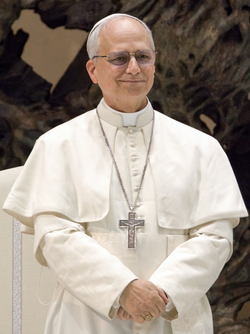
Pope Leo XIV
(Photo from via Wikipedia)
The Associated Press posted the following related to Pope Leo XIV’s statements on war:
Pope Leo XIV rejects claims that God justifies war in Palm Sunday Mass message
March 29, 2026
ROME (AP) — Pope Leo XIV on Sunday rejected claims that God justifies war and prayed especially for Christians in the Middle East during a Palm Sunday Mass before tens of thousands of people in St. Peter’s Square.
With the U.S.-Israeli war on Iran entering its second month and Russia’s ongoing campaign in Ukraine, Leo dedicated his Palm Sunday homily to insist that God is the “king of peace” who rejects violence and comforts those who are oppressed.
“Brothers and sisters, this is our God: Jesus, King of Peace, who rejects war, whom no one can use to justify war,” Leo said. “He does not listen to the prayers of those who wage war, but rejects them.”
Leaders on all sides of the Iran war have used religion to justify their actions. https://apnews.com/article/vatican-palm-sunday-francis-pope-5749906e8c5d5303b1fb06e33607e062
This was bold of Pope Leo and seems to push against positions taken by the Church of Rome.
For example, the Vatican has the following from the Catechism of the Catholic Church at its official website:
2309 The strict conditions for legitimate defense by military force require rigorous consideration. the gravity of such a decision makes it subject to rigorous conditions of moral legitimacy. At one and the same time: – the damage inflicted by the aggressor on the nation or community of nations must be lasting, grave, and certain; – all other means of putting an end to it must have been shown to be impractical or ineffective; – there must be serious prospects of success; – the use of arms must not produce evils and disorders graver than the evil to be eliminated. the power of modem means of destruction weighs very heavily in evaluating this condition.
These are the traditional elements enumerated in what is called the “just war” doctrine. The evaluation of these conditions for moral legitimacy belongs to the prudential judgment of those who have responsibility for the common good.
2310 Public authorities, in this case, have the right and duty to impose on citizens the obligations necessary for national defense. Those who are sworn to serve their country in the armed forces are servants of the security and freedom of nations. If they carry out their duty honorably, they truly contribute to the common good of the nation and the maintenance of peace. https://www.vatican.va/content/catechism/en/part_three/section_two/chapter_two/article_5/iii_safeguarding_peace.html?utm_source=chatgpt.com
It is well known that early Christians would not participate in carnal warfare.
Here is something from Theophilus of Antioch (who is considered a saint by the Greco-Roman Catholics and those of us in the Continuing Church of God) wrote about 180 A.D.:
Consider, therefore, whether those who teach such things can possibly live indifferently, and be commingled in unlawful intercourse, or, most impious of all, eat human flesh, especially when we are forbidden so much as to witness shows of gladiators, lest we become partakers and abettors of murders. But neither may we see the other spectacles, lest our eyes and ears be defiled, participating in the utterances there sung. Theophilus of Antioch. To Autolycus, Book III, Chapter XV. Translated by Marcus Dods, A.M. Excerpted from Ante-Nicene Fathers, Volume 2. Edited by Alexander Roberts & James Donaldson. American Edition, 1885. Online Edition)
So, true Christians did not believe that they were to fight nor even watch the violent sports that were popular in the second century.
Also in the second century, Greco-Roman Catholic saint Irenaeus wrote:
… from the Lord’s advent, the new covenant which brings back peace, and the law which gives life, has gone forth over the whole earth, as the prophets said: For out of Zion shall go forth the law, and the word of the Lord from Jerusalem; and He shall rebuke many people; and they shall break down their swords into ploughshares, and their spears into pruning-hooks, and they shall no longer learn to fight. … But if the law of liberty, that is, the word of God, preached by the apostles (who went forth from Jerusalem) throughout all the earth, caused such a change in the state of things, that these [nations] did form the swords and war-lances into ploughshares, and changed them into pruning-hooks for reaping the grain, [that is], into instruments used for peaceful purposes, and that they are now unaccustomed to fighting, but when smitten, offer also the other cheek, then the prophets have not spoken these things of any other person, but of Him who effected them. (Irenaeus Against Heresies, Book IV, Chapter XXXIV, section 4)
Notice that not watching violent sports or being in the military was also the position of the third century Roman Catholic saint, theologian, and bishop Hippolytus, who also adds various occupations to those that reject one from being a follower of Christ:
16:6 A charioteer, likewise, or one who takes part in the games, or one who goes to the games, he shall cease or he shall be rejected. 7 If someone is a gladiator, or one who teaches those among the gladiators how to fight, or a hunter who is in the wild beast shows in the arena, or a public official who is concerned with gladiator shows, either he shall cease, or he shall be rejected. 8 If someone is a priest of idols, or an attendant of idols, he shall cease or he shall be rejected. 9 A military man in authority must not execute men. If he is ordered, he must not carry it out. Nor must he take military oath. If he refuses, he shall be rejected. 10 If someone is a military governor, or the ruler of a city who wears the purple, he shall cease or he shall be rejected. 11 The catechumen or faithful who wants to become a soldier is to be rejected, for he has despised God. (Hippolytus. The Apostolic Tradition of Hippolytus of Rome. From the work of Bernard Botte (La Tradition Apostolique. Sources Chretiennes, 11 bis. Paris, Editions du Cerf, 1984) and of Gregory Dix (The Treatise on the Apostolic Tradition of St. Hippolytus of Rome, Bishop and Martyr. London: Alban Press, 1992) as translated by Kevin P. Edgecomb http://www.bombaxo.com/hippolytus.html viewed 08/06/09)
Around 250 A.D., COG elder/presbyter Pionius of Smyrna asked:
To whom have we done wrong? Have we perchance murdered someone? Or, do we persecute anyone? Or have we obliged anyone to venerate idols? (Martyrdom of Pionius as translated in Monroy, Mauricio Saavedra. The Church of Smyrna: History and Theology of a Primitive Christian Community. Peter Lang edition, 2015, p. 155)
He asked those questions knowing full well that real Christians had not done any of those things.
As late as the beginning of the fourth century, the Greco-Roman Catholic apologist Lactanus/Lactanius wrote:
For when God forbids us to kill, He not only prohibits us from open violence, which is not even allowed by the public laws, but He warns us against the commission of those things which are esteemed lawful among men. Thus it will be neither lawful for a just man to engage in warfare (Lactanus. Divine Institutes, Book VI (Of True Wisdom and Religion), Chapter 20).
Or why should he carry on war, and mix himself with the passions of others, when his mind is engaged in perpetual peace with men? {The Christian} considers it unlawful not only himself to commit slaughter, but to be present with those who do it, and to behold it (Lactanus. Divine Institutes, Book V (Of True Wisdom and Religion), Chapter 18).
Christianity Today has recognized that early Christians were against military service:
The ancient church understood that war has been around as long as human beings and sin have coexisted. It is a consistent tenet throughout the Christian tradition that war is the result of sin. The responses to war, however, have followed two basic trains of thought: pacifism, and the idea that certain wars can be just.
Pacifism is characteristic of the early centuries of Christianity in someone like the North African apologist Tertullian (160-220 A.D.), who regularly warned Christians to distance themselves from pagan culture. He wrote:
“How will he serve in the army even during peacetime without the sword that Jesus Christ has taken away? Even if soldiers came to John and got advice on how they ought to act, even if the centurion became a believer, the Lord by taking away Peter’s sword, disarmed every soldier thereafter. We are not allowed to wear any uniform that symbolizes a sinful act” (On Idolatry 19.3).
The third-century Roman Presbyter Hippolytus wrote The Apostolic Tradition, Canon 16, (ca. 215 A.D.) which opposed serving in the military as a matter of church discipline:
“A soldier in the lower ranks shall kill no one. If ordered to do so, he shall not obey, and he shall not take an oath. If he does not want to comply with this directive, let him be dismissed [from the church].”
(Elowsky, Joel. Ancient Christian Commentary on Current Events: What Is War Good For? Christianity Today, posted October 28, 2003).
Now, I should add that is doubtful that most of those quoted in the article were true Christians themselves. Yet, it is clear that they understood that John the Baptist and the Apostles were against war.
The Roman Catholic theologian Hippolytus, early third century, noted this:
That it is not meet for Christians to bear arms (Hippolytus. Heads of the Canons of Abulides or Hippolytus, Which Are Used by the Ethiopian Christians. Excerpted from Ante-Nicene Fathers, Volume 5. Edited by Alexander Roberts & James Donaldson. American Edition, 1886. Online Edition Copyright © 2005 by K. Knight).
Theological historian Bart Ehrman noted this as a difference between the Jews and the early Christians:
Further indications of a separation of Christians from Jews came soon thereafter in the Jewish uprising against the Romans in Palestine, leading to a three-year war and the ultimate destruction of Jerusalem and the Temple in the year 70 C.E. Old traditions indicate that the Christian Jews refused to participate in the struggle (Ehrman B. From Jesus to Constantine: A History of Early Christianity. The Teaching Company, Chantilly (VA), 2004, p. 33).
Furthermore, the historian Kenneth Scott Latourette noted that even late into the third century:
…perhaps most of the early Christians had conscientious scruples against military service (Latourette K.S. A History of Christianity, Volume 1, Beginnings to 1500. Harper, San Francisco, 1975, p. 89).
And while after some time, much of the empire soldiers professed Christ, this empire-wide acceptance of Christianity occurred with a “compromise with the world…a serious peril to the Gospel” (ibid, p.108).
The Greco-Romans changed their views on carnal warfare after the influence of Emperor Constantine and other non-Christians, not the Bible. “According to the view of many historians, the Constantinian shift turned Christianity from a persecuted into a persecuting religion” (History of Christian thought on persecution and tolerance. World Heritage Encyclopedia. Copyright © 2021, World Library Foundation). Of course, original catholic Christians were never the persecutors, only the persecuted—and this was never to change in this age.
“As early as the fifth century, St. Augustine of Hippo was considering the moral consequences of war. He was one of the first people to articulate a philosophical statement on war and justice, known as the Just War doctrine” (Just War Doctrine. Catholic League for Religious and Civil Rights, October 21st, 2014). The concept of “just war,” whereby limited uses of war were considered acceptable originated with earlier non-Christian Roman and Greek thinkers such as Cicero and Plato (Syse H. “The Platonic roots of just war doctrine: a reading of Plato’s Republic”. Diametros, 2010, 23: 104–123). Augustine (and others) borrowed much of the justification for warfare from pagan writers and Roman Law (Wells D, ed. An Encyclopedia of War and Ethics. Greenwood Press, 1996, pp. 30–31.).
Leading Roman Catholic theologians tried to justify war in the fifth (Augustine) and thirteenth centuries (Aquinas). Thomas Aquinas actually listed some of the objections that real Christians should have to war:
Objection 1. It would seem that it is always sinful to wage war. Because punishment is not inflicted except for sin. Now those who wage war are threatened by Our Lord with punishment, according to Mt. 26:52: “All that take the sword shall perish with the sword.” Therefore all wars are unlawful.
Objection 2. Further, whatever is contrary to a Divine precept is a sin. But war is contrary to a Divine precept, for it is written (Matthew 5:39): “But I say to you not to resist evil”; and (Romans 12:19): “Not revenging yourselves, my dearly beloved, but give place unto wrath.” Therefore war is always sinful.
Objection 3. Further, nothing, except sin, is contrary to an act of virtue.
But war is contrary to peace. Therefore war is always a sin.
Objection 4. Further, the exercise of a lawful thing is itself lawful, as is evident in scientific exercises. But warlike exercises which take place in tournaments are forbidden by the Church, since those who are slain in these trials are deprived of ecclesiastical burial. Therefore it seems that war is a sin in itself.
On the contrary, Augustine says in a sermon on the son of the centurion [Ep. ad Marcel. cxxxviii]: “If the Christian Religion forbade war altogether, those who sought salutary advice in the Gospel would rather have been counselled to cast aside their arms, and to give up soldiering altogether. On the contrary, they were told: ‘Do violence to no man . . . and be content with your pay’ [Luke 3:14. If he commanded them to be content with their pay, he did not forbid soldiering.” (Aquinas Thomas. The Summa Theologica of St. Thomas Aquinas. Second and Revised Edition, 1920. Literally translated by Fathers of the English Dominican Province. Online Edition Copyright © 2006 by Kevin Knight. Nihil Obstat. F. Innocentius Apap, O.P., S.T.M., Censor. Theol. Imprimatur. Edus. Canonicus Surmont, Vicarius Generalis. Westmonasterii. APPROBATIO ORDINIS. Nihil Obstat. F. Raphael Moss, O.P., S.T.L. and F. Leo Moore, O.P., S.T.L. Imprimatur. F. Beda Jarrett, O.P., S.T.L., A.M., Prior Provincialis Angliæ).
After listing 4 valid objections, Aquinas attempts to justify war over those objections. I would simply comment here that it is impossible to Do violence to no man if you are killing or trying to kill others–thus for Aquinas to use Augustine’s argument here simply does not prove his point. The main point of Luke 3:14 is that John the Baptist taught that newly repentant people who happened to have been in the military (and who probably were not allowed to quit) should do NO VIOLENCE. Presumably, like the Apostle Paul taught about slaves (1 Corinthians 7:21), soldiers were being told that they should accept their burden until they could be free of it–and perhaps because of them doing no violence, it may be that they might be allowed out of their military obligation early (military commanders generally do not want soldiers who will not fight).
Anyway, to further justify war, Thomas Aquinas continued with:
Those who wage war justly aim at peace, and so they are not opposed to peace, except to the evil peace, which Our Lord “came not to send upon earth” (Matthew 10:34). Hence Augustine says (Ep. ad Bonif. clxxxix): “We do not seek peace in order to be at war, but we go to war that we may have peace. Be peaceful, therefore, in warring, so that you may vanquish those whom you war against, and bring them to the prosperity of peace” (Ibid).
Perhaps I should add here that the term “evil peace” is in no version of the Bible that I have ever seen, hence does not appear to be a valid reason for justifying Christian participation in warfare.
It should be noted that although the early Church was against military service, in the fourteenth century the Roman Church later decreed:
Both, therefore, are in the power of the Church, that is to say, the spiritual and the material sword, but the former is to be administered for the Church but the latter by the Church; the former in the hands of the priest; the latter by the hands of kings and soldiers, but at the will and sufferance of the priest. However, one sword ought to be subordinated to the other and temporal authority, subjected to spiritual power…Furthermore, we declare, we proclaim, we define that it is absolutely necessary for salvation that every human creature be subject to the Roman Pontiff (THE BULL UNAM SANCTAM , 1302. English translation taken from a doctoral dissertation written in the Dept. of Philosophy at the Catholic University of America, and published by CUA Press in 1927. In Medieval Sourcebook, http://www.fordham.edu/halsall/source/b8-unam.html 01/16/06).
Thus, Roman leaders endorsed killing and the use of the military under the authority of church leadership.
The Crusades were one of the most famous use of the military by those associated with the Roman Catholic (as well as Eastern Orthodox) Church.
As well as the famous inquisition:
The next major step in the establishment of the Inquisition was taken by Innocent III…In the West, the same pope launched a “Crusade” against the Cathars, or Albigenses, of Southern France in 1208…In the second century of the Christian Era, most Christians refused to take up arms at all.. One millennium later, Christians were not only fighting for the church against “infidels” who had conquered ancient biblical lands, but against other Christians, heretical ones, who only asked to be able to live in peace on their ancestral soil…Perhaps for medieval popes the crucial factor that caused them to condemn dissidents was really the dissidents’ rejection of papal authority (Brown HOJ. Heresies: Heresy and Orthodoxy in the History of the Church. Hendrickson Publishers, Peabody (MA), 1988, p. 260-261).
But using military force was not just Rome’s position in the Middle Ages.
Notice the following curious statements from the its former pontiff, Benedict XVI, who to a large degree is supporting his predecessor, as well as the position of Aquinas:
In this regard, the Introduction of “Spirituali Militum Curae” expressly cites “Gaudium et Spes,” recalling that those doing military service must be considered as “ministers of the security and freedom of peoples”, because, “if they carry out their duties properly, they also truly contribute to stabilizing peace” (cf. “Gaudium et Spes,” n. 79).
If, therefore, the Council calls members of the armed forces “custodians of security”, how much more so would be the Pastors to whom they are entrusted!
I therefore urge you all to ensure that military Chaplains are authentic experts and teachers of what the Church teaches and practices, with a view to building peace in the world.
Pope John Paul II’s Apostolic Constitution is an important milestone in this teaching and its contribution in this context can be summed up in the words you have rightly chosen as the theme of this Congress: “‘Ministerium pacis inter arma’ — Soldiers at the service of peace”.
My Predecessor considered this “ministerium pacis inter arma” “a new proclamation of the Gospel in the military world, of which the Christian soldiers and their communities cannot fail to be the first heralds” (Address, Third International Congress of Military Ordinariates, 11 March 1994; ORE, 23 March, n. 5, p. 6).
The Church is missionary by nature and her principal task is evangelization, which aims to proclaim and to witness to Christ and to promote his Gospel of peace and love in every environment and culture.
The Church is also called in the military world to be “salt”, “light” and “leaven”, to use the images to which Jesus himself refers, so that mindsets and structures may be ever more fully oriented to building peace, in other words, to that “order planned and willed by the love of God” (Message for World Day of Peace, 1 January 2006, n. 3; ORE, 21 December 2005, p. 6), in which people and peoples can develop to the full and see their own fundamental rights recognized (cf. ibid., n. 4).
The Church’s teaching on the subject of peace is an essential aspect of her social doctrine. Grafted onto very ancient roots, it continued to develop in the past century in a sort of “crescendo” which culminated in the Pastoral Constitution “Gaudium et Spes,” in the Encyclicals of Bl. John XXIII and of the Servants of God Paul VI and John Paul II, as well as in their Addresses to the United Nations Organization and their Messages for each World Day of Peace.
This insistent appeal for peace has influenced Western culture, fostering the ideal that the Armed Forces are “an exclusive service for the security and freedom of peoples” (John Paul II, Address, Third International Convention of Military Ordinariates; ORE, 23 March 1994, n. 5, p. 6). (Benedict XVI. Giving Priority to the Soldier’s Christian Formation. Vatican translation of the address Benedict XVI delivered in the Vatican on Oct. 26 to the participants in the 5th International Congress of Military Ordinariates. From http://www.zenit.org/english/ 11/13/06 ).
So even though mentioning the “Gospel of peace,” Benedict XVI seemed to clearly be teaching that participants in the military are essential to the Roman Catholic’s teaching on peace. We in the Continuing Church of God take a different view.
Consider as Christians we are to promote the “gospel of peace” (Ephesians 6:15).
Consider that:
165 Great peace have those who love Your law, (Psalms 119:165)
Notice that the Bible prophecies about Jesus:
3 He shall judge between many peoples, And rebuke strong nations afar off; They shall beat their swords into plowshares, And their spears into pruning hooks; Nation shall not lift up sword against nation, Neither shall they learn war any more. 4 But everyone shall sit under his vine and under his fig tree, And no one shall make them afraid; For the mouth of the LORD of hosts has spoken (Micah 4:3-4).
4 He shall judge between the nations, And rebuke many people; They shall beat their swords into plowshares, And their spears into pruning hooks; Nation shall not lift up sword against nation, Neither shall they learn war anymore. (Isaiah 2:4)
6 For unto us a Child is born, Unto us a Son is given; And the government will be upon His shoulder. And His name will be called Wonderful, Counselor, Mighty God, Everlasting Father, Prince of Peace. 7 Of the increase of His government and peace There will be no end, Upon the throne of David and over His kingdom, To order it and establish it with judgment and justice From that time forward, even forever. The zeal of the Lord of hosts will perform this. (Isaiah 9:6-7)
Thus, we in the Continuing Church of God see no reason to encourage behaviour that Christ will eliminate–Jesus is the Prince of Peace! And that is part of why we teach against Christians participating in carnal warfare.
That said, it is encouraging that Pope Leo XIV is calling for peace.
There are Roman Catholic prophecies that suggest that there will be splits in the Church of Rome, and perhaps some will embrace the original faith.
Some items of related interest may include:
Military Service and the Churches of God: Do Real Christians Participate in Carnal Warfare or Encourage Violence? Here are current and historical perspectives on a matter which show the beliefs of the true church on military participation. Is war proper for Christians? A related sermon would be: Christians, Violence, and Military Service.
Greco-Roman Catholic Prophecies: Do They Mirror, Highlight, or Contradict Biblical Prophecies? People of all faiths may be surprised to see what various Roman and Orthodox Catholic prophets have been predicting as many of their predictions will be looked to in the 21st century.
The Last Pope of the Malachy Prophecies: Do Biblical and Greco-Roman Catholic Prophecies Point to Pope Leo XIV? This 154 page book has biblical and Greco-Roman Catholic prophecies related to the last pope, an antipope who will be the final Antichrist.
Beliefs of the Original Catholic Church: Could a remnant group have continuing apostolic succession? Did the original “catholic church” have doctrines held by the Continuing Church of God? Did Church of God leaders uses the term “catholic church” to ever describe the church they were part of? Here are links to related sermons: Original Catholic Church of God?, Original Catholic Doctrine: Creed, Liturgy, Baptism, Passover, What Type of Catholic was Polycarp of Smyrna?, Tradition, Holy Days, Salvation, Dress, & Celibacy, Early Heresies and Heretics, Doctrines: 3 Days, Abortion, Ecumenism, Meats, Tithes, Crosses, Destiny, and more, Saturday or Sunday?, The Godhead, Apostolic Laying on of Hands Succession, Church in the Wilderness Apostolic Succession List, Holy Mother Church and Heresies, and Lying Wonders and Original Beliefs. Here is a link to that book in the Spanish language: Creencias de la iglesia Católica original.