It is in the news again. The current Pontiff Benedict XVI is trying to become closer with the Orthodox:
Meeting between Pope Benedict and Patriarch Alexy becoming more likely – Vatican official
Interfax – August 7, 2007
Moscow – A meeting between Pope Benedict XVI and Patriarch of Moscow and All Russia Alexy II is becoming evermore likely, Cardinal Roger Etchegaray, President of the Pontifical Council for Justice and Peace and Vice-Dean of the College of Cardinals said after a meeting with the Patriarch…
Orthodox believers and Catholics should hold a profound dialogue and the meeting between the Pope and Alexy II should express the profoundness of these relations, he said.Alexy II recognizes that many efforts have been made to improve interaction between the two Churches, he said.
The relations between the two Churches have become warmer, yet they have never been cold. Personal relations with the Patriarch are a good example for interaction between the Catholic and Orthodox Churches, he said.
Patriarch Alexy’s address to the PACE session in Strasbourg scheduled for autumn will address the whole of Europe, he said. http://www.interfax-religion.com/?act=news&div=3442
While many applaud this, I believe that this closeness is dangerous. The Vatican’s goal is dominance.
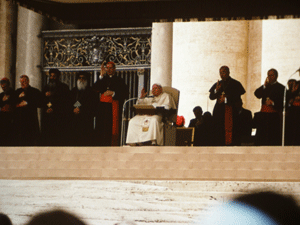
John Paul II stated that the Roman Catholic Church and the Eastern Orthodox Church were the “two lungs” of the Church.
The June-July 2007 edition of The Journal: News of the Churches of God contains an edited version of the following article:
Orthodox Should Reject Unity With Roman Catholics
By COGwriter
Most people in the Churches of God (COGs) know relatively little about the Eastern Orthodox Church (Orthodox). Because the similarities of some of its practices with those of the Roman Catholic Church, recent pontiffs have attempted to take steps to attempt to restore unity between the two groups. Yet few realize that the Orthodox have many teachings that have similarities to COG doctrines.
The Great Schism
In 1054, there was a separation of the Orthodox churches from the Roman Church. Although many historians feel that political considerations played the deciding role, two main doctrinal reasons are cited for this separation, which the Orthodox refer to as “the great schism”.
The first was the authority of Roman bishop. Essentially the Orthodox position was (and remains) that there were “five churches that comprised the One Holy Catholic and Apostolic Church before the Great Schism”. These five were the Orthodox Churches of Constantinople, Alexandria, Antioch, and Jerusalem (the other Orthodox churches, like the Russian, Serbian, etc. all hold similar doctrinal positions, but simply are not considered to have the prestige of “original Apostolic authority” ), plus the Roman Catholic Church.
After Roman Pontiff Leo IX exceeded what the Orthodox considered to be his jurisdiction (he excommunicated Cerularius, the Orthodox Patriarchate of Constantinople, who in turn excommunicated Leo IX), the Orthodox felt that the Church of Rome separated from their communion and the two groups have been officially separated ever since. This is something that recent pontiffs have attempted to change.
The second issue had to do with the “filioque clause” of the so-called Apostle’s Creed. The Orthodox position is that the Romans changed the Creed to include the statement that the Holy Spirit proceeds “from the Father and the Son“, whereas it originally stated that the Holy Spirit proceeded from the Father previously according to the Orthodox.
It may be interesting to note that Catholic scholars have claimed that the Orthodox have had no saints since the Great Schism. Notice:
The Greek Church once brilliant with many saints produced no more saints after the schism…learned Greeks fled to western Europe bringing with them the culture of the decadent schismatic church and caused a partial return to paganism in the Renaissance period…The final result of the Greek Schism appears in Communism, which is a complete return to unbelief and barbarism (Kramer, Herman Bernard. The Book of Destiny. Nihil Obstat: J.S. Considine, O.P., Censor Deputatus. Imprimatur: +Joseph M. Mueller, D.D., Bishop of Sioux City, Iowa, January 26, 1956. Reprint TAN Books, Rockford (IL), 1975, pp. 52-53).
It should be noted that the Greek Orthodox Church does not agree with the above and tend to be aghast when they learn of it. Similarly, notice how the same Roman source indicates that the “scourge” of called Wormwood in Revelation 7:10-11 has to do with the Greek schism:
Verses 19 and 11
The scourge announced by the third trumpet…the idea if “WORMWOOD” indicates that the Third Scourge to be the GREEK SCHISM…It has carried away from Christendom approximately one third of the membership of the true Church. Schism is not heresy but…As disobedience, it perverts the source of spiritual life into sources of spiritual death…
The description in the Apocalypse fits the Greek Schism in every detail (Kramer, Herman Bernard. The Book of Destiny. Nihil Obstat: J.S. Considine, O.P., Censor Deputatus. Imprimatur: +Joseph M. Mueller, D.D., Bishop of Sioux City, Iowa, January 26, 1956. Reprint TAN Books, Rockford (IL), 1975, pp. 201,203,205).
The Orthodox do not believe that the schism carried their people away from Christendom. But that is historically how many Catholic leaders have viewed the situation.
But What About the Church of God?
Possibly because the Orthodox tend to rely more on Greek writings (the New Testament and nearly all of the early Christian writings were in Greek) and not Latin, plus the fact that its leading Patriarchate (Constantinople) is in Asia Minor, the Orthodox have many doctrines that the Roman Catholic Church does not teach, but that the COGs generally do teach.
What are the differences between the Orthodox and the Catholics? What are the similarities between the Living Church of God and the Orthodox?
Here are twelve such doctrines:
1. The Eastern Orthodox, like the Church of God, reject the Roman Catholic notion of purgatory.
2. The Eastern Orthodox, like the Church of God, number the ten commandments as they originally were and not as the Roman Catholics number them.
3. Many (though not all) of the Eastern Orthodox, like the Church of God, believe that God has a plan of salvation that can occur at the time of the final judgment. Yet, the Roman Church rejects the idea that salvation can be available after the first death.
4. The Eastern Orthodox, like the Church of God, do not believe that God’s plan will result in most being lost or that it is a plan of terrorism. This differs from the Roman Catholic view of eternal torment.
5. The Eastern Orthodox, like the Church of God, believe in baptism by immersion. The Roman Catholics usually employ sprinkling.
6. The Eastern Orthodox, like the Church of God, believe in “the responsible use of contraception within marriage”. The Roman Catholic position is far more limiting.
7. The Eastern Orthodox, like the Church of God, reject “the dogma of the immaculate conception of the Virgin”. That is a Roman Catholic dogma.
8. The Eastern Orthodox, like many in the Church of God, agree that “the final goal at which every Christian must attain: to become god”. The Roman Catholic teaching in this area is less than clear.
9. The Eastern Orthodox, like the Church of God, teach that presbyters (which they call “priests” but the COG calls “elders”) can be married. The Roman Church requires celibacy for all presbyters, even though that was not its original position.
10. The Eastern Orthodox, like the Church of God, teach that “Christians must always be ‘People of the Book’ “. Yet, throughout history, the Church of Rome has tended to place more emphasis on non-biblical sources for much of its doctrines.
11. The Eastern Orthodox, like the Church of God, do not observe Ash Wednesday. The Church of Rome added this observance in the Middle Ages from non-biblical sources.
12. Neither the Living Church of God nor the Orthodox believe that the jurisdiction of Rome has any real bearing on apostolic succession.Yet, the Roman Church has officially claimed that apostolic succession was lost by the Orthodox and others when they stopped accepting the jurisdiction of Rome:
Regarding the Greek Church, it is sufficient to note that it lost Apostolic succession by withdrawing from the jurisdiction of the lawful successors of St. Peter in the See of Rome. The same is to be said of the Anglican claims to continuity (O’Reilly, Thomas. “Apostolicity.” The Catholic Encyclopedia. Vol. 1. New York: Robert Appleton Company, 1907).
While there are certain ceremonial similarities (as well as differences) between the Roman Catholics and Eastern Orthodox, if the Orthodox really wish to become “the people of the book” they need to reject all non-biblical doctrines and not enter into greater unity with Rome. There are too many differences in doctrine between the Catholics and the Orthodox for unity without major compromise.
The Romans Now Want the Orthodox
The current Roman Pontiff (Benedict XVI) has repeatedly stated that he wants unification with the Orthodox Churches (e.g. Pope tells Cypriot Orthodox leader he holds ‘firm hope’ for Christian unity. Associated Press – June 16, 2007) and certain Orthodox leaders seem to favor it (e.g. Alexy II Favors Ecumenical Ties: Says Orthodox-Catholic Partnership Is Important. Zenit – June 15, 2007). The previous pontiff (John-Paul II) referred to the Romans and the Orthodox as the “two lungs” of the church.
However, the Orthodox may wish to be aware of a Catholic prophecy concerning this. Around 1202 the Catholic Abbott Joachim prophesied:
A remarkable Pope will be seated on the pontifical throne, under special protection of the angels. Holy and full of gentleness, he shall undo all wrong, he shall recover the states of the Church, and reunite the exiled temporal powers. As the only Pastor, he shall reunite the Eastern to the Western Church…This holy Pope shall be both pastor and reformer. Through him the East and West shall be in ever lasting concord. The city of Babylon shall then be the head and guide of the world.
Rome, weakened in temporal power, shall forever preserve her spiritual dominion, and shall enjoy great peace…(Cited in Connor, Edward. Prophecy for Today. Imprimatur + A.J. Willinger, Bishop of Manterey-Fresno. Tan Books and Publishers, Rockford (IL), 1984, pp. 31-32).
Biblical prophecy states that there will be a major unifying religion that it calls “Babylon the Great” (Revelation 17:5)–but one that the Bible warns against.Catholic-Orthodox unity will not be good for either group.
The Orthodox (and all others) need to heed the Bible and:
“Come out of her, my people, lest you share in her sins, and lest you receive of her plagues. For her sins have reached to heaven, and God has remembered her iniquities” (Revelation 18:4-5).
The Orthodox, individually, need to reject unity with Rome. Orthodox-Catholic unity will not be a good thing.
The plain truth is that if those in the Orthodox churches will study their Bibles, they will find a lot more doctrines that the Bible and the COGs hold in common than they will in the Bible and the Roman Church. On the unification issue, nearly all of the American and South African Orthodox members I have had contact with oppose unity with Rome. Yet, much of the Orthodox clergy in other areas seem to support it.
The fact that the COGs and the Orthodox trace their histories through cities other than Rome is also something that the two groups have in common.
Furthermore, if they look into their roots, the Orthodox will also find that the VAST MAJORITY of professing Christians in Asia Minor (an area where the Orthodox also trace their history) did not even accept the Trinitarian doctrine until the latter half of the fourth century, because they held a Semi-Arian view of the Godhead (the view that the Father and Son are both God, but that the Holy Spirit is not) similar to that held by most COGs.
Why It Matters
Truth is important. And sadly, many will be misled in the future with what the Bible calls signs and lying wonders.
Notice what one Orthodox writer has wisely warned against:
Peter Jackson (20th century): To which Mary are Muslims and Protestants being drawn?… Rome began to see her more and more as a “goddess,” a fourth Hypostasis of the Trinity…Today, as heterodox Christians become more and more ecumenist and work toward creating a “One World Church,” the search has begun for a Mary of universal recognition, one who will appeal not only to those who bear the name Christian, but apparently to Muslims and others as well, just as attempts are likewise being made to identify the “new Christ” with the Muslim concept of their coming Mahdi and with the Messiah still awaited by the Jews. This, of course, will be no Christ at all but the antichrist (Jackson P. ORTHODOX LIFE., No. I, 1997., Brotherhood of Saint Job of Pochaev at Holy Trinity Monastery, Jordanville, N.Y. pp. 18-22. http://fr-d-serfes.org/orthodox/theotokos.htm viewed 05/04/09).
The time of Antichrist is near (please see Does God Have a 6,000 Year Plan? What Year Does the 6,000 Years End?). Neither the Orthodox nor the Catholics of Rome should follow apparitions that claim to be Mary (see Mary, the Mother of Jesus and the Apparitions) for false unity.
While most of us in the COGs recognize that there will be massive religious unity with some form of Catholicism at the time of the end, we need to be getting the warning message out to as many who will listen. And that certainly should include trying to reach as many of the 250,000,000 people who claim ties to the Orthodox churches.By recognizing that there actually are some doctrinal and historical similarities between the groups, I believe that those of us in the COGs will be better able to explain our positions in a manner that people like the Orthodox will better be able to relate to. Since the recent overtures by the Roman Pontiffs will give some within the Orthodox churches reason to consider their affiliation, I believe this is an excellent time to try to reach them.
Perhaps I should also mention that the Orthodox, like the Churches of God, do not accept the Protestant teaching about being “born-again” nor eternal tormenting.
Several articles of possibly related interest may include:
Some Similarities and Differences Between the Orthodox Church and the Churches of God Both groups have some amazing similarities and some major differences. Do you know what they are?
Pope Benedict XVI and Orthodox Unity This contains some other news articles on this subject.
Russia and the Sabbath Was there Sabbath-keeping in Russia? Did the Russian Orthodox ever accept that?
Which Is Faithful: The Roman Catholic Church or the Church of God? Do you know that both groups shared a lot of the earliest teachings? Do you know which church changed? Do you know which group is most faithful to the teachings of the apostolic church? This documented article answers those questions.
Europa, the Beast, and the Book of Revelation discusses the largest church since the second/third century.
There are Many COGs: Why Support the Living Church of God? This is an article for those who wish to easily sort out the different COGs. It really should be a MUST READ for current and former WCG members or any interested in supporting the faithful church.
Born Again: A Question of Semantics? Many Protestants use the term born-again. Do they know where the concept came from or does it matter?
Universal Salvation? There Are Hundreds of Verses in the Bible Supporting the Doctrine of True Apocatastasis Do you believe what the Bible actually teaches on this?
History of Early Christianity Are you aware that what most people believe is not what truly happened to the true Christian church?
The Churches of Revelation 2 & 3 Do they matter? Most say they must, but act like they do not. This article contains some history about the Church of God (sometimes referred to as the continuation of Primitive Christianity) over the past 2000 years.
Location of the Early Church: Another Look at Ephesus, Smyrna, and Rome What actually happened to the primitive Church? And did the Bible tell about this in advance?
Apostolic Succession What really happened? Did structure and beliefs change? Are many of the widely-held current understandings of this even possible? Do the Orthodox realize that Catholic scholars really do not believe that several of the claimed “apostolic sees” of the Orthodox have apostolic succession–despite the fact that the current pontiff himself seems to wish to ignore this view? Is there actually a true church that has ties to any of the apostles that is not part of the Catholic or Orthodox churches? Read this article if you truly are interested in the truth on this matter.